
Skip to content
KitploitKITPLOIT
ToolsBlog
Submit
ToolsBlog
Submit

Hacking, PenTest, and Cybersecurity Tools for Your Security Arsenal!

Kitploit is a directory of hacking, cybersecurity, and pentesting tools. Discover the latest project updates to find vulnerabilities, analyze systems, automate testing, and strengthen your security.

··Feeds·Contact·Privacy·© 2026 Kitploit

Tool Directory

Categories

View all categories
Loading categories
CVE-2024-6387_Check — Lightweight Python scanner that identifies servers vulnerable to OpenSSH regreSSHion (CVE-2024-6387) via rapid banner retrieval across IPs, domains, and CIDR ranges with multi-threading. | Kitploit
Tools/GitHubGitHub/edsonjt81/cve-2024-6387_check
ReconnaissanceVulnerability ScannersVulnerability AnalysisInformation GatheringNetwork SecurityPenetration Testing
GitHubedsonjt81/cve-2024-6387_check

CVE-2024-6387_Check

Lightweight Python scanner that identifies servers vulnerable to OpenSSH regreSSHion (CVE-2024-6387) via rapid banner retrieval across IPs, domains, and CIDR ranges with multi-threading.

Most Popular

View all →

Discover the most used tools by our community.

Explore all tools

Browse our collection of tools

View all tools →
Share
View Repository
122 years agoNot yet reviewed

CVE-2024-6387_Check

image

📜 Description

CVE-2024-6387_Check is a lightweight, efficient tool designed to identify servers running vulnerable versions of OpenSSH, specifically targeting the recently discovered regreSSHion vulnerability (CVE-2024-6387). This script facilitates rapid scanning of multiple IP addresses, domain names, and CIDR network ranges to detect potential vulnerabilities and ensure your infrastructure is secure.

🌟 Features

  • Rapid Scanning: Quickly scan multiple IP addresses, domain names, and CIDR ranges for the CVE-2024-6387 vulnerability.
  • Banner Retrieval: Efficiently retrieves SSH banners without authentication.
  • Multi-threading: Uses threading for concurrent checks, significantly reducing scan times.
  • Detailed Output: Provides clear, emoji-coded output summarizing scan results.
  • Port Check: Identifies closed ports and provides a summary of non-responsive hosts.

🚀 Usage

root@kitploit:~
python CVE-2024-6387_Check.py <targets> [--port PORT] [--timeout TIMEOUT] [--list FILE]

Examples

Single IP

root@kitploit:~
python CVE-2024-6387_Check.py 192.168.1.1

IPs from a file

root@kitploit:~
python CVE-2024-6387_Check.py -l ip_list.txt

Multiple IPs and Domains

root@kitploit:~
python CVE-2024-6387_Check.py 192.168.1.1 example.com 192.168.1.2

CIDR Range

root@kitploit:~
python CVE-2024-6387_Check.py 192.168.1.0/24

With Custom Port

root@kitploit:~
python CVE-2024-6387_Check.py 192.168.1.1 example.com --port 2222

Output

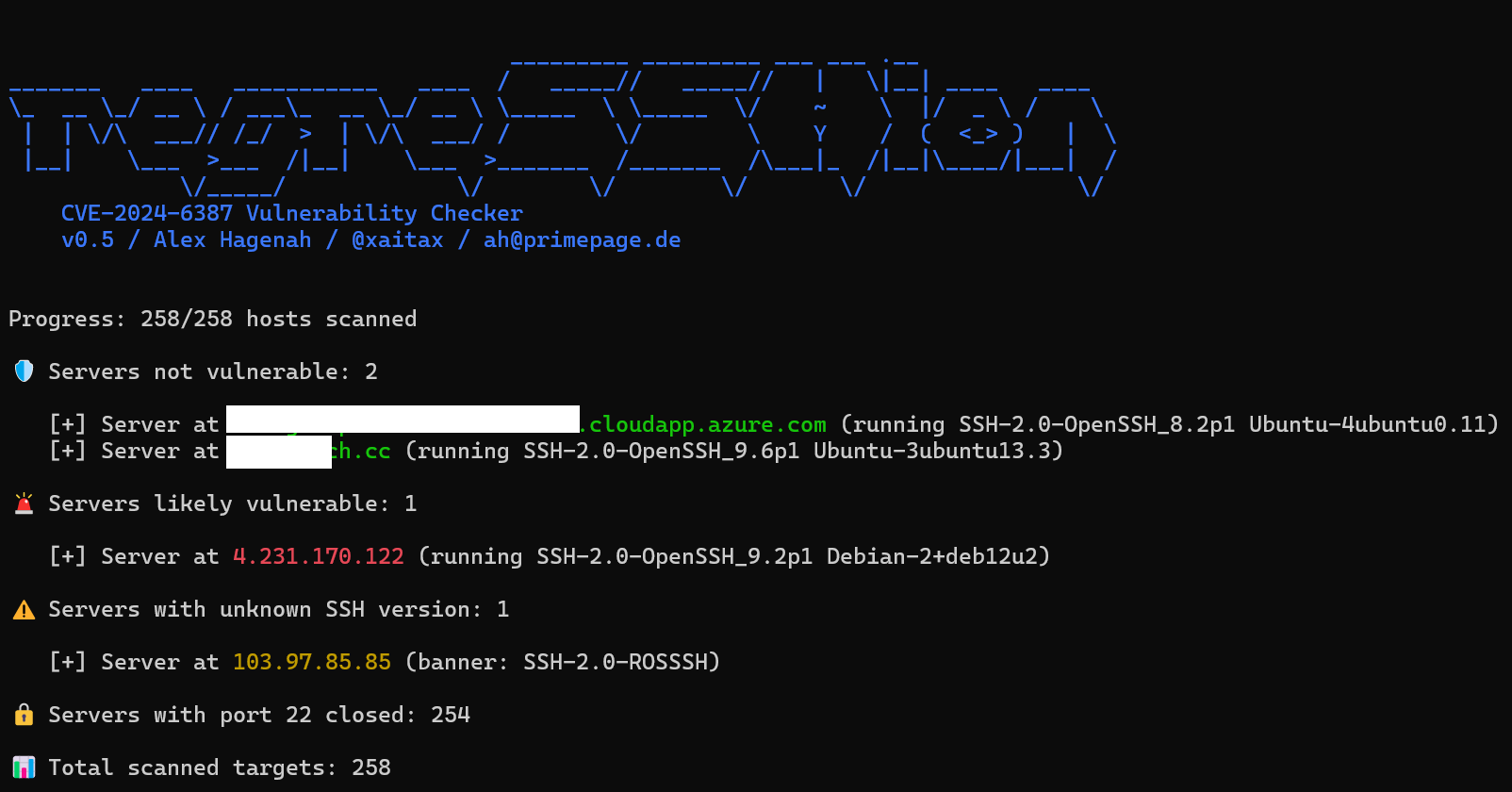
The script will provide a summary of the scanned targets:

  • 🚨 Vulnerable: Servers running a vulnerable version of OpenSSH.
  • 🛡️ Not Vulnerable: Servers running a non-vulnerable version of OpenSSH.
  • ⚠️ Unknown: Servers running an unknown version of SSH
  • 🔒 Closed Ports: Count of servers with port 22 (or specified port) closed.
  • 📊 Total Scanned: Total number of targets scanned.
root@kitploit:~
🛡️ Servers not vulnerable: 2

   [+] Server at somedomain.cloudapp.azure.com (running SSH-2.0-OpenSSH_8.2p1 Ubuntu-4ubuntu0.11)
   [+] Server at regresshion_test.cc (running SSH-2.0-OpenSSH_9.6p1 Ubuntu-3ubuntu13.3)

🚨 Servers likely vulnerable: 1

   [+] Server at 4.231.170.122 (running SSH-2.0-OpenSSH_9.2p1 Debian-2+deb12u2)

⚠️ Servers with unknown SSH version: 1

   [+] Server at 103.97.85.85 (banner: SSH-2.0-ROSSSH)

🔒 Servers with port 22 closed: 254

📊 Total scanned targets: 257

📚 References

Qualys Blog on regreSSHion Vulnerability

Download Tool