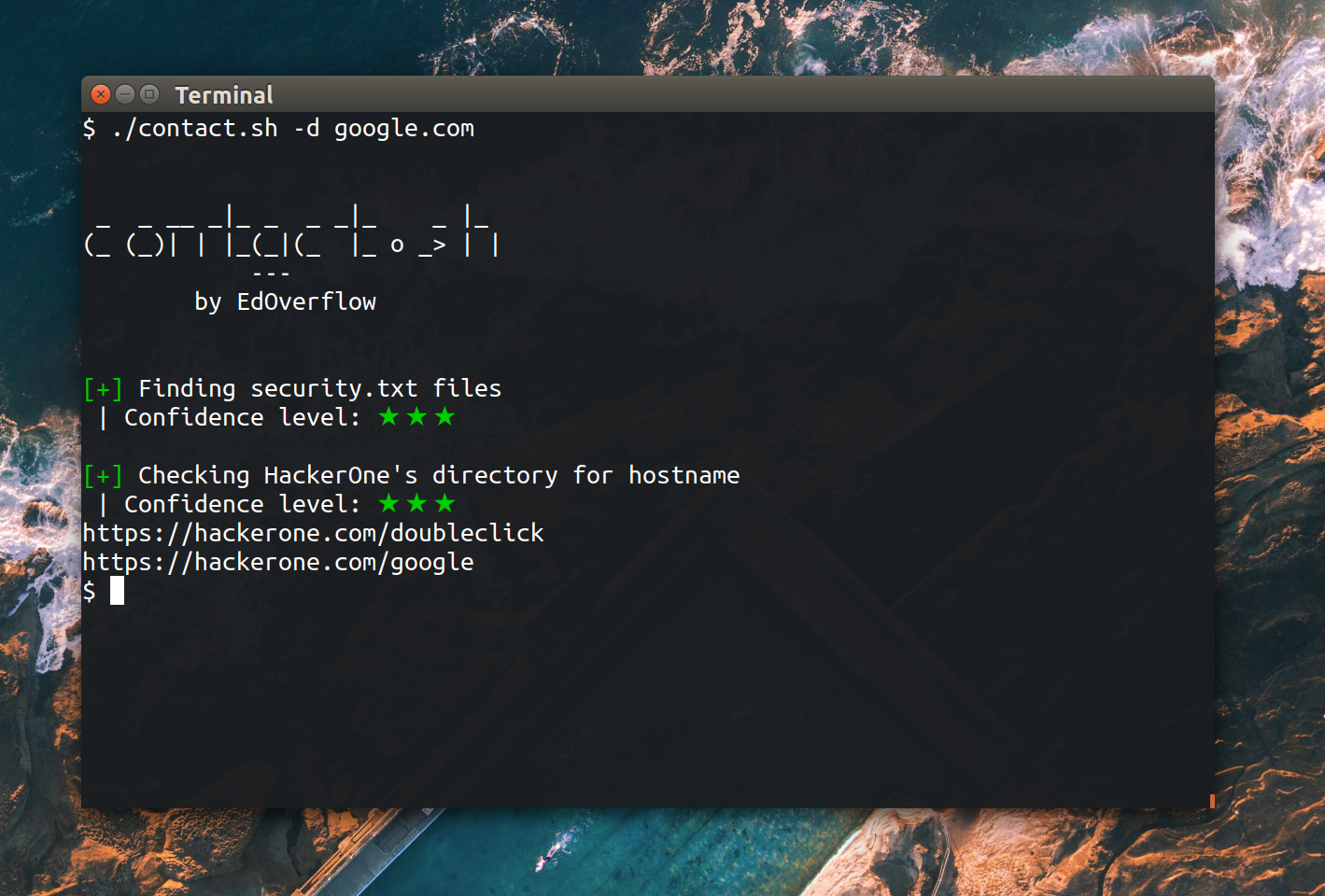
 edoverflow/contact.sh
An OSINT tool to find contacts in order to report security vulnerabilities.

An OSINT tool to find contacts in order to report security vulnerabilities.

Make sure you have installed the whois and jq packages.
$ git clone https://github.com/EdOverflow/contact.sh.git
$ cd contact.sh/
$ chmod u+x contact.sh
$ ./contact.sh -d google.com -c google
$ brew install gnu-sed --with-default-names
$ brew install jq
$ git clone https://github.com/EdOverflow/contact.sh.git
$ cd contact.sh/
$ chmod u+x contact.sh
$ ./contact.sh -d google.com -c google
$ ./contact.sh


 _  _ __ _|_ _  _ _|_    _ |_
(_ (_)| | |_(_|(_  |_ o _> | |
            ---
        by EdOverflow


[i] Description: An OSINT tool to find contacts in order to report security vulnerabilities.
[i] Usage: ./contact.sh [Options] use -d for hostnames (-d example.com), -c for vendor name (-c example), and -f for a list of hostnames in a file (-f domains.txt)
[i] Example: ./contact.sh -d google.com -c google
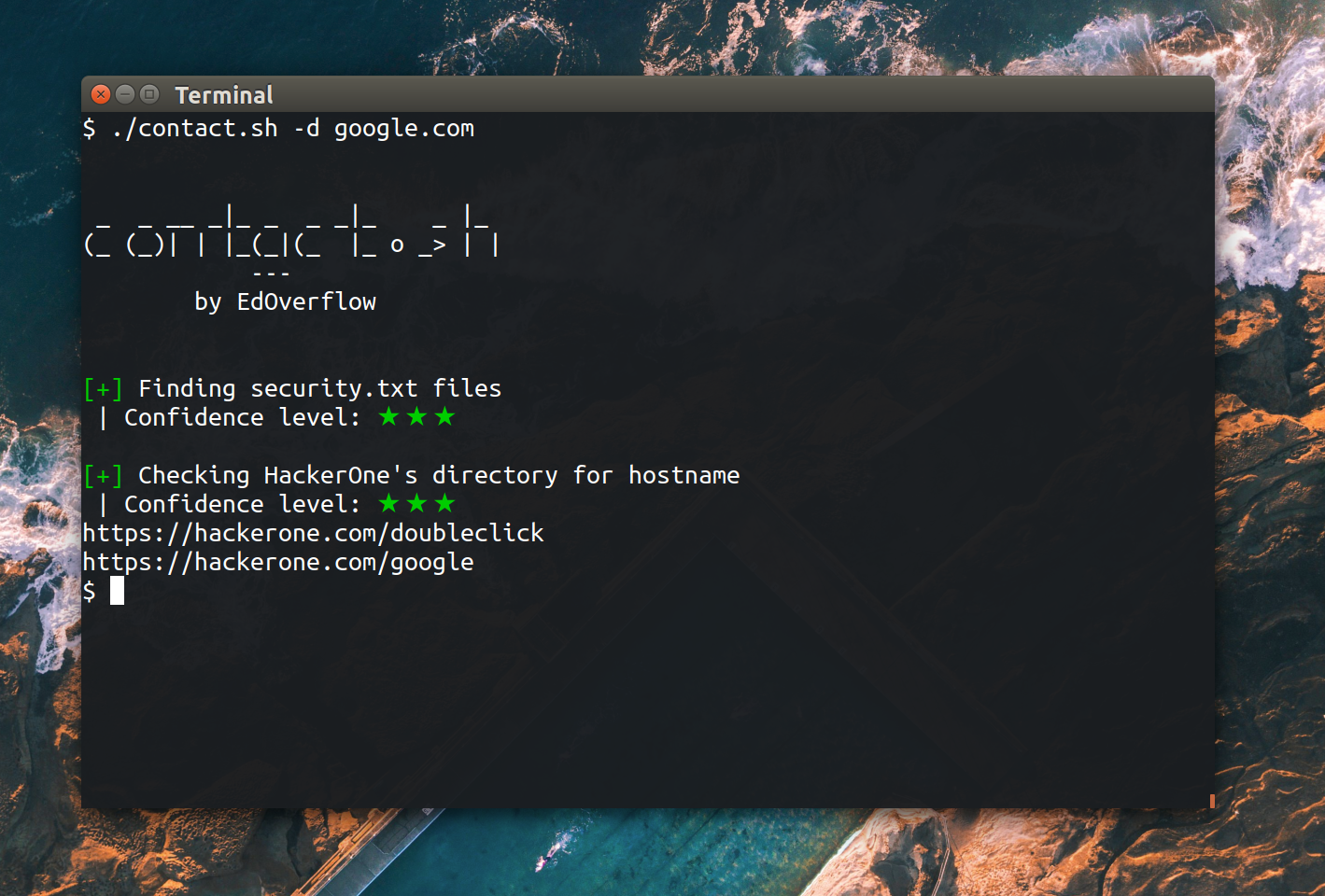
Use the -d flag when trying to find addresses linked to a domain. contact.sh will return a "Confidence level" based on the source of the information retrieved. A security.txt file located on the domain will have a higher priority than a Twitter account on the company's website.
$ ./contact.sh -d google.com
The -c flag allows you to specify the company's name.
$ ./contact.sh -c google
If the company's name contains spaces, make sure to place the name inside quotes.
$ ./contact.sh -c "keeper security"
You can check a list of domains using the -f flag.
$ ./contact.sh -f domains.txt
For the best results, combine both flags as follows:
$ ./contact.sh -d google.com -c google
contact.sh abides by the target's robots.txt file.
$ ./contact.sh -d linkedin.com


 _  _ __ _|_ _  _ _|_    _ |_
(_ (_)| | |_(_|(_  |_ o _> | |
            ---
        by EdOverflow


[+] Finding security.txt files
 | Confidence level: ★ ★ ★
[!] The robots.txt file does not permit crawling this hostname.

[+] Checking HackerOne's directory for hostname
 | Confidence level: ★ ★ ★
https://hackerone.com/linkedin
I welcome contributions from the public.
The issue tracker is the preferred channel for bug reports and features requests.
The bug tracker utilizes several labels to help organize and identify issues.
Use the GitHub issue search — check if the issue has already been reported.
