 dylanclaudio/reporte-de-escalada-de-privilegios-local-dirty-frag
Se realizó una evaluación de vulnerabilidades sobre una máquina virtual con Kali Linux utilizando un script detector para la vulnerabilidad Dirty Frag, asociada a las CVE-2026-43284 y CVE-2026-43500. Posteriormente se ejecutó un Proof of Concept (PoC) público escrito en lenguaje C para validar la posibilidad de realizar una escalada local

Student: Jonatan Claudio
A vulnerability assessment was performed on a virtual machine running Kali Linux using a detection script for the Dirty Frag vulnerability, associated with the following CVEs:
Subsequently, a public Proof of Concept (PoC) written in C was executed to validate the possibility of performing a local privilege escalation from an unprivileged user to root.
The exploitation was carried out locally within the vulnerable virtual machine.
uname -r result

Exploit execution
Example:
127.0.0.1
The CVE-2026-43284 vulnerability affects the Linux kernel's IPsec ESP subsystem through a corruption related to Page-Cache Write.
The flaw allows an unprivileged local user to modify kernel-associated memory and eventually escalate privileges to gain root access.
This vulnerability affects Linux kernels from January 2017 to May 2026.
python3 dirty_frag_detect.py
gcc -O0 -Wall -o exp exp.c -lutil
./exp
See repository.
The CVE-2026-43500 vulnerability affects the Linux kernel's RxRPC subsystem.
The flaw allows modification of internal structures related to Page-Cache Write and facilitates the attainment of elevated privileges.
The Dirty Frag exploit combines this vulnerability with CVE-2026-43284 to increase exploit compatibility and effectiveness.
The exploit used a chain of vulnerabilities to cover limitations of different Linux distributions.
On systems where AppArmor restricts namespaces, the RxRPC vulnerability keeps the exploitation viable.
The final result was gaining root access from an unprivileged user.
The following was identified:
uname -r
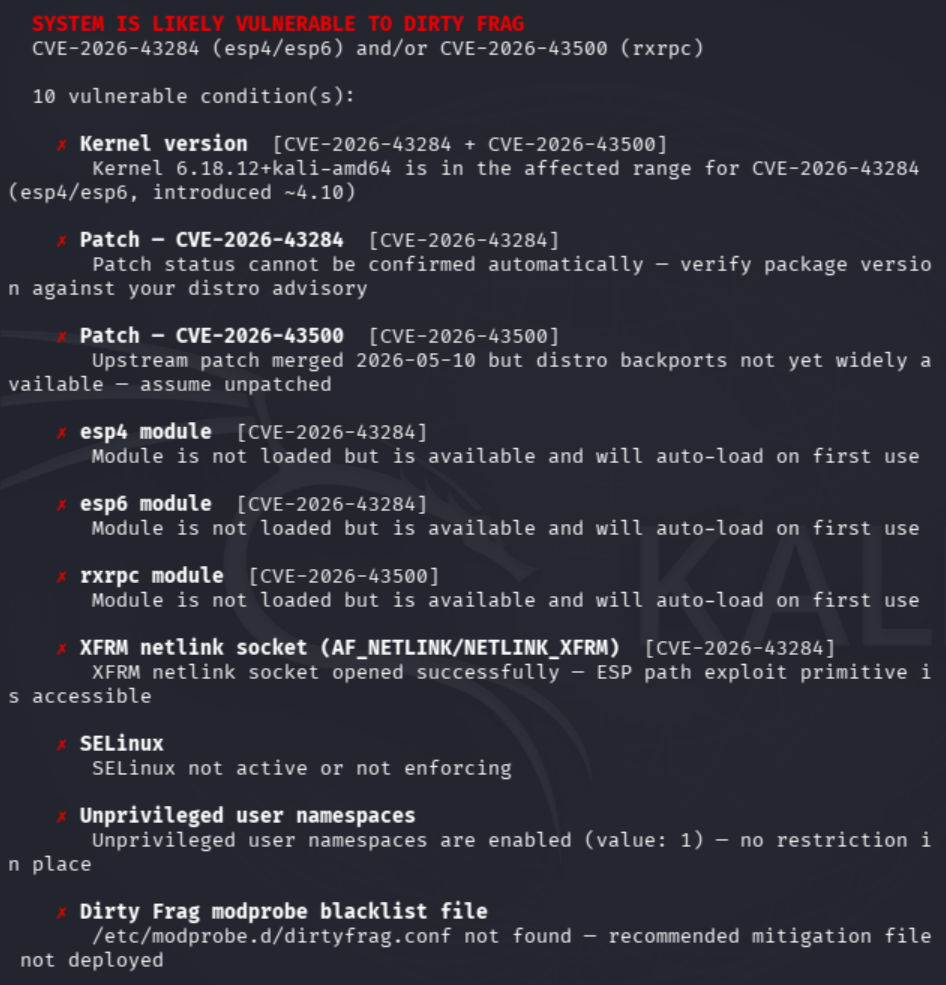
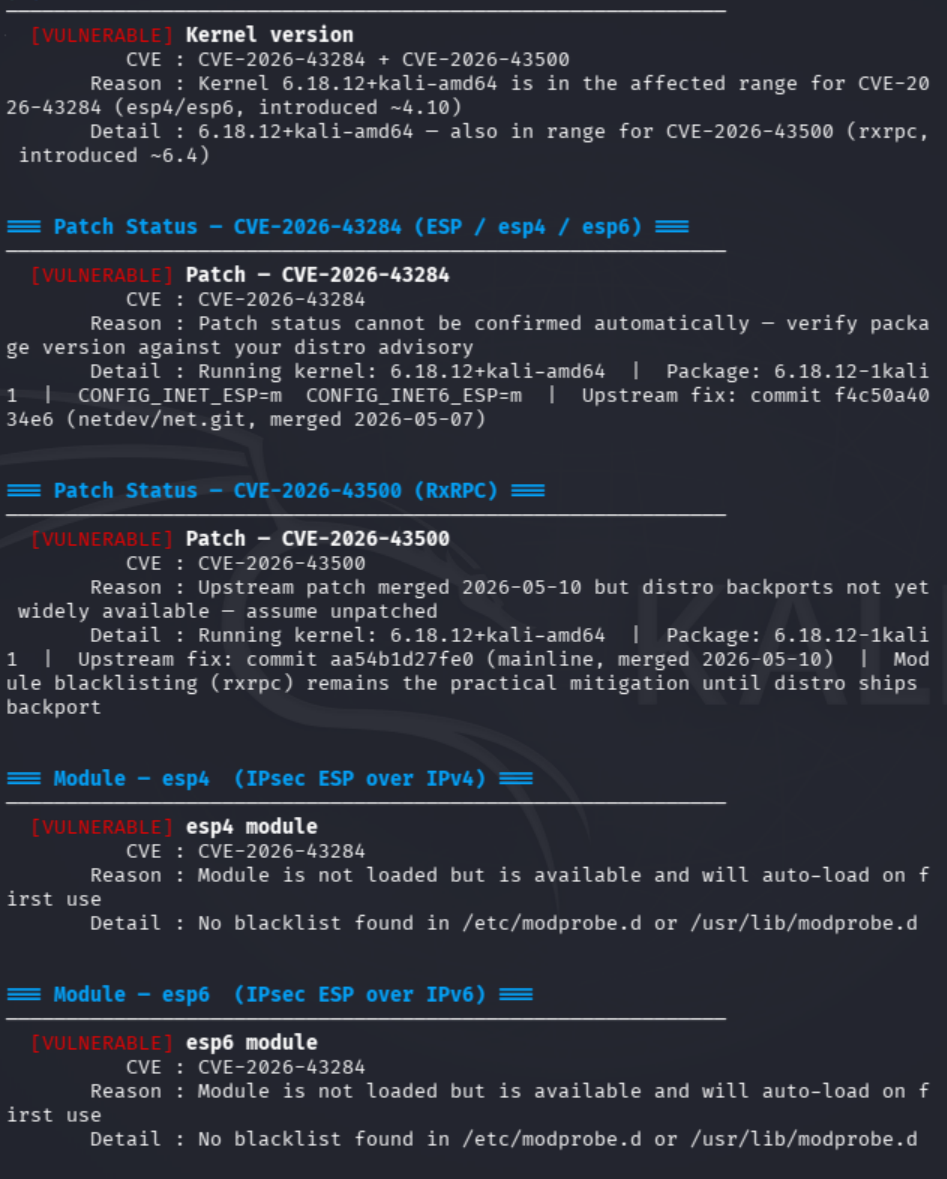
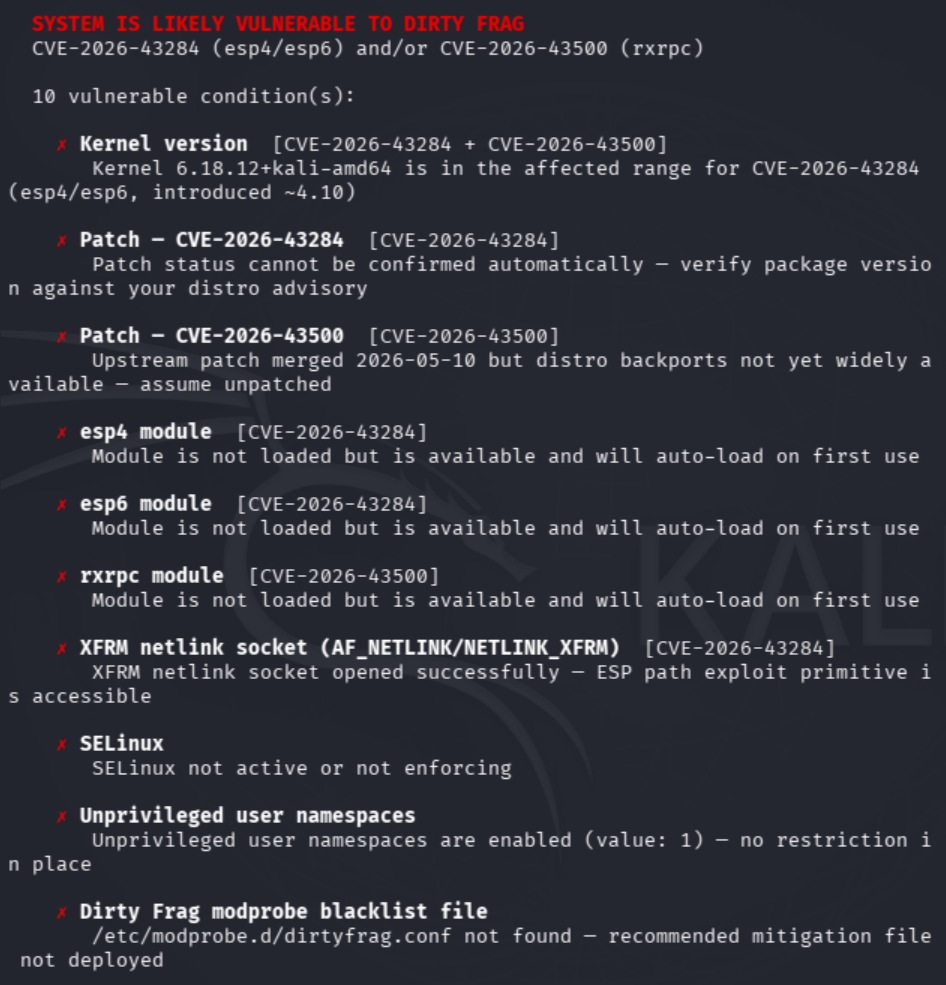
The Dirty Frag detector was executed:
python3 dirty_frag_detect.py
The script confirmed:
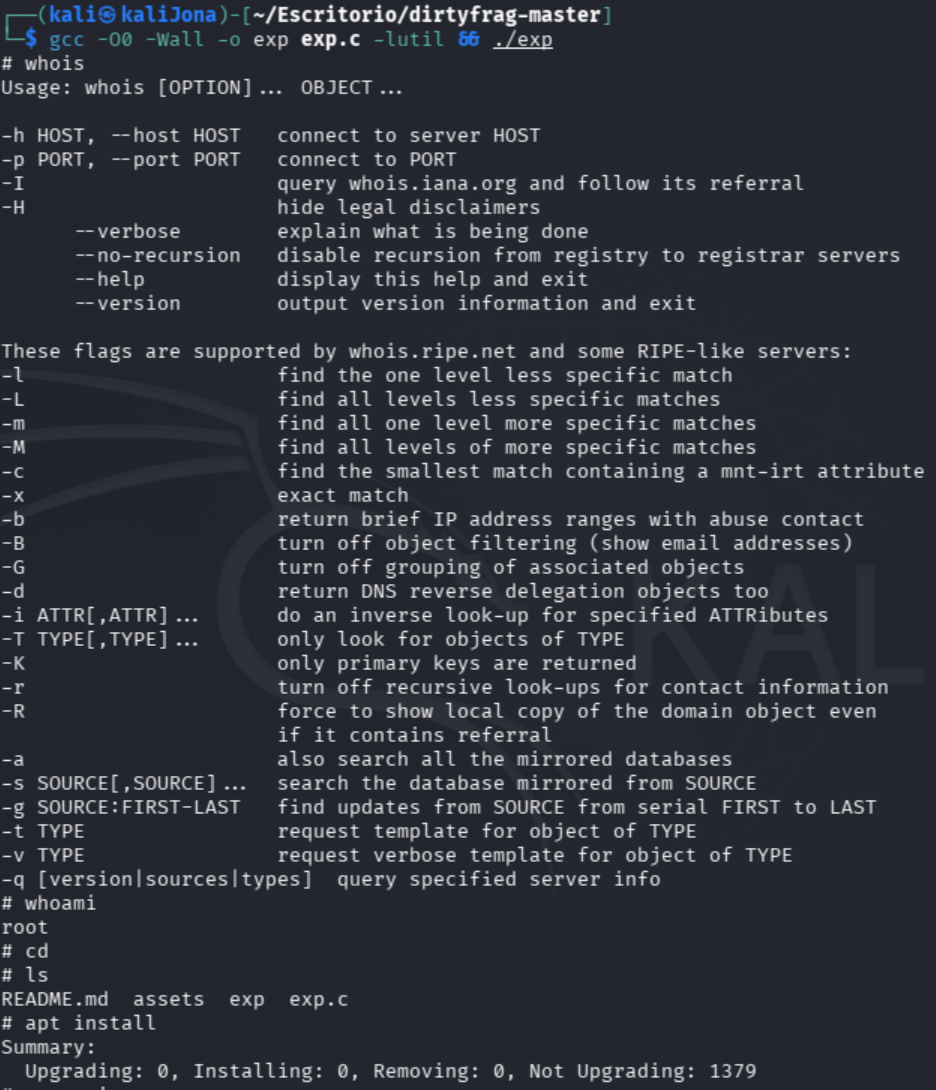
The public exploit was compiled and executed:
gcc -O0 -Wall -o exp exp.c -lutil
./exp
The exploit allowed obtaining:
uid=0(root)
whoami
Update the Linux kernel to a patched version.
As a temporary mitigation:
sh -c "printf 'install esp4 /bin/false\ninstall esp6 /bin/false\ninstall rxrpc /bin/false\n' > /etc/modprobe.d/dirtyfrag.conf; rmmod esp4 esp6 rxrpc 2>/dev/null; echo 3 > /proc/sys/vm/drop_caches; true"
| CVE | Subsystem | Status |
|---|---|---|
| CVE-2026-43284 | IPsec ESP | Vulnerable |
| CVE-2026-43500 | RxRPC | Vulnerable |
The vulnerability allows an unprivileged local user to gain full root access on the affected system.
This can allow:
The evaluated machine presented a critical local privilege escalation vulnerability via the Dirty Frag exploitation chain.
The exploitation was successful and allowed obtaining root access from an unprivileged user, demonstrating the critical impact of keeping Linux kernels outdated.
The Python code was extracted from the repository: https://github.com/liamromanis101/DirtyFrag-Detector
The C exploitation code was extracted from the repository: https://github.com/V4bel/dirtyfrag/tree/master
