
Skip to content
KitploitKITPLOIT
ToolsBlog
Submit
ToolsBlog
Submit

Hacking, PenTest, and Cybersecurity Tools for Your Security Arsenal!

Kitploit is a directory of hacking, cybersecurity, and pentesting tools. Discover the latest project updates to find vulnerabilities, analyze systems, automate testing, and strengthen your security.

··Feeds·Contact·Privacy·© 2026 Kitploit

Tool Directory

Categories

View all categories
Loading categories
Argus — Multi-phase reconnaissance and attack-surface scanner that maps domains, IPs, ASNs, cloud assets, and CVEs into a knowledge graph with CVSS scoring and compliance mapping. | Kitploit
Tools/GitHubGitHub/dozermx/argus
ReconnaissancePort ScanningVulnerability AnalysisWeb Application ExploitationInformation GatheringWeb SecurityFuzzingNetwork SecurityPenetration TestingThreat IntelligenceSubdomain EnumerationAPI Security
55 months agoNot yet reviewed

Most Popular

View all →

Discover the most used tools by our community.

Explore all tools

Browse our collection of tools

View all tools →
Share
GitHubdozermx/argus

Argus

Multi-phase reconnaissance and attack-surface scanner that maps domains, IPs, ASNs, cloud assets, and CVEs into a knowledge graph with CVSS scoring and compliance mapping.

View Repository

Argus

Python License Version Phases Platform Async Graph No API Keys Web UI Last Commit Stars Repo Size

Argus

Security Intelligence Framework

Argus is a multi-phase security reconnaissance and analysis framework built for professional penetration testing and attack surface assessment. It runs fully autonomous — no API keys required, no external services, no accounts. A single command produces a complete picture of an organization's external exposure.


Architecture

root@kitploit:~
argus/
├── sources/          Certificate Transparency, passive DNS, brute force
├── correlators/      DNS resolution, CDN bypass, port scanning
├── intelligence/     43 analysis modules
│   ├── Core          TLS, HTTP, email, content discovery, JS secrets
│   ├── Graph         Attack paths, compliance, CVE, anomaly detection
│   ├── Advanced      SSRF chains, OAuth/GraphQL/WebSocket, BGP, stealth
│   └── Intelligence  Deep CVE, API enumeration, cloud storage, threat intel
├── ontology/         Knowledge graph (NetworkX), entity model, pivot engine
├── output/           HTML report, executive report, CSV, JSON, terminal
└── web/              FastAPI real-time dashboard with WebSocket

The engine builds a Knowledge Graph of all discovered entities — domains, IPs, certificates, organizations, technologies, open ports — and the relationships between them. Every finding is an anomaly attached to a graph node with a CVSS 3.1 score, attack path linkage, and compliance mapping.


43 Phases


Installation

Requirements: Python 3.9+, Linux/macOS/Termux

root@kitploit:~
git clone https://github.com/DozerMx/Argus
cd Argus
pip install -r requirements.txt

Web UI (optional):

root@kitploit:~
pip install fastapi uvicorn websockets

Usage

root@kitploit:~
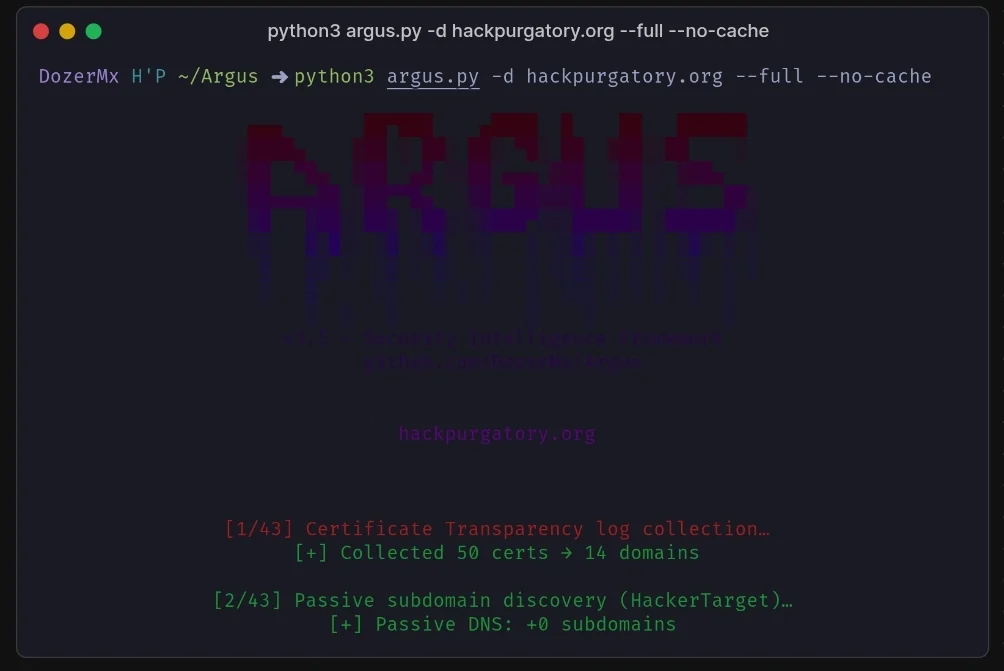
python argus.py -d TARGET [OPTIONS]

Basic scans

root@kitploit:~
# CT log collection + DNS resolution + anomaly detection
python argus.py -d target.com

# Full 43-phase scan
python argus.py -d target.com --full

# Full scan with executive report
python argus.py -d target.com --full --output executive

# Full scan with authentication and fuzzing
python argus.py -d target.com --full --fuzz --auth

# Scan with known credentials
python argus.py -d target.com --full --auth --user admin --password admin123

Targeted modules

root@kitploit:~
# Subdomain brute force + AXFR
python argus.py -d target.com --brute --axfr

# Deep infrastructure: ASN + CDN bypass + ports
python argus.py -d target.com --deep --cdn-bypass --ports

# Stealth scan (paranoid jitter profile)
python argus.py -d target.com --full --stealth-profile paranoid

# Through Tor
python argus.py -d target.com --full --proxy socks5://127.0.0.1:9050

Bulk and continuous

root@kitploit:~
# Bulk scan from file
python argus.py -f targets.txt --full --output json

# Continuous monitoring with Slack alerts
python argus.py -d target.com --daemon --webhook https://hooks.slack.com/...

# Web UI dashboard
python argus.py --serve --ui-port 8080

Options

root@kitploit:~
Target:
  -d DOMAIN             Single target domain
  -f FILE               File with one domain per line

Scan Modules:
  --full                Enable all modules
  --deep                ASN, cloud detection, Wayback, reverse IP
  --brute               Subdomain brute force + permutations
  --axfr                DNS zone transfer
  --cdn-bypass          CDN/WAF origin IP discovery
  --ports               TCP port scan + banner grab (178 ports)
  --jarm                JARM TLS fingerprinting
  --fuzz                Parameter fuzzing (SQLi, XSS, SSRF, IDOR, traversal)
  --auth                Authentication analysis
  --user USER           Username for authenticated scanning
  --password PASS       Password for authenticated scanning

Output:
  --output FORMAT       terminal | html | executive | json | csv
  --outfile PATH        Output file path
  -v                    Verbose logging
  -q                    Quiet mode

Performance:
  --threads N           Concurrent threads (default: 30)
  --timeout N           Request timeout in seconds (default: 10)
  --proxy URL           Proxy (socks5://host:port or http://host:port)
  --no-cache            Disable disk cache
  --stealth-profile     paranoid | careful | normal | aggressive

Web UI:
  --serve               Launch real-time web dashboard
  --ui-port N           Web UI port (default: 8080)

Daemon:
  --daemon              Continuous monitoring mode
  --webhook URL         Webhook URL for alerts (Slack/Telegram)
  --interval N          Scan interval in hours (default: 6)

Output

HTML Report

Interactive graph visualization of the full infrastructure with findings, risk scoring, and relationship mapping. Self-contained single file.

Executive Report

Business-language summary with attack path narrative, compliance violations by framework, prioritized remediation roadmap, and risk matrix.

JSON

Complete machine-readable output including the full knowledge graph, all anomalies with CVSS scores, attack paths, and scan metadata. Suitable for integration with SIEM, ticketing, or custom tooling.


Scan Modules Detail

Content Discovery Tests 100+ paths against each alive domain. Detects .env files, Git repositories, admin panels, backup archives, database dumps, Spring Actuator endpoints, GraphQL interfaces, and more. Includes SPA/CDN catch-all detection — hosts that respond 200 to any URL are handled correctly with pattern validation to eliminate false positives.

Fuzzer Context-aware parameter fuzzing. Infers parameter type (numeric, string, path, URL) before selecting payloads. Tests SQLi (50 payloads, error-based and time-based), XSS (39 payloads), SSRF (45 payloads including AWS/GCP/Azure metadata), path traversal (33 payloads), open redirect, and IDOR. WAF detection with 3 levels of evasion.

Authentication Discovers login forms, extracts CSRF tokens automatically, detects CAPTCHA and skips. Tests 132 credential combinations including vendor defaults, breach-derived passwords, and domain-specific variants. JWT analysis with HMAC brute force for weak secrets. OAuth/SSO endpoint detection.

SSRF Chains Goes beyond single-endpoint detection. Uses confirmed SSRF to pivot: enumerates AWS IAM credentials, GCP service account tokens, Azure managed identity tokens, and probes internal services (Redis, Elasticsearch, Consul, Prometheus, Tomcat). Tests Gopher protocol for Redis write access.

BGP Intelligence Per-IP AS path analysis via RIPEstat and BGPView. Maps ASN, prefixes, direct peers, IXP presence. Detects route anomalies (multiple origin ASNs) as BGP hijack indicators. Correlates cloud providers by ASN automatically.

Protocol Fuzzer OAuth 2.0: implicit flow detection, missing PKCE, open redirect_uri, missing state parameter, unauthenticated token endpoints. GraphQL: full introspection, depth limit testing, batch query abuse, field suggestion extraction, mutation enumeration. WebSocket: origin bypass (CSWSH), unauthenticated upgrade.

Cloud Storage 35 permutations of the target name tested against S3, Azure Blob Storage, Google Cloud Storage, and DigitalOcean Spaces. Public buckets yield file listings. Private buckets are confirmed as existing.

Deep CVE Fingerprints 22 technologies (Apache, Nginx, PHP, OpenSSL, Tomcat, Spring, WordPress, jQuery, OpenSSH, Redis, MySQL, etc.) from response headers, banners, and page content. Matches against a versioned CVE database including critical vulnerabilities from 2019–2024.

Threat Intelligence DNS blacklist verification (Spamhaus, SpamCop, SORBS, Barracuda) via public DNS queries. Tor exit node detection. ASN reputation against known bulletproof hosting providers. All sources are public — no API keys required.


Detected Anomaly Categories

SeverityExamples
CRITICALEmail spoofing (no SPF/DMARC), exposed Spring Actuator heapdump, SSRF to cloud metadata, SQL injection confirmed, public S3 bucket, Git config exposed
HIGHMissing HSTS/CSP, admin panels, .env files, CORS misconfiguration, JWT with weak algorithm, HTTP request smuggling, BGP route anomaly

Compliance Mapping

Every finding is mapped to applicable framework controls:

  • OWASP Top 10 2021
  • GDPR (Articles 25, 32)
  • ISO 27001:2022
  • NIST CSF 2.0
  • PCI-DSS v4.0
  • CIS Controls v8

Knowledge Graph

Argus builds a relational graph connecting:

root@kitploit:~
Domain ── resolves_to ──> IP ── belongs_to ──> ASN
  |                              |
  +── has_cert ──> Certificate   +── hosts ──> Domain
  |
  +── runs ──> Technology ── has_cve ──> CVE

Graph analytics produce:

  • Centrality scoring (which nodes are most critical)
  • Bridge node detection (single points of failure)
  • Cluster identification (related infrastructure groups)
  • Attack path synthesis (entry point to target chains)

Scan Diff

Every scan saves a snapshot. Subsequent scans compare against the previous state and report:

  • New domains discovered
  • New open ports
  • New anomaly types
  • Infrastructure changes

Requirements

root@kitploit:~
aiohttp>=3.9.0
dnspython>=2.4.0
networkx>=3.2.0
rich>=13.7.0
python-dateutil>=2.8.2

Optional for web UI:

root@kitploit:~
fastapi>=0.110.0
uvicorn[standard]>=0.29.0
websockets>=12.0

License

For authorized security testing only. Users are responsible for ensuring they have explicit written permission before scanning any target.


github.com/DozerMx/Argus

Download Tool
RangeCategoryCoverage
1–9ReconnaissanceCT log collection, passive DNS, AXFR, subdomain brute force (2,500+ words + permutations), DNS resolution, IPv6, ASN intelligence, CDN origin bypass
10–17Surface AnalysisTLS fingerprinting, HTTP header analysis, content discovery (100+ paths), JavaScript secret scanning, supply chain CVEs, cache poisoning, CORS, HTTP smuggling probes
18–30IntelligenceEmail security (SPF/DMARC/DKIM), Wayback Machine, reverse IP, JARM C2 fingerprinting, anomaly detection, CVSS 3.1 scoring, attack path synthesis, compliance mapping (OWASP/GDPR/ISO 27001/NIST/PCI-DSS), CVE correlation, graph analytics, scan diff
31–35Active TestingHTTP request smuggling (CL.TE/TE.CL/TE.TE), cross-org correlation, GNN subdomain prediction, authentication analysis (forms/JWT/Basic Auth), parameter fuzzing (SQLi/XSS/SSRF/IDOR/traversal)
36–39AdvancedBGP/AS path + cloud provider correlation, SSRF chain pivoting (cloud metadata, internal services, Gopher), OAuth/GraphQL/WebSocket protocol fuzzing, honeypot detection
40–43Intelligence+Deep CVE fingerprinting (22 technologies), API/OpenAPI/Swagger enumeration, cloud storage enumeration (S3/Azure/GCS/DO), threat intelligence (DNS blacklists, Tor exits, ASN reputation)
MEDIUMTLS without forward secrecy, GraphQL introspection, missing security headers, wildcard certificates, API spec exposed
LOWServer version disclosure, X-Powered-By header, WordPress detection





