 dmaivel/covirt
An x86-64 code virtualizer for VM based obfuscation



An x86-64 code virtualizer for VM based obfuscation.
*PE support only tested on binaries compiled via MinGW-w64
CMake will fetch all these dependencies, so installing them yourself is not necessary.
| Name | Version |
|---|---|
| CMake | 3.25+ |
| Zydis | 4.1.0+ |
| zasm | Latest |
| LIEF | 0.15.1+ |
A C++23 compatible compiler is required in order to build.
git clone https://github.com/dmaivel/covirt.git
cd covirt
mkdir build
cd build
cmake ..
cmake --build . --config Release
If you are compiling on Windows via Visual Studio, you must use clang-cl: cmake .. -T ClangCL -A x64.
Usage: covirt [--help] [--version] [--output OUTPUT_PATH] [--vm_code_size MAX] [--vm_stack_size SIZE] [--no_self_modifying_code] [--no_mixed_boolean_arith] [--show_dump_table] INPUT_PATH

Code virtualizer for x86-64 ELF & PE binaries

Positional arguments:
  INPUT_PATH                         path to input binary to virtualize

Optional arguments:
  -h, --help                         shows help message and exits
  -v, --version                      prints version information and exits
  -o, --output OUTPUT_PATH           specify the output file [default: INPUT_PATH.covirt]
  -vcode, --vm_code_size MAX         specify the maximum allowed total lifted bytes [default: 2048]
  -vstack, --vm_stack_size SIZE      specify the size of the virtual stack [default: 2048]
  -no_smc, --no_self_modifying_code  disable smc pass
  -no_mba, --no_mixed_boolean_arith  disable mba pass
  -d, --show_dump_table              show disassembly of the vm instructions
For covirt to know which functions need to be virtualized, you must add the start and end markers into your source code, like so:
#include "covirt_stub.h"

int my_function(...)
{
    int result = 0;

    __covirt_vm_start();
    // ...
    __covirt_vm_end();

    return result;
}
[!IMPORTANT]
- Do not place
__covirt_vm_endin unreachable locations (i.e. after a return), as it will prevent the end stub from emitting__covirt_vm_...();stubs won't work usingMSVCbecause they use inline assemblySSE4support is required
#include <covirt_stub.h>
#include <stdio.h>

int calculate(int a, int b)
{
    int result = 0;

    __covirt_vm_start();

    for (int i = 0; i < 10; i++)
        if (i > 5)
            result += result + a;
        else
            result += (result >> 1) + b;
    printf("result = %d\n", result);

    __covirt_vm_end();

    return result;
}

int main()
{
    calculate(5, 12);
}
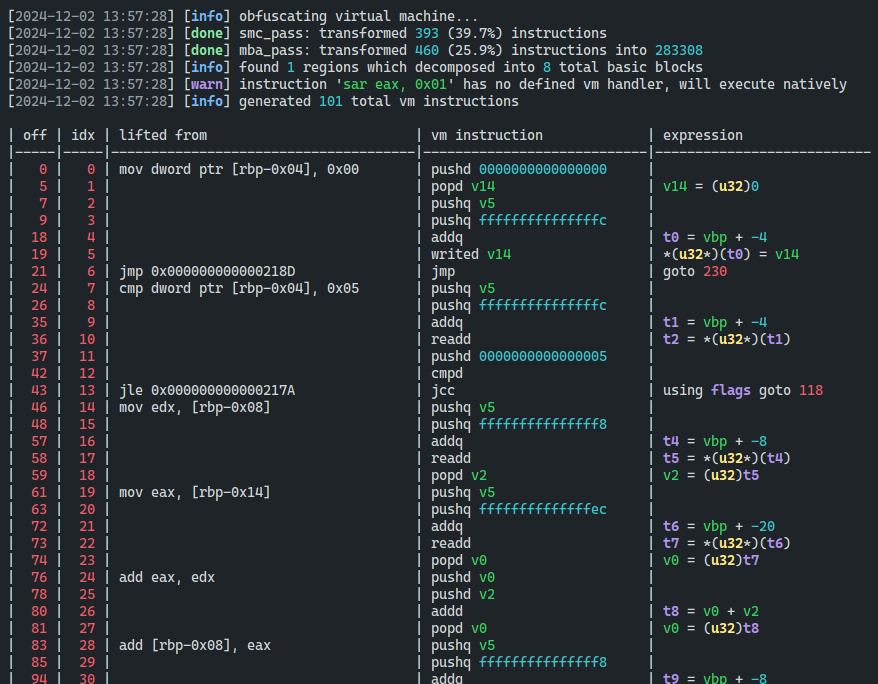
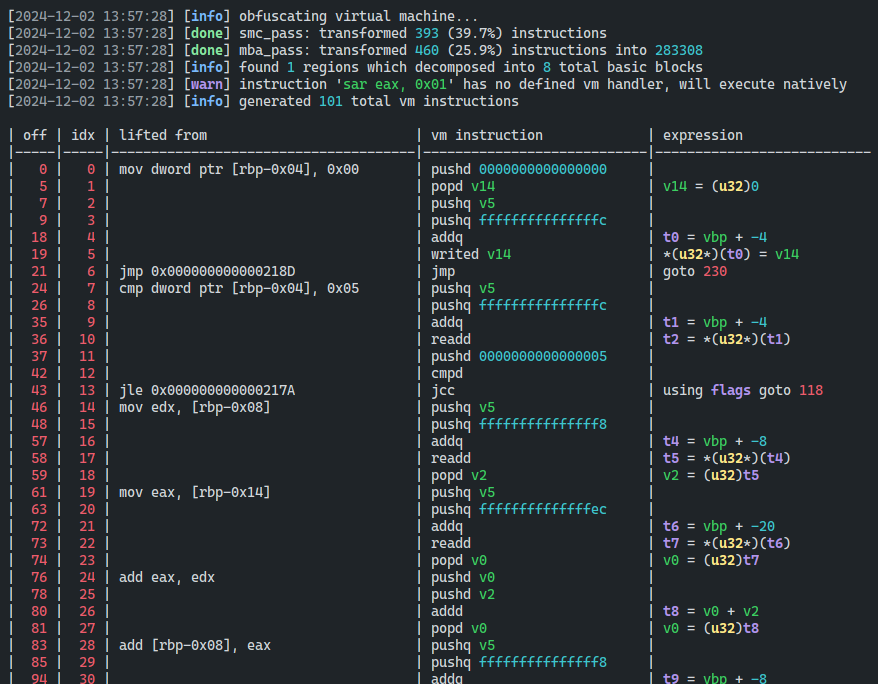
The example application above was virtualized using covirt a.out -d, which outputs a dump of the VM instructions following obfuscation and virtualization. The current VM implementation pushes most operands onto the stack to process them, reducing the complexity of encoding the VM instructions. For instructions that don't have a defined VM handler, they will be executed natively (vm_exit -> native instruction -> vm_enter). Calling functions follows the same pipeline, in which we exit, call the function, and reenter the VM. All together, the transformations make the binaries grow significantly in size:
a.out as an ELF: 15.5 kB -> 1.0 MBa.out as a PE: 259.3 kB -> 1.3 MB| Description | IDA |
|---|---|
IDA decompilation of vm_entry, which has been obfuscated via the MBA pass only. Over 27k LOC were generated by the decompiler. | 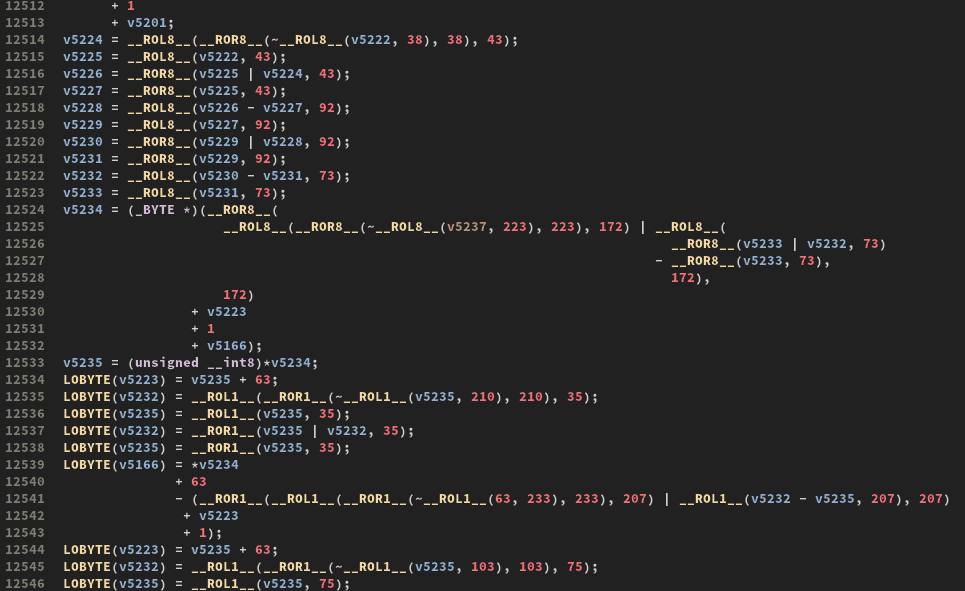 |
IDA disassembly of vm_entry, which has been obfuscated via the MBA & SMC passes. Decompilation doesn't work. | 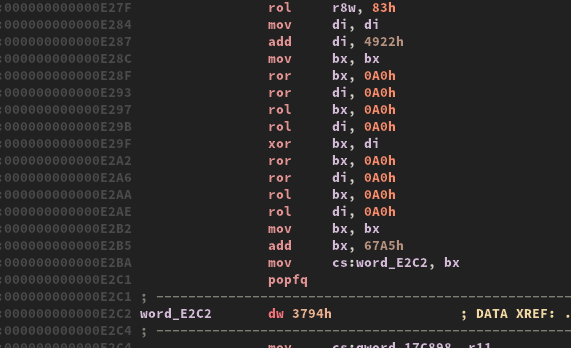 |
