 davidhuser/mxmap
Automated pipeline that resolves Swiss municipality domains, scrapes websites for email addresses, and classifies email providers via MX, SPF, DKIM, DMARC, and SMTP probes to map digital dependencies.

[!IMPORTANT] MXmap has a successor. This project grew into a team research effort covering all municipalities in Germany, Austria and Switzerland: secassure2026.mxmap-project.org (source). The Swiss map at mxmap.ch stays online, but its data is frozen as of April 2026 and will not be updated.

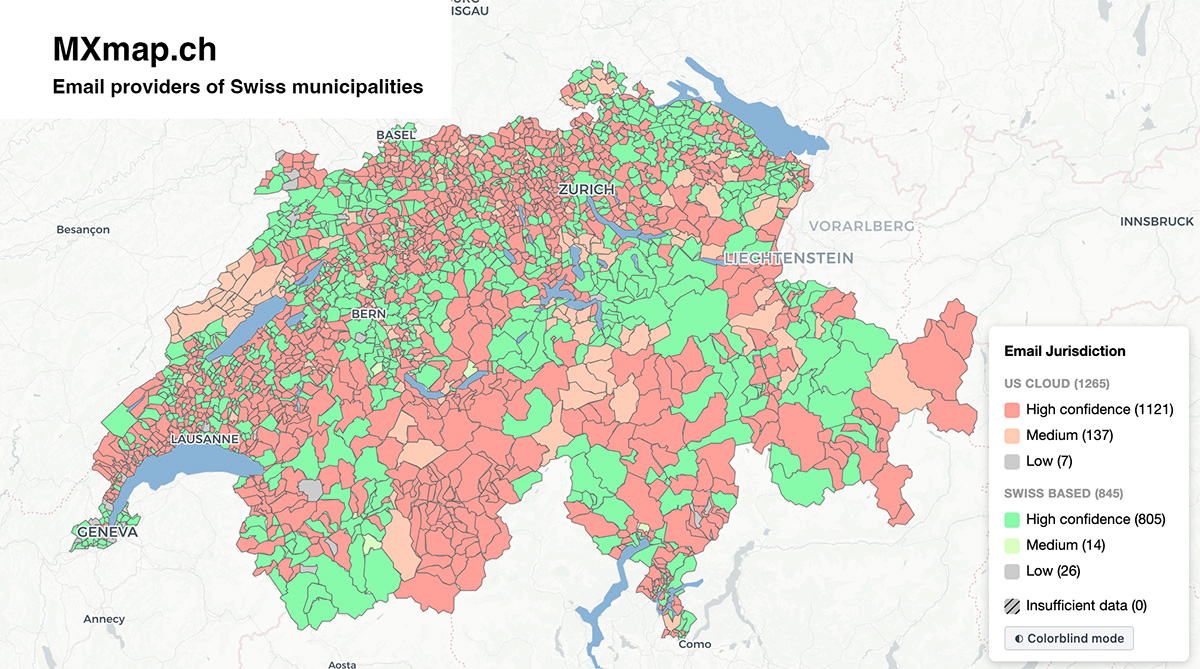
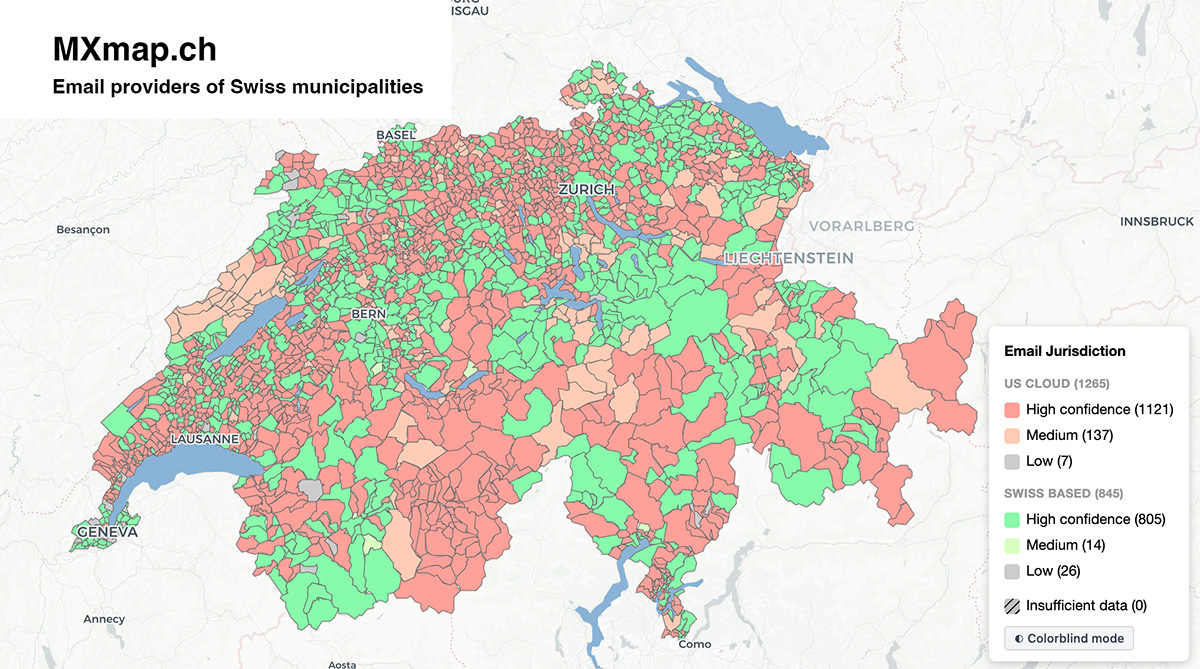
Interactive maps showing where Swiss municipalities host their email and how deeply their DNS is tied to US hyperscalers (Microsoft, Google, AWS) versus Swiss providers and self-hosted solutions.
The data pipeline has two stages:
Resolve domains — Fetches all ~2100 Swiss municipalities from Wikidata and the BFS (Swiss Statistics) API, applies manual overrides, scrapes municipal websites for email addresses, guesses domains from municipality names, and verifies candidates with MX lookups. Scores source agreement to pick the best domain. Outputs municipality_domains.json.
Classify providers — For each resolved domain, looks up all MX hosts, pattern-matches them, then runs 10 concurrent probes (SPF, DKIM, DMARC, Autodiscover, CNAME chain, SMTP banner, Tenant, ASN, TXT verification, SPF IP). Aggregates weighted evidence, computes confidence scores (0–100). Outputs data.json (full) and data.min.json (minified for the frontend).
flowchart TD
    subgraph resolve ["1 · Resolve domains"]
        bfs[/"BFS Statistics API"/] --> merge["Merge ~2100 municipalities"]
        wikidata[/"Wikidata SPARQL"/] --> merge
        overrides[/"overrides.json"/] --> per_muni
        merge --> per_muni["Per municipality"]
        per_muni --> scrape["Scrape website for<br/>email addresses"]
        per_muni --> guess["Guess domains<br/>from name"]
        scrape --> mx_verify["MX lookup to<br/>verify domains"]
        guess --> mx_verify
        mx_verify --> score["Score source<br/>agreement"]
    end

    score --> domains[("municipality_domains.json")]
    domains --> classify_in

    subgraph classify ["2 · Classify providers"]
        classify_in["Per unique domain"] --> mx_lookup["MX lookup<br/>(all hosts)"]
        mx_lookup --> mx_match["Pattern-match MX<br/>+ detect gateway"]
        mx_match --> concurrent["10 concurrent probes<br/>SPF · DKIM · DMARC<br/>Autodiscover · CNAME chain<br/>SMTP · Tenant · ASN<br/>TXT verification · SPF IP"]
        concurrent --> aggregate["Aggregate weighted<br/>evidence"]
        aggregate --> vote["Primary vote<br/>+ confidence scoring"]
    end

    vote --> data[("data.json + data.min.json")]
data --> frontend["Leaflet map<br/>mxmap.ch"]see classifier.py for the full implementation details, but in summary,
we use a weighted evidence system where each probe contributes signals of varying strength towards different provider classifications.
uv sync

# Stage 1: resolve municipality domains
uv run resolve-domains

# Stage 2: classify email providers
uv run classify-providers

# Serve the map locally
python -m http.server
uv sync --group dev

# Run tests (90% coverage threshold enforced)
uv run pytest --cov --cov-report=term-missing

# Lint & format
uv run ruff check src tests
uv run ruff format src tests
Country-specific forks, alphabetical by country code:
New country forks are welcome — consider starting from the successor's pipeline, which adds a DANE/DNSSEC/SPF/DMARC scanning stage.
Related projects:
See also the forks of this repository.
If you spot a misclassification, please open an issue with the BFS number and the correct provider.
For municipalities where automated detection fails, corrections can be added to overrides.json.
