
Local privacy proxy that replaces secrets and PII before AI requests leave your machine.
Keep sensitive values out of LLM requests without breaking the conversation.
Install · Quick start · Policies · Monitoring · Pi / OMP · Security
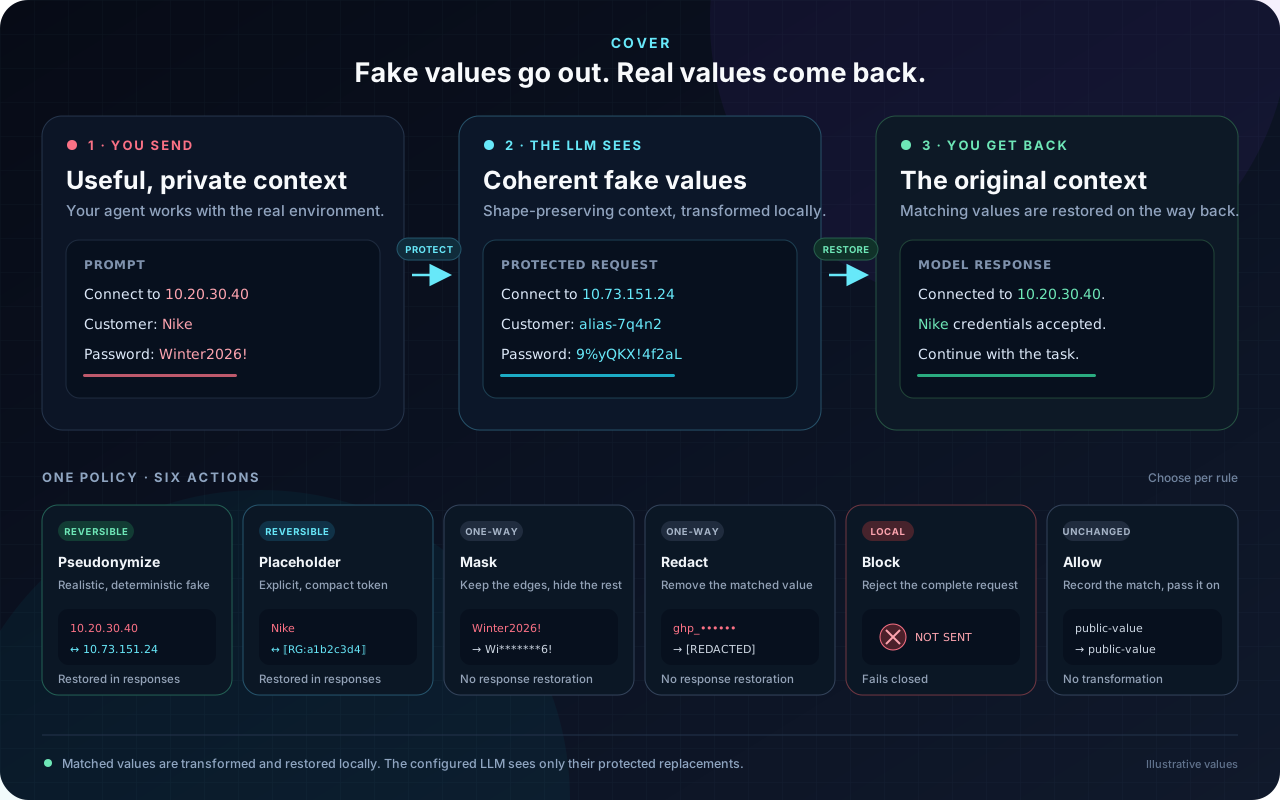
Cover is a local privacy proxy for Codex, Claude Code, Cursor, SDKs, and other HTTP-based AI clients. It scans outgoing JSON, replaces matched values locally, and restores reversible replacements in JSON and streaming responses. The LLM receives the protected values, while the agent can continue using the originals.
Cover runs as a transparent reverse proxy with policy-driven replacement, deterministic pseudonyms, operational checks, Codex support, and strict failure handling. It is designed to stay local, observable, and explicit about what it cannot inspect.
flowchart LR
A["Agent"] -->|"JSON request"| C["Cover<br/>detect · transform · enforce"]
C -->|"protected request"| L["LLM or router"]
L -->|"JSON or SSE response"| C
C -->|"restored response"| A
The installer clones Cover, builds it with Go, installs it to
~/.local/bin/cover, configures selected clients, and starts the proxy.
curl -fsSL https://raw.githubusercontent.com/DavidCarliez/cover/main/scripts/install.sh | bash
Requirements: git and the Go version declared in go.mod.
Prebuilt Linux, macOS, and Windows archives and their checksums are available from GitHub Releases.
For a non-interactive install:
COVER_AGENTS=openai,claude \
curl -fsSL https://raw.githubusercontent.com/DavidCarliez/cover/main/scripts/install.sh | bash
git clone https://github.com/DavidCarliez/cover.git
cd cover
go build -o cover ./cmd/cover
install -m 0755 cover ~/.local/bin/cover
The core binary has no cgo dependency. Standard Go cross-compilation works:
GOOS=linux GOARCH=arm64 go build -o cover-linux-arm64 ./cmd/cover
GOOS=windows GOARCH=amd64 go build -o cover.exe ./cmd/cover
cover init # write ~/.config/cover/config.yaml
cover start --detach # run in the background
cover doctor # verify the local setup
cover test # local redaction round trip, no network call
cover monitor # watch privacy-safe request metadata
cover init prompts for OpenAI, Anthropic, or a custom upstream. The complete
configuration is documented in configs/config.example.yaml.
Stopping Cover does not change client configuration. A client still pointed at Cover will fail to connect until Cover is restarted or the client is pointed back to its direct provider or router.
Built-in regex detection covers AWS and GCP keys, GitHub, GitLab, Slack,
Stripe, and Anthropic tokens, private-key blocks, JWTs, explicit generic secret
assignments, emails, SSNs, credit cards, phone numbers, and IBANs. A bare OpenAI
sk-... value is deliberately not a dedicated built-in category. Define an
explicit rule if your environment needs one.
Rules live under rules in ~/.config/cover/config.yaml. A selector can be a
regular expression, a builtin_* detector, or a list of JSON object keys.
rules:
password_fields:
keys: [password, passwd, pwd, passphrase, user_password, database_password]
category: password
action: pseudonymize
generator: password
priority: 220
ipv4_addresses:
detector: builtin_ipv4
category: ip_address
action: pseudonymize
generator: ipv4
priority: 100
customer_name:
pattern: '(?i)\bNIKE\b'
category: customer
action: pseudonymize
generator: alias
priority: 80
forbidden_secret:
pattern: '(?i)secret\s*[:=]\s*(?P<value>[^\s,;]+)'
action: block
priority: 200
Key selectors protect complete string values. For example,
{"password":"admin"} is protected without treating an unrelated
{"username":"admin"} as a password. Named (?P<value>...) groups let a
regex replace only the captured value.
Pseudonym generators: ipv4, ipv6, hostname, domain, fqdn, email,
username, password, secret, uuid, url, and alias.
Rules are validated at startup. Invalid selectors, expressions, actions, generators, or capture groups prevent Cover from starting. Detector errors, mapping exhaustion, malformed JSON, compressed bodies, and explicit blocks do not fall back to forwarding the original request.
Cover creates ~/.config/cover/pseudonym.key with owner-only permissions.
HMAC-SHA-256 derives the same pseudonym for the same original value across
sessions and restarts. Different installations produce different pseudonyms.
The key cannot recover original values. Restoration uses bounded mappings held
only in process memory. Mappings are separated by X-Cover-Session, expire
after the configured TTL, and are deleted when an isolated request completes.
Back up the key only if stable pseudonym continuity matters.
cover inspect request.json
cover inspect request.json --session demo
The report contains the transformed request, matched rules, categories, actions, warnings, and blocked state. It does not send a network request or print the reversible mapping.
cover doctor
cover doctor --json
Doctor validates the configuration, listener policy, limits, pseudonym key, redaction round trip, upstream-loop protection, daemon, fail-closed behavior, audit log, environment routing, Codex provider, and Codex request compression. Its live probe is rejected locally and does not spend model tokens.
cover monitor
cover monitor --follow=false -n 50
cover monitor --json
The default monitor shows only allowlisted metadata: time, HTTP status, transformation count, byte counts, latency, categories, and generic errors. Audit logs never contain request or response bodies, matched values, mappings, paths, queries, or upstream credentials.
cover monitor --show-content
cover monitor --show-content --once
cover monitor --show-content --json
This opt-in view shows each caught original and replacement, followed by the exact transformed JSON handed to the upstream transport. It is live-only and never added to the audit log. Capture starts after an authenticated local viewer connects and stops when it disconnects. The stream is loopback-only, uses a token derived from the installation key, and disconnects slow viewers.
[!WARNING] This terminal output is sensitive. Do not use
--show-contentin shared terminals, recorded sessions, CI logs, or support transcripts.
Cover forwards request methods, paths, queries, and headers to the configured upstream. Existing provider authentication still works because Cover does not rewrite authentication headers.
Codex uses the Responses API. Add a user-level provider to
~/.codex/config.toml and disable request compression so Cover can inspect the
body:
model_provider = "cover"
[model_providers.cover]
name = "Cover"
base_url = "http://127.0.0.1:8317"
wire_api = "responses"
requires_openai_auth = true
supports_websockets = false
[features]
enable_request_compression = false
These keys follow the official
Codex configuration reference.
If [features] already exists, add the setting to that table. For a router
that reads a token from the environment, replace requires_openai_auth with
env_key = "YOUR_ROUTER_KEY_ENV_NAME".
Keep Cover's upstream pointed at the real router URL. Use
configs/codex-router.example.yaml as a
starting point. The selected model can be OpenAI, Anthropic, Gemini, DeepSeek,
or another model because Cover operates on the router's generic JSON traffic.
Responses API encrypted_content
fields are opaque and cryptographically verified. Cover leaves them unchanged
during request scanning and response restoration.
export ANTHROPIC_BASE_URL=http://127.0.0.1:8317
export OPENAI_BASE_URL=http://127.0.0.1:8317/v1
Claude Code uses the first form. OpenAI-compatible SDKs and clients generally
use the /v1 form. The installer can persist these settings, and cover env
prints the exports for the clients selected during installation.
SDK constructors can set the same base URL directly:
client = OpenAI(base_url="http://127.0.0.1:8317/v1", api_key=os.environ["OPENAI_API_KEY"])
client = anthropic.Anthropic(base_url="http://127.0.0.1:8317", api_key=os.environ["ANTHROPIC_API_KEY"])
Cursor and other applications can use the same endpoint when they expose an
API base URL setting. Confirm routing with cover doctor or cover monitor.
The official harness extension controls Cover from Pi or Oh My Pi while keeping the privacy engine in the local Go proxy:
pi install npm:cover-harness
# or
omp plugin install cover-harness
Configure only the providers that must go through the current Cover upstream:
/cover providers openai-codex,deepseek=/
/cover on
/cover doctor
OpenAI-family providers default to the /v1 proxy path. =/ selects the proxy
root for transports such as DeepSeek that add their own request path. Use
/cover status, /cover start, /cover stop, and /cover monitor for normal
operation. /cover off restores direct provider routing.
Protection is fail-closed: while enabled, configured providers remain pointed
at Cover when its daemon is unavailable, so requests fail locally rather than
bypassing the proxy. Extension state is private and local at
~/.config/cover/harness.json.
The same package appears in the Pi package gallery. OMP users can also add this repository as a marketplace:
omp plugin marketplace add DavidCarliez/cover
omp plugin install cover-harness@cover
Regex and key-aware rules cannot identify every name, address, customer ID, or
internal codename. Cover can run a small local
llama.cpp model as an additional
semantic detector.
cover models pull
cover models status
cover restart
The default model is Qwen2.5-0.5B-Instruct in a roughly 490 MB Q4 GGUF. Cover
starts llama-server on loopback and enforces per-call and overall request
budgets. Missing binaries, startup failures, timeouts, and detector errors fail
closed when the detector is enabled. Returned spans must occur verbatim in the
input before Cover accepts them.
Leave this feature disabled on unsupported platforms. See the
detectors.llm_fallback section in
configs/config.example.yaml for limits,
batching, concurrency, and model paths.
Cover protects matching string values in JSON bodies that actually pass through the proxy. It does not claim to discover every sensitive value.
Data can still leave the machine when it appears in:
allow rule;encrypted_content, which must remain unchanged for protocol safety;Inline image handling is configurable with media.images: allow, warn, or
block. Cover does not inspect pixels, and no media policy can recognize every
possible encoding.
Cover rejects non-loopback listeners unless network.allow_remote: true is
explicitly configured. If Cover and its upstream router run on different
hosts, use TLS or another trusted transport and apply separate network access
controls. Cover itself does not authenticate ordinary proxy traffic.
Request, buffered-response, total-stream, and per-SSE-event limits bound memory use. Oversized requests return HTTP 413, oversized buffered responses return HTTP 502, and oversized streams are terminated.
Read SECURITY.md before reporting a vulnerability. Please use
the private reporting route described there rather than opening a public issue.
CONTRIBUTING.mdCODE_OF_CONDUCT.md| Area | Cover functionality |
|---|
| Policy | Declarative rules with allow, placeholder, pseudonymize, mask, redact, and block actions |
| Realistic replacements | Deterministic generators for IP addresses, hosts, domains, emails, usernames, passwords, UUIDs, URLs, and aliases |
| Context-aware rules | Whole-value protection by JSON key, including short passwords such as admin, plus regex and built-in detector selectors |
| Stable identities | Installation-keyed HMAC pseudonyms remain consistent across requests, sessions, and restarts |
| Mapping safety | Bounded, session-isolated, memory-only reversible mappings with TTL and capacity limits |
| Inspection | cover inspect previews the protected JSON without contacting an LLM |
| Diagnostics | cover doctor verifies policy, daemon health, local fail-closed behavior, and Codex routing |
| Monitoring | Metadata-only audit and monitor views, plus explicit live-only inspection of caught and forwarded content |
| Proxy hardening | Loopback-by-default listeners, body and stream limits, generic safe errors, and fail-closed parsing |
| Codex compatibility | Responses API and router configuration, compression checks, safe SSE restoration, and immutable encrypted_content fields |
| Optional semantic pass | A local llama.cpp detector can inspect free-form text that regular expressions miss |
| Command | Purpose |
|---|
cover install | Configure clients, shell exports, and the background proxy |
cover init | Create the configuration file |
cover start [--detach] | Start Cover in the foreground or background |
cover stop | Stop the background process |
cover restart | Restart it in the background |
cover status [--json] | Show process, listener, and redacted upstream status |
cover version [--json] | Show build version, commit, and date |
cover env | Print shell exports for configured clients |
cover test | Run a synthetic local redaction and restoration check |
cover inspect request.json | Preview exactly what Cover would forward |
cover doctor [--json] | Run configuration, privacy, daemon, and routing checks |
cover monitor | Show recent safe metadata and follow new events |
cover monitor --show-content | Show sensitive live transformations and outbound JSON |
cover models pull | Download the optional local detector runtime and model |
cover models status | Report local detector installation and configuration |
cover completion | Generate shell completion scripts |
| Action | Result |
|---|
allow | Record the match but leave it unchanged |
placeholder | Replace it with a short reversible token |
pseudonymize | Replace it with a realistic, deterministic value |
mask | Keep the first and last characters and mask the middle |
redact | Replace it with [REDACTED] |
block | Reject the complete request locally |