 d35ha/callobfuscator
Obfuscate specific windows apis with different apis

Obfuscate (hide) the PE imports from static/dynamic analysis tools.
This's pretty forward, let's say I've used VirtualProtect and I want to obfuscate it with Sleep, the tool will manipulate the IAT so that the thunk that points to VirtualProtect will point instead to Sleep, now at executing the file, windows loader will load Sleep instead of VirtualProtect, and moves the execution to the entry point, from there the execution will be redirected to the shellcode, the tool put before, to find the address of VirtualProtect and use it to replace the address of Sleep which assigned before by the loader.
#include <cobf.hpp>

int main() {
	cobf obf_file = cobf("sample.exe");
	obf_file.load_pe();
	obf_file.obf_sym("kernel32.dll", "SetLastError", "Beep");
	obf_file.obf_sym("kernel32.dll", "GetLastError", "GetACP");
	obf_file.generate("sample_obfuscated.exe");
	obf_file.unload_pe();
	return 0;
};
config.ini).cobf.exe <input file> <out file> [config file]; Template for the config file:
; * Sections can be written as:
; [dll_name]
; old_sym=new_sym
; * The dll name is case insensitive, but
; the old and the new symbols are not.
; * You can use the wildcard on both the
; dll name and the old symbol.
; * You can use '#' at the start of
; the old or the new symbol to flag
; an ordinal.
; * The new symbol should be exported
; by the dll so the windows loader can resolve it.
; For example:
; * Obfuscating all of the symbols
; imported from user32.dll with ordinal 1600.
[user32.dll]
*=#1600
; * Obfuscating symbols imported from both
; kernel32.dll and kernelbase.dll with Sleep.
[kernel*.dll]
*=Sleep
; * Obfuscating fprintf with exit.
[*]
fprintf=exit
Build this code sample
#include <windows.h>
#include <stdio.h>

int main() {
	SetLastError(5);
	printf("Last error is %d\n", GetLastError());
	return 0;
};
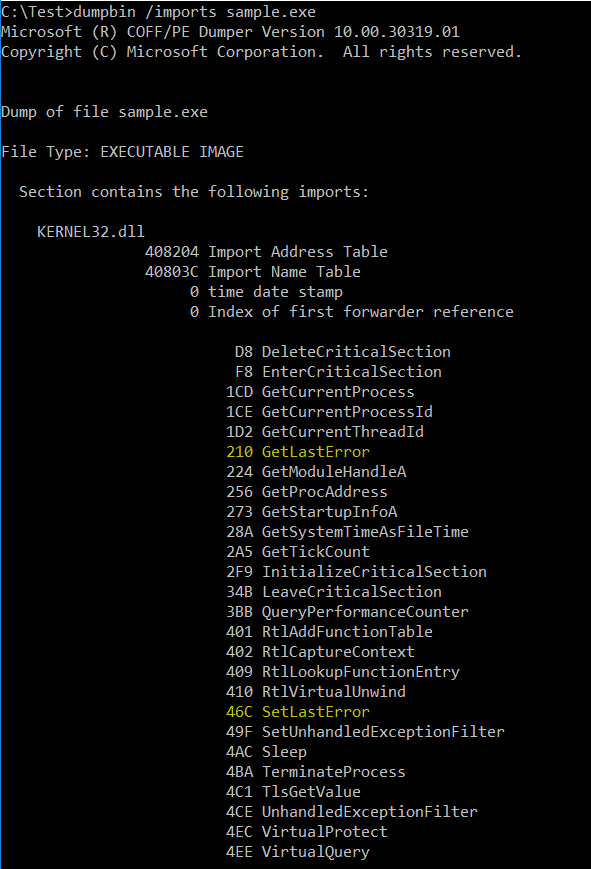
After building it, this is how the kernel32 imports look like
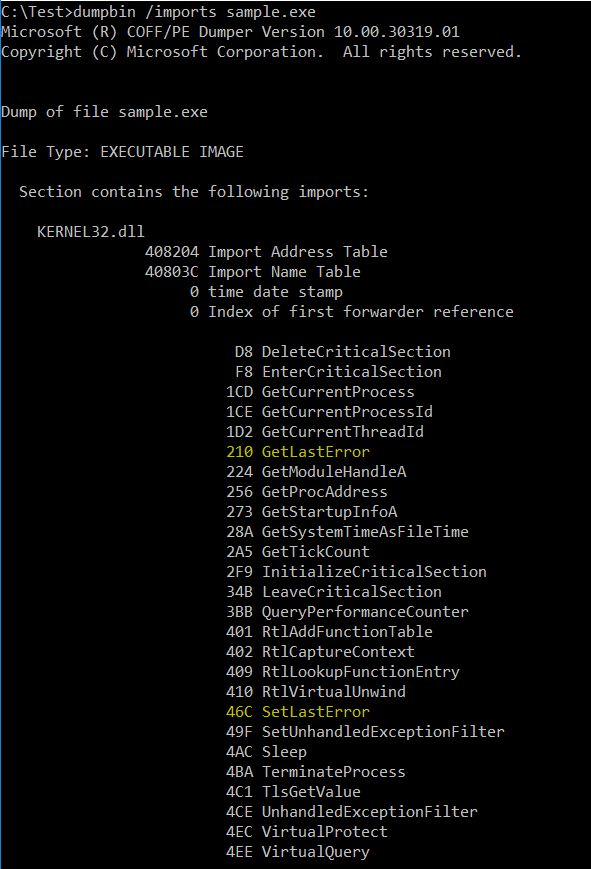
Now let's obfuscate both SetLastError and GetLastError with Beep and GetACP (actually any api from kernel32 will be ok even if it's not imported at all).
The used configurations are
[kernel32.dll]
SetLastError=Beep
GetLastError=GetACP
Here is the output (also you can use the library directly as shown above).

Again let's have a look on the kernel32 imports
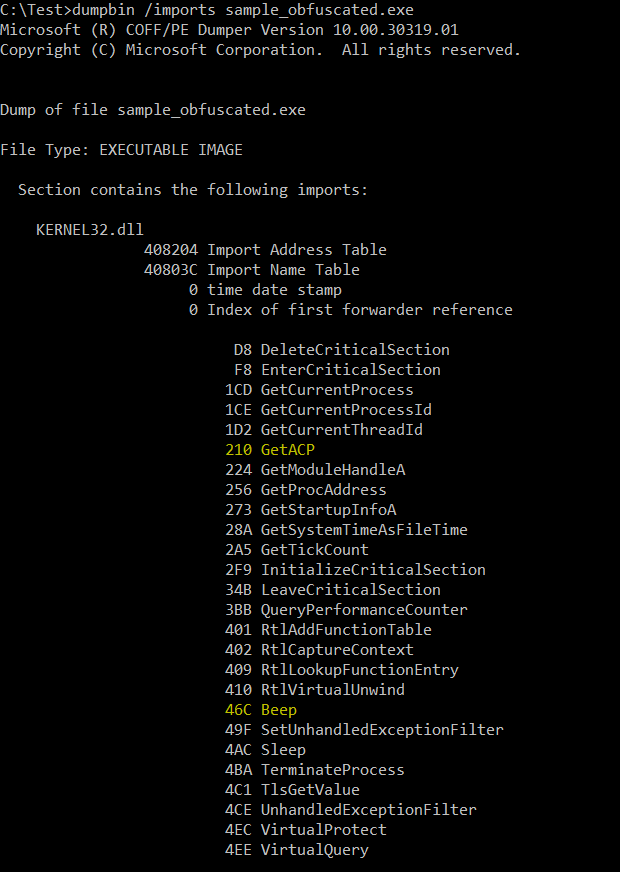
There's no existence of SetLastError or GetLastError
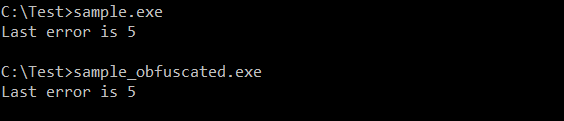
A confirmation that two files will work properly
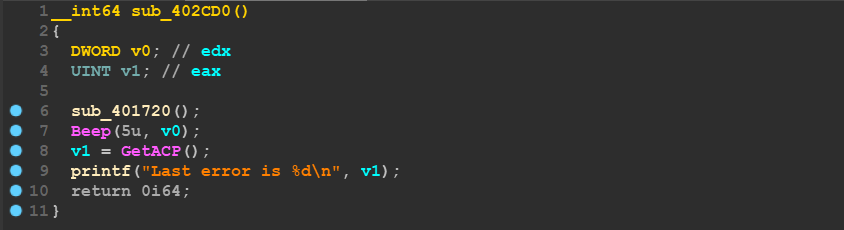
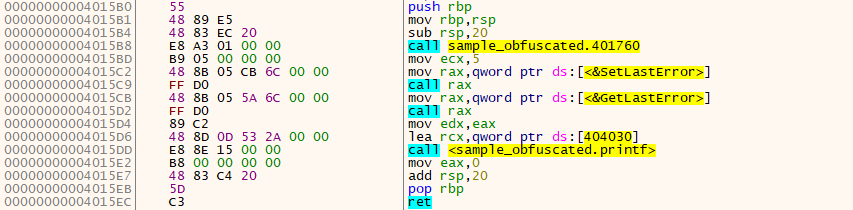
IDA HexRays Decompiler
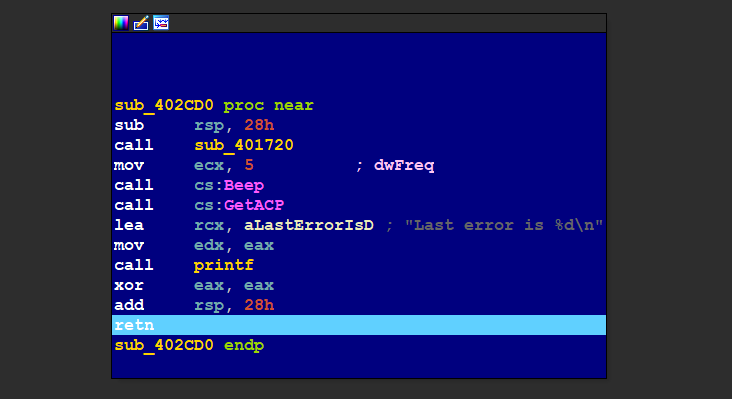
IDA Debugger
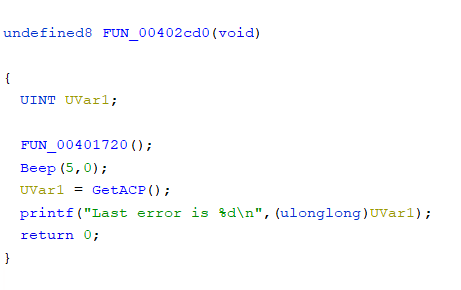
Ghidra
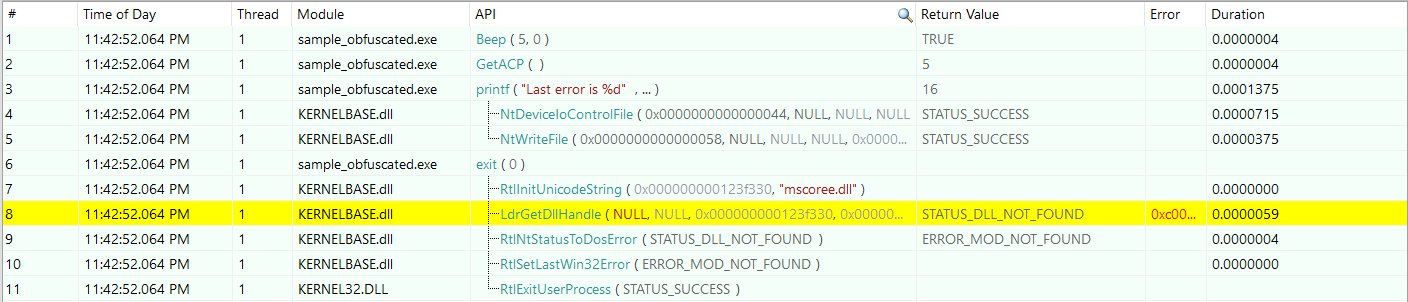
ApiMonitor
That's because all of the static analysis tool depend on what is the api name written at IAT which can be manipulated as shown.
For ApiMonitor, because of using IAT hooking, the same problem exists.
On the other side, for tools like x64dbg the shown api names will only depend on what is actually called (not what written at the IAT).
.cobf for holding the shellcode and the other needed datas.git clone https://github.com/d35ha/CallObfuscator.