 cyeezy08/fenrirlvx
High-speed Go CLI for WordPress attack surface mapping, plugin fingerprinting, and offline CVE correlation

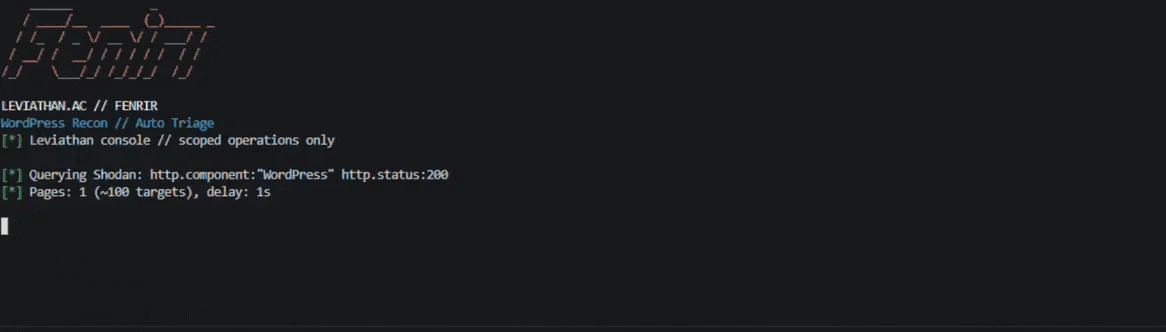
High-speed Go CLI for WordPress attack surface mapping, plugin fingerprinting, and offline CVE correlation.
FenrirLVX is a focused, low-footprint Go security utility built for authorized offensive security operations, bug bounty triage, and perimeter auditing. It fingerprints WordPress targets, enumerates plugins and themes, correlates detected versions against a local vulnerability database (vuln_db.json), and outputs deterministic triage findings without external API dependencies.
[!IMPORTANT] Use FenrirLVX only against assets you own or have explicit written authorization to assess.
vuln_db.json).amd64, arm64, 386).brew install leviathan-offsec/tap/fenrir
fenrir --help
Download the archive for your platform from
releases. Each archive
contains the binary, vuln_db.json, and a SHA256SUMS file. Verify it:
sha256sum -c SHA256SUMS --ignore-missing
./fenrir-v0.1.0-linux-amd64 --help
Run it from the directory containing vuln_db.json. The database is looked
up by relative path, so the binary and the JSON file need to sit together.
git clone https://github.com/leviathan-offsec/FenrirLVX.git
cd FenrirLVX
go build -o fenrir .
./fenrir --help
vuln_db.json is committed, so a source build is fully offline-capable with no
extra setup. Requires Go 1.27 or newer.
vuln_db.json is generated from a Wordfence export, which is not committed
because of its size. To rebuild it from your own feed:
# needs the Wordfence API key and an export
cp wordfence_production.json .
go run ./tools/convertor.go
The convertor parses the feed and rewrites vuln_db.json in place. It is a
maintenance tool, not part of a normal build.
Scan an authorized target URL directly without third-party services:
fenrir scan -t https://staging.example.com
The scan outputs detected CMS technologies, active plugins, detected themes, and correlations against local vulnerability definitions with confidence scoring.
export SHODAN_API_KEY="your-api-key"
fenrir wordpress -t staging.example.com -k $SHODAN_API_KEY
The Shodan key is optional; direct scanning functions entirely offline.
fenrir mass -k $SHODAN_API_KEY -q 'http.component:"WordPress" org:"TargetOrg"' -p 1 -d 5
| Flag | Supported Commands | Description |
|---|---|---|
-t | scan, wordpress | Target URL or domain |
-k | wordpress, mass | Shodan API key (optional) |
-q | mass | Shodan search query filter |
-p | mass | Total result pages to fetch (default: 1) |
-d | mass | Polling delay in seconds between queries (default: 5) |
-P | mass | Enable strict/precision version matching |
FenrirLVX utilizes deterministic severity signaling in its terminal output:
[+] Clean       No matching vulnerability signature in local database
[!]             Low or medium-severity signal / unverified version match
[!!]            High-severity vulnerability signature detected
[!!!]           Critical CVSS / exploit-confirmed vulnerability signature
[SKIP]          Honeypot, WAF canary, or synthetic response filtered
A clean verdict also reports database coverage:
[+] staging.example.com Clean
    database coverage  3/7 plugins matched  4 with no advisory data
[!IMPORTANT]
Cleanmeans no local signature matched, not that the target is free of known issues. Four plugins had no advisory data in this database, and that gap is stated rather than hidden. An offline scanner cannot prove absence. It can only report what its data covers.
[!NOTE] Plugins with an unbounded advisory (a
*on either version bound) will match any detected version. Those matches are flagged so you can discount them.
cmd/          Cobra command wiring and CLI interface
pkg/banner/   Console branding and output telemetry
pkg/engine/   Fingerprinting, asset enumeration, and CVE correlation
pkg/shodan/   Shodan host discovery client
tools/        Database convertor and release build script
build.ps1     Cross-platform release build (Windows)
vuln_db.json  Local vulnerability definitions and signatures
go build ./...
go test ./...
go vet ./...
The pkg/engine tests cover range-boundary handling, version parsing,
coverage accounting and the clean-path disclosure. They are the regression net
for the two failure modes that matter here: a plugin silently missing from the
database, and a match firing on an advisory with no upper bound.
MIT License. Developed by @cyeezy08 for Leviathan OffSec.
