 cyber-note/cve-2026-34835-black-box-analysis
A black-box (DAST) security analysis of CVE-2026-34835 focusing on external validation methodology, observable behavior, security impact, and defensive recommendations.

This repository provides a black-box security analysis of CVE-2026-34835 from the perspective of an external penetration tester.
The objective is not to reverse engineer the vulnerability, but to document how a security assessor can identify, validate, and evaluate its impact during an authorized assessment.


A dynamic application security testing (DAST) perspective on CVE-2026-34835, a Moderate-severity validation bypass vulnerability.
This report evaluates how the flaw manifests from an external, black-box penetration testing perspective, focusing strictly on observable behavior and application response anomalies.
Rack::Request Handling Logic3.0.0.beta1 to < 3.1.21, and 3.2.0 to < 3.2.63.1.21 and 3.2.6According to the public security advisory, affected Rack versions may incorrectly process certain malformed Host header values, leading to unexpected application behavior. This analysis does not rely on source code review and is based solely on publicly available advisories and observable application behavior.
Applications relying on Host header trust decisions may behave unexpectedly if malformed values are accepted. When downstream application controls or front-end routing layers rely on partial string verification methods—such as checking prefixes or suffixes—this loose validation mechanism could allow malformed inputs to bypass intended handling logic.
The following workflow illustrates the black-box replication pipeline used to analyze the behavior from an external perspective:
Passive Fingerprinting (Attempt to identify the underlying infrastructure when possible)
      │
      ▼
Manipulate Host Header (Inject malformed variations via Intercepting Proxy)
      │
      ▼
Observe Response Differences (Analyze status codes and header behavior)
      │
      ▼
Verify Application Behavior (Determine whether malformed values are accepted)
      │
      ▼
Evaluate Potential Security Impact (Map out business logic implications)
From a black-box testing perspective, an auditor can assess whether the target appears vulnerable by manipulating the Host header using an intercepting proxy (e.g., Burp Suite Repeater) and observing if the server continues processing the request instead of dropping it with an HTTP 400 Bad Request.
Consider a hypothetical scenario where an external perimeter rule restricts traffic or grants specific access based on a trusted string format:
trusted-banking.com).During an assessment, an auditor can leverage authority control characters (such as @) to position the trusted string at the beginning of the header while altering the overall structure:
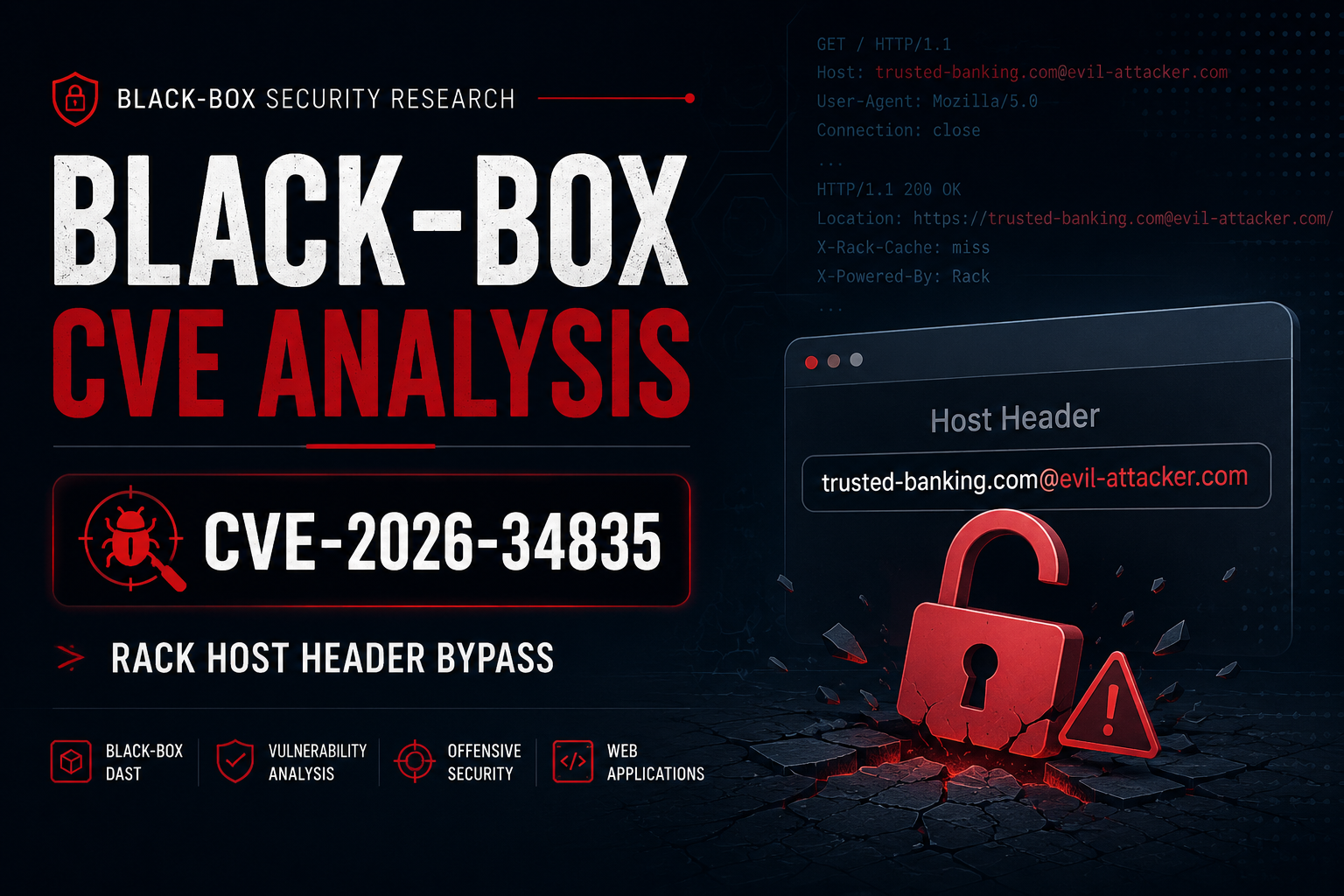
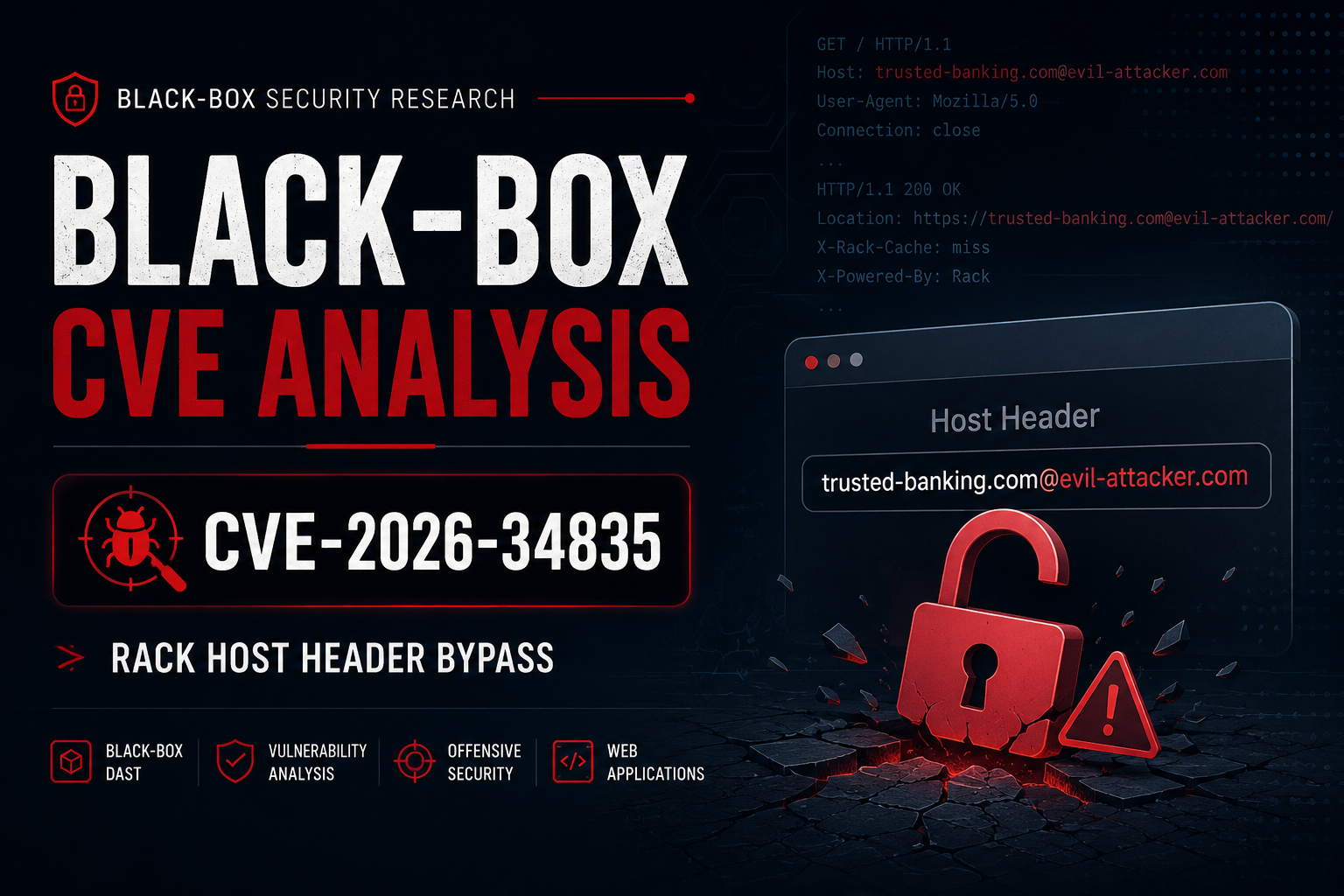
GET / HTTP/1.1
Host: [email protected]
User-Agent: Mozilla/5.0
Connection: close
400 Bad Request.During dynamic analysis, look for the following potential behaviors when inputting malformed Host values:
While this validation discrepancy does not grant direct command execution capabilities on its own, it acts as a critical catalyst for secondary high-impact attacks:
Host values.X-Rack-Cache, custom cookie structures, or specific stack trace formats), passive fingerprinting may help identify Rack-based deployments.400 Bad Request or continue processing.Host header with multiple control characters (@, /, ?, #) to see how the infrastructure handles boundary boundaries.X-Cache headers to evaluate if anomalous host strings are cached by upstream proxies.3.0.0.beta1 to < 3.1.21, and 3.2.0 to < 3.2.6.3.1.21 or 3.2.6.
