 cyber-niz/dirty-frag
C proof-of-concept exploit for CVE-2026-43284 (Dirty Frag), a Linux kernel local privilege escalation that uses page-cache corruption to gain root on vulnerable systems.




This repository contains a Proof of Concept (PoC) for:
CVE-2026-43284 — Dirty Frag
The exploit demonstrates a vulnerability affecting vulnerable Linux systems.
Dirty Frag (sometimes referred to as Copy Fail 2) is a critical Linux kernel local privilege escalation vulnerability affecting multiple kernel subsystems.
The bug enables an unprivileged local attacker to escalate privileges and gain root access on vulnerable systems through controlled page-cache corruption.
Originally discovered by Hyunwoo Kim (@v4bel), the vulnerability is considered a modern successor to earlier Linux page-cache exploitation techniques such as Dirty Pipe and Copy Fail.
| Field | Information |
|---|---|
| CVE | CVE-2026-43284 |
| Additional CVE | CVE-2026-43500 |
| Nickname | Dirty Frag / Copy Fail 2 |
| Impact | Local Privilege Escalation |
| Severity | High / Critical |
| Exploitation | Reliable & Deterministic |
| Disclosure Date | May 2026 |
| Affected Systems | Linux Kernels (2017+) |
The vulnerability originates from unsafe handling of shared socket buffer (skb) fragments that reference page-cache-backed memory regions.
Under specific conditions involving:
splice(2)sendfile(2)the kernel may unintentionally allow modification of read-only cached file data.
This behavior creates a highly powerful:
Arbitrary Page Cache Write Primitive
which attackers can abuse to overwrite sensitive files in memory and obtain full root privileges.
The vulnerability primarily affects the following kernel components:
esp4, esp6)| Vulnerability | Similarity |
|---|---|
| Dirty Pipe | Page-cache overwrite primitive |
| Copy Fail | Earlier Linux kernel page corruption |
| Dirty COW | Privilege escalation via memory race |
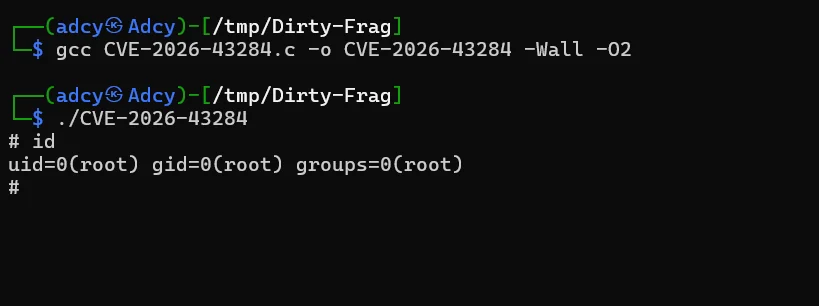
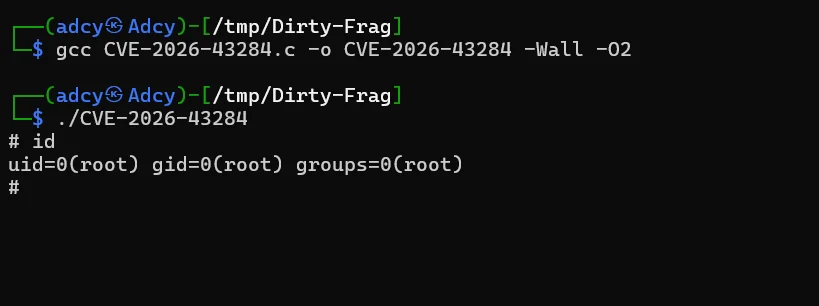
Compile the exploit using GCC:
gcc CVE-2026-43284.c -o CVE-2026-43284 -Wall -O2
Run the compiled binary:
./CVE-2026-43284
| Requirement | Version |
|---|---|
| Linux Kernel | Vulnerable Version |
| GCC | Any Recent Version |
| Architecture | x86_64 Recommended |
sudo apt update
sudo apt install gcc
sudo pacman -S gcc
sudo dnf install gcc
- This project is for educational and authorized security research only.
- Do NOT use this against systems without permission.
- The author assumes no liability for misuse or damages.
🔗 CVE Record
https://www.cve.org/CVERecord?id=CVE-2026-43284
🔗 NVD Entry
https://nvd.nist.gov/vuln/detail/CVE-2026-43284
🔗 Plesk Security Advisory
https://support.plesk.com/hc/en-us/articles/40314546777239-Vulnerability-CVE-2026-43284-Dirty-Frag
🔗 Tenable Research
https://www.tenable.com/blog/dirty-frag-cve-2026-43284-cve-2026-43500-frequently-asked-questions-linux-kernel-lpe
🔗 Help Net Security Article
https://www.helpnetsecurity.com/2026/05/08/dirty-frag-linux-vulnerability-cve-2026-43284-cve-2026-43500/
🔗 Dirty Frag Technical Writeup
https://www.dirtyfrag.tech/
🔗 WebWorld Security Analysis
https://www.webworld.blog/2026/05/08/dirty-frag-cve-2026-43284/
🔗 Skynats Advisory
https://www.skynats.com/blog/dirty-frag-linux-kernel-vulnerability/
🔗 University of Cologne Security Notice
https://itcc.uni-koeln.de/en/services/information-security/it-security/vulnerability-cve-2026-43284-dirty-frag
🔗 Reddit Technical Discussion
https://www.reddit.com/r/linuxadmin/comments/1t9ncbl/linux_dirty_frag_lpe_cve202643284_cve202643500/
| CVE | Description |
|---|---|
| CVE-2026-43284 | xfrm-ESP Page-Cache Write |
| CVE-2026-43500 | RxRPC Page-Cache Write |
| Dirty Pipe | Similar page-cache corruption class |
| Copy Fail | Previous related Linux LPE chain |