 corelight/hassh
Fingerprint SSH clients and servers.


NOTE: This Corelight repository was created so that it can be actively maintained, as per a request from Salesforce whose original repository is not being maintained.
"HASSH" is a network fingerprinting standard which can be used to identify specific Client and Server SSH implementations. The fingerprints can be easily stored, searched and shared in the form of an MD5 fingerprint.

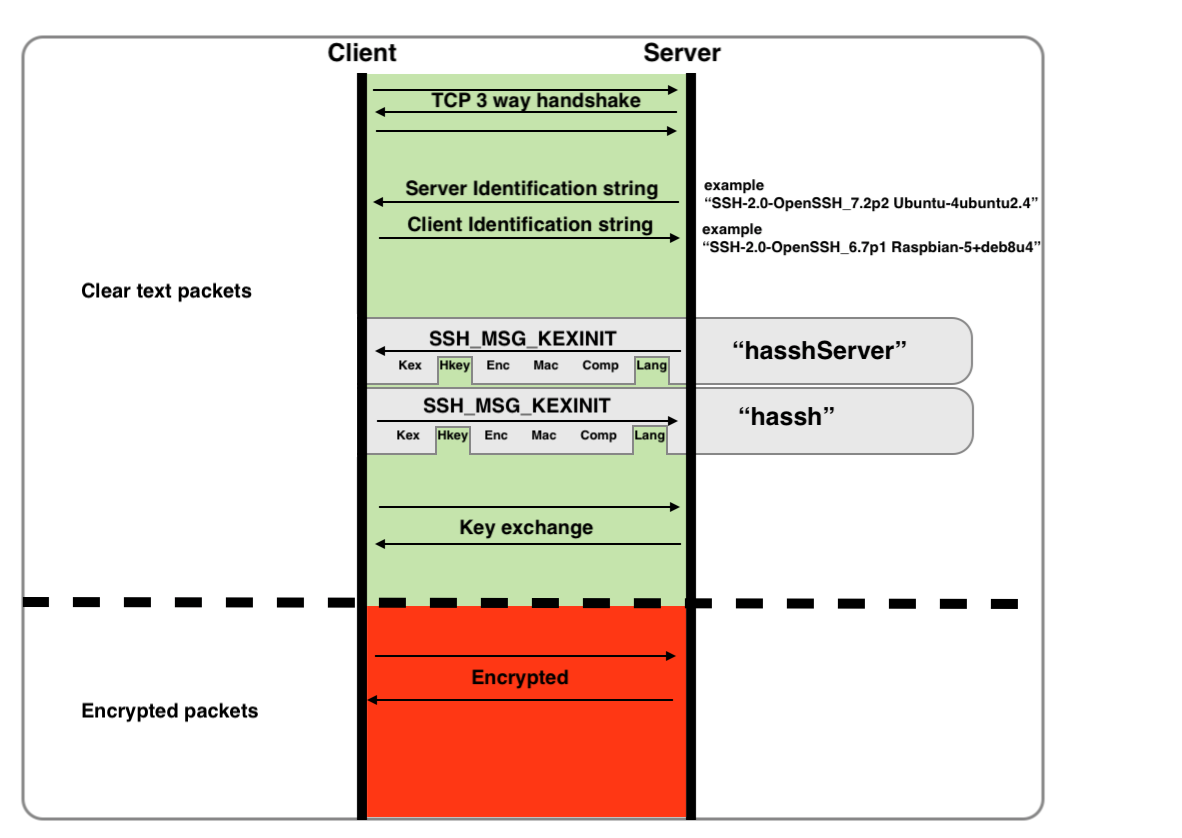
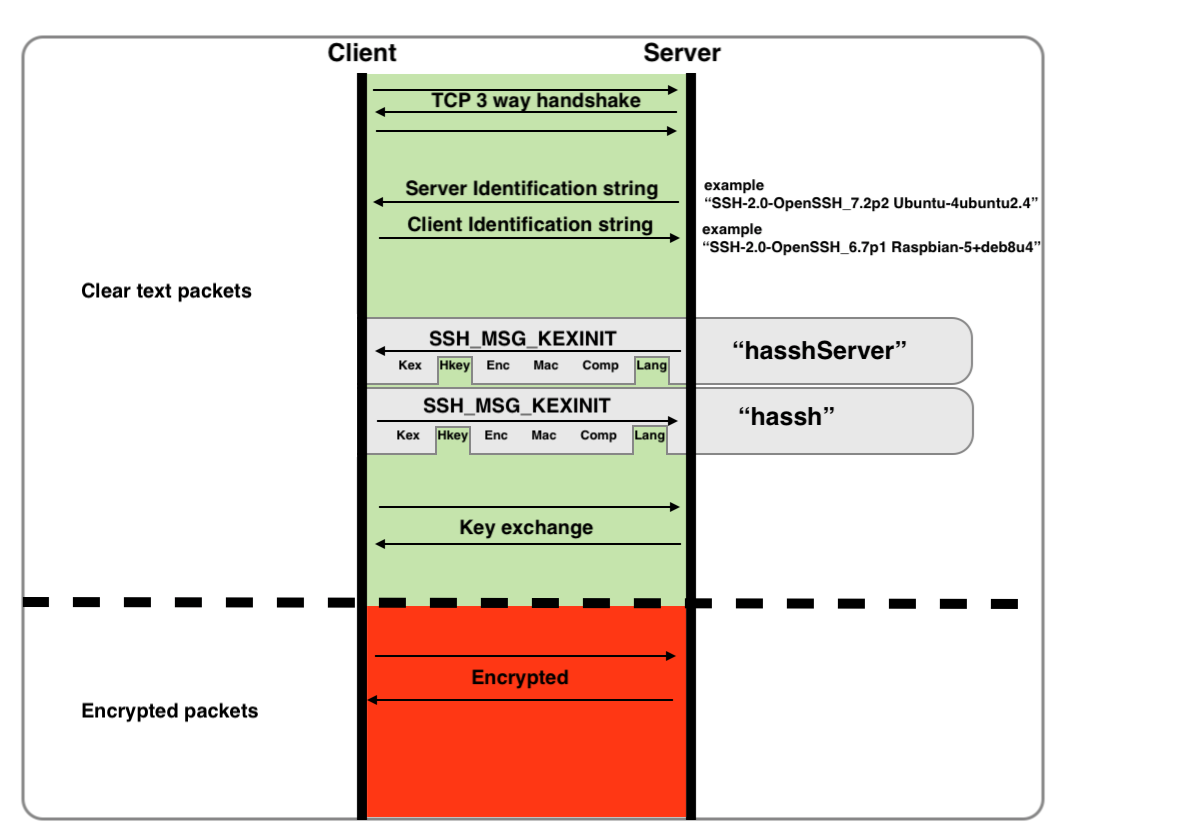
"hassh" and "hasshServer" are MD5 hashes constructed from a specific set of algorithms that are supported by various SSH Client and Server Applications. These algorithms are exchanged after the initial TCP three-way handshake as clear-text packets known as "SSH_MSG_KEXINIT" messages, and are an integral part of the setup of the final encrypted SSH channel. The existence and ordering of these algorithms can be unique enough such that it can be used as a fingerprint to help identify the underlying Client and Server application or unique implementation, regardless of higher level ostensible identifiers such as "Client" or "Server" strings.
For the "Cyberduck" SFTP client SSH-2.0-Cyberduck/6.7.1.28683 (Mac OS X/10.13.6) (x86_64) , the set of supported algorithms is as follows :
| Function | Algorithms seen in SSH_MSG_KEXINIT packets |
|---|---|
| Key Exchange methods | [email protected],diffie-hellman-group-exchange-sha256,ecdh-sha2-nistp521,ecdh-sha2-nistp384,ecdh-sha2-nistp256,diffie-hellman-group-exchange-sha1,diffie-hellman-group1-sha1,diffie-hellman-group14-sha1,diffie-hellman-group14-sha256,diffie-hellman-group15-sha512,diffie-hellman-group16-sha512,diffie-hellman-group17-sha512,diffie-hellman-group18-sha512,[email protected],diffie-hellman-group15-sha256,[email protected],[email protected],diffie-hellman-group16-sha256,[email protected],[email protected],[email protected] |
| Encryption | aes128-cbc,aes128-ctr,aes192-cbc,aes192-ctr,aes256-cbc,aes256-ctr,blowfish-cbc,blowfish-ctr,cast128-cbc,cast128-ctr,idea-cbc,idea-ctr,serpent128-cbc,serpent128-ctr,serpent192-cbc,serpent192-ctr,serpent256-cbc,serpent256-ctr,3des-cbc,3des-ctr,twofish128-cbc,twofish128-ctr,twofish192-cbc,twofish192-ctr,twofish256-cbc,twofish256-ctr,twofish-cbc,arcfour,arcfour128,arcfour256 |
| Message Authentication | hmac-sha1,hmac-sha1-96,hmac-md5,hmac-md5-96,hmac-sha2-256,hmac-sha2-512 |
| Compression | [email protected],zlib,none |
Concatenating these algorithms together with a delimiter of ";" gives the hasshAlgorithms, which is useful for detailed analysis.
[email protected],diffie-hellman-group-exchange-sha256,ecdh-sha2-nistp521,ecdh-sha2-nistp384,ecdh-sha2-nistp256,diffie-hellman-group-exchange-sha1,diffie-hellman-group1-sha1,diffie-hellman-group14-sha1,diffie-hellman-group14-sha256,diffie-hellman-group15-sha512,diffie-hellman-group16-sha512,diffie-hellman-group17-sha512,diffie-hellman-group18-sha512,[email protected],diffie-hellman-group15-sha256,[email protected],[email protected],diffie-hellman-group16-sha256,[email protected],[email protected],[email protected];aes128-cbc,aes128-ctr,aes192-cbc,aes192-ctr,aes256-cbc,aes256-ctr,blowfish-cbc,blowfish-ctr,cast128-cbc,cast128-ctr,idea-cbc,idea-ctr,serpent128-cbc,serpent128-ctr,serpent192-cbc,serpent192-ctr,serpent256-cbc,serpent256-ctr,3des-cbc,3des-ctr,twofish128-cbc,twofish128-ctr,twofish192-cbc,twofish192-ctr,twofish256-cbc,twofish256-ctr,twofish-cbc,arcfour,arcfour128,arcfour256;hmac-sha1,hmac-sha1-96,hmac-md5,hmac-md5-96,hmac-sha2-256,hmac-sha2-512;[email protected],zlib,none
Finally the hassh is simply the MD5 of hasshAlgorithms, and is used for storage, searching and sharing. Some examples follow:
de30354b88bae4c2810426614e1b6976  Powershell Renci.SshNet.SshClient.0.0.1 (used by Empire exploit modules)
fafc45381bfde997b6305c4e1600f1bf  Ruby/Net::SSH_5.0.2 x86_64-linux (used by Metasploit exploit modules)
b5752e36ba6c5979a575e43178908adf  Python Paramiko_2.4.1 (used by Metasploit exploit modules)
16f898dd8ed8279e1055350b4e20666c  Dropbear_2012.55 (used in IOT embedded systems)
8a8ae540028bf433cd68356c1b9e8d5b  CyberDuck Version 6.7.1 (28683)
06046964c022c6407d15a27b12a6a4fb  OpenSSH_7.7p1 Ubuntu-4
For a standard SSH-2.0-OpenSSH_5.3 SSH server, the set of supported algorithms is as follows :
