 completetech-security/node-cve-2026-105482-check
Offline Node.js evidence checker for CVE-2026-105482: DNS resolution NUL-name truncation. Single-file Python; JSON/CSV/HTML reports; no exploit payloads.





Offline evidence checker for CVE-2026-105482 — Node.js: DNS resolution NUL-name truncation. It compares Node.js runtime versions that you report against the fixed releases named in the Node.js October 2026 security advisory, and writes the result as CSV, JSON or HTML.
Python 3.10+, standard library only. The single executable, node_cve_2026_105482_check.py, can be copied on its own.
Version evidence, not an assessment of a live system. A result describes the version you supplied. It does not show that a patch is deployed, that the flaw is reachable, or that it can be exploited.
This repository covers only CVE-2026-105482. It is a small, offline triage tool.
unknown; they are never labelled safe.exploitability: not_tested.fixed_version_reported means the supplied version is at or above the vendor's fixed release. It is not attestation of what is deployed.Supply data only for systems you are authorized to assess.
node --version run where the application runs), plus its build source if known. The checker never obtains this itself.# Assess one version and print JSON to stdout
python node_cve_2026_105482_check.py --version 22.23.4 --format json
# Assess the synthetic example inventory and save an HTML report
python node_cve_2026_105482_check.py --inventory examples/inventory.example.json --format html --output report.html
# Assess a CSV list and exit 1 if any result is a finding
python node_cve_2026_105482_check.py --csv-list inventory.csv --fail-on-finding
# Show all options, or run the local synthetic tests
python node_cve_2026_105482_check.py --help
python -m unittest -v
inventory.csv above is your own file; see CSV list for its columns. With no --format, the report is CSV. With no --output, it goes to stdout.
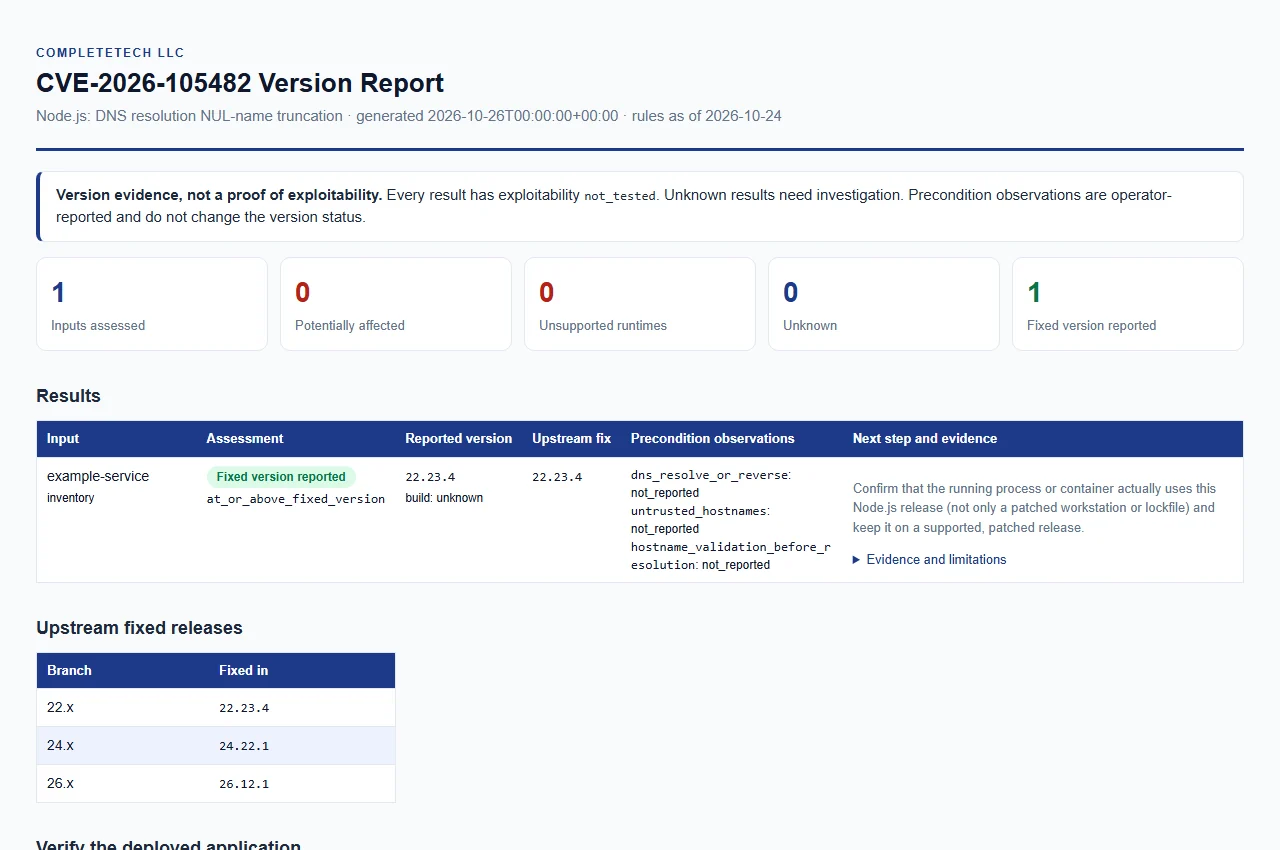
The preview shows the HTML report in light and dark themes. Open the synthetic example report. It uses example data only and is not a live assessment.
The rules are dated 2026-10-24 (rules_as_of in reports). They were reviewed against the official Node.js release advisory, published 2026-10-21, and the linked fixed releases.
| Node.js major | Fixed version |
|---|---|
| 22.x | 22.23.4 |
| 24.x | 24.22.1 |
| 26.x | 26.12.1 |
How a plain stable version such as 22.20.0 or v24.22.1 is classified:
potentially_affected. The vendor does not establish an introduced version, so every earlier version of each named major is treated this way, and versions below the fixed version require remediation.fixed_version_reported.unknown. It is not assumed to be patched.unsupported_runtime. This is upgrade guidance, not a claim that this flaw exists in every historical build. The vendor states that end-of-life versions are always affected by a security release; the checker does not assert that for this specific flaw.unknown. They need explicit vendor evidence; do not label unknown builds safe.End-of-life majors are 0 (an inference, because the schedule lists only 0.8, 0.10 and 0.12), 4–21, 23 and 25, taken from the Node.js release schedule as reviewed on 2026-10-24. This list is built into the checker; the schedule is not fetched at run time.
A version number is not a patch or build signature. Vendor, backported and custom builds may contain fixes that their version number does not show, or may lack them.
At least one of --version, --inventory or --csv-list is required. They can be combined; results appear in the order --version values, then --inventory files, then --csv-list files. Each version or inventory row describes a separate runtime.
