 chocapikk/wpprobe
A fast WordPress plugin enumeration tool


"Because why scan blind when WordPress exposes itself?"
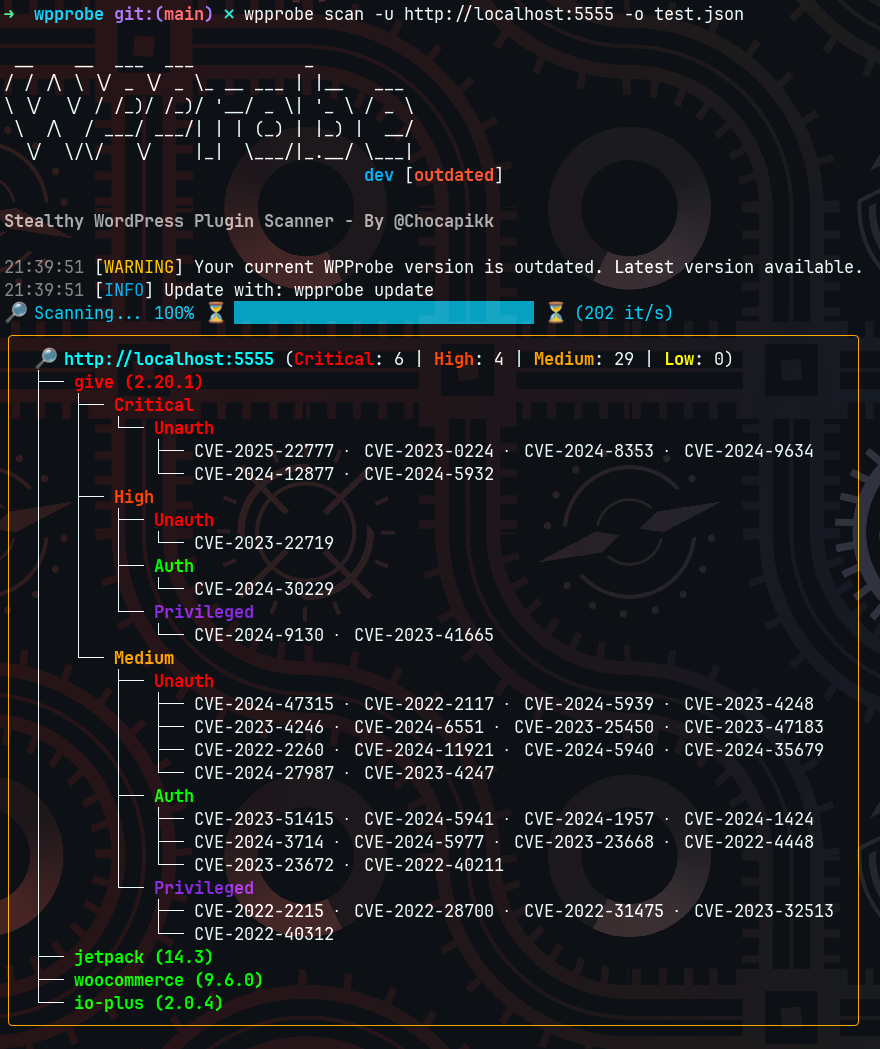






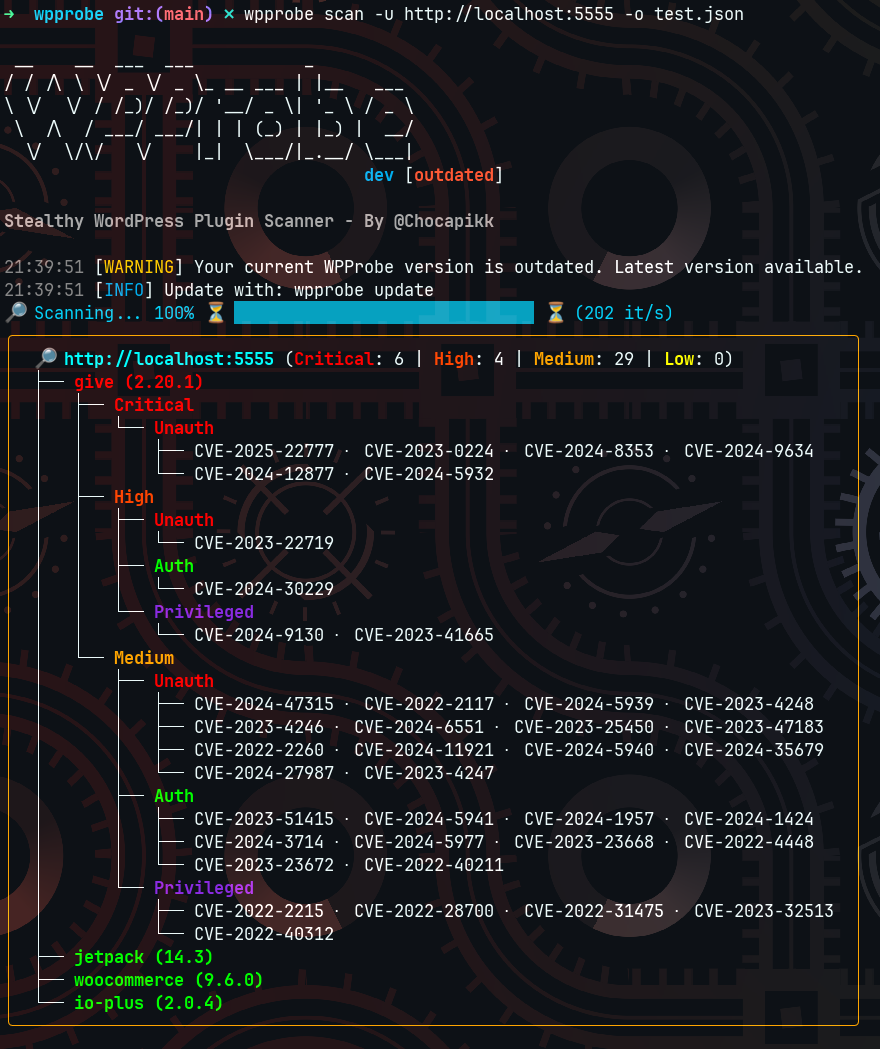
A fast WordPress plugin and theme scanner that detects installed plugins via REST API enumeration and themes from HTML discovery, then maps them to known vulnerabilities. Over 5000 plugins detectable without brute-force, thousands more with it.
Since March 9, 2026, Wordfence deprecated their v2 API. All WPProbe versions prior to v0.10.16 have broken update-db functionality. You need to update WPProbe.
By default, wpprobe update-db fetches a pre-built database from this repo (updated every 2h via CI), so no API key is needed. If you want to fetch directly from Wordfence yourself, you can optionally set up a free API key:
--api-key flaggo install github.com/Chocapikk/wpprobe@latest
wpprobe update-db
wpprobe scan -u https://example.com
| Mode | Method | Stealth | Coverage |
|---|---|---|---|
stealthy (default) | REST API endpoint matching + HTML theme discovery | High | 5000+ plugins + themes |
bruteforce | Direct directory checks | Low | 10k+ plugins |
hybrid | Stealthy first, then brute-force | Medium | Maximum |
wpprobe scan -u https://example.com --mode stealthy
wpprobe scan -u https://example.com --mode bruteforce
wpprobe scan -u https://example.com --mode hybrid
# Kali Linux (included in kali-rolling)
sudo apt install wpprobe

# Go (requires 1.22+)
go install github.com/Chocapikk/wpprobe@latest

# Nix
nix-shell -p wpprobe

# Docker
docker run -it --rm wpprobe scan -u https://example.com

# From source
git clone https://github.com/Chocapikk/wpprobe && cd wpprobe && go build -o wpprobe
# Mount current directory for input/output files
docker run -it --rm -v $(pwd):/data wpprobe scan -f /data/targets.txt -o /data/results.csv

# Persist vulnerability databases
docker run -it --rm \
  -v $(pwd):/data \
  -v wpprobe-config:/config \
  wpprobe scan -f /data/targets.txt -o /data/results.json

# Update databases
docker run -it --rm \
  -v wpprobe-config:/config \
  -e WORDFENCE_API_KEY=your_key \
  -e WPSCAN_API_TOKEN=your_token \
  wpprobe update-db
# Single target
wpprobe scan -u https://example.com

# Multiple targets with threading
wpprobe scan -f targets.txt -t 20

# Custom options
wpprobe scan -u https://example.com \
  --header "User-Agent: CustomAgent" \
  --proxy http://proxy:8080 \
  --rate-limit 10 \
  --no-check-version

# Output formats
wpprobe scan -u https://example.com -o results.csv
wpprobe scan -u https://example.com -o results.json
# Update databases (Wordfence requires free API key, WPScan requires Enterprise API token)
wpprobe update-db --api-key your_wordfence_key
# Or use env var
export WORDFENCE_API_KEY=your_key_here
wpprobe update-db

# Search vulnerabilities
wpprobe search --cve CVE-2024-1234
wpprobe search --plugin woocommerce
wpprobe search --severity critical
wpprobe search --auth Unauth
wpprobe search --title "SQL Injection" --details

# Database statistics
wpprobe list
Set WORDFENCE_API_KEY for Wordfence database updates (free). Set WPSCAN_API_TOKEN for WPScan database updates (Enterprise plan only).
wpprobe update
Only binaries installed from a release update themselves. A build from source is
usually ahead of the last release, so replacing it would be a downgrade: rebuild
it from the repository instead, or pass --force to install the release binary
anyway.
On startup WPProbe checks the newest published release to label the banner. The answer is cached for 24 hours, and the check can be turned off entirely:
export WPPROBE_NO_UPDATE_CHECK=1
Stealthy mode queries exposed REST API routes (?rest_route=/) and matches discovered endpoints against a precompiled database of known plugin signatures. It also discovers active themes by parsing wp-content/themes/ references from the page HTML and fetches their version from style.css. This generates minimal requests and avoids detection by WAFs.
Brute-force mode checks plugin directories directly via GET requests. A 403 response confirms the plugin exists (directory listing forbidden). A 200 response is validated by checking for readme.txt in the directory listing to avoid false positives from WordPress instances that return 200 for all paths.
Hybrid mode combines both: stealthy first for low-noise detection, then brute-force for remaining plugins. Themes are always discovered via HTML regardless of mode.
Detected plugins and themes are correlated with known CVEs from Wordfence and WPScan databases, with version range matching to identify vulnerable installations.
CSV:
URL,Plugin,Version,Severity,AuthType,CVEs,CVE Links,CVSS Score,CVSS Vector,Title
http://example.com,give,2.20.1,critical,Unauth,CVE-2025-22777,https://www.cve.org/CVERecord?id=CVE-2025-22777,9.8,CVSS:3.1/AV:N/AC:L/PR:N/UI:N/S:U/C:H/I:H/A:H,GiveWP <= 3.19.3 - Unauthenticated PHP Object Injection
The JSON output is always an array, with one object per scanned target, so a single file remains valid whether you scan one URL or many with -f.
JSON:
[
  {
    "url": "http://example.com",
    "plugins": {
      "give": [
        {
          "version": "2.20.1",
          "severities": [
            {
              "critical": [
                {
                  "auth_type": "Unauth",
                  "vulnerabilities": [
                    {
                      "cve": "CVE-2025-22777",
                      "cve_link": "https://www.cve.org/CVERecord?id=CVE-2025-22777",
                      "title": "GiveWP <= 3.19.3 - Unauthenticated PHP Object Injection",
                      "cvss_score": 9.8,
                      "cvss_vector": "CVSS:3.1/AV:N/AC:L/PR:N/UI:N/S:U/C:H/I:H/A:H"
                    }
                  ]
                }
              ]
            }
          ]
        }
      ],
      "wordpress-seo": [
        {
          "version": "27.1.1"
        }
      ]
    }
  }
]

