 chaos-boops/clpstnet
CLPSTNet: A Progressive Multi-Scale Convolutional Steganography Model Integrating Curriculum Learning

Fengchun Liu; Tong Zhang; Chunying Zhang
This repository contains the official implementation of the paper "CLPSTNet: A Progressive Multi-Scale Convolutional Steganography Model Integrating Curriculum Learning".
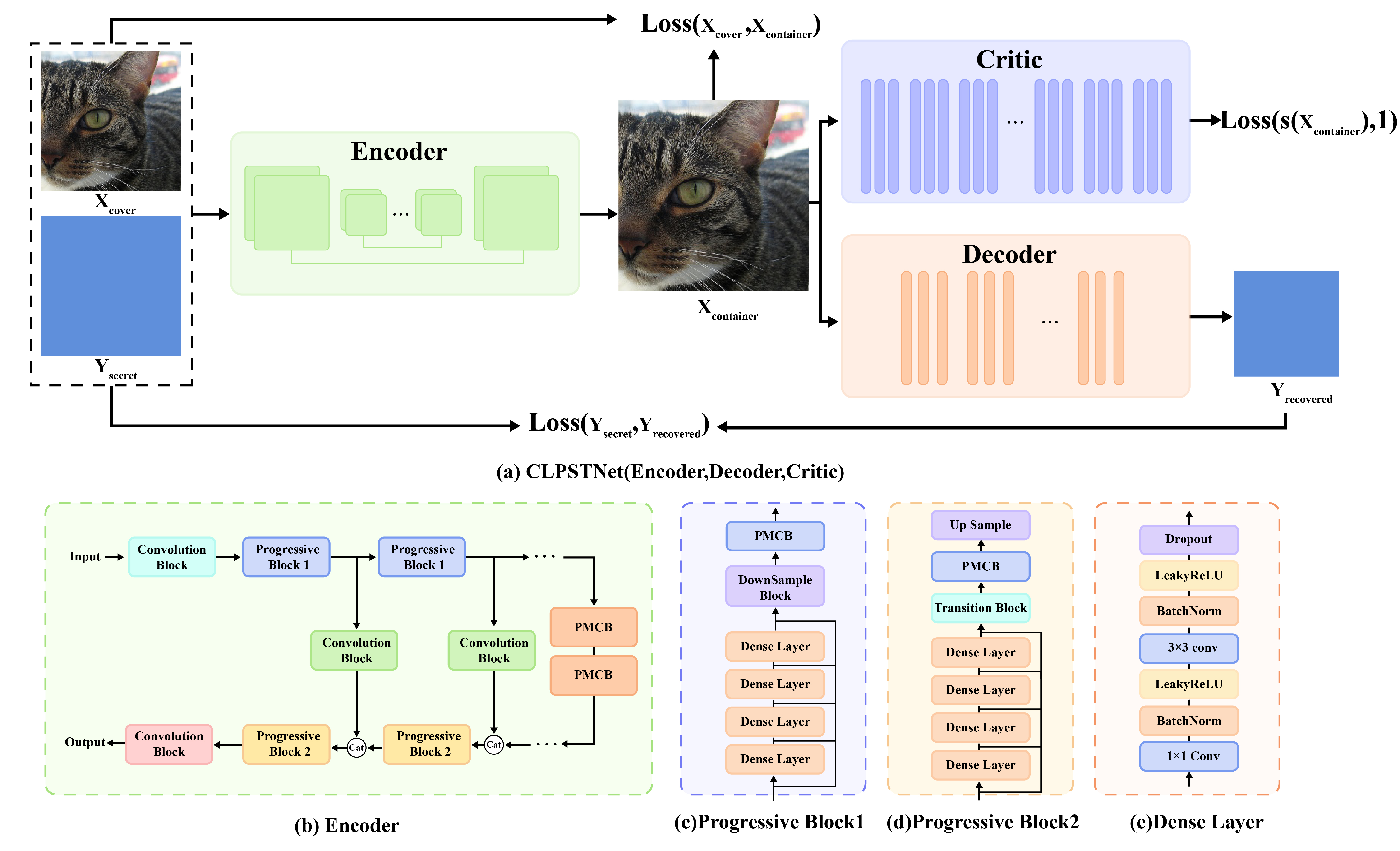
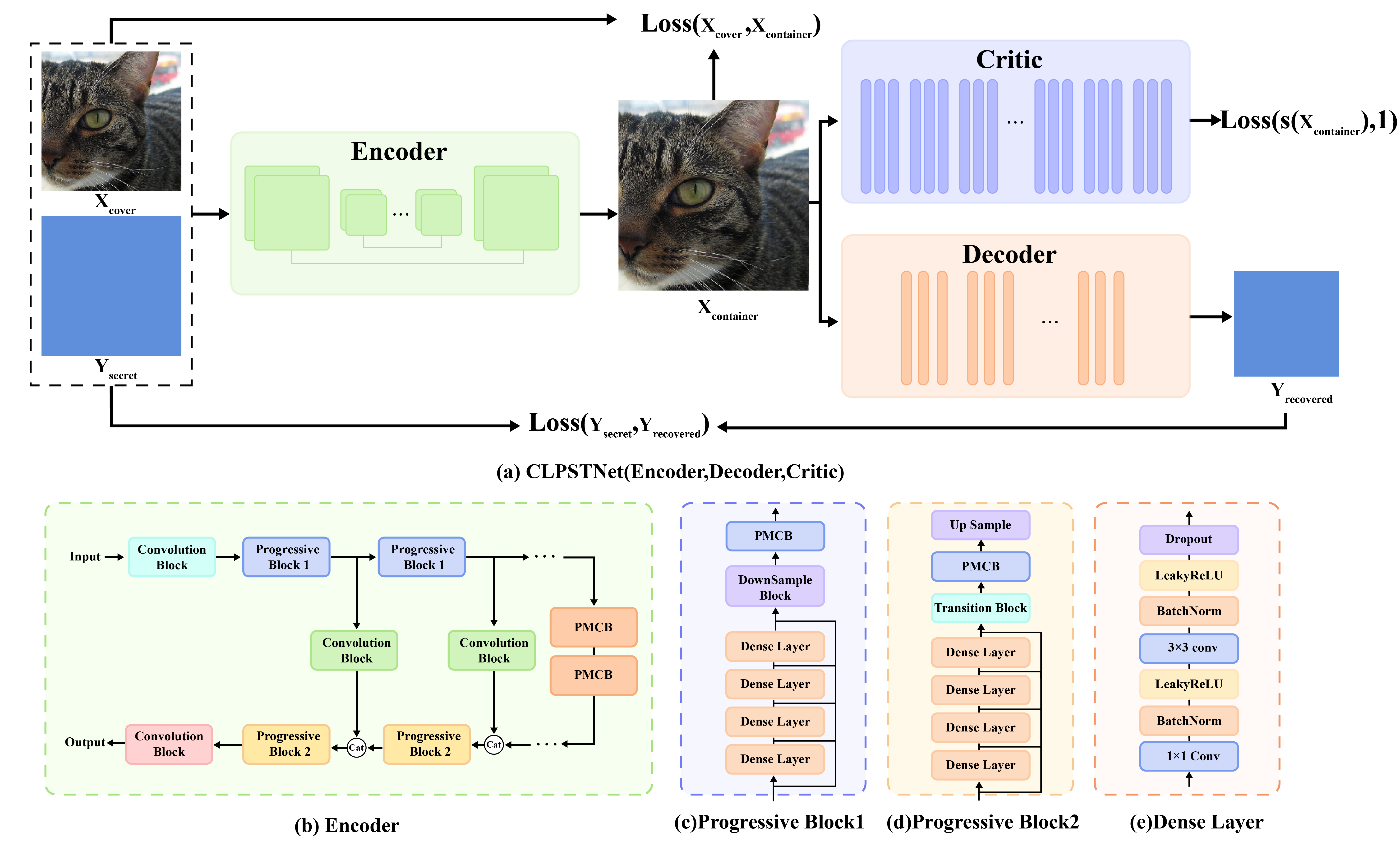
CLPSTNet is a progressive multi-scale convolutional steganography network model that integrates curriculum learning. The network consists of multiple progressive multi-scale convolutional modules that integrate Inception structures and dilated convolutions. The module contains multiple branching pathways, starting from a smaller convolutional kernel and dilatation rate, extracting the basic, local feature information from the feature map, and gradually expanding to the convolution with a larger convolutional kernel and dilatation rate for perceiving the feature information of a larger receptive field, so as to realize the multi-scale feature extraction from shallow to deep, and from fine to coarse, allowing the shallow secret information features to be refined in different fusion stages.
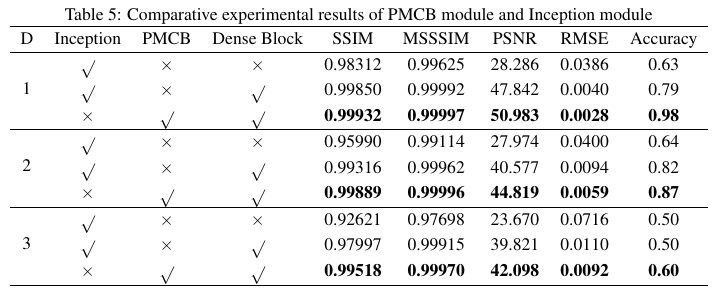
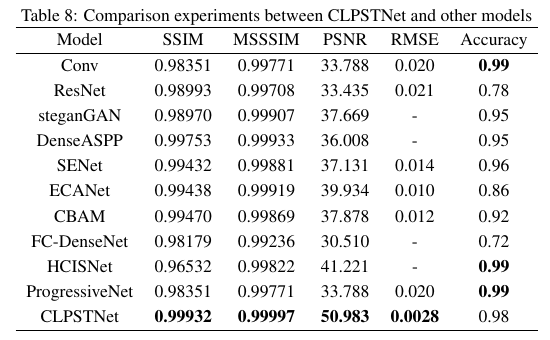
The experimental results show that the proposed CLPSTNet not only has high PSNR, SSIM metrics and decoding accuracy on three large public datasets, ALASKA2, VOC2012 and ImageNet, but also the steganographic images generated by CLPSTNet have low steganalysis scores.
Our experimental environment is as follows:
Please run the following command to install dependency packages:
pip install -r requirement.txt
The model is trained and evaluated on three public datasets:VOC2012;ImageNet;ALASKA2 Default dataset used in the code. The directory structure should be:
../VOC2012/
├── train/
├── val/
└── test/
CLPSTNet consists of three main components:
The core of CLPSTNet is the Progressive Multi-Scale Convolutional Block (PMCB), which is implemented in the clpstnet.py file.
The encoder network ( Encoder_Network in clpstnet.py ) is responsible for hiding secret information within the cover image. It uses a series of Progressive Multi-Scale Convolutional Blocks to gradually embed the secret data while maintaining the visual quality of the cover image.
The decoder network ( decode_Network in decoder.py ) extracts the hidden information from the stego image. It also uses a multi-scale architecture with various convolution branches to effectively recover the embedded secret data.
The critic network ( XuNet in critic.py ) is designed to distinguish between cover images and stego images. It serves as an adversary during training, pushing the encoder to generate more imperceptible stego images.
To train the CLPSTNet model, run the main.py script:
python main.py
The training process includes the following steps:
Data Loading : Images are loaded from the specified dataset.
Secret Generation : Random binary data is generated as secret information to be hidden(D).
Forward Pass : The cover image and secret data are passed through the encoder to generate a stego image, which is then passed through the decoder to recover the secret.
Loss Calculation : Multiple loss functions are calculated:
Optimization : The model parameters are updated using Adam optimizer.
To evaluate the trained model, use the val.py script:
python val.py
This script loads a trained model and evaluates it on the validation dataset, calculating:
For generating sample stego images from the trained model, use the sample.py script:
python sample.py
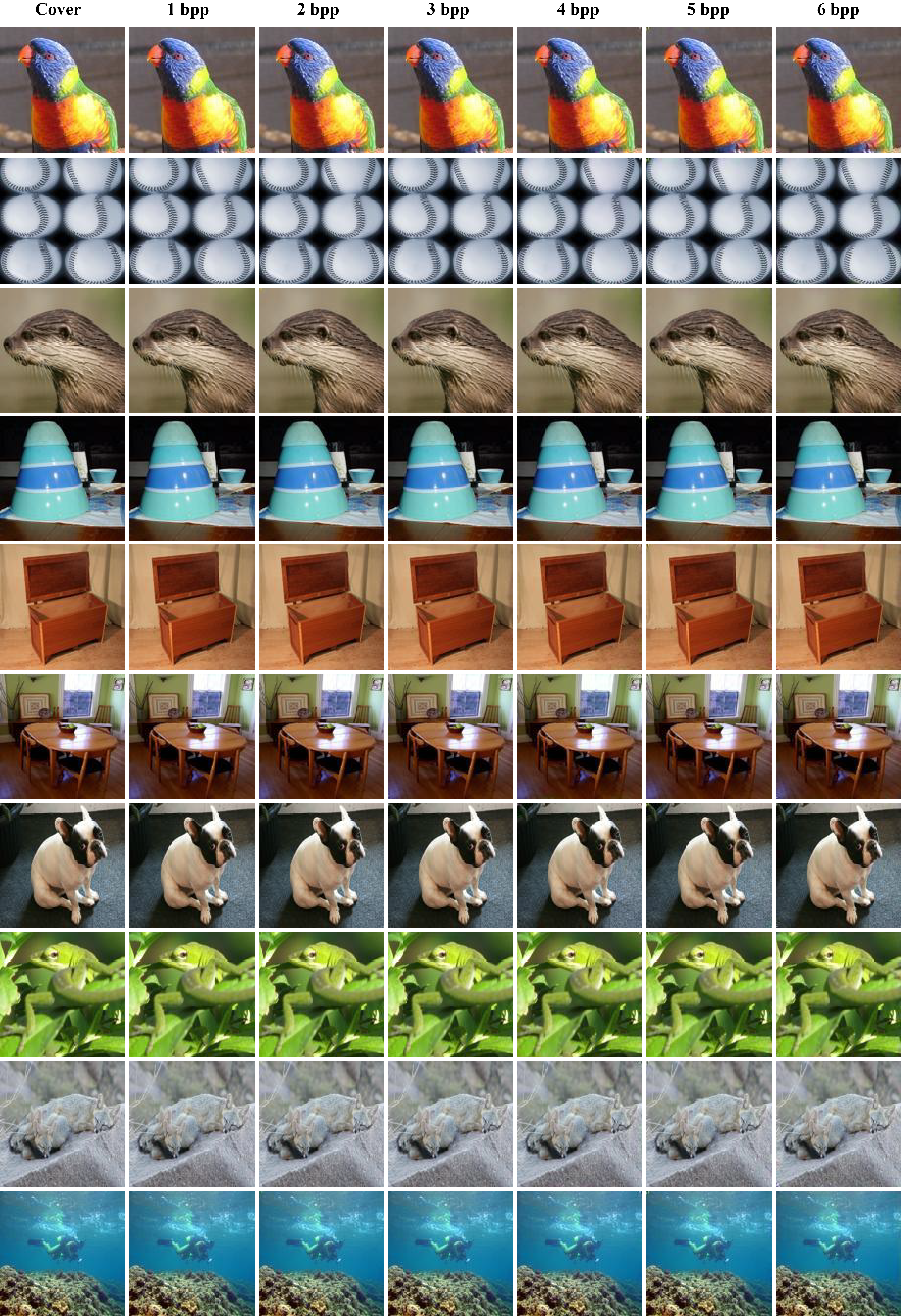
If you find our work useful in your research, please consider citing:
@article{liu2025clpstnet,
 title={CLPSTNet: A Progressive Multi-Scale Convolutional Steganography Model Integrating Curriculum Learning},
 author={Liu, Fengchun and Zhang, Tong and Zhang, Chunying},
 journal={arXiv preprint arXiv:2504.16364},
 year={2025}
}
If you encounter any issues while using this repository, please feel free to leave messages in issues or contact us at:
