
Skip to content
KitploitKITPLOIT
ToolsBlog
Log in
Submit
ToolsBlog
Submit

Hacking, PenTest, and Cybersecurity Tools for Your Security Arsenal!

Kitploit is a directory of hacking, cybersecurity, and pentesting tools. Discover the latest project updates to find vulnerabilities, analyze systems, automate testing, and strengthen your security.

··Feeds·Contact·Privacy·© 2026 Kitploit

Tool Directory

Categories

View all categories
Loading categories
CVE-2023-25292 — Reflected Cross Site Scripting (XSS) in Intermesh BV Group-Office version 6.6.145, allows attackers to gain escalated privileges and gain sensitive information via the GO_LANGUAGE cookie | Kitploit
Tools/GitHubGitHub/brainkok/cve-2023-25292
Vulnerability AnalysisWeb Application ExploitationInformation GatheringPenetration TestingLearning & Education
GitHubbrainkok/cve-2023-25292

CVE-2023-25292

Reflected Cross Site Scripting (XSS) in Intermesh BV Group-Office version 6.6.145, allows attackers to gain escalated privileges and gain sensitive information via the GO_LANGUAGE cookie

View Repository
22 years agoNot yet reviewed

Most Popular

View all →

Discover the most used tools by our community.

Explore all tools

Browse our collection of tools

View all tools →
Share

CVE-2023-25292

Reflected Cross Site Scripting (XSS) in Intermesh BV Group-Office version 6.6.145, allows attackers to gain escalated privileges and gain sensitive information via the GO_LANGUAGE cookie

Vulnerability Details

  • Product: Group Office Application
  • Version: 6.6.145
  • Vulnerability Type: Reflected XSS
  • Severity: Medium
  • CVSS v3.1 Score: 6.1 (AV:N/AC:L/PR:N/UI:R/S:C/C:L/I:L/A:N)

Vulnerability Description

The application is vulnerable to a reflected XSS attack via the “GO_LANGUAGE” cookie that injects malicious JavaScript into the application's response. The malicious script is executed in the context of the affected website, allowing an attacker to steal sensitive information such as session cookies, personal information, etc. The vulnerability exists in the cookie of the Group Office application. By sending a specially crafted cookie to the server, an attacker can inject malicious JavaScript code into the response, which is then executed in the context of the affected website. This can result in sensitive information being stolen from the user's browser, such as session cookies and personal information.

Impact

This vulnerability allows an attacker to steal sensitive information from the affected website and its users, such as session cookies, personal information, and more. An attacker can also use this vulnerability to inject further malicious code into the affected website, compromising its functionality and potentially exposing sensitive information.

Remediation for the vendor

  • Filter input data to prevent malicious payloads from being included in the response.
  • Use a Content Security Policy (CSP) to restrict the execution of untrusted JavaScript in the response.
  • Escape or encode all user input before including it in the response.

Remediation for the end user

  • Upgrade to version 6.6.147 of the Group Office application.

Steps to Reproduce

  1. Go to the vulnerable instance of group-office.
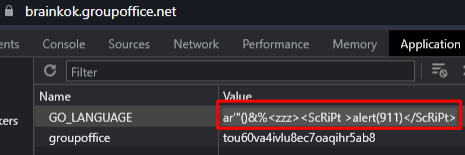
  2. Change the “GO_LANGUAGE” cookie with F12, to the following payload:
ar'"()&%<zzz><ScRiPt>alert(911)</ScRiPt>
image

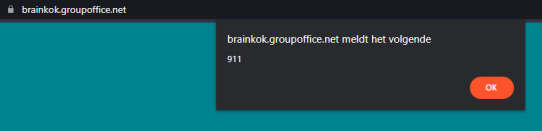
  1. Reload the page and then you will see that the payload is executed. image

References

  • https://github.com/Intermesh/groupoffice/blob/master/CHANGELOG.md
  • https://cve.mitre.org/cgi-bin/cvename.cgi?name=CVE-2023-25292
Download Tool