 blue-yonder/tsfresh
Automatic extraction of relevant features from time series:






This repository contains the TSFRESH python package. The abbreviation stands for
"Time Series Feature extraction based on scalable hypothesis tests".
The package provides systematic time-series feature extraction by combining established algorithms from statistics, time-series analysis, signal processing, and nonlinear dynamics with a robust feature selection algorithm. In this context, the term time-series is interpreted in the broadest possible sense, such that any types of sampled data or even event sequences can be characterised.
Data Scientists often spend most of their time either cleaning data or building features. While we cannot change the first thing, the second can be automated. TSFRESH frees your time spent on building features by extracting them automatically. Hence, you have more time to study the newest deep learning paper, read hacker news or build better models.
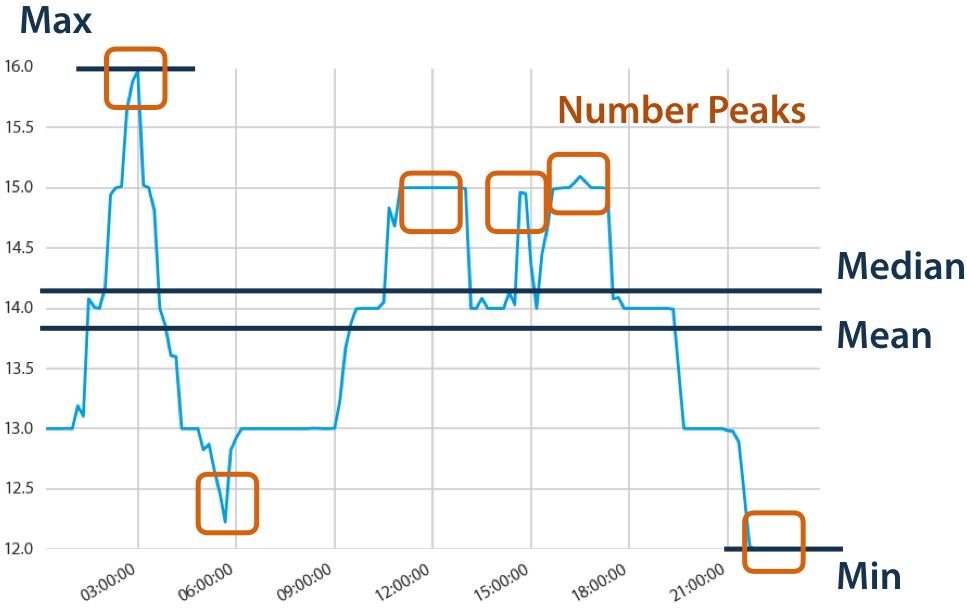
TSFRESH automatically extracts 100s of features from time series. Those features describe basic characteristics of the time series such as the number of peaks, the average or maximal value or more complex features such as the time reversal symmetry statistic.
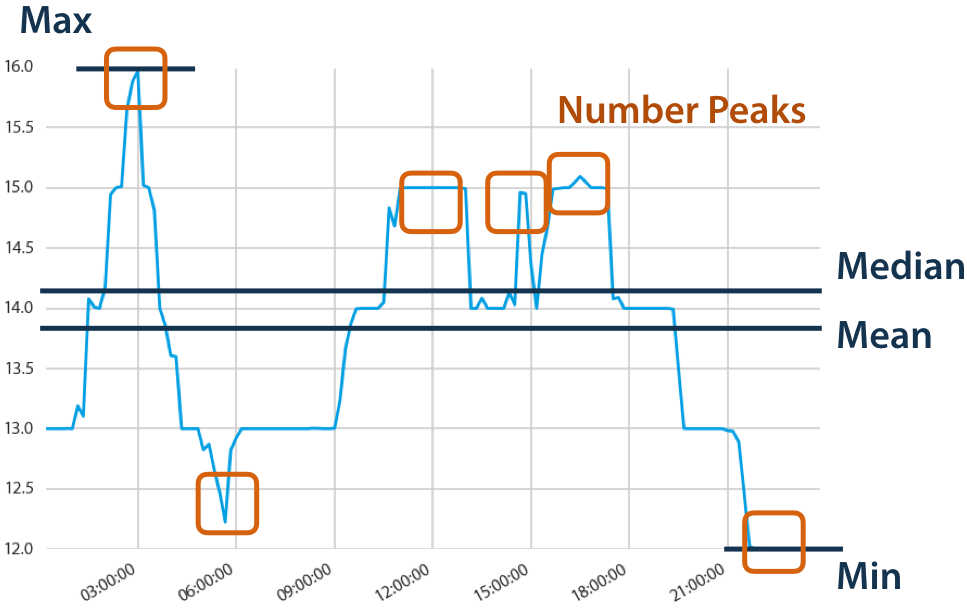
The set of features can then be used to construct statistical or machine learning models on the time series to be used for example in regression or classification tasks.
Time series often contain noise, redundancies or irrelevant information. As a result most of the extracted features will not be useful for the machine learning task at hand.
To avoid extracting irrelevant features, the TSFRESH package has a built-in filtering procedure. This filtering procedure evaluates the explaining power and importance of each characteristic for the regression or classification tasks at hand.
It is based on the well developed theory of hypothesis testing and uses a multiple test procedure. As a result the filtering process mathematically controls the percentage of irrelevant extracted features.
The TSFRESH package is described in the following open access paper:
The FRESH algorithm is described in the following whitepaper:
Normality models simulate how humans detect time-series anomalies:
Teh, H.Y., Wang, K.I-K., Kempa-Liehr, A.W. (2021). Expect the Unexpected: Unsupervised feature selection for automated sensor anomaly detection. IEEE Sensors Journal 15.16, p. 18033-18046, doi: 10.1109/JSEN.2021.3084970.
Teh, H.Y., Wang, K.I-K., Kempa-Liehr, A.W. (2025). Feature-based normality models for anomaly detection. Sensors 25.4757, p. 1-25, doi: 10.3390/s25154757.
Systematic time-series feature extraction even works for unsupervised problems:
Due to the fact that tsfresh basically provides time-series feature extraction for free, you can now concentrate on engineering new time-series, like e.g. differences of signals from synchronous measurements, which provide even better time-series features:
Kempa-Liehr, A.W., Oram, J., Wong, A., Finch, M., Besier, T. (2020). Feature engineering workflow for activity recognition from synchronized inertial measurement units. In: Pattern Recognition. ACPR 2019. Ed. by M. Cree et al. Vol. 1180. Communications in Computer and Information Science (CCIS). Singapore: Springer, p. 223–231. doi: 10.1007/978-981-15-3651-9_20.
Simmons, S., Jarvis, L., Dempsey, D., Kempa-Liehr, A.W. (2021). Data Mining on Extremely Long Time-Series. In: 2021 International Conference on Data Mining Workshops (ICDMW). Ed. by B. Xue et al. Los Alamitos: IEEE, p. 1057-1066. doi: 10.1109/ICDMW53433.2021.00137.
Systematic time-series features engineering allows to work with time-series samples of different lengths, because every time-series is projected into a well-defined feature space. This approach allows the design of robust machine learning algorithms in applications with missing data.
Is your time-series classification problem imbalanced? There is a good chance that undersampling of time-series feature matrices might solve your problem:
You are not working with time-series, but with 2D and 3D images? Spatial variation sequences (SVS) are an excellent application for tsfresh:
Jeune, H., Pechan, N., Reitsma, S., Kempa-Liehr, A.W. (2021). Spatial Variation Sequences for Remote Sensing Applications with Small Sample Sizes. In: 2024 Image and Video Technology. 11th Pacific-Rim Symposium, Ed. by W.Q. Yan et al., Lecture Notes in Computer Science (14403). Springer Nature: Singapore, p. 153-166. doi: {10.1007/978-981-97-0376-0_12.
Koptev, I., Tian, J., Peel, E., Parker, R., Walker, C., Kempa-Liehr, A.W. (2025). Interpretable Dimensionality Reduction in 3D Image Recognition with Small Sample Sizes. Journal of Nondestructive Evaluation 44.44, p. 1-12, doi: 10.1007/s10921-025-01183-z.
