 benny-e/guardd
ML-Based behavioral endpoint detection system for Linux machines

Machine learning driven behavioral anomaly detection for Linux using eBPF + Isolation Forest






Guardd collects low-level system events (process execution, network activity), aggregates them into time-windowed feature vectors, and detects anomalous behavior using a machine learning model.
Guardd is focused on detecting unknown threats
[!WARNING] This project is still in development
Features and detection accuracy are actively being improved
Feedback, suggestions, and contributions are welcome
guardd runs as a single systemd service that manages the full lifecycle of data collection, training, and detection.
On startup:
If no model exists, guardd begins collecting baseline behavioral data
It collects 1 day (default) of data to initially train on
Once training succeeds, it switches automatically into detection mode
During operation:
System activity is continuously aggregated into time windows and converted into feature vectors
Each window is scored by the trained Isolation Forest model
Anomalies are emitted as NDJSON
Ongoing:
The model is retrained automatically once per week
Detection resumes immediately after retraining with the updated model
git clone https://github.com/benny-e/guardd.git
cd guardd
sudo bash install.sh
This will:
Install system dependencies
Copy the project to /opt/guardd
Create a Python virtual environment
Install the package
Build eBPF components
Install the systemd service
sudo systemctl start guardd.service
systemctl status guardd.service
journalctl -u guardd.service -f
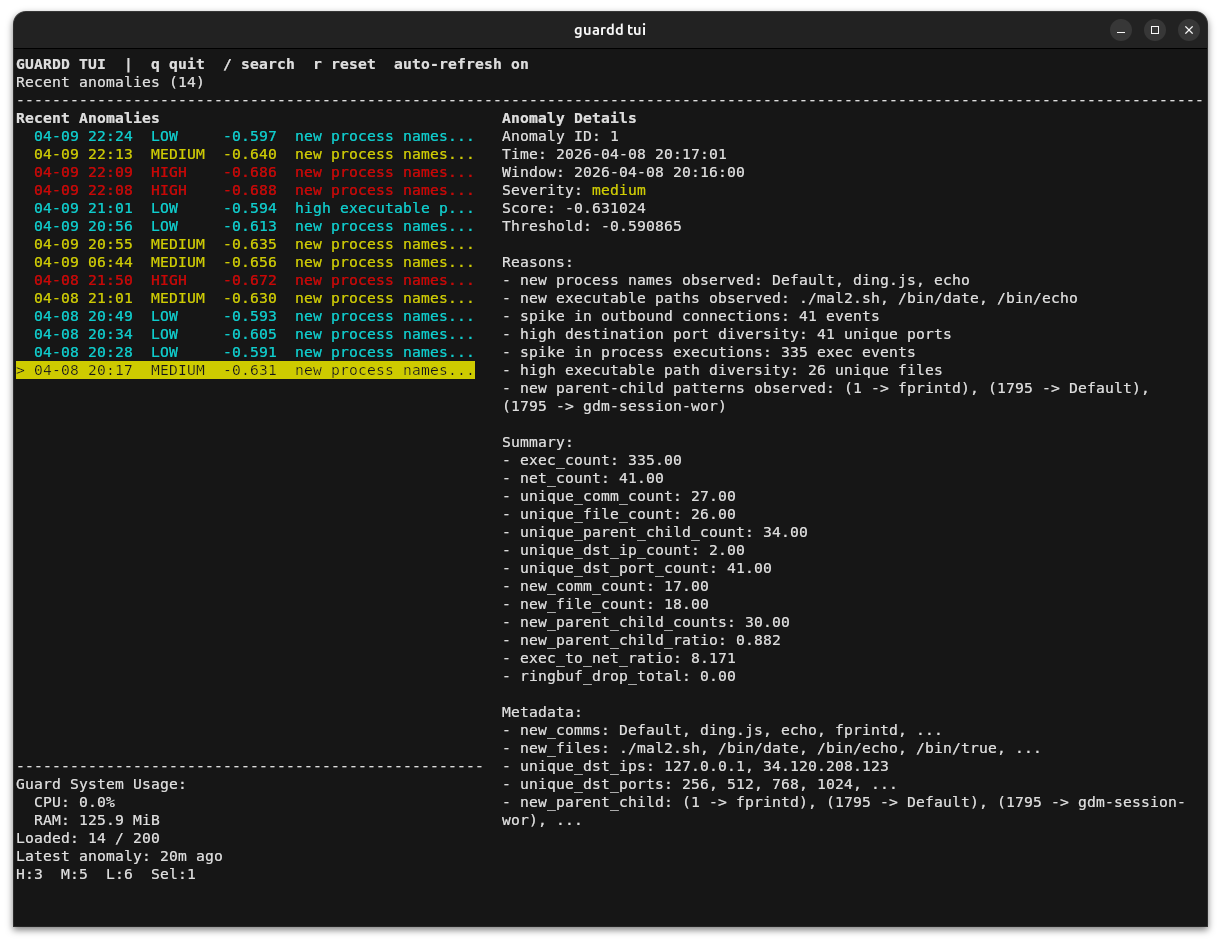
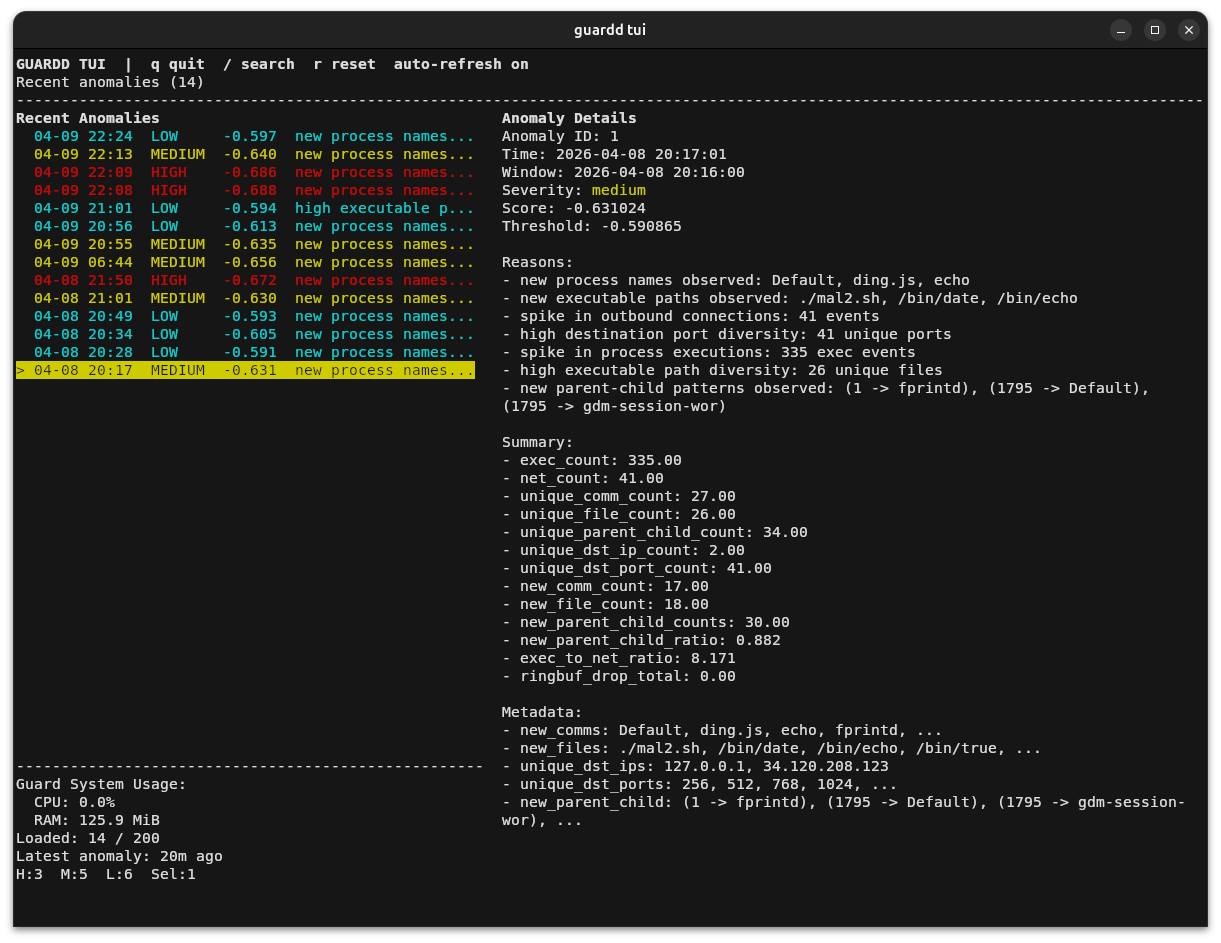
guardd includes a terminal UI for browsing recent alerts and searching anomalies
To launch: (after starting guardd.service)
guardd tui
You can run guardd directly from the command line without installing the systemd service. This can be configured to run with other init systems
sudo guardd daemon
Collect data:
sudo guardd collect
Train model:
sudo guardd train
Run Detection:
sudo guardd detect
guardd supports configuration via a config.toml file.
By default, the daemon looks for:
/opt/guardd/config.toml
[daemon]
mode = "auto"
bootstrap_retry_seconds = 60
retrain_interval_seconds = 604800

[training]
min_training_rows = 1
contamination = 0.01
n_estimators = 200
threshold_percentile = 10.0

[paths]
db_path = "/opt/guardd/data/features.db"
model_path = "/opt/guardd/data/model.bundle"
guardd_path = "/opt/guardd/ebpf/guardd"
Controls the lifecycle of guardd.
mode
-- "auto" → full pipeline (collect → train → detect)
-- "collect" → only collect data
-- "detect" → only run detection (requires model)
bootstrap_retry_seconds
-- How often guardd attempts initial training when no model exists
-- During this phase, guardd collects data and periodically pauses to try training
retrain_interval_seconds
-- How often the model is retrained after initial bootstrap
-- Default: 7 days (default)
Controls model behavior and requirements.
min_training_rows
-- Minimum number of feature windows required to train
-- If not met, training fails and will retry later
contamination
-- Expected proportion of anomalies in the data
-- Passed directly to Isolation Forest
-- Typical values: 0.01–0.05
n_estimators
-- Number of trees in the Isolation Forest
-- Higher = more accurate, slower training
threshold_percentile
-- Determines anomaly cutoff score
-- Lower = more aggressive detection
Controls where guardd reads/writes data.
db_path
-- SQLite database storing feature vectors and anomalies
model_path
-- Serialized model bundle used for detection
guardd_path
-- Path to the eBPF collector binary
Config values override CLI defaults
CLI arguments can still override config if explicitly provided
Model accuracy relies heavily on good training data. Longer training times will result in a more accurate detector
python3
python3-venv
python3-pip
clang
llvm
libbpf-dev
libelf-dev
bpftool
build-essential
pkg-config
sqlite3
