 avalz/waf-a-mole
A guided mutation-based fuzzer for ML-based Web Application Firewalls

A guided mutation-based fuzzer for ML-based Web Application Firewalls, inspired by AFL and based on the FuzzingBook by Andreas Zeller et al.
Given an input SQL injection query, it tries to produce a semantic invariant query that is able to bypass the target WAF. You can use this tool for assessing the robustness of your product by letting WAF-A-MoLE explore the solution space to find dangerous "blind spots" left uncovered by the target classifier.


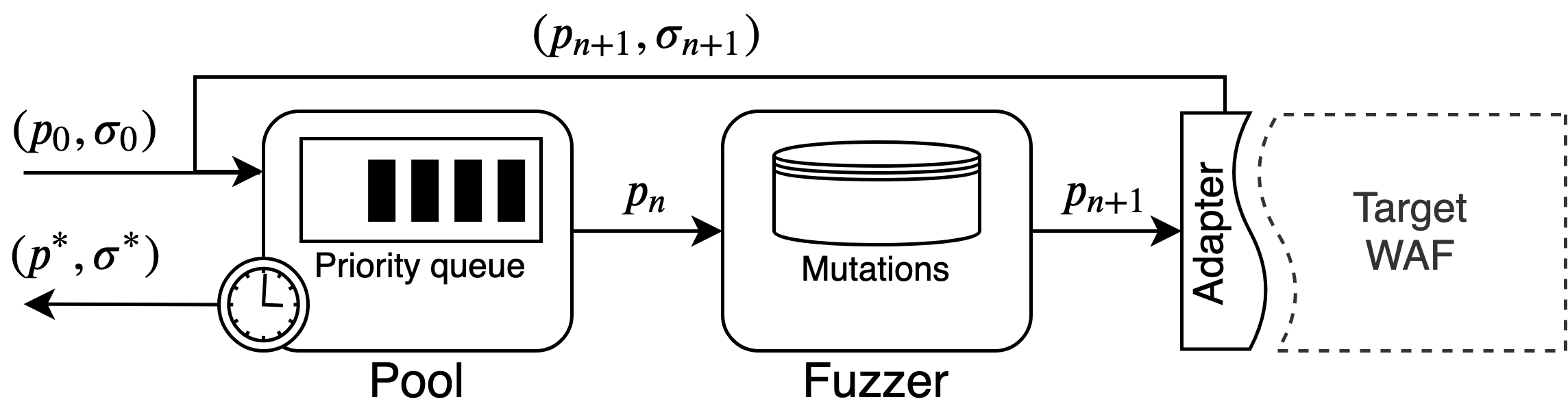
WAF-A-MoLE takes an initial payload and inserts it in the payload Pool, which manages a priority queue ordered by the WAF confidence score over each payload.
During each iteration, the head of the payload Pool is passed to the Fuzzer, where it gets randomly mutated, by applying one of the available mutation operators.
Mutations operators are all semantics-preserving and they leverage the high expressive power of the SQL language (in this version, MySQL).
Below are the mutation operators available in the current version of WAF-A-MoLE.
| Mutation | Example |
|---|---|
| Case Swapping | admin' OR 1=1# ⇒ admin' oR 1=1# |
| Whitespace Substitution | admin' OR 1=1# ⇒ admin'\t\rOR\n1=1# |
| Comment Injection | admin' OR 1=1# ⇒ admin'/**/OR 1=1# |
| Comment Rewriting | admin'/**/OR 1=1# ⇒ admin'/*xyz*/OR 1=1#abc |
| Integer Encoding | admin' OR 1=1# ⇒ admin' OR 0x1=(SELECT 1)# |
| Operator Swapping | admin' OR 1=1# ⇒ admin' OR 1 LIKE 1# |
| Logical Invariant | admin' OR 1=1# ⇒ admin' OR 1=1 AND 0<1# |
| Number Shuffling | admin' OR 1=1# ⇒ admin' OR 2=2# |
WAF-A-MoLE implements the methodology presented in "WAF-A-MoLE: Evading Web Application Firewalls through Adversarial Machine Learning". A pre-print of our article can also be found on arXiv.
If you want to cite us, please use the following (BibTeX) reference:
@inproceedings{demetrio20wafamole,
  title={WAF-A-MoLE: evading web application firewalls through adversarial machine learning},
  author={Demetrio, Luca and Valenza, Andrea and Costa, Gabriele and Lagorio, Giovanni},
  booktitle={Proceedings of the 35th Annual ACM Symposium on Applied Computing},
  pages={1745--1752},
  year={2020}
}
pip install -r requirements.txt
You can evaluate the robustness of your own WAF, or try WAF-A-MoLE against some example classifiers. In the first case, have a look at the Model class. Your custom model needs to implement this class in order to be evaluated by WAF-A-MoLE. We already provide wrappers for sci-kit learn and keras classifiers that can be extend to fit your feature extraction phase (if any).
wafamole --help
Usage: wafamole [OPTIONS] COMMAND [ARGS]...

Options:
  --help  Show this message and exit.

Commands:
  evade  Launch WAF-A-MoLE against a target classifier.
wafamole evade --help
Usage: wafamole evade [OPTIONS] MODEL_PATH PAYLOAD

  Launch WAF-A-MoLE against a target classifier.

Options:
  -T, --model-type TEXT     Type of classifier to load
  -t, --timeout INTEGER     Timeout when evading the model
  -r, --max-rounds INTEGER  Maximum number of fuzzing rounds
  -s, --round-size INTEGER  Fuzzing step size for each round (parallel fuzzing
                            steps)
  --threshold FLOAT         Classification threshold of the target WAF [0.5]
  --random-engine TEXT      Use random transformations instead of evolution
                            engine. Set the number of trials
  --output-path TEXT        Location were to save the results of the random
                            engine. NOT USED WITH REGULAR EVOLUTION ENGINE
  --help                    Show this message and exit.
We provide some pre-trained models you can have fun with, located in wafamole/models/custom/example_models. The classifiers we used are listed in the table below.
| Classifier name | Algorithm |
|---|---|
| WafBrain | Recurrent Neural Network |
| ML-Based-WAF | Non-Linear SVM |
| ML-Based-WAF | Stochastic Gradient Descent |
| ML-Based-WAF | AdaBoost |
| Token-based | Naive Bayes |
| Token-based | Random Forest |
| Token-based | Linear SVM |
| Token-based | Gaussian SVM |
| SQLiGoT - Directed Proportional | Gaussian SVM |
| SQLiGoT - Directed Unproportional | Gaussian SVM |
| SQLiGoT - Undirected Proportional | Gaussian SVM |
| SQLiGoT - Undirected Unproportional | Gaussian SVM |
In addition to ML-based WAF, WAF-a-MoLE supports also rule-based WAFs. Specifically, it provides a wrapper for the ModSecurity WAF equipped with the OWASP Core Rule Set (CRS), based on the pymodsecurity project.
Bypass the pre-trained WAF-Brain classifier using a admin' OR 1=1# equivalent.
wafamole evade --model-type waf-brain wafamole/models/custom/example_models/waf-brain.h5 "admin' OR 1=1#"
Bypass the pre-trained ML-Based-WAF SVM classifier using a admin' OR 1=1# equivalent.
wafamole evade --model-type mlbasedwaf wafamole/models/custom/example_models/mlbasedwaf_svc.dump "admin' OR 1=1#"
Bypass the pre-trained ML-Based-WAF SVM classifier using a admin' OR 1=1# equivalent. Note that SQLiV5 is a dataset sourced from Kaggle expanded with a series of queries generated by WAF-A-MoLE itself, as a proof of concept that WAF-A-MoLE queries can enhance the robustness of a WAF with retraining. Use mlbasedwaf_svc_sqliv3.dump to bypass the WAF trained with the original Kaggle dataset (SQLiV3).
wafamole evade --model-type mlbasedwaf wafamole/models/custom/example_models/mlbasedwaf_svc_sqliv5.dump "admin' OR 1=1#"
Bypass the pre-trained ML-Based-WAF SGD classifier using a admin' OR 1=1# equivalent.
wafamole evade --model-type mlbasedwaf wafamole/models/custom/example_models/mlbasedwaf_sgd.dump "admin' OR 1=1#"
