
 ambitsecurity/jshound
Find every API request a web app makes, from the JavaScript it ships: method, URL, body, headers and GraphQL operations. One command.

Recover every request a web app is built to make from the JavaScript it ships: method, URL, body, content type and headers.
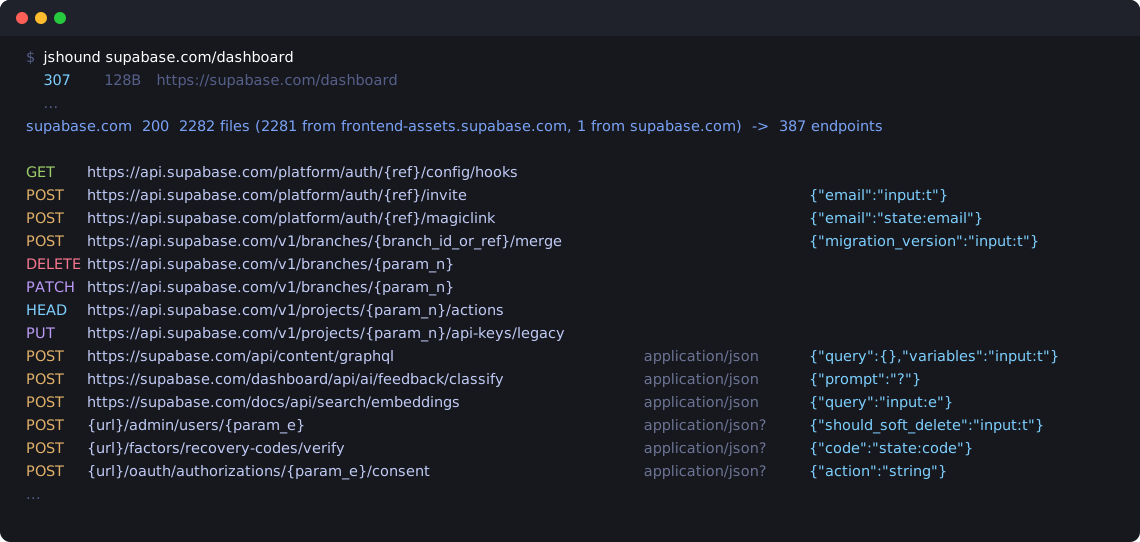
A single page app's JavaScript bundle contains every API request the app can make. Given a URL, jshound finds the app's bundle, crawls all of it, lazily loaded chunks included, and extracts those requests.
It is passive. The only requests it makes are unauthenticated GETs for public static files, the page and its JavaScript. The analysis runs locally, and nothing is sent to the app's API.
git clone https://github.com/AmbitSecurity/jshound && cd jshound
python3 -m venv .venv && source .venv/bin/activate
pip install -e .
Needs Python 3.10 or newer and Node 18 or newer.
jshound supabase.com/dashboard
$ jshound supabase.com/dashboard
  307    128B  https://supabase.com/dashboard
  200     19K  https://supabase.com/dashboard/org
  200     28K  https://frontend-assets.supabase.com/studio/8617532ae1a4/_next/static/chunks/1p849pzlxcp4n.js?dpl=dpl_ESaSquAbnWrJqbvvyRh7F1qj5wWH
  ...
supabase.com  200  2282 files (2281 from frontend-assets.supabase.com, 1 from supabase.com)  ->  387 endpoints
              1 declared chunk(s) could not be fetched
              -> .jshound/supabase.com/endpoints.txt  (also requests.jsonl, urls.txt, openapi.json)
frontend-assets.supabase.com, where supabase's build lives.POST https://api.supabase.com/platform/auth/{ref}/otp {"phone":"state:phone"}
DELETE https://api.supabase.com/v1/projects/{param_n}/functions/{param_e}
DELETE https://supabase.com/dashboard/api/integrations/stripe-sync application/json {"projectRef":"input:e","startTime":"input:t"}
POST https://supabase.com/docs/api/search/fts application/json {"query":"computed:trim"}
Several targets at once, or a list on stdin:
jshound app.example.com api.example.com
cat scope.txt | jshound
Files already on disk, such as a previous run's js/ folder, are read without touching the network:
$ jshound examples/demo-app
GET    https://demo-app.test/api/feature-flags
POST   https://demo-app.test/t/events                                  {"sid":"?","evt":"?"}
DELETE https://demo-app.test/v1/sessions/current
POST   {baseUrl}/v1/media                         multipart/form-data  {"file":"file-upload"}
POST   {baseUrl}/v1/subscribe                     application/json     {"email":"computed:trim","pageUri":"state:href"}
GET    {baseUrl}/v1/users/{param_o}/profile
Everything goes to .jshound/<host>/, or to -o DIR:
endpoints.txt | the table above, one request per line |
requests.jsonl | one JSON object per request: method, url, body, content_type, headers, graphql or rpc, and the page and file it came from |
urls.txt | METHOD URL for the requests whose host is known, for tools that take a list |
openapi.json | an OpenAPI 3 document, to import into Burp, Caido or Postman |
js/ | every file that was fetched |
{...} is a value jshound could not resolve, written as the code writes it: {baseUrl},
{window.__CONFIG__.apiBaseUrl}. In a path, {ref} is a parameter, and {param_o} is the
function parameter o./api/surveys/, goes through code jshound does not follow to its
base yet. requests.jsonl names the file it came from.input: an argument, state: a property
of an object, computed: the result of a call, ? unknown.application/json? is a content type inferred from the file's other requests rather than read
at the call site. ~{...} is a body that has more fields than the ones listed.{graphql} is a GraphQL operation, with its name, type and variables as the body.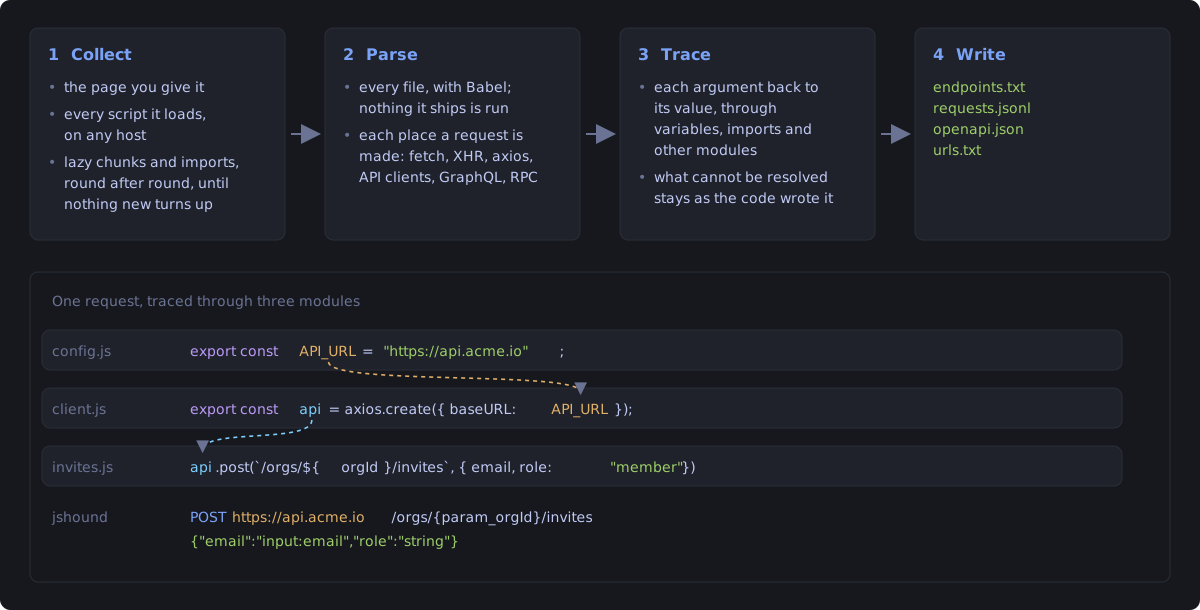
| bundler | lazy chunk URLs | module tree | how |
|---|---|---|---|
| webpack 5 | yes | yes | reads __webpack_require__.u out of the syntax tree |
| webpack 4 | yes | yes | has no .u, so the named URL builder is matched by shape rather than by name |
| Rspack | yes | yes | webpack-compatible, usually emitting ESM |
| Turbopack | yes | n/a | no builder at all; the chunk list is a literal array |
| Vite / Rollup | yes | n/a | paths are written down (__vite__mapDeps); flat ESM has no registry to walk |
| esbuild | yes | n/a | same |
| Parcel | yes | n/a | the runtime global is suffixed per build (parcelRequire5707) and the chunk table is an object, not an array |
| Metro (React Native) | n/a | n/a | ships one bundle, no chunks; detected by __METRO_GLOBAL_PREFIX__ |
| webpack Module Federation | yes | yes | the builder carries no id map, so ids are taken from the __webpack_require__.e(480) call sites |
jshound requests the target you give it, and the JavaScript files that target's pages load, wherever
they are hosted. For supabase that is mostly frontend-assets.supabase.com. These are public static
files that any visitor's browser downloads. Those other hosts get nothing but those GETs.
It refuses any URL a target names in private address space (loopback, RFC1918, link local), unless
the target you gave it is itself private or you pass --allow-private.
-o DIR | where results go (default .jshound/<host>) |
-q | do not print each request as it is made |
-v | also print the analysis log |
--max-chunks N | stop after this many lazy chunks and imports (default 50000) |
--no-chunks | do not follow lazy chunks |
--proxy URL | send every request through a proxy (or set JSHOUND_PROXY) |
--proxy-ca FILE | the CA certificate of a proxy that intercepts TLS |
--client PROFILE | pin one browser TLS profile instead of rotating when blocked |
--allow-private | allow URLs in private address space (see Scope) |
blocked by Cloudflare and reads nothing. jshound imitates the newest Chrome, Firefox
and Safari that curl_cffi knows, so keep curl_cffi up to date. --proxy helps with rate limits and
IP bans, not with challenges.document.createElement("script"), using a URL it gets from an API call, is not in anything
jshound downloads.See CONTRIBUTING.md.
MIT.
