 aetherai3/aether-protocol-p
Working implementation: cryptographically verified short-lived identities for AI decision authentication — CVE-2025-59536 (Patent Pending US 64/006,746)

Cryptographically Verified Short-Lived Identity Infrastructure for Autonomous AI Systems
Patent Pending — US Application 64/006,746 — Filed March 16, 2026
"Every AI system in the world can be compromised by injecting false instructions into its pipeline. Aether Protocol makes that physically impossible."
On February 25, 2026, Check Point Research disclosed CVE-2025-59536 — a critical vulnerability (CVSS 8.7) in Claude Code that allowed attackers to inject malicious instructions into .claude/settings.json configuration files that executed immediately upon a developer opening a project folder.
The root cause was not a bug in Claude's reasoning. It was the absence of a cryptographic authentication layer between AI instruction and execution.
This gap — between what an AI decides and what gets executed — exists in every autonomous AI system deployed today. APIs, state stores, configuration files, message queues, shared memory — all of them carry AI instructions to execution layers with no authentication in between.
Anthropic's Frontier Safety Roadmap (February 2026) explicitly identifies "cryptographically verified short-lived identities" as a priority goal for April 2026.
The Aether Protocol is a working implementation of that goal.
Classical and post-quantum cryptography both rest on mathematical hardness — problems that are computationally difficult to solve. The security guarantee degrades as computing power scales.
The Aether Protocol rests on a different foundation entirely: physical non-determinism.
Each session, a quantum circuit executes on IBM Quantum hardware. The measurement outcomes arise from quantum vacuum fluctuations in superconducting qubits cooled to 15 millikelvin. These outcomes cannot be predicted before they occur — not by any algorithm, classical or quantum. This is not a computational limitation. It is a consequence of quantum mechanical non-determinism, confirmed by the violation of Bell inequalities.
A signing key derived from this outcome inherits the same property: it could not have been predicted before the measurement, and it did not exist before this session.
Destroyed at session end — hours after creation — the key cannot be retroactively attacked. Shor's algorithm on the signing curve requires days of quantum computation. The key is gone before any attack could complete.
This is the Ontological Root of Trust: security grounded in physics, not mathematics.
 The Protocol operates on a three-phase session model: initialization, operation, and destruction.
Full architecture is documented in the white paper: docs/AETHER_PROTOCOL_WHITEPAPER.md
The white paper applies black box disclosure — architecture and results are shared openly. Implementation details are available under a Mutual Non-Disclosure Agreement.
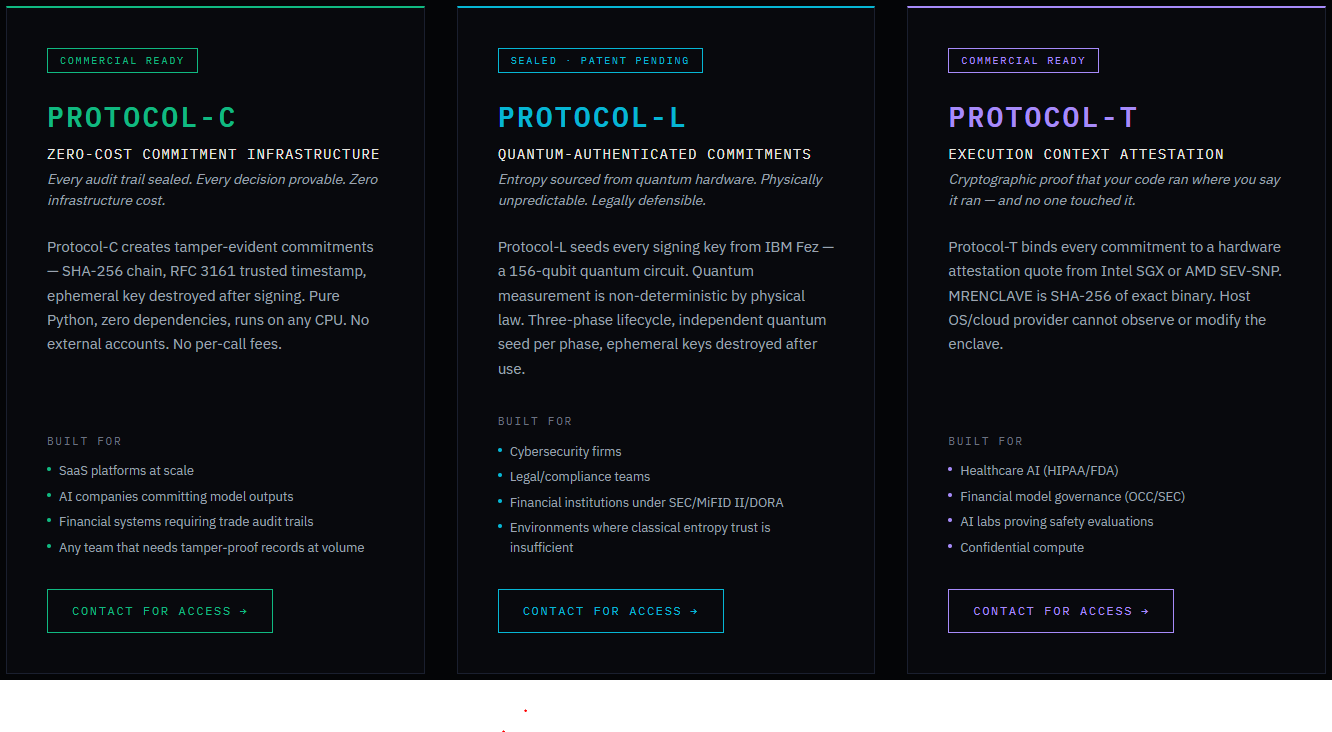
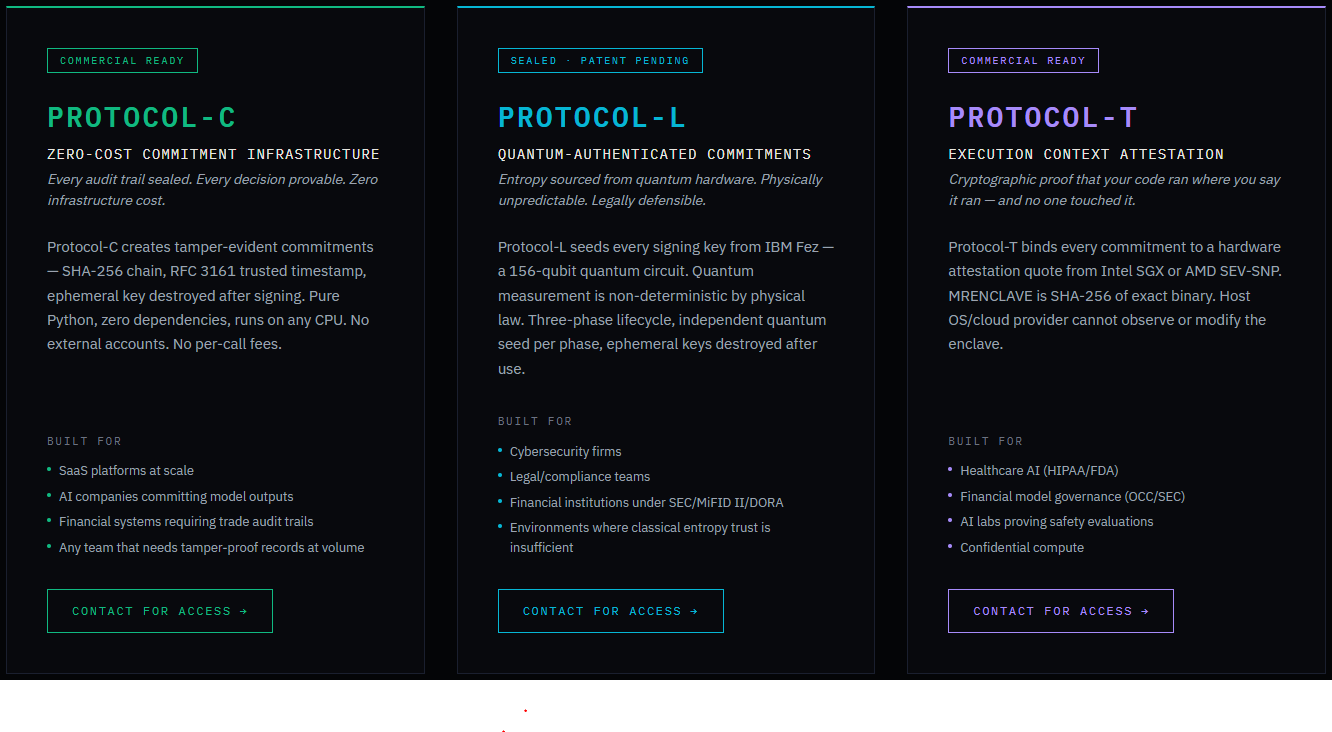
01 — The Economics: Why $0 Matters at Scale IBM QPU time costs roughly $100/min. At 10,000 users generating commitments, that translates to ~$3,300/month for operations that don't need quantum entropy. Protocol-C eliminates that cost entirely by sourcing entropy from the OS kernel — same chain architecture, zero QPU overhead.
02 — What It Guarantees: Same Chain, Different Source SHA-256 commitment chain. RFC 3161 trusted timestamps. Ephemeral key destruction after every signing operation. The output is computationally indistinguishable from quantum-seeded commitments — identical chain format, identical verification path.
03 — Who Uses It SaaS platforms, AI companies committing model outputs, financial institutions operating at scale. One environment variable switches any Protocol-C deployment to Protocol-L when quantum assurance becomes necessary.
Protocol-C is open source — available now. It is the free, classical (CSPRNG) implementation of the authentication layer whose absence made CVE-2025-59536 possible: sign each AI decision with a one-shot key, verify before execution, keep a record nobody can forge.
pip install git+https://github.com/AetherAI3/PROTOCOL-C.git(not yet on PyPI) · Repository: github.com/AetherAI3/PROTOCOL-C · White paper: Protocol-C: A Free, Auditable Authentication Layer for AI DecisionsHonest scope: Protocol-C is classical cryptography with a temporal safety margin — not post-quantum and not quantum-sourced. The quantum-entropy variant is Protocol-L.
01 — The Lifecycle: Commit → Execute → Settle Three independently signed phases. Each phase receives its own ephemeral secp256k1 key, seeded from a unique quantum measurement. SHA-256 binding chains the phases together — tampering with any phase invalidates the entire commitment.
02 — Quantum Entropy Foundation 156-qubit IBM circuit (Fez). Quantum measurement is non-deterministic by physical law — no seed, no state, no replay. Ephemeral keys live approximately one hour. 168× safety margin against Shor's algorithm at current qubit counts.
03 — Dispute Resolution: Evidence, Not Logs Exportable proof packages for regulators and counterparties. Structured for DORA, SEC, MiFID II, and FCA compliance frameworks. Every commitment is independently verifiable — no trust in the issuing party required.
COMMIT → EXECUTE → SETTLE · secp256k1 + RFC 6979 · RFC 3161 / DigiCert · PATENT FILED
01 — The Problem There is a gap in every AI audit trail. Logs are circumstantial — they cannot prove which model version ran, whether the pipeline was intact, or if intermediate data was modified. Signatures prove intent, not execution context.
02 — How Attestation Works MRENCLAVE — the SHA-256 measurement of the exact binary loaded into the enclave. The enclave cannot be observed or modified by the host OS, hypervisor, or cloud provider. Attestation quotes are verifiable via Intel or AMD root certificates.
03 — Who Needs It Healthcare AI under HIPAA/FDA. Financial institutions governed by OCC/SEC. AI labs required to prove safety evaluations ran unmodified. Any confidential compute environment where execution integrity is non-negotiable.
Intel SGX / AMD SEV-SNP · MRENCLAVE Binding · Remote Attestation · 76 Tests
This is not theoretical. Two production systems are running the Protocol today.
AetherSecurity — Autonomous penetration testing platform integrating live IBM Quantum hardware for defense entropy, quantum-guided exploit search, and cryptographically signed agent decisions.
Aether Terminal (in development) — Trading platform with quantum middleware verifying every AI-generated trade decision before execution.
