 adscanpro/cve-2026-41089-longlogon
CVE-2026-41089 checker: unauthenticated, non-destructive detection for the Netlogon CLDAP stack buffer overflow (CVSS 9.8). Reports whether a domain controller's domain is long enough to crash, without sending the overflow. The binary-verified analysis the public PoCs got wrong.








LongLogon is an unauthenticated, non-destructive precondition checker for CVE-2026-41089, a pre-auth stack buffer overflow in the Windows Netlogon service. With no credentials, and without sending the overflow, it reports whether a domain controller's DNS domain name is long enough for the bug to crash it.
On a normally-named domain controller, no. The public exploit PoCs for this CVE
(the most-starred one, and the copies that followed it) claim to crash a domain
controller by sending a long username. They do not crash an unpatched DC on an
ordinary domain, for two reasons confirmed by diffing the pre- and post-patch
netlogon.dll and reproducing the crash in a lab:
0x16), which routes to the
bounds-safe BuildSamLogonResponseEx. The vulnerable legacy BuildSamLogonResponse
is only reached with that bit clear. LongLogon uses 0x02.User field
is capped at 130 wide chars by the binary, far short of the 528-byte buffer. The
bytes that carry the write onto the stack cookie are the server's own long DNS names,
which no payload length changes.So the popular exploit fails on an ordinary domain, and a recv timeout (which a single
dropped UDP packet causes on a healthy DC) gets misread as a crash. LongLogon is not
one of those exploits: it is the corrected, binary-verified analysis, shipped as a
non-destructive checker that never sends the overflow. The lab-confirmed crash
threshold and full mechanism are below.
A stack-based buffer overflow (CWE-121, CVSS 9.8) in the Netlogon DC-locator path
NlGetLocalPingResponse → BuildSamLogonResponse → NetpLogonPutUnicodeString.
Answering a CLDAP or MAILSLOT ping, the DC serializes its own forest, domain, and
host names plus a small attacker-controlled string into a fixed 528-byte stack
buffer (ushort local_258[264]), with the stack cookie immediately after it. When
the server's own DNS names are long enough, the cumulative write reaches the
buffer end, the trailing L'\0' terminator overruns the cookie, __report_gsfailure
fires, and lsass.exe dies with STATUS_STACK_BUFFER_OVERRUN (0xc0000409). The
domain controller reboots. Unauthenticated, one UDP packet.
Where Zerologon (CVE-2020-1472) abused an all-zero challenge, LongLogon abuses a pathologically long domain name.
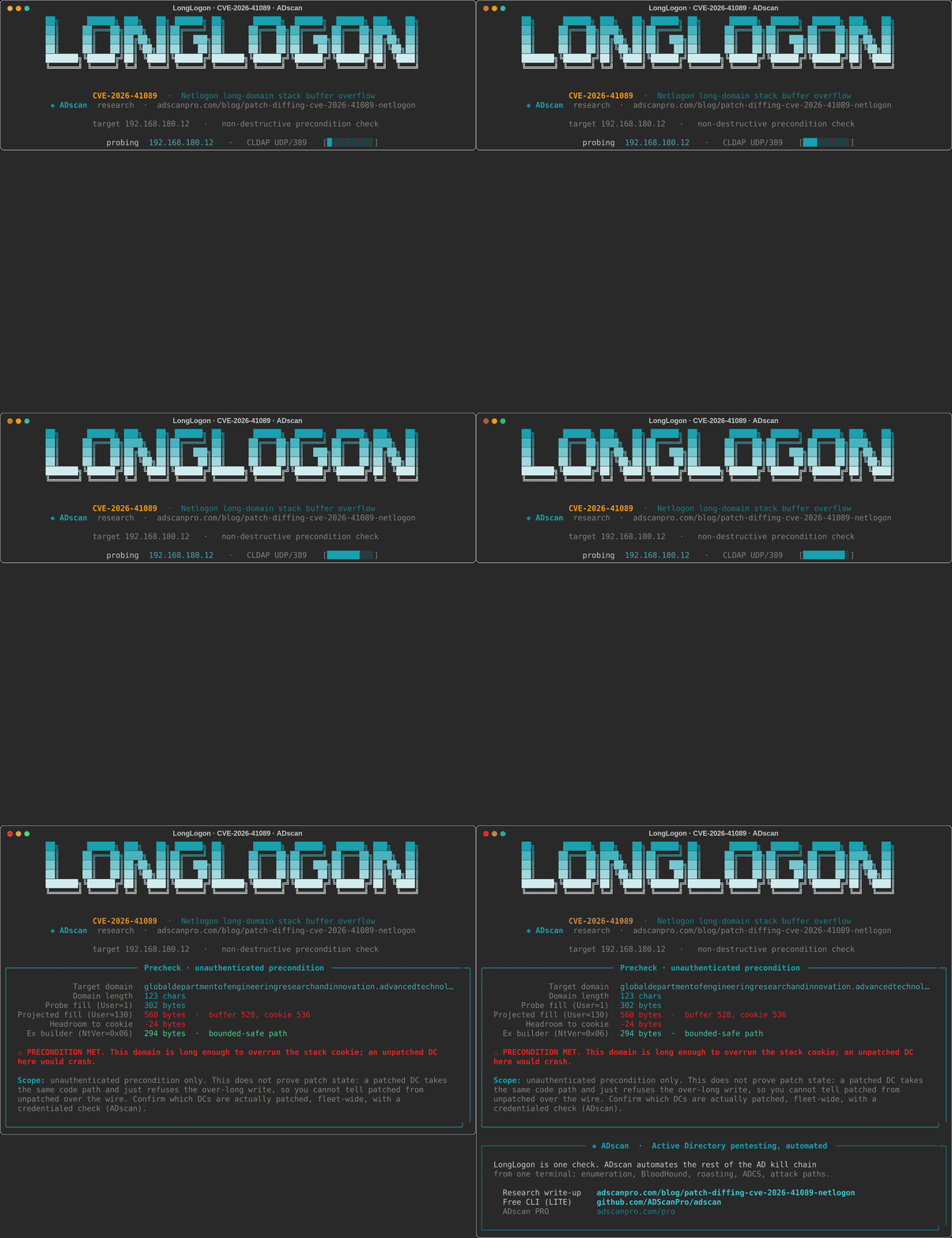
longlogon.py is non-destructive. It sends benign CLDAP pings with a minimal
User field, measures the legacy-builder response, and reports whether the
overflow precondition holds: whether this DC's domain is long enough that an
unpatched DC would crash.
It does not:
Knowing which of your DCs are actually patched needs a credentialed (admin) version check across the fleet. That is the kind of thing ADscan automates in an engagement (see below).
The only attacker-controlled bytes that reach the buffer come from the CLDAP User
filter, bounded to 130 wide chars, far short of the 528-byte buffer on their own.
The bytes that carry the cursor onto the cookie are the server's own names, which
the attacker does not control. A default-named DC (corp.local) cannot be crashed.
That is why Microsoft rates it "Exploitation Less Likely." In a lab, the minimum
DNS domain length to crash Windows Server 2016 (with a 7-char host name) was
98 characters.
With uv, zero setup. Dependencies are declared inline
(PEP 723), so this auto-installs rich in an ephemeral environment:
uv run longlogon.py <dc-ip> <dc-dns-domain>
Or with pip:
pip install rich
python3 longlogon.py <dc-ip> <dc-dns-domain>
The DNS domain must match what the DC serves. It is not secret: rootDSE, reverse DNS, and CLDAP itself all reveal it. The output is a precondition verdict plus the per-field buffer-fill math.
NtVer routing matters. The vulnerable legacy BuildSamLogonResponse is only
reached when (NtVer & 0xc) == 0 and (NtVer & 0x2) != 0. Public exploit attempts
that send NtVer=0x16 or 0x06 set bit 2 (0x4) and hit the bounded-safe
BuildSamLogonResponseEx, so they never trigger the bug. LongLogon uses 0x02.
Unpatched Windows Server domain controllers, 2012 R2 through 2025. First patched builds:
| Windows Server | First patched build |
|---|---|
| 2016 | 10.0.14393.9140 |
| 2019 | 10.0.17763.8755 |
| 2022 | 10.0.20348.5074 |
| 2022 23H2 | 10.0.25398.2330 |
| 2025 | 10.0.26100.32772 |
For authorized security research and defensive validation only. This repository ships the non-destructive precondition checker, not a weaponized crasher, for an actively-exploited, wormable CVE. Patch your domain controllers.
Research by Yeray Martín Domínguez · ADscan · CVE-2026-41089 · Netlogon · Active Directory · domain controller · stack buffer overflow · CLDAP · unauthenticated · pre-auth · proof of concept

