 adityabhatt3010/cve-2025-54253-inside-the-adobe-aem-forms-zero-day
Breaking down CVE-2025-54253 — an Adobe AEM-Forms exploit path from XXE to full remote code execution and its real-world impact.

TL;DR: Adobe Experience Manager (AEM) Forms on JEE (≤ 6.5.23.0) contained a critical, network-accessible flaw (CVE-2025-54253) that allows unauthenticated remote code execution via misused Struts/OGNL endpoints. A companion XXE (CVE-2025-54254) enables arbitrary file reads. These are high-impact enterprise issues — patch immediately, hunt for indicators, and apply hardened configuration and detection controls.
AEM is everywhere in large enterprises: marketing sites, document workflows, and forms that often hold PII and business-critical content. An unauthenticated RCE in AEM-Forms is therefore an attacker’s jackpot — entry, lateral movement staging, and sensitive data exfiltration all become realistic outcomes. Adobe issued patches and advisories shortly after public PoCs started circulating, which elevated this to an urgent, real-world risk.
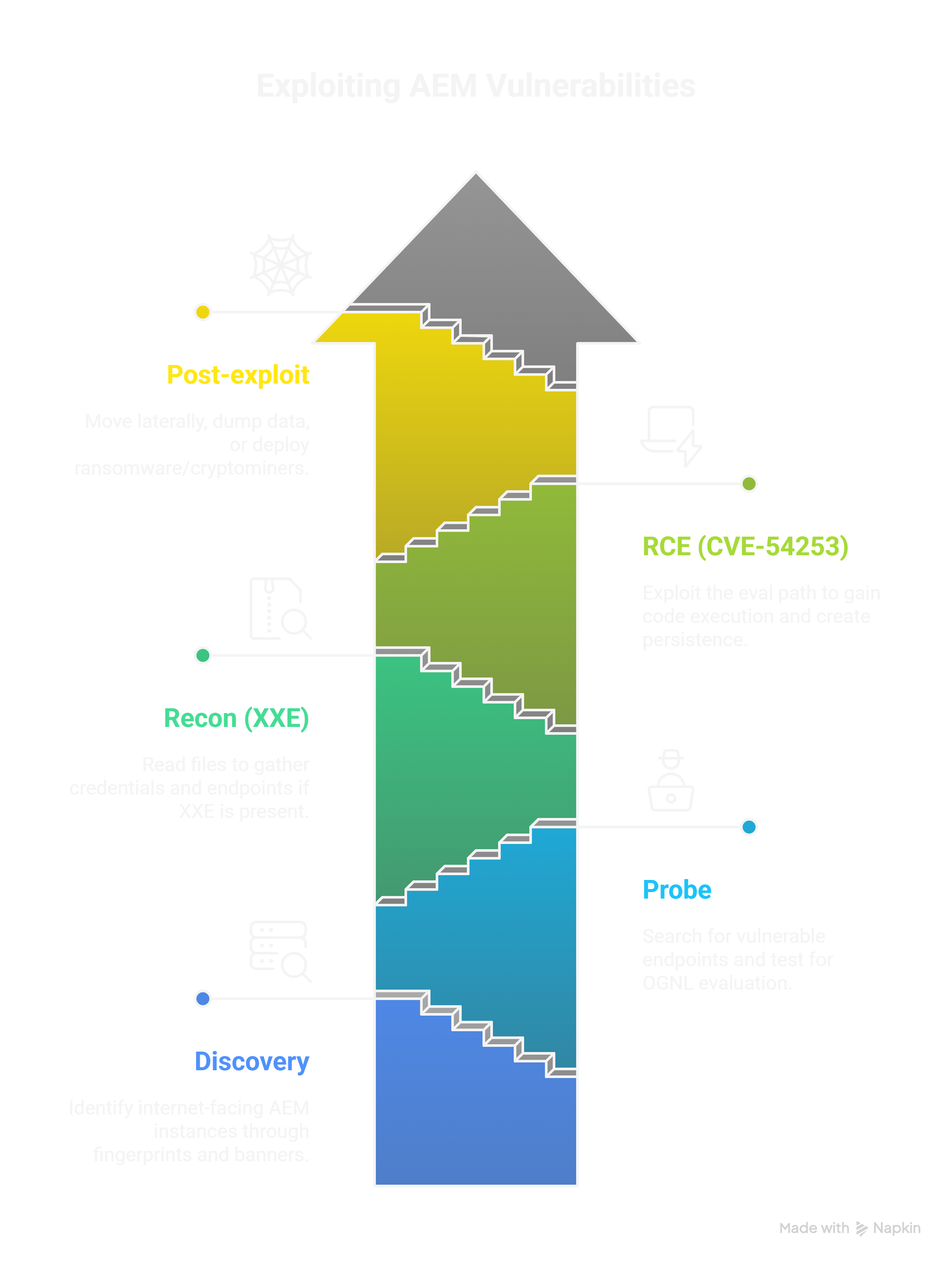
At a technical level, CVE-2025-54253 stems from unsafe evaluation of user-controlled input by server components exposed by AEM Forms running on JEE — effectively enabling OGNL/Struts-style evaluation paths that weren’t properly gated. In practical terms: an attacker can reach a network-exposed endpoint and trigger server-side evaluation that results in arbitrary command execution. CVE-2025-54254 is a classic XML External Entity (XXE) that allows file reads from the server, which is commonly used to scout for secret files, credentials, or environment specifics before escalating. The NVD and Adobe advisories provide the vulnerability metadata and severity scoring.
Public proof-of-concepts and demos have been published in repositories and topic searches that aggregate PoCs — inspect them only for research/context, never to reuse maliciously.
When I test an environment, I follow a short, repeatable checklist that’s safe to show defenders and publish:
These checks let me triage risk quickly and build an evidence set for remediation without performing destructive actions.
Defenders should focus on a few high-signal indicators:
/etc files in logs correlated to suspicious requests.ProjectDiscovery/Nuclei and community detection templates surfaced quickly for this issue; defenders can use non-exploit templates to fingerprint vulnerable hosts and generate alerts without running exploit code.
This is a classic example of dual-use research: technical writeups, PoCs, and exploit demos exist in the wild and are essential for learning — but publishing weaponized step-by-step exploit code for a zero-day in widely deployed enterprise software benefits attackers. In my article I avoid runnable exploit code and instead focus on detection, mitigations, and safe test patterns. Cite advisories and PoC repos for context, but do not publish exploit payloads yourself.
If you run or audit enterprise web platforms, treat AEM as a high-value asset: inventory every instance, patch or mitigate quickly, and add detection controls that look for the specific request fingerprints and abnormal post-exploit behaviors I outlined. For writers: a CVE-centered piece that blends the technical overview, safe detection recipes, and an automation script that only checks versions will resonate strongly with both red and blue audiences.
