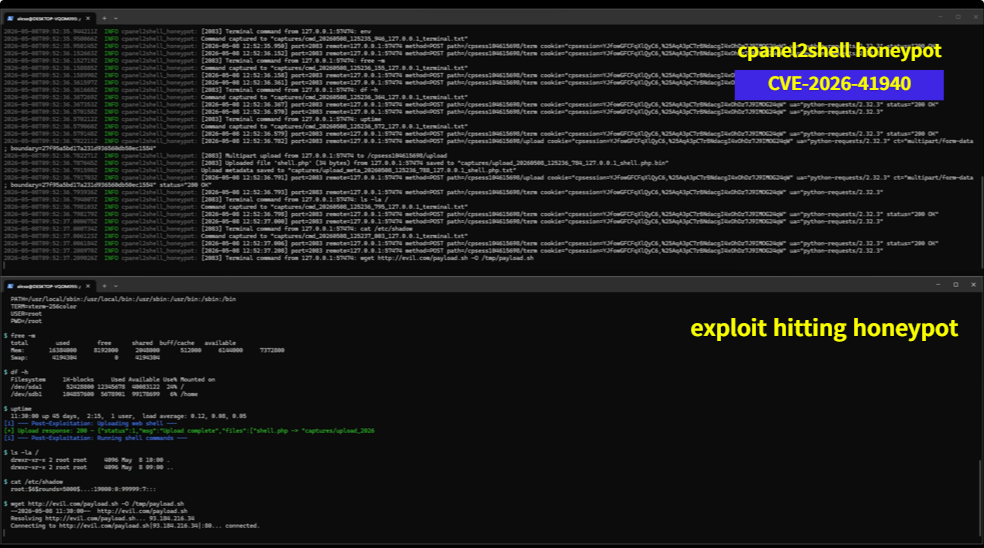
 acuciureanu/cpanel2shell-honeypot
A Rust honeypot that simulates a vulnerable cPanel/WHM instance for CVE-2026-41940

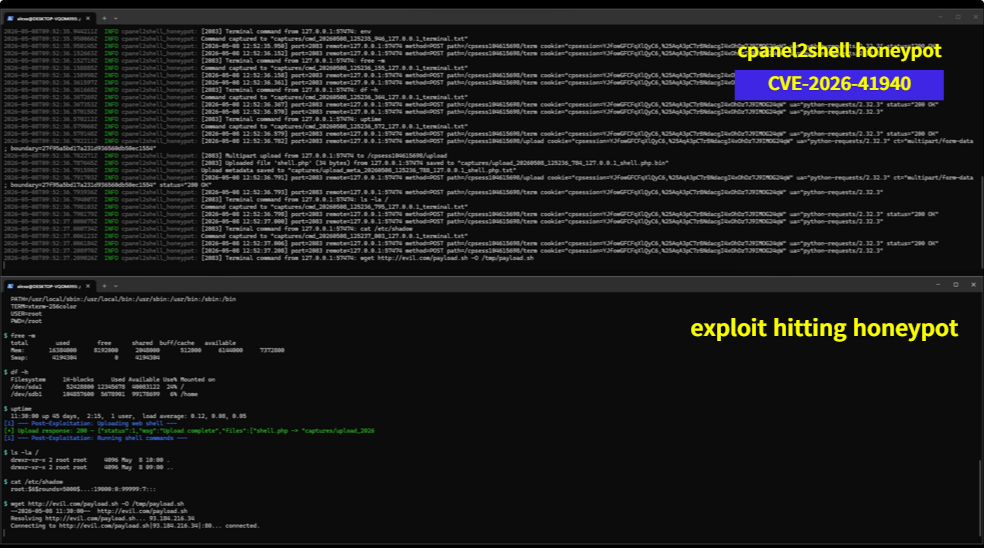
A Rust honeypot that simulates a vulnerable cPanel/WHM instance for CVE-2026-41940 (cPanel2Shell authentication bypass).
This honeypot emulates the response sequence used by cPanel2Shell vulnerability scanners:
msg_code:[expired_session] marker on token endpointsAttackers who proceed past the initial probe are dropped into a fake bash shell backed by an in-memory virtual filesystem.
cargo build --release
# Default: ports 2087, 2083 with auto-generated TLS
./target/release/cpanel2shell-honeypot

# Custom ports
./target/release/cpanel2shell-honeypot -p 2083,2087

# Disable TLS
./target/release/cpanel2shell-honeypot --no-tls

# Per-hostname TLS with hot-reload
./target/release/cpanel2shell-honeypot --certs-config data/certs.toml

# All options
./target/release/cpanel2shell-honeypot --help
Create data/certs.toml (see data/certs.example.toml):
default = "auto"

[auto]
cache_dir = "./captures/certs"
key_type = "ecdsa-p256"
validity_days = 365
issuer_cn = "Let's Encrypt Authority X3"

[[host]]
sni = "cpanel.example.com"
cert = "/etc/honeypot/certs/cpanel.pem"
key = "/etc/honeypot/certs/cpanel.key"
src/
├── main.rs          # Entry point, runtime setup
├── cli.rs           # Command-line arguments
├── config.rs        # Application configuration
├── router.rs        # HTTP route definitions
├── capture.rs       # Request logging and payload storage
├── sessions/        # Session persistence
├── handlers/        # HTTP request handlers
├── shell/           # Bash interpreter and VFS
│   ├── lexer.rs     # Tokenizer
│   ├── parser.rs    # Recursive descent parser
│   ├── exec.rs      # AST executor
│   ├── expand.rs    # Variable expansion
│   ├── builtins.rs  # Shell builtins
│   ├── commands.rs  # External command stubs
│   ├── vfs.rs       # Virtual filesystem
│   └── init.rs      # Filesystem seed data
└── tls/             # TLS certificate management
    ├── config.rs    # Certificate configuration
    ├── generator.rs # Certificate generation
    ├── resolver.rs  # SNI certificate resolution
    └── watcher.rs   # Config file hot-reload
The fake shell implements a subset of bash:
$VAR, ${VAR:-default})$(cmd), `cmd`)Session state (cwd, env, VFS writes, history) persists across restarts via JSON snapshots.
All attacker activity is written to ./captures/:
| File Pattern | Description |
|---|---|
upload_*.bin | Uploaded files |
upload_meta_*.txt | Upload metadata |
post_*.txt | POST request bodies |
cmd_*.txt | Terminal commands |
sessions/*.json | Session snapshots |
certs/ | Cached TLS certificates |
until/case keywordsMIT
