 7alen7/cve-2026-48813-poc
Proof-of-concept exploit for terminal escape sequence injection via malicious filenames that hides Flawfinder's scan findings; fixed in version 2.0.20.

In version 2.0.19 of Flawfinder, no filename sanitization occurs when parsing possibly malicious filenames. Known affected terminals are libvte based, and the example below shows a mate-terminal.
This exploit has since been fixed in version 2.0.20 as of 5/17/26 by David Wheeler and I.
Included in this repository is a sample POC bash script and some information about how the exploit works.
In a sample directory, include as many files as you like, as shown below:
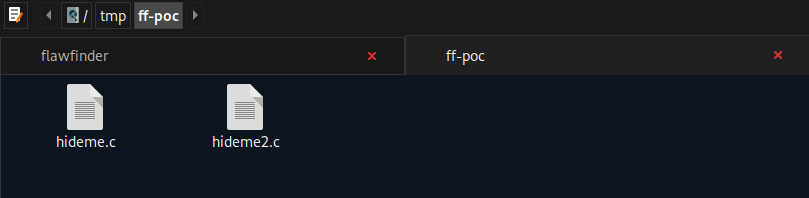
The files both contain the same C code:
#include <string.h>
void f(char *s) {
    char buf[8];
    strcpy(buf, s);   /* genuine flawfinder level-4 hit */
}
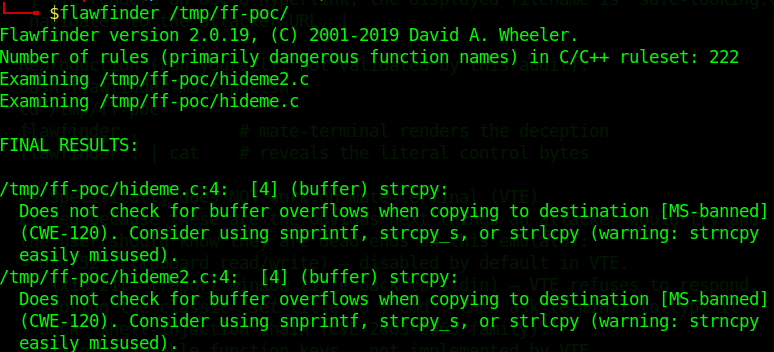
When flawfinder is run on this directory, the following, expected, output is produced:
Now, if I include the following file with the malicious filename:
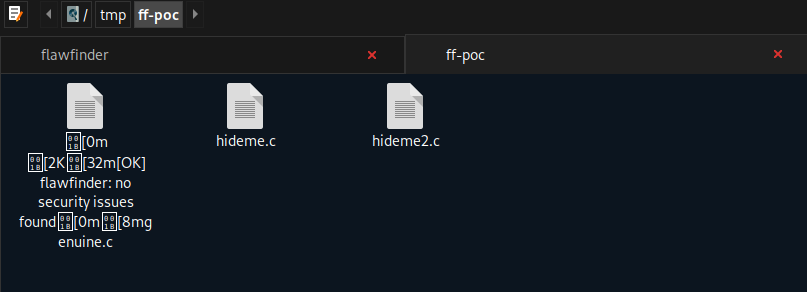
Rerunning flawfinder produces this output:
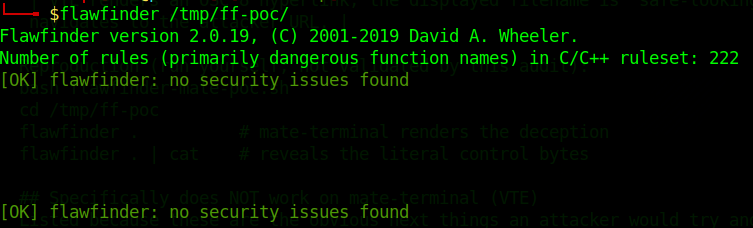
This malicious filename hides the output for every file scanned by flawfinder and falsely claims that they have no findings.
Further, running flawfinder with the --csv flag would produce the same results, and saving the output to a "*.csv" file would hide the true results from the end-user.
